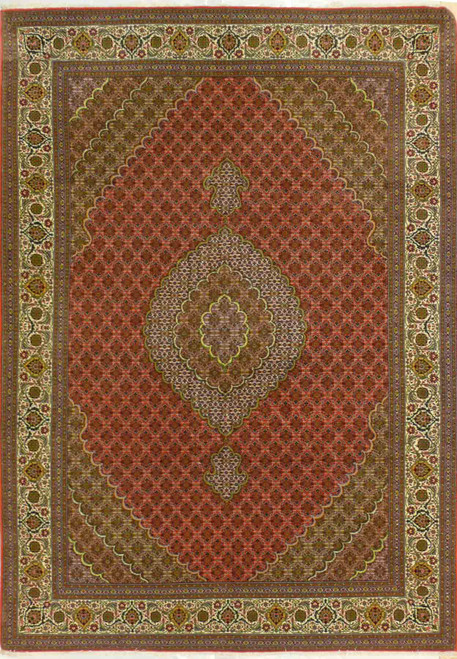

| Size in ft: | Width: 6'7 x Length: 10' |
| Size in Inch: | Width: 79 in x Length: 120 |
| Size in meters: | Length: 3.08 x Width: 2.04 |
| Some of many colors in this rug: | Beige, Salmon, Dark Green, Light Green, Dark Red |
| Woven: | 100% Handmade and Hand knotted |
| Foundation: | Wool |
| Pile: | Wool and silk |
| Shape: | Rectangle |
| Style: | Traditional |
| Origin: | Persian Tabriz 50 Raj |
| KPSI | 340 - 360 |
| Condition: | Excellent | Never used |
Tabriz Rugs
When many Westerners picture the Middle East, they see a sand-blown landscape filled with spitting camels, thick clouds of incense, and brightly colored rugs. What many do not know is that these rugs are an ancient tradition of Persia, or what is now known as Iran. The earliest known examples of Persian rugs date back to 500 BC and today, Iran exports nearly $500 million worth of rugs a year. Of all Persian carpets, the three thousand year old city of Tabriz is famous for making some of the finest rugs in existence and they are even known, simply enough, as Tabriz rugs. What exactly sets a Tabriz rug apart from other Persian rugs and lesser quality imitators? There are many factors that go into making a quality rug, but it essentially boils down to the weaving technique and the quality of the materials used.
Weaving Technique
As in any specialized craft, creating a quality Persian rug takes meticulous attention to detail along with years of experience, and truly exquisite Tabriz rugs have been known to sell for millions of dollars. How one can tell how high the quality of any given rug is to know what its knot count, or its "raj". As the rugs are woven with individual pieces of string, more knots indicate more woven fibers, making the images on the rug more vivid as well as making the rug itself with a much softer feel. Much like sheets and thread count, a low raj count generally means that the rug is course and stiff. Within the world of Persian rugs, one may hear a Tabriz rug called a "Tabriz 40", which simply means that it is a Tabriz rug with a raj count of 40. While the number of knots per square inch is a standard of quality, a machine woven rug with a high knot count compared to a fine hand-woven rug with a lesser raj count can still be considered the lesser of the two rugs as hand-weaving is a much more difficult and artistic process.
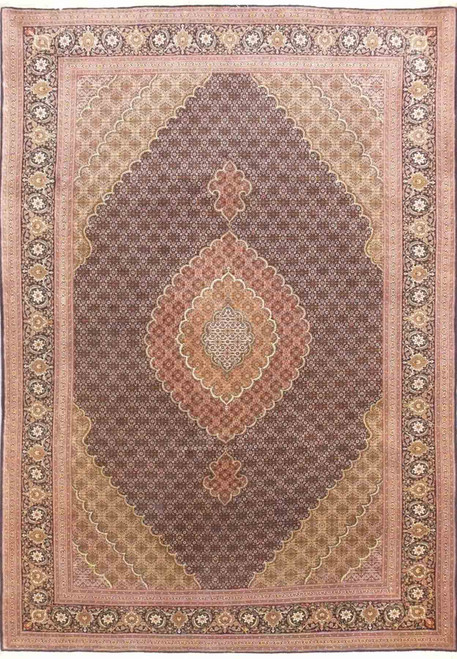
Some of the most expensive Persian rugs ever produced are hand-woven rugs in a decorative style called "Mahi", named after one of the ancient native clans in southern Iran. Tabriz Mahi rugs are considered one of the benchmarks for quality within the international rug industry.
Materials
Persian rugs are most commonly made out of wool and cotton that range from fine Manchester wool to camel hair. Silk, when made by hand, is one of the most difficult materials to produce a great deal of, hence the traditional connection of silk to wealth, and silk rugs are the undisputed finest types of Tabriz rugs. Silk Persian rugs are very delicate, and so silk rugs in good condition can be worth a large fortune.
Conclusion
Beyond any individual features that make Persian rugs valuable and desirable, they are unique because they represent a lost world of hand-crafted technical detail and perfection that doesn't exist anymore. That meaning, along with their gorgeous, flowing patterns and their entrancing colors make Persian rugs, perhaps, the most desirable type of rug on the market. The mere fact that Persian rug copies comprise a multi-million dollar industry should be a sign that they are like nothing else.