

Persian Nain 6 LA and Habibian Rugs: The Finest Expression of Persian Weaving
Posted by Rugs.net on Apr 5th 2026
Rugs.net · Persian Rug Guide
Persian Nain 6 LA and Habibian Rugs
The Finest Expression of Persian Weaving: Kork Wool, Natural Silk and Colors Found Nowhere Else
By Rugs.net Specialists · Persian Rug Experts
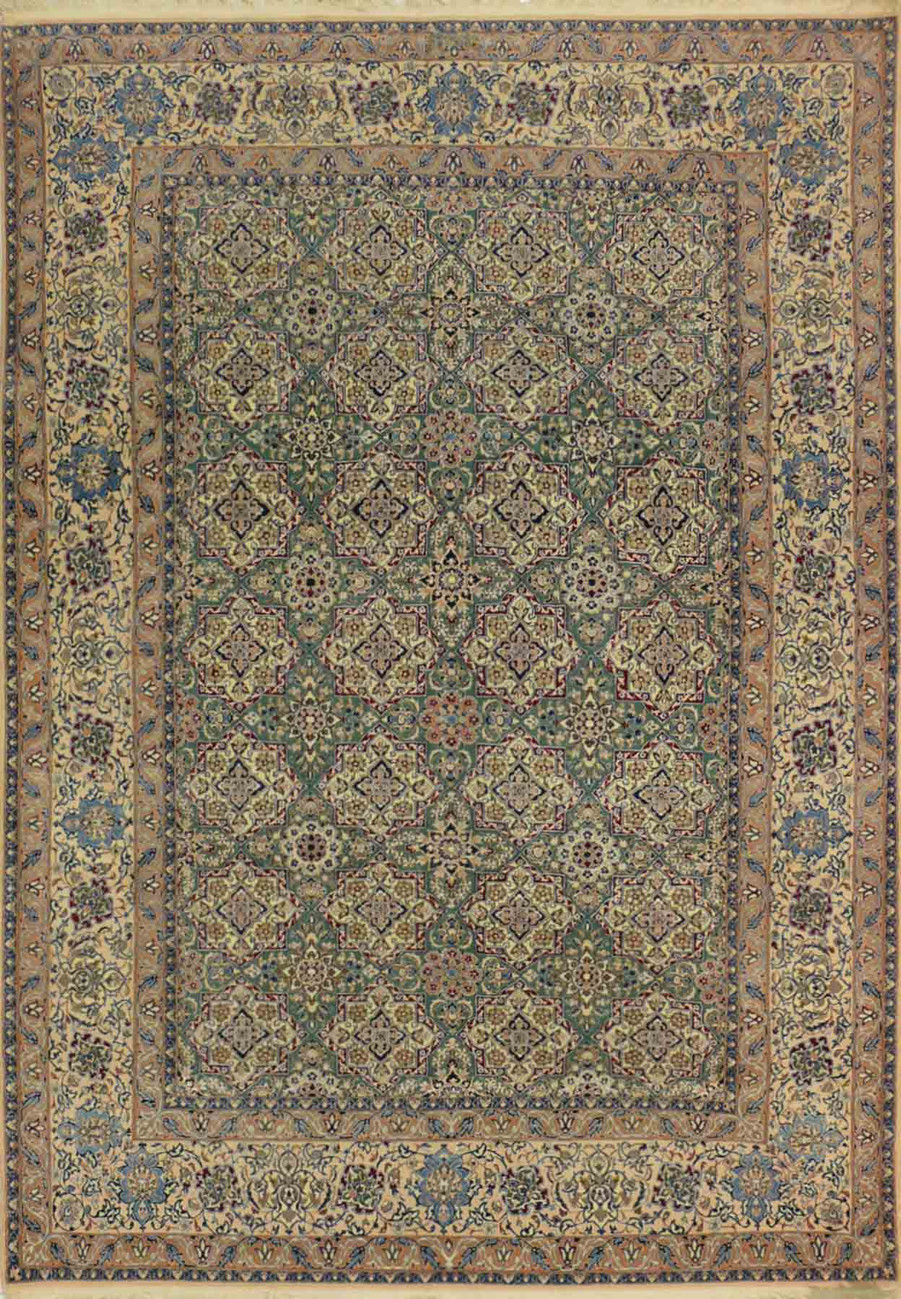
There are Persian rugs that impress with their boldness. And then there are rugs that stop you completely because of a quality you cannot immediately name: something in the light, something in the color, something in the surface that makes you look twice, then a third time, and then sit down to understand what you are actually looking at. That is what happens with a Nain 6 LA Habibian rug.
Nain rugs occupy a unique position in the world of Persian weaving. They are not the most famous city to outsiders. They do not carry the same immediate name recognition as Isfahan or Kashan. But among collectors, dealers and anyone who knows what they are looking at, a Nain 6 LA, and especially a signed Habibian, is considered one of the pinnacles of the entire Persian rug tradition. Not because of tradition alone, but because of what the rug actually is when you see it in person.
This guide explains everything: the city, the Habibian family, the LAA system that determines quality, the extraordinary color palette that sets Nain apart from every other weaving city in Persia, and the specific pieces from our collection at Rugs.net.
In This Guide
- 01 Nain: The Desert City That Reinvented Persian Weaving
- 02 The Habibian Family: Founders of the Nain Rug Tradition
- 03 What Is 6 LA? Understanding the Nain Quality System
- 04 Kork Wool and Silk: The Materials Behind the Magic
- 05 The Colors of Nain: Unlike Any Other Persian Rug
- 06 The Design Language of Nain Rugs
- 07 Featured: 6'8 x 10'1 Nain 6 LAA Habibian Wool and Silk
- 08 Featured: 7 x 11 Nain Habibian 6 LAA Signed by Chief Weaver
- 09 Shop Nain Rugs at Rugs.net
Nain: The Desert City That Reinvented Persian Weaving
Nain is a small city in the Isfahan Province of central Iran, situated in the high desert east of Isfahan. It is a city with ancient roots, among the oldest continuously inhabited settlements in Persia, but its reputation in the rug world is actually quite recent. Before the twentieth century, Nain was known primarily for producing fine wool and textile cloth, not rugs.
That changed dramatically in the 1930s. When demand for luxury textiles declined, Nain's skilled weavers, who had spent generations mastering the handling of fine wool and silk fibers, turned their expertise toward rug making. They did not simply copy existing Persian styles. They developed an entirely new aesthetic: lighter in color, finer in construction, more intricate in arabesque detail than anything being made elsewhere in Persia at the time.
The result was a weaving tradition that went from nothing to world-renowned in the space of two decades. By the 1950s, Nain rugs were being sought by collectors and connoisseurs across Europe and America. Today, a fine Nain 6 LA is considered among the most technically accomplished handmade rugs produced anywhere in the world.
Unlike Kashan or Isfahan, whose rug traditions stretch back centuries, Nain's rug weaving only began in earnest in the 1930s. What it lacks in age it more than compensates for in technical refinement. No city in Persia produces a finer handmade rug than Nain at its best.
The Habibian Family: Founders of the Nain Rug Tradition
The Habibian family is inseparable from the story of Nain rugs. They did not merely participate in the development of Nain weaving: they invented it. Habibian and his brother are credited as the founding fathers of the entire Nain rug tradition. When Nain's textile industry declined in the early twentieth century, it was the Habibian workshop that first pivoted to rug production and established the design vocabulary, construction standards and material requirements that define Nain rugs to this day.
The earliest Habibian pieces were extraordinary even by Nain standards. Some of the first rugs produced by the family were made entirely of pure silk, a level of ambition that immediately set a standard for the city. As the tradition developed, wool was incorporated alongside silk, but the Habibian commitment to the finest available materials and the most exacting construction standards never wavered.
Today, a rug signed by the Habibian workshop carries a meaning similar to a signed painting by a recognized master. It is not simply a mark of quality. It is authentication of provenance, an assurance that the piece was produced under the direct supervision of the family whose name defines the category. When you see "Habibian" woven into the border of a Nain rug, you are looking at the origin of the entire tradition.
A rug signed specifically by the chief weaver, as in our featured 7 x 11 piece, represents the highest tier even within Habibian production. The chief weaver's signature indicates personal oversight of the entire piece from design to completion, a level of individual accountability that is extraordinarily rare in any rug-producing city.
Habibian did not just weave rugs. He created a weaving tradition from nothing and set the standard that every other Nain weaver has tried to match ever since. A signed Habibian is not a label. It is a lineage.
What Is 6 LA? Understanding the Nain Quality System
One of the first things a serious buyer learns about Nain rugs is the LAA system. LAA is a Persian term and it refers to the number of threads that make up each individual warp strand in the rug's foundation. This single number tells you more about a Nain rug's quality, fineness and value than almost any other specification.
Here is how it works. Each warp thread (the vertical foundation threads running the length of the rug) is itself made up of multiple twisted threads. In a standard Nain warp, three threads are twisted together. If each of those three is made of two individual threads, you have 3 times 2, giving you a 6 LAA warp. If each is made of three threads, you get 3 times 3, which is a 9 LAA warp. The lower the LAA number, the finer and thinner the warp thread, and consequently the finer and more detailed the weave the rug can achieve.
| LAA Rating | Approx. KPSI | Quality Tier | Character |
|---|---|---|---|
| 6 LA | 400 – 600 KPSI | Finest Grade | Maximum design detail, lightest pile, most silk highlights, highest value |
| 9 LA | 250 – 350 KPSI | Fine Grade | Still exceptional, slightly heavier pile, somewhat less intricate detail |
| 12 LA | 150 – 200 KPSI | Standard Grade | Good quality Nain, suitable for most interiors |
A 6 LA Nain at 400 to 600 knots per square inch is in an entirely different tier from a standard Nain. The design resolution is dramatically higher. The arabesques are sharper and more detailed. The silk highlights catch and refract light in a way that is only possible when the pile is this fine. The difference between a 6 LA and a 9 LA is visible to a non-expert eye. The difference between a 6 LA and anything outside the Nain tradition is immediately obvious to anyone.
In the Nain LAA system, lower always means better. A 6 LA Nain is finer than a 9 LA. A 9 LA is finer than a 12 LA. When you see "6 LAA" on a Nain rug, you are looking at the finest production grade the city makes.
Kork Wool and Silk: The Materials Behind the Magic
The pile texture of a Nain 6 LAA Habibian up close. The kork wool has a natural softness and sheen that no standard wool can match. The silk highlights create the luminous depth visible throughout the design. This level of material quality cannot be replicated in any other rug type.
The extraordinary quality of a Nain 6 LA begins with the fiber. Nain weavers use a specific type of wool called kork wool, also called cork wool, which is harvested exclusively from the neck area of the sheep. The neck produces the finest, softest fibers on the animal's body. These fibers have a naturally high lanolin content, giving them an intrinsic softness, resilience and subtle sheen that is simply not achievable with wool from other parts of the fleece.
Kork wool is significantly more expensive than standard wool because the yield per animal is small and the processing is more demanding. Most rug-producing cities do not use it exclusively. In Nain, particularly in 6 LA production, kork wool is the standard. There is no substitute.
The second material is natural silk, woven as pile highlights throughout the design. In a 6 LA Habibian, the silk is not decorative in a superficial sense. It is structural to the visual effect of the rug. Silk catches and reflects light differently from wool, with a direction-dependent luminosity that makes certain design elements appear to glow or shift in tone as you move around the rug. The arabesques, the floral medallion and the border details: wherever you see the greatest visual intricacy in a Nain, those elements are almost always where the silk highlights appear.
The combination of kork wool and natural silk on a cotton foundation gives a Nain 6 LA a tactile quality unlike any other Persian rug. The pile is simultaneously firm and extraordinarily soft. The surface has weight and substance while the silk highlights give it a visual lightness. It is a paradox of texture that only the finest handmade rugs achieve.
Most wools come from the body fleece. Kork wool comes exclusively from the neck, the finest, softest, most lanolin-rich fiber on the animal. Combined with natural silk, it produces a pile surface that is unique to Nain and unmistakable once you have touched it.
The Colors of Nain: Unlike Any Other Persian Rug
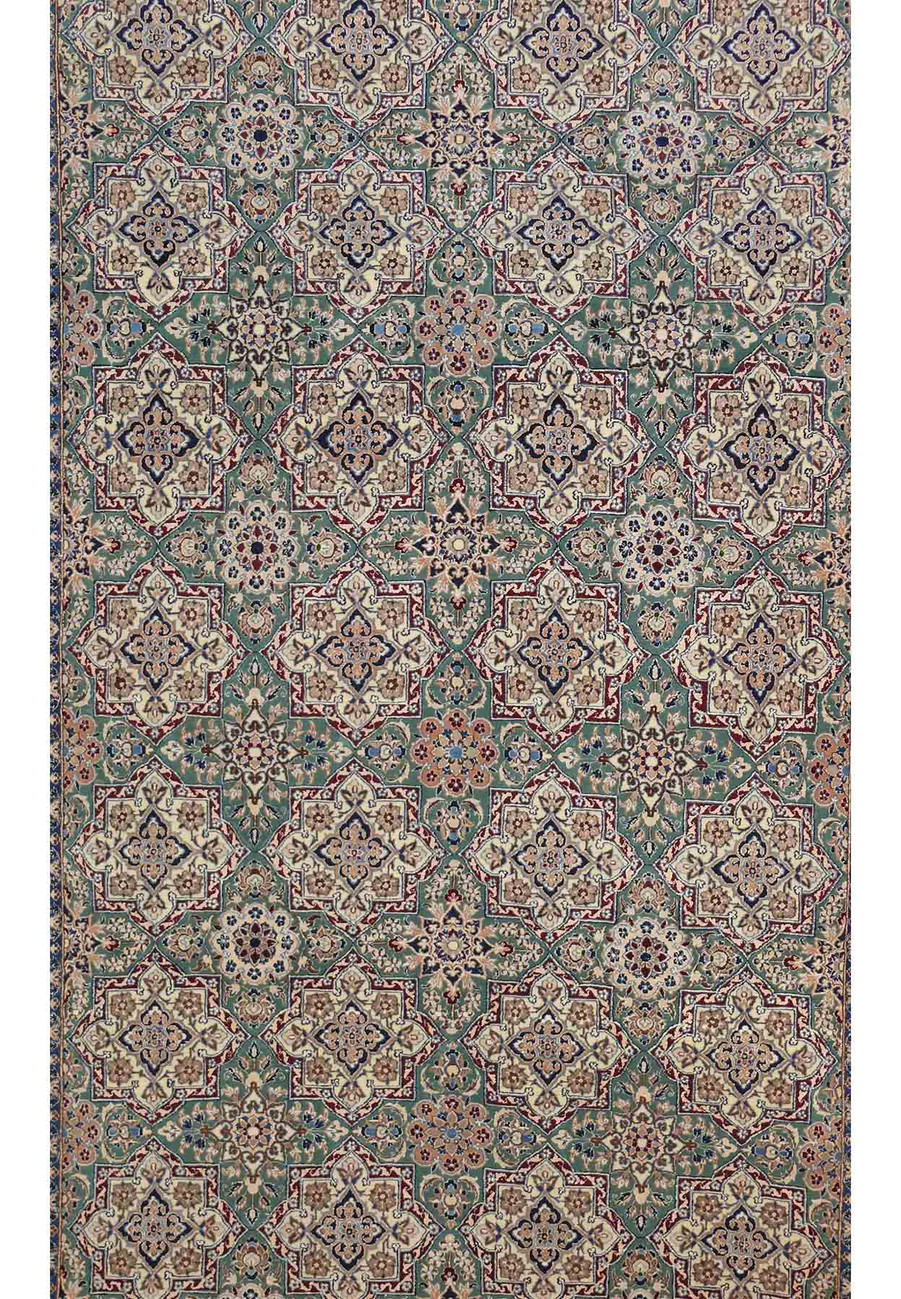
The color detail of a Nain 6 LAA Habibian arabesque field. The ivory ground is not white. It is warm, complex and alive. The indigo blue of the arabesques has a depth that shifts with the light. The gold and sage highlights are drawn from natural dyes that mellow beautifully over decades.
The color palette of a Nain rug is one of the most distinctive and immediately recognizable in the entire world of Persian rugs. It is not like the deep crimson fields of Kashan, the warm terracotta and navy of Tabriz, or the rich jewel tones of Bijar. Nain has its own completely separate color world, and it is one that no other Persian city produces.
Ivory and Cream: The Nain Ground
The field background of a Nain rug is almost always ivory or cream, though not the stark, flat white of a dyed ground. It is the natural color of undyed or lightly processed kork wool, which has a warm, complex quality full of subtle variation. This ground color is the foundation of the Nain palette. It creates a lightness, a sense of air and space in the rug that is unique to the city. Every other element in the design (the blue arabesques, the gold accents, the silk highlights) reads against this ivory ground with a clarity and crispness that is impossible on a darker field.
Indigo Blue: Deep, Cool and Luminous
The dominant design color in most Nain rugs is a very specific shade of indigo blue, deep and cool rather than warm, with a complex, layered quality that reflects the way natural indigo dye interacts with fine wool and silk fibers. This is not the navy of a Bijar or the midnight blue of a Kashan. Nain blue has a clarity and a luminosity to it, especially in the silk-highlighted arabesques, where it seems almost to emit light rather than simply reflect it. In full sunlight or good interior lighting, the blue elements in a Nain 6 LA genuinely glow.
Soft Gold, Sage and Muted Rose: The Accent Palette
Where most Persian rug traditions reach for bold, saturated accent colors, Nain uses a restrained and sophisticated accent palette: soft golds, sage greens, muted bronze and occasionally the most delicate blush of rose. These are not primary design colors. They are supporting voices that add warmth and depth to the composition without competing with the ivory ground and indigo blue that dominate. The result is a color harmony that is simultaneously complex and completely calm. A Nain rug can sit in almost any well-designed interior, whether traditional or contemporary, without creating competition.
Red and Green: The Rare Exceptions
Bold reds and deep greens are uncommon in Nain rugs. When they do appear, they tend to be softer and more muted than in other Persian cities, used sparingly as accent notes rather than field or ground colors. If you encounter a Nain rug with a dominant red field, examine it carefully. True Nain 6 LA production favors the ivory-blue palette overwhelmingly.
Ivory, indigo, soft gold, sage. That palette belongs to Nain and to no other city. If you want a Persian rug that works in a light-filled, contemporary interior without looking like a traditional rug store, a Nain 6 LA is the answer most collectors eventually arrive at.
The Design Language of Nain Rugs
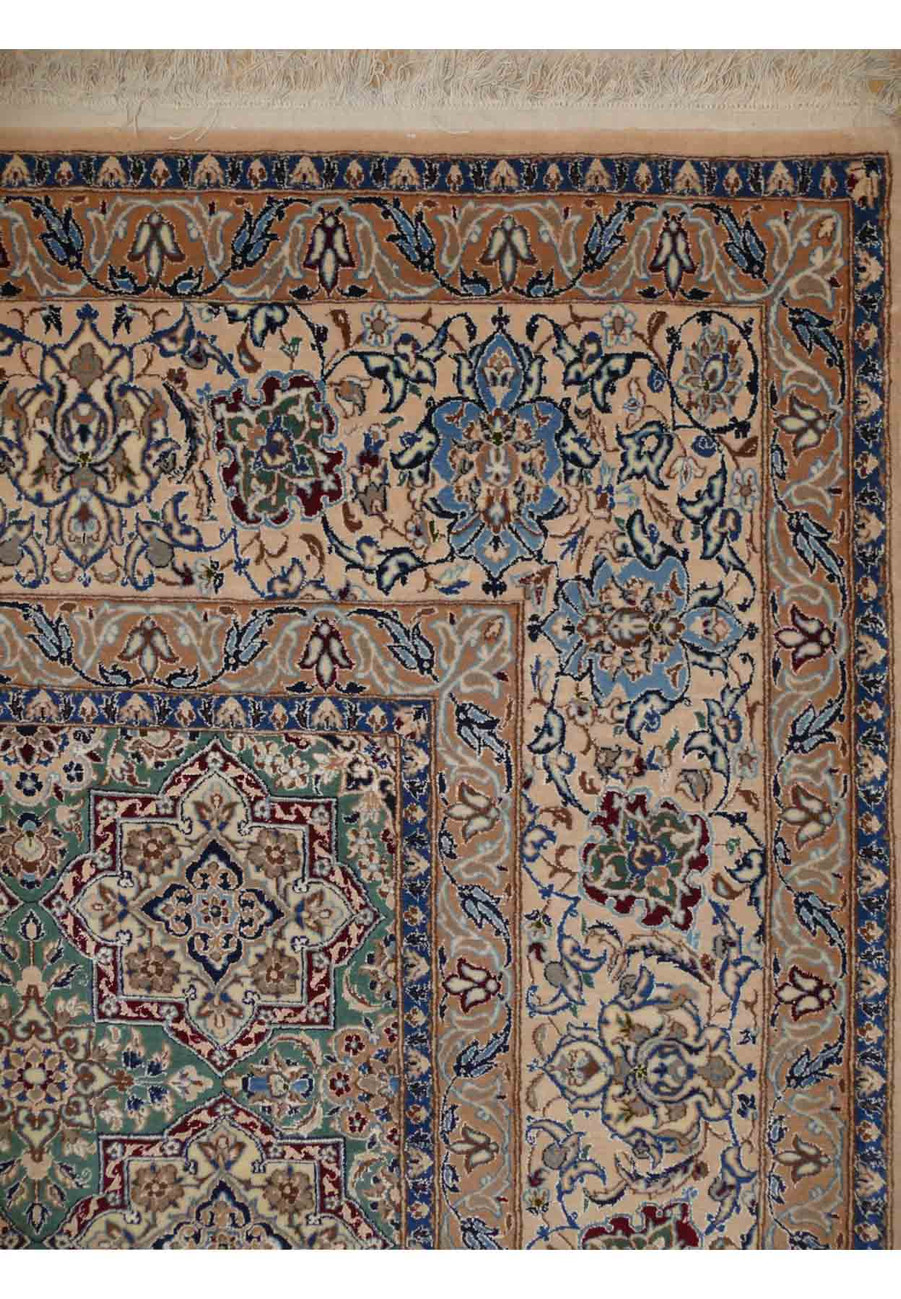
The corner and border system of a Nain 6 LAA Habibian. The main border shows the classical Shah Abbasi palmette and vine motif, framed by layered guard borders with their own floral and geometric detail. At this knot density, every leaf and petal is rendered with a precision more reminiscent of engraving than weaving.
Nain rugs draw their design vocabulary from the great classical tradition of Persian court weaving, specifically the Shah Abbasi style associated with the Safavid period of Isfahan. The flowing arabesques, the central medallion with radiating corner pieces, the palmette-and-vine border system. All of these elements come from this classical tradition. What Nain brought to it was a refinement of execution that matches or exceeds anything produced in the Safavid period itself.
The central composition of a Nain 6 LA almost always features a medallion, typically circular or oval, at the center of the ivory field, with matching quarter-medallion corner pieces anchoring the composition. The field between medallion and border is filled with dense arabesques: scrolling, interlacing vine tendrils with palmettes, rosettes and floral motifs woven into every available space. At 400 to 600 knots per square inch, these arabesques are rendered with a sharpness and detail that is extraordinary even by Persian standards.
The border system in a fine Nain is itself a complete composition. The main border typically features the Shah Abbasi palmette motif, with large elaborate flower heads alternating with curling vine work, framed on both sides by guard borders with their own detailed repeating patterns. In a 6 LA Habibian, the borders alone contain more design information than many entire ordinary rugs.
Featured: 6'8 x 10'1 Nain 6 LAA Habibian Wool and Silk
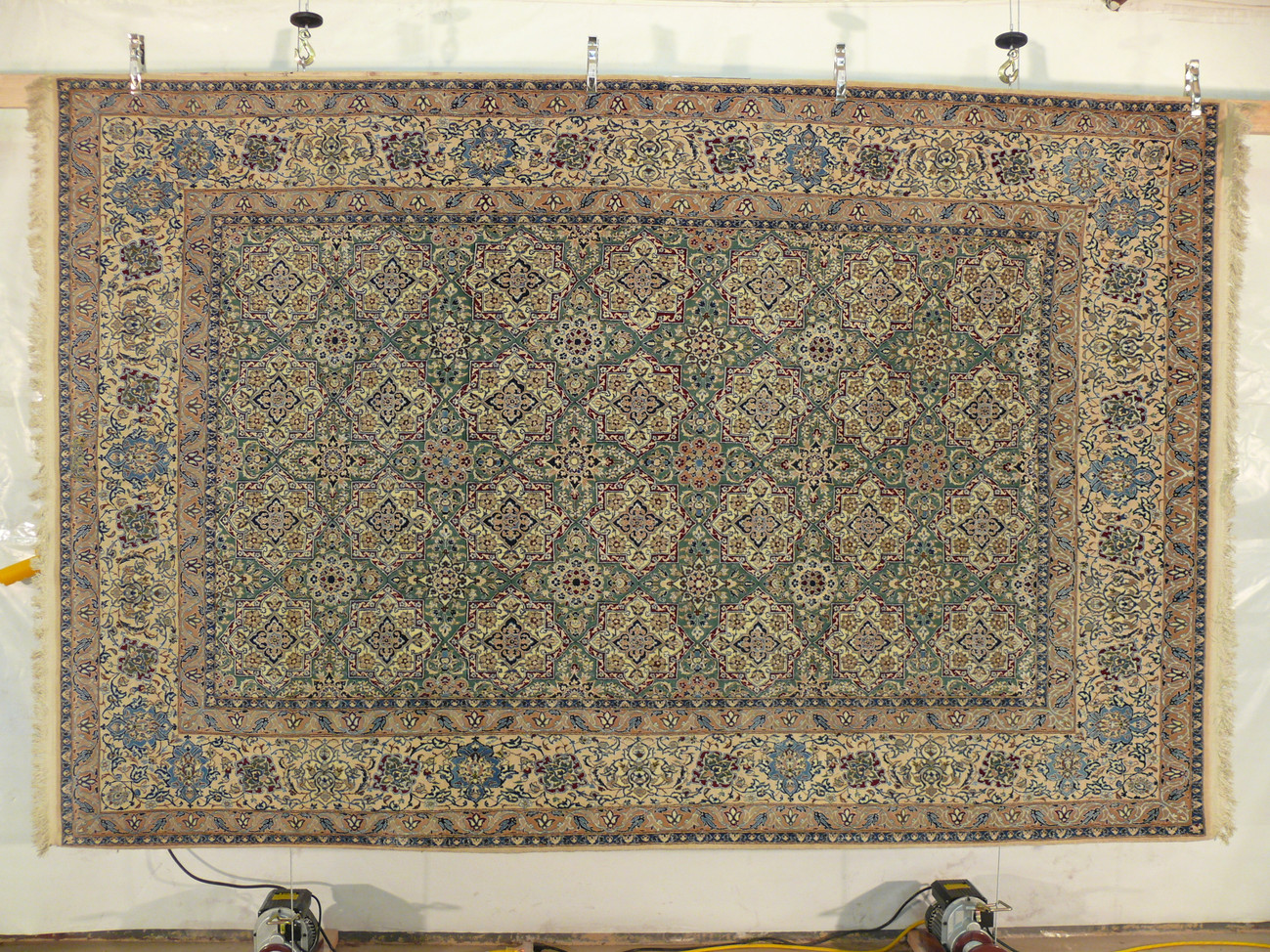
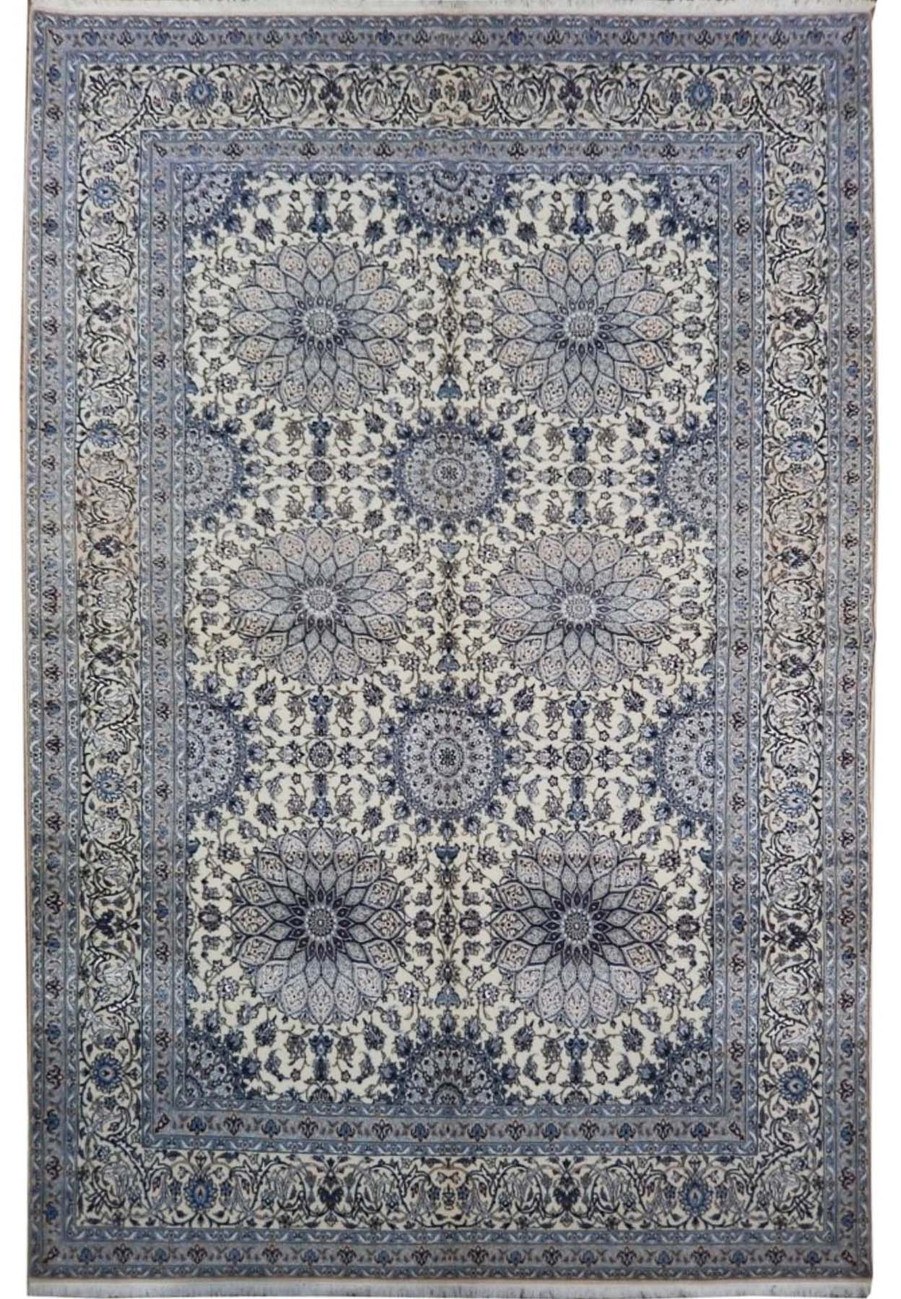
Featured: 7 x 11 Nain Habibian 6 LAA Signed by Chief Weaver
A signed Habibian is already in a category of its own. A Habibian signed specifically by the chief weaver is rarer still. It represents the personal authentication of the individual master craftsman who oversaw every stage of the rug's production from design to completion. There are collectors who spend years searching for pieces of this provenance.
Shop Nain Rugs at Rugs.net
At Rugs.net we carry one of the finest selections of authentic Persian Nain rugs available in the United States, sourced directly from Nain with no middlemen. Every piece is verified for authenticity, described honestly with full specifications, and shipped free to all 50 states with free returns and same day shipping on orders before 2 PM EST.
| Piece | Size | Grade |
|---|---|---|
| 6'8 x 10'1 Nain 6 LAA Habibian Wool and Silk | 6'8" x 10'1" | 6 LAA: Finest |
| 7 x 11 Nain 6 LAA Habibian, Signed by Chief Weaver | 7' x 11' | 6 LAA: Signed |
| View All Nain Rugs at Rugs.net | All sizes | Full collection |
Interested in other fine Persian rugs? Our collection also includes Isfahan rugs, Qum silk rugs, Kashan rugs and Bijar rugs. Every rug is 100% authentic, hand-knotted, and directly imported.
The Most Refined Persian Rug You Can Own
A Nain 6 LA Habibian is not a rug for everyone. It is a rug for the person who wants the most technically accomplished, most color-refined, most quietly extraordinary Persian rug that exists. Ivory and indigo. Kork wool and natural silk. The Habibian name woven into the border. Five hundred knots per square inch. A color palette that works in any interior and improves over decades. This is what the finest Persian weaving looks like.
Every Nain rug at Rugs.net ships free to all 50 states, comes with free returns with home pickup, ships same day before 2 PM EST, and is backed by our price beat guarantee. Questions? Call us at 855-576-7705.
Shop Nain Rugs 6'8 x 10 Habibian 6 LAA 7x11 Signed HaBibian