
All About Oriental Rugs
No object carries the spirit of the East quite like the rug. What follows is the full story: how the knotted rug was born, how it is made, where it comes from, and how to read the patterns woven into it.
01 The Beginnings of the Art of Rug Knotting
02 About Oriental Rugs
03 Construction and Production
04 The Regions of Origin
05 Persia, Region by Region
06 Patterns and Style
07 Materials and How to Test Them
08 Caring for Your Rug
The Beginnings of the Art of Rug Knotting
To this day we still do not know where and when the first knotted rugs were made. Much speaks for the assumption that nomads were the first to produce such rugs. For one thing, nomads have raised sheep since time immemorial, the most important suppliers of rug wool, and for another it is very easy to imagine that a people who suffered from extreme winter cold would be the first to hit upon the idea of weaving thick blankets to protect themselves from wind and cold.
It is true that ancient writings and classical authors contain several references to the existence of rugs, yet it is uncertain whether these were knotted rugs. From fragments found in ancient Egyptian burial chambers, some of which date from the second millennium before Christ, we know that various forms of flatweave were already highly developed at that time. Knotted rugs, however, were most likely still unknown.
Even so, in the development of rug research we are today still very much at the beginning. Apart from a few technical advances in our science, our present knowledge rests essentially on what was already worked out and recognized decades ago. Although our theories have since been refined and some of the crudest errors corrected, we have learned comparatively little since the days of Martin, Kendrick, Tattersall, Bode, Kuehnel and other researchers of the early twentieth century.
The Pazyryk Rug
The greatest discovery of more recent research was the find of a knotted rug from the fifth century before Christ. The Russian archaeologist Rudenko found this piece, knotted with the Ghiordes knot, in 1947 at Pazyryk in the Altai Mountains during the excavation of a Scythian grave. Further fragments discovered at the same site are worked with the Senneh knot. In its schematic layout the Pazyryk itself largely resembles the later Oriental rugs: a large central field surrounded by narrow and wide borders. On the madder-red ground of the field, squares arranged in rows carry schematized flower motifs. Around the squares runs a band of octagons that resemble the guls (flowers) of the later Turkmen rugs. The first wide border contains a procession of elk; this is followed by a narrow border with flower motifs, similar to those in the squares but with reversed coloring.
In the second wide border one sees, on a red ground, a procession of horses, some ridden and some led by grooms. What is interesting here is that each horse wears a richly embroidered saddle cloth whose pattern corresponds almost exactly to that of the rug itself. In the outermost border the octagon pattern of the field is repeated.
In the view of Maurice Dimand, the Pazyryk consists of a mixture of Assyrian, Achaemenid and Scythian motifs. From this he concludes that it must be a Persian product, since similar patterns have been found on the alabaster slabs of the palaces of Sennacherib (704 to 681 before Christ) and Ashurbanipal (668 to 631 before Christ). Quite instinctively I would consider this view to be mistaken. The Altai Mountains lie more than 3,000 kilometers northeast of Persia, north of Xinjiang and Mongolia. Then as now, this land was inhabited by Mongol peoples. The Scythians themselves came originally from Mongolia. Like all peoples related to them, they had a preference for animal depictions. We will never be able to say with absolute certainty where the Pazyryk really comes from, yet there is good reason to believe it was made roughly in the region where it was found, probably by Scythians who had moved west with the great migration of the Mongol peoples. Since we know, or can at least assume, that the first knotted rugs originated in the East Turkestan to Mongolia region, an area populated mainly by nomadic shepherds, it would be absurd to suppose, as Ulrich Schuermann has done, that the Pazyryk was knotted in Azerbaijan or some other part of Persia. That would mean that of all peoples, the very one that strove westward for decades, if not centuries, would have dragged this rug several thousand kilometers eastward.
Early Fragments
In 1920, Sir Aurel Stein of the British Museum found a whole series of rug fragments during his excavations in Loulan, an East Turkestan town on the old trade route. Most of them were knotted with the Ghiordes knot, a few also with the Spanish knot. One could of course argue that these are the remains of trade goods from the West. It is, however, much more probable that these pieces were made on the spot, somewhere between the second and third century. From this one may conclude that rug knotting was a highly developed and widespread art form in East Turkestan and Mongolia long before it found its way west.
On the other hand, we also have evidence that knotted rugs were already being made in Persia and other parts of the Middle East in the time of the Sassanids (224 to 642). Fragments of knotted rugs excavated at Dura-Europos can be dated, by means of clearly identified buildings, to the third century; they are knotted with the Senneh and the Ghiordes knot. Persian wool rugs are also mentioned in the Sui Annals (590 to 617). In the year 638, when the Sassanid king Chosroes II was defeated by the Byzantine emperor Heraclius, an enormous rug was found in his palace at Ctesiphon, which was called the "Spring Rug of Chosroes." According to the surviving accounts, this rug was interwoven with gold and silver threads and set with pearls and jewels. Its size and several other features suggest, however, that it was not knotted but flat woven. By the latest calculations this piece must have weighed at least two tons and been assembled from several parts. Fragments of genuine knotted rugs with Spanish knots have been excavated in Egypt. They date from the fifth century and are probably of Coptic origin.
The First Persian Rugs
After the fall of the Sassanid dynasty and the establishment of the caliphate, the records of Persian weaving become more numerous and more definite, above all because Arab historians and geographers studied and described the customs and practices of the peoples of Islam. From then on we possess a wealth of written reports. We know, for instance, that rugs were made in Fars, Mazandaran and Gilan, and, according to the Muqaddasi writings of the tenth century, also in the Qainat. Although the Arab chroniclers tell us nothing about the weaving technique of the rugs they describe, one may safely assume that these were knotted rugs, most probably produced by nomadic tribes that had moved south in search of new pastures. If one compares the symbols of these early nomad rugs with those of the Turkmen, Baluch, Yoeruek and Qashqai of the nineteenth century, a common root of all these images and forms becomes clear. This root, as already mentioned, is very probably to be sought in the Far East and in Mongolia in particular.
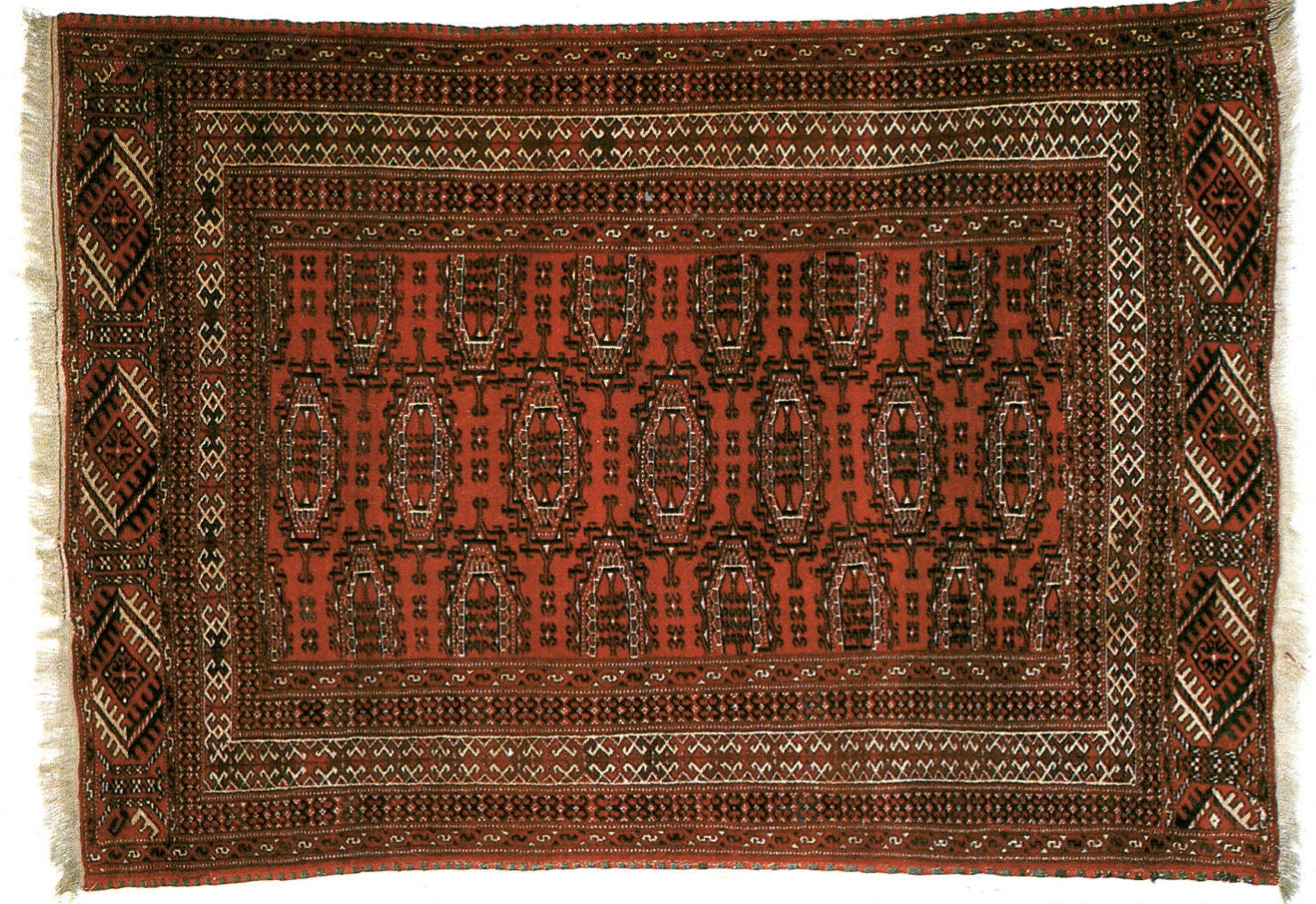
Prayer rug from Baluch. End of the 19th century.
After the conquest of Persia by the Seljuks, around 1037, the land was settled by many Turks who brought their own language and culture with them. They colonized Azerbaijan and Hamadan, where they are still found today. A. Cecil Edwards is nevertheless wrong when he claims, "The Seljuk women were weavers and brought the Turkish knot to these provinces," for the Persians were already using the Ghiordes knot in the third century (and, if one follows the theory that the Pazyryk comes from Persia, even since the sixth century before Christ). Likewise the Persian knot had been known in East Turkestan since the beginning of the tenth century.
No complete pieces of the Persian Seljuk rugs survive. There are, however, some from Asia Minor that are probably comparable to those made in Persia under Turkish influence. Among the surviving pieces we can distinguish three groups: first, the three whole rugs and five fragments found in 1905 in the Ala-ed-Din Mosque in Konya, the Seljuk capital; a further group discovered in 1929 (1930 according to Dimand) in the Eshrefoglu Mosque in Beysehir; and a third group, consisting of seven fragments, excavated in the ruins of Fostat in Egypt. The Ala-ed-Din Mosque was built in 1220, the Eshrefoglu Mosque in 1296 (1298 according to Erdmann). Since these two holy sites were probably furnished with new rugs, the Konya fragments therefore date from the thirteenth century.
The Seljuks were of Turkmen origin. On all the fragments of their rugs one finds stylized geometric flower patterns of the kind that remained in use into the fourteenth and sixteenth centuries in the "Holbein" and "Lotto" rugs. On some fragments one also sees rows of red octagons that evidently belong to that common tradition we spoke of in connection with the Turkmen of the nineteenth century. A certain kinship with early Mongol and Chinese rugs is also clearly recognizable. One of the Beysehir pieces has a light blue ground on which dark blue lozenges with scarlet stars are seen. At the sides of the lozenges, various hook motifs alternate. This is a variation of the Chinese meander pattern, of the kind also found on Mongol rugs of the twelfth or thirteenth century from East Turkestan.
Two of the pieces, including an almost five meter long complete rug from Beysehir, carry on a dark blue ground light blue geometric flower wreaths with hook motifs and lotus palmettes. Such patterns are derived from Chinese silk rugs that had reached Persia and Turkey in the thirteenth century. The border of the complete rug shows, on a mauve ground, a strictly geometric interlace of black trefoil motifs. The trefoil was a very popular motif on Chinese textiles from the time of the Han dynasty (206 before Christ to 220 after Christ). It is also found very frequently on the felt saddle cloths with appliqued patterns that the Mongol riders used in the twelfth and thirteenth centuries.
Thus in the earliest known examples of Islamic weaving a clear connection with Far Eastern styles can be established. This is of course not surprising, since the makers of these pieces themselves came from the Far East. A close stylistic kinship can also be recognized with the Turkmen nomad rugs of the nineteenth century: these show the octagon, rhombus and hook motifs that correspond almost exactly to the "dyrnak" roses (gul) of the Yomut, or the geometric rosettes on one of the Ala-ed-Din fragments, which recall so clearly the "kepse" roses of the Yomut, along with many further motifs that recurred for centuries on Turkish and Caucasian rugs. So even in the most creative and fruitful periods, weavers remained bound to these deeply rooted traditions and drew on a stock of motifs that had matured and developed over centuries. These traditions are still alive today, even if in part in a regrettably flattened form.
We have more documentary references, though no surviving examples, from the time of the Ilkhanid dynasty, from about 1220 to 1380. For nearly 300 years, from 1155 to 1424, the territory of the Bakhtiari west of Isfahan was ruled by the atabegs of the Fazluyid dynasty. Ibn Battuta reports that after he had visited their capital Idhej, a green rug was rolled out before him in his honor. Of the ruler Ghazan Khan we know that he had his administrative buildings near Tabriz laid with Fars rugs and that he sent similar pieces as gifts to the mausoleum of Sayf ad-Din Khalid ibn Khalid in Damascus. Of still greater importance for research, however, is a series of well preserved colored miniatures depicting rugs and bridges.
When Marco Polo visited the Mongol-Persian empire in the thirteenth century, he was astonished at the wealth of silk, wall hangings and rugs. Hulagu, the first Ilkhan, established his summer residence at Tabriz. Under his successor Ghazan the city became an important cultural center. Ghazan's chancellor Rashid ad-Din (died 1318) built at the edge of the city the Rab-i-Rashidi, an academy for art and science. There he commissioned numerous manuscripts, one of which has survived. It bears the title "Jami at-Tawarikh" (Universal History) and is dated with the Islamic years 707 and 714 (that is, 1307 and 1314). It need not surprise us that the illustrations of this work are very strongly influenced by Chinese art.
Of still greater importance is the famous Demotte manuscript of the "Shahnameh" (Book of Kings) by Firdausi from the middle of the fourteenth century. It was named after the New York dealer Demotte who, since he could not sell it as a whole, divided it up at the beginning of the century. Dimand held the book to be a work from Tabriz. Today, however, the opinion is that it comes from Baghdad, the capital and winter residence of the Ilkhans. On three of the miniatures it contains, rugs are depicted. Two of them show in the central field a pattern of interlocking ovals of a kind not found on any of the later Persian rugs. Only in more recent times were comparable patterns used in the Caucasus. On the third rug a stylized animal pattern in double octagons is seen, which we also know from Turkish rugs of the fourteenth century. The somewhat later "Book of Poems," or "Diwan," commissioned by Sultan Junaid Nakhash al-Sultani, likewise contains a noteworthy miniature of two rugs. One shows on a pale yellow ground a pattern of stars and octagons; the other carries a pattern of rectangles of various colors.
At that time the Persian rugs, as far as can be said from the surviving pieces, were very stylized and geometric in character. But then, with the Mongol conquerors, came a taste for the naturalism of Chinese art, which under the Ilkhans, and still more clearly under the following Timurid dynasty, had a formative effect on the Persian style.
Medallion rug from Farahan. Beginning of the 19th century.
Timur's attack began in 1380. In 1405 he died as ruler of Persia. With the fifteenth century the classical period of Persian art began. The oldest surviving examples of Persian rug art date from the last two decades of that century. They clearly show the change from strictly geometric forms to floral asymmetry. This change is, however, not due only to the influence of Chinese motifs. The establishment of royal manufactories, which from then on competed with the nomads, also played a large part. The new style of the Timurid period, which first made itself felt in book illustrations and bookbindings, showed itself above all in the use of garlands of leaves and flowers, peonies, pomegranates, palmettes and mushrooms, combined with geometric patterns and arabesques. Alongside these, animals and fabulous creatures such as dragons and phoenixes are also depicted.
The first visible evidence of Timurid rug art is found today in book illustrations from that time. The rulers Shah Rukh (1405 to 1447) and Baysunghur expanded the great centers of learning and culture in Baghdad and Tabriz and founded similar academies in Samarkand, Bukhara and Shiraz (the last built by Shah Rukh's son Sultan Ibrahim). The capital of the Timurids was Herat in Khorasan, the easternmost province of Persia (today Afghanistan). In neither the new nor the old academies, however, can any great change of style in painting be recognized in the early years of the fifteenth century. The Chinese influence was strong. Trade with China flourished. Ming porcelain is seen in many miniatures of that time. Of at least one of the leading artists of Persia, Ghiyath ad-Din, we know that he had even been to the Far East himself. It almost seems as if China was as important for the Persian painters of the fifteenth century as Italy was for the European artists of the eighteenth and nineteenth centuries.
As in painting, the style of rugs too at first changed only very slightly, so far as we can judge today. Herat was probably the chief rug center, since most rug depictions appear on the Herat miniatures. The pieces depicted are so enormously similar to the strictly geometric prototypes from Turkey that some experts have expressed doubts about their Persian origin. Rugs with purely geometric patterns are frequently found on the miniatures of that time. Dimand cites several examples, among them one from the "Shahnameh" (1429 to 1430) in the Gulistan Palace in Tehran. The rug depicted on it has a pattern of alternating red and green octagons formed from knotted bands and carrying inside them an arrangement of various leaves. Similar examples are also found on early Italian paintings, though these may possibly not be knotted rugs but embroideries. Two rugs very similar to Dimand's example were depicted by Taddeo Gaddi on his "Marian Polyptych," which is in the church of San Giovanni Fuorcivitas in Pistoia. It bears the date 1353. Another miniature depicted by Dimand, from Sadi's "Gulistan," shows Sadi and his teacher sitting on a rug whose pattern consists of cross motifs and stars connected by interlaced bands. The manuscript dates from 1426 to 1427. In the British Museum there is an Italian manuscript of about 1335 to 1340, a petition of the inhabitants of Prato to Robert of Anjou, the king of Naples; in one of the illustrations one sees the king on the throne, covered by a rug or embroidery with a pattern similar to the piece on the Gulistan miniature: red and blue crosses on a light green ground form, in reverse, blue and red octagonal stars.
Patterns of this kind, of the sort frequently depicted on Italian paintings of the fourteenth and fifteenth centuries, of course existed not only on rugs. In silk versions they were also used as draperies and altar cloths. This is in no way surprising, for the European weavers of that time produced almost exclusively simple utility fabrics of wool and linen. Only toward the end of the fourteenth century did silk weaving spread in Italy too, particularly in Venice, Genoa, Lucca and Florence. Until then, silk fabrics and embroideries were imported from China, the Middle East, Byzantium and Moorish Spain. There is abundant evidence for this, not only in the literature but above all in several interesting finds in medieval graves. The burial garment of Cangrande della Scala, lord of Venice, who died in 1329, consisted largely of Central Asian silk. In the tomb of Duke Rudolf of Austria (died 1365), silk was found into which the name of the Persian ruler Abu Said had been woven.
In an article on the medieval cloth trade between Europe and the Orient, Donald King writes that the Romanesque artists and architects were undoubtedly influenced by Islamic silk weaving. As we will see later in connection with the frescoes of Pinturicchio in Siena, in many paintings of the Middle Ages the floors of churches and castles are laid with mosaic patterns of Oriental influence.
Among the painted fabrics, the endless knot surrounded by a square seems to have been the most popular pattern. In the British Museum there is an Italian miniature from the early fifteenth century depicting a Genoese banking scene. The pattern of the mosaic floor is almost identical with one of the rugs from the Demotte manuscript of the "Shahnameh." Around 1480 the first cartouche patterns, as well as flower and animal depictions, appeared. Evidence for this is found on several miniatures, such as a manuscript of Sadi's "Bustan" ("Fruits of the Garden," 1487) and above all a "Zafarnameh" ("Book of the Victories of Timur"), where for the first time a medallion rug is depicted. Both miniatures are attributed to the artist Bihzad (Behzad).
Italian paintings indicate, however, that floral arabesque patterns were known much earlier than one might suppose on the basis of the Oriental book illustrations: two works by the Florentine Master of the Straus Madonna, the "Madonna and Child with Four Saints" (private collection) and the polyptych "Madonna and Child with Eight Saints and Two Angels" (San Donato, Citille), show on the floor at the feet of the Virgin embroideries or rugs with floral arabesques. The active period of this master lay between 1380 and 1420.
One must of course not forget that Azerbaijan, the northwestern province of Persia, was during the Timurid period ruled by Turkmen, first by the Kara Koyunlu ("Black Sheep") and after 1469 by the Ak Koyunlu ("White Sheep"). Their capital was Tabriz. European visitors at the court of Uzun Hasan, among them the Venetian envoy Giosafat Barbaro (1471), confirmed that the royal palaces were furnished with rugs. The Blue Mosque in Tabriz, built under the "Black Sheep," bears witness that floral ornament was very well known at that time. Quite a few experts even hold that some of the rugs we today attribute to the early Safavid period could equally well have been made toward the end of the fifteenth century in Tabriz. Tabriz was, after all, also the political and cultural center of the first Safavid shahs, before the Turks first conquered the city in 1514.
About Oriental Rugs
How to Approach the World of the Rug
It sounds like a truism, but when we think of rugs, the Orient with its very own atmosphere comes to mind almost as a matter of course. No one associates the word "rug" with the West, and nobody thinks, for example, of the French tapestry weaves of Aubusson or the Savonnerie. This association with the Orient is normal and entirely justified, for it was there that the rug arose and developed, at once a fundamental element of practical, everyday life and one of the great artistic achievements of those peoples. It will therefore surprise no one if these pages give a great deal of space to the Oriental rug, especially the antique and old production up to about 1920, which had not yet been completely displaced by the modern commercial demand from the countries of Europe and America. In our homes this fascinating piece of craftsmanship represents a pure furnishing object. Its task is to cover the floor, and in doing so it remains partly hidden beneath the furniture. For the Oriental, by contrast, rugs were and are always the finest pieces of his furnishing. He eats on rugs, sleeps on rugs, withdraws into a room laid with rugs, and there too has his private sanctuary, where he prostrates himself five times a day in prayer. And it is in just this close connection with daily life that every example must be seen. Only thus can we gauge its true cultural significance.
The Concept of Style in Rug Art
How, as people of the West, can we understand such different, far distant cultural and artistic forms of expression? How, apart from aesthetic criteria, can we judge a piece? When we have to make an appraisal, for example, Western conceptions of space, proportion, perspective and so on come to our aid. In most cases we also know the creator of the picture and the artistic milieu in which it arose, and we have ideas about its symbolic content as well. The rug, by contrast, stands far from all these criteria. With the exception of a few exceptional cases, it is an anonymous product, because from the outset it was understood as something living, serving daily use and not merely wanting to be exhibited and admired. In looking at a rug we must first note that the ornament rests on only two concrete elements: the pattern or drawing, and the color. The pattern can be quite simple or highly complicated, the coloring plain or finely graduated. Their reciprocal relationship makes up the character, the spirit of a rug.
-
The compositional schemes and the decorative elements have been the same for centuries, yet the manner of interpretation and their individual combination, as well as the colors mainly used, have led to numerous styles bound to time and place. According to the cultural milieu one can distinguish four basic types of rug: the nomad rug, the rug from the small village workshop, the rug from the specialized urban workshop, and finally the rug from the great court manufactory. According to its commercial significance, the decorative tradition, the type of loom (vertical or horizontal), the nature of the material used and the type of knot, the rug takes on a quite different character from case to case. The nomad product appears simple, elemental, even naive, with a few contrasting colors. More elaborate is the rug of the village workshop, for it shows abstract, geometric or stylized patterns and is rich in color. Very complex and refined is the rug of the urban workshops; it displays a multitude of geometric, stylized, floral patterns and shows numerous balanced colors. In the rug of the court manufactory this refinement is taken to the extreme; the patterns appear very complex, geometric, and contain above all scrolling vine ornament; the colors are very varied and harmoniously composed. The style of a rug is thus determined by the individual relationship between pattern and color. But the places of production contribute to this in a decisive way as well, since they in turn, according to the epoch, set the patterns and colors on the basis of their own cultural tradition and the techniques applied. Whoever wants to grasp a rug in its entirety must take all components into account: function, style, pattern, place of production, history and technique.
What Style Reveals
By the general view, to recognize a rug means to assign to it the name of the region of origin, and thus of the area of production. Through the different combinations of patterns and colors, decorative typologies arose that are useful for classification. Yet this does not mean that there are fixed rules for an unambiguous identification according to this scheme. A style does not always correspond to a single, precisely outlined place of origin. Confusion is also caused by names chosen rather arbitrarily, out of convenience. This applies, for example, to the so called "Bukhara pattern," which does not come from that city at all, but was created by Turkmen nomads of Central Asia. The city of Bukhara represented only the trade and export center for these rugs with their unique geometric pattern. Determining a rug is therefore anything but simple. One must compare the drawing and the colors with typical examples from the supposed region of origin and work out the constant elements, the character of the differing elements and the predominant elements. To rely on the decorative typology alone, however, is dangerous. One must never forget to examine also the properties of the material used as well as any technical features, for example the number of weft threads between two rows of knots, the color of the warp or weft threads, the appearance of the side edges, the type of knot. All these indications together provide the basis for assigning a rug to a particular geographical area. In view of these difficulties, it is often advisable to let doubts about the provenance of a rug stand, rather than to insist on uncertain attributions.
The Rug Between Reality and Theory
When we speak of rugs, we generally mean the knotted rug, made on a horizontal or vertical loom. Through knotting one obtains not a normal flatweave but a pile, which conceals beneath it the load bearing structure of the rug, the foundation weave. The foundation weave in turn results from the interlacing of the vertical warp threads with the horizontal weft threads. In knotting, two warp threads are joined together at a time. Each horizontal row of knots is followed by one or more weft threads. After each knot the thread is cut off. In this way one obtains those characteristic "wool tufts" that in their totality make up the pile of a rug. To build up a pattern, one uses threads of different color, proceeding as if each knot corresponded to a tessera of a mosaic. There are various methods of knotting. The starting material, however, is always the same and consists of wool, cotton or, for more valuable pieces, silk. Since these are in all cases organic fibers, they are by nature subject to decay. Sheep's wool above all loses its elasticity over time and becomes brittle and fragile. The relatively low durability of the starting materials is the reason why hardly any rugs from older times have survived. But at the same time this gives us a handle for chronological placement and the definition of the antique rug.
The Origins Lie in Darkness
On the fundamental question of where and why the knotted rug arose, the definitive answers are still outstanding, above all because we lack concrete documentary evidence. Thus over time two theories arose about the origin of the knotted rug. The first theory holds that primitive nomadic peoples developed the knotted rug long ago in order to protect themselves from the cold of the ground, without having to sacrifice the skins of their valuable herd animals. According to this view, the knotted rug arose on very simple horizontal looms that were easy to dismantle and transport. The rug thus had the precise task of representing an artificial fleece as a substitute for the natural skins of sheep and goats. At the beginning of this invention there stood, then, entirely practical and not artistic considerations. Only after some time did the desire arise for pattern and drawing and for an adornment of the tent interior. The rugs subsequently received various colors and patterns, which finally developed into constant motifs. Then the nomad peoples showed their products to settled village and town dwellers as well, who finally took a liking to the artful textiles and adopted the new technique. So much for the first theory.
For the adherents of the second theory, the knotted rug likewise arose in early times, but at a higher cultural level and among settled peoples who already knew the vertical loom. The new fabric is said to have been created in order to satisfy quite specific aesthetic needs, namely to serve as adornment for the living quarters. From the outset, then, an artistic motivation was inherent in the rug, which surely also showed itself in its use at celebrations and on courtly occasions. Only subsequently, according to this theory, did the nomad peoples take over the new product, whereby under their hand it turned out much coarser and more primitive, since they had to make it on horizontal looms. The nomads adapted the more highly developed vertical looms to their way of life and converted them into horizontal looms. In the year 1949 this second theory received an apparently concrete proof through an archaeological find. In the Pazyryk valley of the Siberian Altai Mountains the burial mound of a Scythian prince was found. Preserved by the ice, a magnificent, densely knotted rug remained almost completely intact. Two special borders enclose it: the outer border shows a train of horses and riders, the inner one a row of elk. The rug can be dated to the fifth century before Christ and thus represents the oldest piece of this art form. With its refined design and execution, the Pazyryk rug seems to confirm the hypothesis that artistic motives stood at the beginning of the art of knotting. Yet perhaps the dispute between the adherents of the two theories is also idle: nothing speaks against the view that the knotted rug arose in the distant past as protection against the cold of the ground and at the same time as adornment for the home.
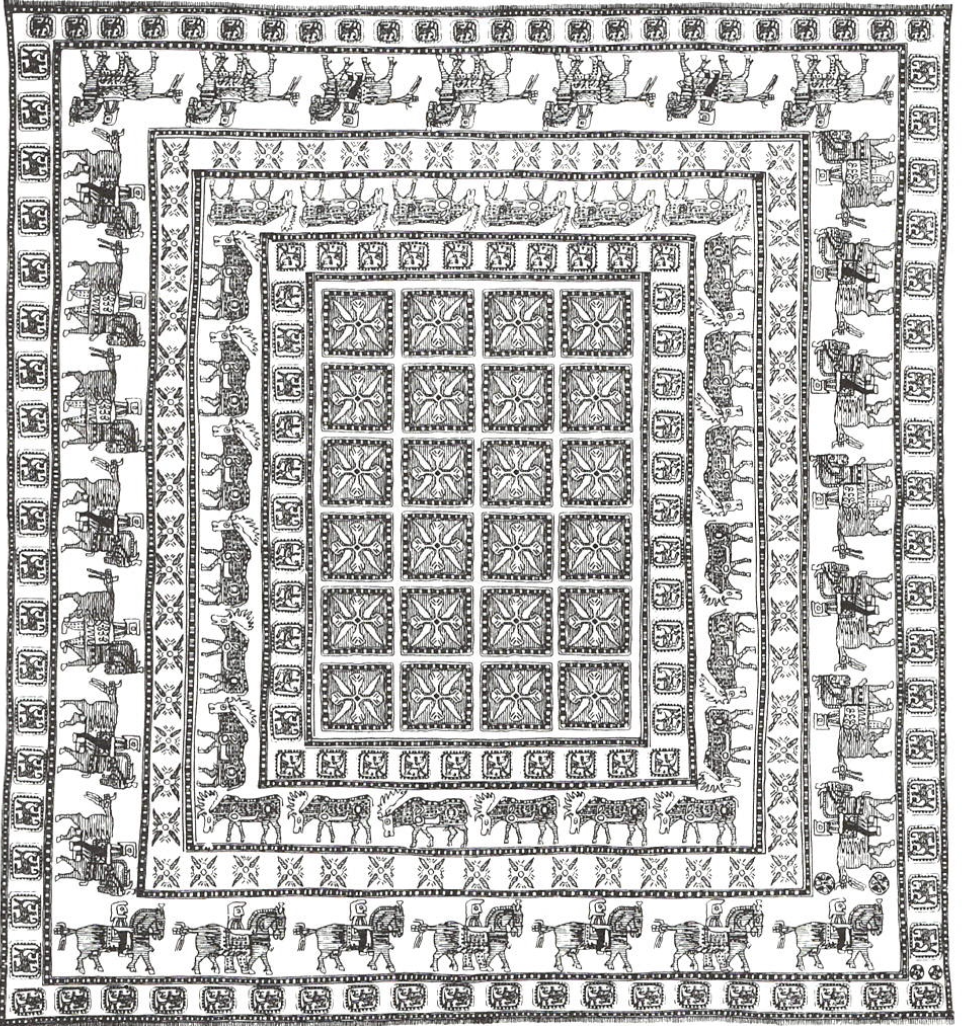
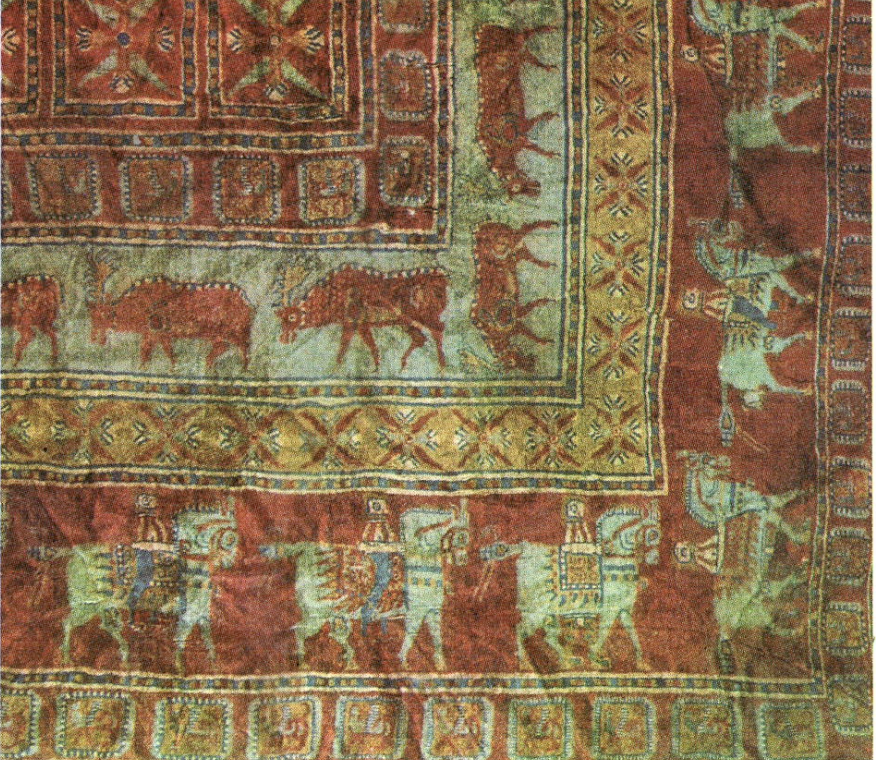
The Pazyryk rug, fifth century BC, the oldest known knotted rug (200 x 183 cm). Left: the complete design. Right: a color detail.
The Provenance
On the question of the place of origin of the knotted rug too, everything is still shrouded in dense darkness, since after all it was spread throughout the entire Middle East. Today the view has become established that the cradle of the knotted rug lies in Central Asia, more precisely in Turkestan, because the oldest fragments after the Pazyryk rug come from here. They go back to the second and third century after Christ. With the great migrations, this textile product is said to have spread westward to Persia, the Caucasus and Anatolia, eastward to China, and some time later in a southerly direction to India as well.
The Rug as a "Living" Object
As a typically Oriental product, the rug acquired a deep significance in the Islamic world and underwent there an incredible development. Already toward the end of the thirteenth century, Marco Polo wrote in his travel account "Il Milione" about Turkey: "Here they make the noblest rugs in the world with the most beautiful colors." Within Islamic culture the rug became a means of artistic expression and at the same time a sacred object. With this it anchored itself deeply in daily life.
The Persians called it ghali, which means roughly "something that one treads underfoot." Thus the rug found its own deep meaning in its nature as a "living" object that is intended for use, worn out and consumed. Compared with other art objects, the rug has only a relatively short life. We thus also understand more easily why antique pieces are so rare. At the same time this gives rise to the need for a chronological ordering and classification that differs clearly from the one usually applied to other art objects.
Placing It in Time
For the division of rugs according to their age there is no generally binding scheme. Most often, however, the following terms are used. Antique rugs are traditional pieces created before the introduction of synthetic dyes (in the span from 1860 to 1870). Semi-antique, or old, normally refers to pieces made from 1860 or 1870 into the first years of the twentieth century. In these the traditional features and colors still predominate, even if changes due to new commercial needs can be recognized. Then follow the modern rugs, made after 1920 to 1930. These adapted themselves completely to the requirements of the Western market in particular; quality and traditional pattern design, however, suffered as a result.
This classification scheme is of course very simple and, moreover, imprecise. In remote areas, for example, completely authentic, traditional pieces with natural colors were still being made well into the twentieth century, which would therefore have to be counted in the category of antique rugs. Knotted rugs created before 1800 are so rare that they are found almost only in museums and large collections. Of the rug production of the sixteenth and seventeenth centuries, mostly only fragments have survived. In the rug trade one therefore finds pieces from the nineteenth and early twentieth centuries, which have naturally best withstood the years.
Construction and Production
Materials
The starting materials for the production of rugs have been the same for centuries, namely wool, cotton and silk. To these are added gold and silver threads, but only for exceptionally valuable pieces reserved for shahs and other rulers. Naturally the use of the various materials depended on their availability, the type of production and the requirements placed on the piece. Wool is the most frequently used fiber, because it is available throughout the Orient. Sheep's wool is preferred, yet goat's wool is also used, and sporadically camel's wool, which is, however, less hard wearing and especially difficult to dye. In antique rugs and in rugs of nomadic origin, wool was used for both the foundation weave and the pile; in old and modern pieces, wool often forms only the pile. Cotton, as a hard wearing material, is particularly suited to bear the strains to which the foundation weave of the rug is exposed. Only in rare cases is cotton also used for the pile, and then only to render purely white areas. Cotton requires cultivation by settled peoples, or at least a permanent availability in trade. Cotton is thus absent from the production of nomad peoples. In village and urban workshops, by contrast, cotton is normally used.
Silk is the most valuable and most durable material. It feels soft, has a particular sheen and allows a much finer knotting and thereby the production of very refined pieces. Silk remained reserved for specialized urban manufactories. They produced rugs with it exclusively to order. Silk is found above all in the pile, either as the sole material or together with wool, in order to give particular sections of the patterning a special character. In the past, silk was also used for the foundation weave in especially luxurious pieces.
Fibers of wool, cotton and silk must first be twisted or spun. This is possible clockwise and counterclockwise. Wool twisted clockwise we designate with the letter Z, the wool spun counterclockwise with S. The corresponding analysis of the yarn can be very helpful in determining a rug.
Colors and Dyes
After twisting, the wool is dyed. This work is traditionally undertaken by the men. Until 1860 to 1870 there were exclusively natural dyes. After that, synthetic dyes came onto the market, which through their ease of handling and low price displaced the natural colors. The master dyers kept the recipes for producing the natural dyes secret. They used many plant dyes, for example saffron, pomegranate rinds or grape leaves for yellow; scale insects (cochineal), cherry juice or madder for red; indigo for various shades of blue; walnut shells, tobacco or tea for black to brown tones. In part the wool was treated in several different dye baths. The dyer knew how long the material was to be left in them in order to achieve a particular tone. In any case the dyeing of the wool was a lengthy and thus expensive affair. When the first synthetic colors were introduced from Europe, they met with great enthusiasm. For this reason the time between 1860 and 1870 plays a decisive role in dating a rug. The first synthetic colors were aniline dyes. They soon proved, however, not to be lightfast and so harmful to the fibers that in 1890 they were simply banned by order of the shah. At the beginning of our century they were replaced by mordant or chrome dyes, which are decidedly lightfast and make a whole palette of colors possible.
In connection with the colors, the abrash deserves special mention. These are gradations of color in the field of the rug. They mostly come about because the weaver uses wool of the same color but not of the same dye lot. This always produces certain color differences, occasionally only with time. Abrash were also often deliberately worked in by the weaver in order to give the rug a craft authenticity.
The Loom
The loom is indispensable for the production of a rug, for only it keeps the numerous warp threads taut and parallel during making. Two kinds of loom are used: horizontal and vertical. Both, however, function on the same principle: two parallel beams stretch the warp threads and hold them at a constant distance from one another, so that the weft threads can pass between them. In this way the foundation weave arises.
The horizontal loom is smaller, more simply built and lies almost on the ground. Only nomadic tribes use it, for it can be set up and taken down even during work. The finished length of rug, the so called fabric, is then simply rolled up. Since the horizontal loom has to be transported, it is much smaller and allows only the production of small or medium sized rugs. The width of the rug cannot, after all, exceed the maximum width of the loom. With kilims, however, two mirror image halves are often sewn together.
The vertical, more developed loom is used by the settled village and town population. It needs solid supporting structures and is often set into the ground. In general one distinguishes three types. The simplest has fixed beams and thus allows only the production of rugs that have the length of the loom. Since the work proceeds from bottom to top, the weaver sits on a height adjustable bench. The second type has a movable lower beam. The warp threads are twice as long as the loom is high. The finished length of rug can be shifted downward and to the back of the loom. The weaver thus does not have to change position. The third loom has rotating beams. The very long warp threads are wound onto the upper beam, the warp beam, and with the progress of the work are wound onto the lower beam. This makes possible the production of very long rugs, once above all in large court manufactories.
The Knots
The knotting work that is typical of this textile product is traditionally carried out by women and even by girls. In court manufactories, however, exclusively men were employed. The work proceeds in horizontal rows from bottom to top. In the Orient, two basic types of knot have been used since time immemorial. The symmetrical knot is also called the Ghiordes knot or Turkish knot, because it was used above all in that country. The asymmetrical knot is, for the corresponding reason, also called the Senneh knot or Persian knot. There is, however, no sharp geographical assignment of these two knot types. Both are applied everywhere, and confusion is added to by the fact that in the Persian town of Senneh, today Sanandaj, the Turkish knot has always been used. A stylistic distribution, by contrast, is recognizable: the symmetrical knot is larger and square and thus better suited to the design of geometric patterns. The asymmetrical knot is smaller and more irregular, and with it one can better render scrolling vine ornament. Both knot forms normally join only two warp threads together. With the symmetrical knot the wool thread is looped around both warp threads and then projects upward between the two. With the asymmetrical knot the wool thread is fully looped around only one warp thread. Between the two ends of the wool thread lies the free warp thread. The difference between the symmetrical and the asymmetrical knot can be recognized when one bends the rug back firmly in the direction of the weft. One thus gets to see a row of knots.
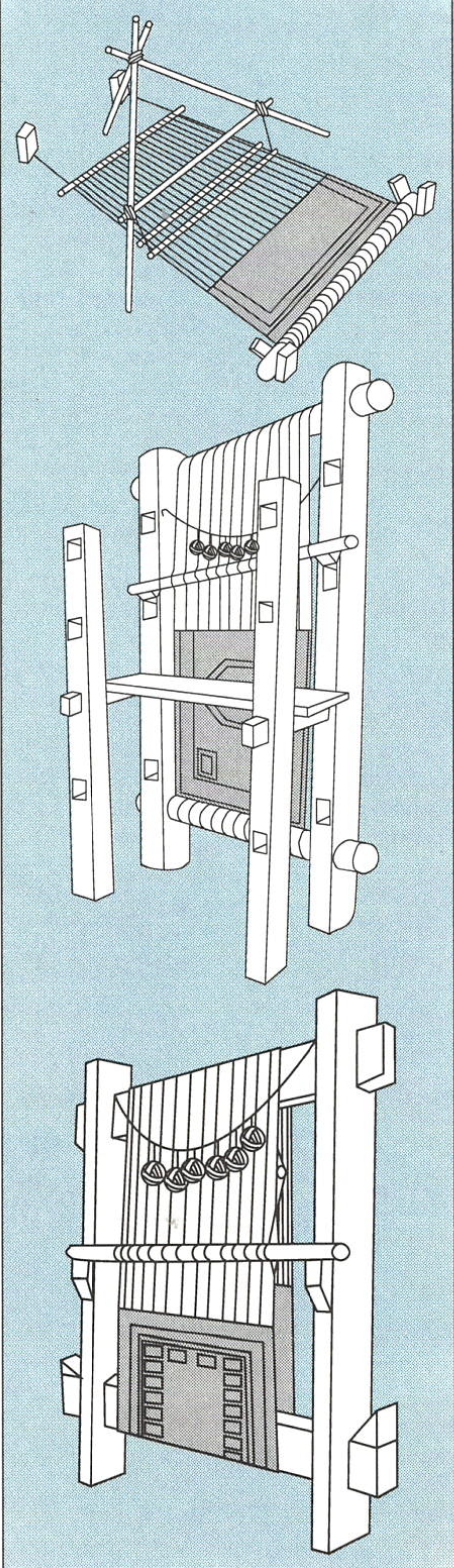
The three looms: 1. Horizontal loom, where the rug is at most as long and wide as the loom itself. 2. Vertical loom with fixed beams, where the rug is at most as long as the loom is high. 3. Vertical loom with a movable lower beam, where the rug can be shifted in height.
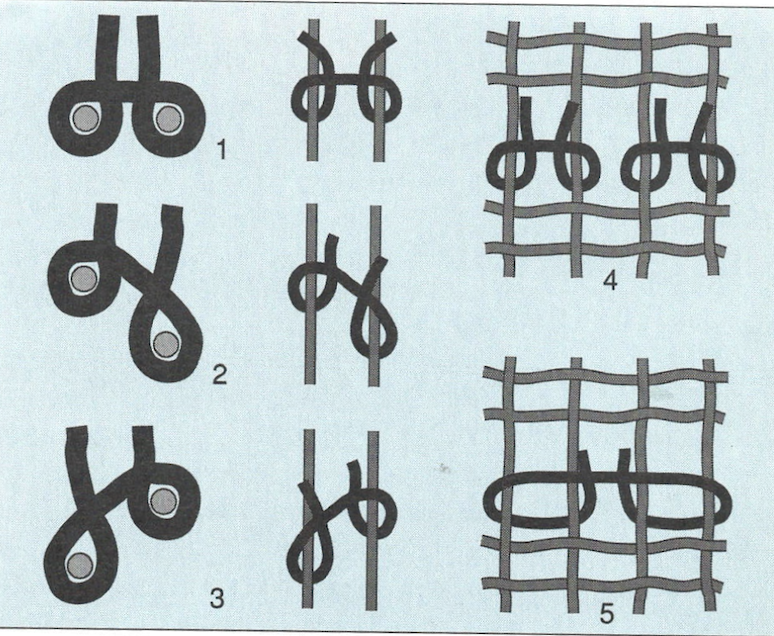
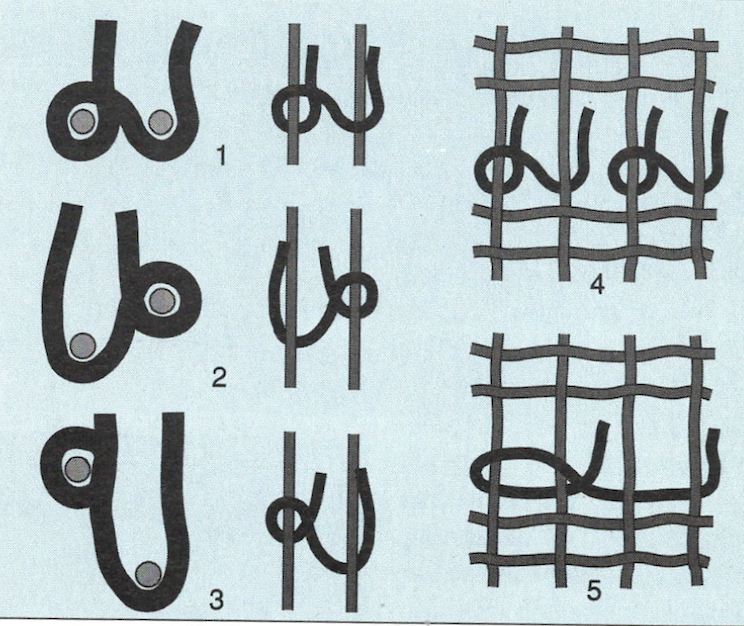
Left: the symmetric knot (Ghiordes or Turkish). Right: the asymmetric knot (Senneh or Persian). Forms 1 to 3 show the knot tied around the warp threads; 4 and 5 the resulting woven structure.
These two knot types also have secondary forms, above all the jufti knot, which is looped around a total of four warp threads instead of two. It is applied above all in modern rugs in order to speed up production, but yields products of inferior quality. In reality the jufti knot goes back to an old tradition of the Iranian region of Khorasan, where with it a special relief effect was produced. A fourth, old knot type was almost unknown in the Orient but was frequently used in Spain and is therefore called the Spanish knot. It is looped around a single warp thread, alternately and row by row staggered around even or odd warp threads. The two free ends of the wool thread then stand on both sides of the warp thread.
The Making
In principle the arrangement is that a horizontal row of knots alternates with one or more wefts. After the warp threads are stretched (beamed), the weaver sets a first row of knots, using a hooked knife. In the normal case, two wefts follow. They bring the knots into a row and reinforce the foundation weave. Then the weaver beats down the knots and the wefts with a special wooden or metal comb.
Each knot has a particular color. The patterning of the rug can be freely invented or prescribed. The weaver either has the pattern in her head or helps herself with a cartoon, a template of the rug pattern on graph paper, or even with a sample piece (wagireh). In some manufactories the master knotter dictates the color of each knot from a written template.
After the rug is finished, the warp threads are cut off and interlaced into the end finishes in various ways. Finally they form the fringes. Then the rug is sheared. This work is undertaken by specialists with special flat shears. They bring the pile of the rug to the desired height, which mostly turns out differently according to the tribe. Finally comes the washing under running water, in order to improve the structure of the rug. At the end the rug is dried in the sun, in order to check the lightfastness of the colors and to break overly conspicuous, bright colors somewhat.
Kilims and Soumaks
For centuries, alongside knotted rugs, flatweaves have also been made in the Orient. They have no knots and thus no pile either. Here the weft thread not only reinforces the basic structure but at the same time also takes on a decorative function. Among the flatweaves there are essentially two types, the kilim and the soumak.
Most kilims are made in the slit technique: the weft does not run across the whole width of the rug but turns back where the boundaries of the color pattern lie. Thus at the boundary between two differently colored areas vertical slits arise. For reasons of stability they are kept at most two centimeters long and are also not sewn up afterward.
The soumaks are made with the technique of wrapped warp threads. The weft thread runs over three or four warp threads and is then led back under one or two warp threads. In this way one obtains a kind of diagonal "stitch." The diagonal pattern wefts are always set in the same direction, or alternately in both diagonals, and then yield a kind of herringbone pattern. The slit kilim and the soumak technique are spread above all among nomadic peoples. They use them not only for rugs but also for objects of daily use, for example for bags, sacks, cradles and horse blankets.
The Regions of Origin
The Oriental rug may be simple or complicated, in geometric or floral style, more abstract or more naturalistic in pattern, but it always shows an incredible variety of motifs, patterns and colors. Through this variety, its anonymous nature and its transience, it is extremely difficult to date and to determine as to its origin. On the basis of stylistic and technical analogies, seven large groups took shape, corresponding to just as many geographical areas. Each group displays unmistakable features. Within each of these seven areas, one further subdivides the rugs in an often conventional way, using as criteria the patterns, the places of origin, or the tribes that made them.
The great areas of the Oriental rug are: Anatolia, Persia, the Caucasus, India, West Turkestan, East Turkestan (that is, Central Asia) and China. Within this extensive and complex panorama it is not easy, on the basis of patterns and colors, to distinguish for example an Anatolian rug from a Caucasian one. This applies of course especially to pieces knotted in the border regions. Whoever can distinguish rugs of different provenance has, in any case, taken a decisive step in the field of rug knowledge.
The seven geographical areas in which Oriental rugs were knotted: Anatolia, Persia, the Caucasus, India, West Turkestan, East Turkestan, and China.
Persia, Region by Region
Introduction
The Persian rug is still regarded in many circles as the Oriental rug par excellence. It shares with its colleague and rival from Anatolia the leading role in the stylistic development of the knotted rugs of the East. Persian knotted rugs are the expression of a genuine art and of social tradition rather than of religious belief. Persian production is distinguished by its extremely complex, calligraphic character, in which pattern and line play the main role. The geometric style is represented by abstract or stylized figures in the field, yet the Persian rug is dominated above all by the curvilinear, floral style. This is also better suited to interpret the lyrical, naturalistic spirit typical of this region.
In Persia, numerous highly complicated patterns arose, dominated by thin, very intricate arabesques. Against this background, differently shaped medallions, palmettes and other abstract ornamental elements are distributed, and not infrequently realistically depicted flowers and animals as well, since the Shiite branch of Islam that prevails in Persia permits, in contrast to the Sunni doctrine of Anatolia, a greater freedom of expression. It tolerates, for example, the depiction of human figures. From the 19th century on, portrait-like depictions come increasingly to the fore and gain weight relative to the rest of the patterning. Numerous colors are used in each rug, yet they never appear very strong and form no striking contrasts. Normally a single color covers no very large areas; rather, an animated, balanced play of color arises, in which small color zones stand side by side, frequently outlined in black. In general the colors red and blue predominate, and there are mostly light drawings on a dark ground. The coloring of nomad rugs is much less refined, and there a geometric, abstract or stylized patterning clearly dominates.
In Persian rugs the asymmetrical knot, also called the Persian or Senneh knot, is predominantly used. In many regions, above all in the west and northwest, the symmetrical knot is also used. Knotting materials are wool, cotton and silk, and on some antique rugs gold and silver threads as well. The dimensions of the rugs vary greatly, the largest pieces being found among antique court pieces, while nomad rugs tend to be small. Patterning with a medallion is by far the most common, the drawing showing abstract or naturalistic character according to the area of production.
The Safavid Style
Since we possess neither rugs nor fragments from before the 16th century, we know only from literary sources and above all from miniatures of the 14th and 15th centuries that there must already have been manufactories in Persia at that time. They created geometrically patterned rugs very similar to those of Anatolian production in the Seljuk period. The first signs of a new formal language became clear toward the end of the 15th century. When the lasting rule of the Safavids (1502 to 1722) began, uniting the nation, the Persian rug gained its independence. The knotters took up pattern ideas adopted from other art forms, for example from the art of the book and from ceramics. An important role was also played by patterns that had penetrated from China, such as the cloudband, the peony, the lotus blossom and other naturalistically depicted elements. On the whole the rug became one of the most important artistic forms of expression of Safavid society. It reached the high point of its development under the rule of Shah Abbas I the Great (1587 to 1629). The art of knotting drew its inspiration from the fine arabesques and flower motifs with which the outlines of miniatures and the embossed leather bindings of books were decorated.
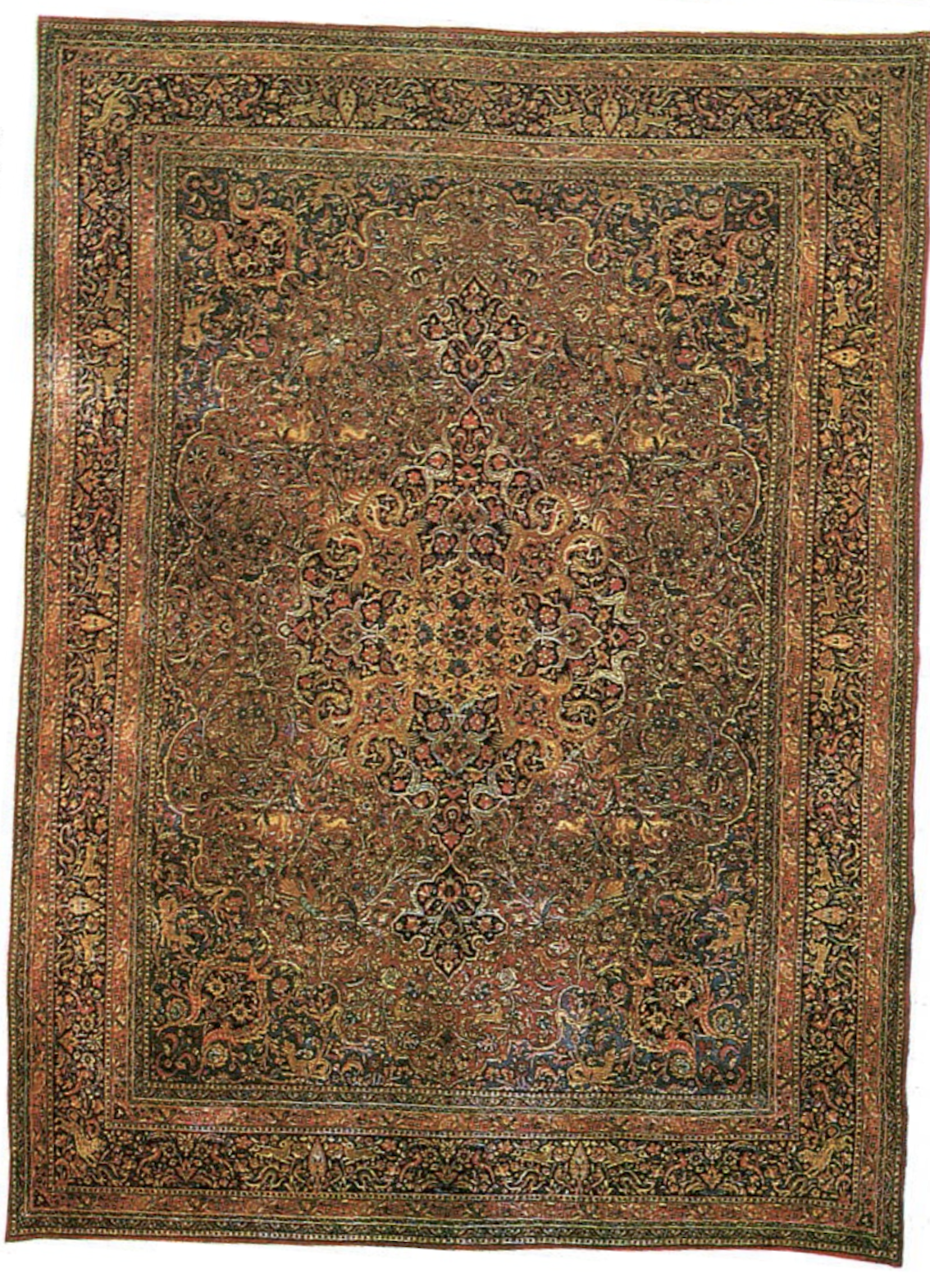
The Safavid style: a finely knotted medallion carpet, its field covered by curvilinear arabesques and floral scrolls.
It had to revolutionize its own strict, traditionally geometric patterns in order to adapt to the new curvilinear mode of expression. The basic pattern now was a very fine network of tendrils and flower stems that intersected one another symmetrically in infinite repeat and covered the entire surface of the field. This gradually filled with blossoms of all kinds, with palmettes, animals and small human figures. The new, calligraphically shaped sensibility led to patterns whose main element was fine lines and no longer differently colored areas. The borders gained a special importance, expressed through a great variety of patterns, and the border always has the task of supporting the effect of the highly complicated arabesque pattern of the central field. This curvilinear or floral Persian style also allowed the depiction of realistic drawings and thus suited the naturalistic taste of this people.
The further development of the pattern also led to great technical upheavals, above all in three areas. First, for the finest pieces the knotters used silk for the foundation weave as well as for the pile, which made finer knotting and more detailed patterning possible. Second, in the most important cities such as Tabriz, Isfahan, Kashan, Kerman and Herat, court manufactories arose (as under the Ottomans in Anatolia and the Mamluks in Egypt), where highly specialized craftsmen knotted the large rugs destined for the Safavid nobility. Third, a separation occurred between the creative phase and the making of the rug: the court miniaturists received the commission to design patterns, which were transferred onto cartoons that served as the knotting template. This distinction between the creative artist and the merely executing craftsman was groundbreaking and led to a complete decoupling of production at court or urban manufactories from production in nomadic settlements or villages, where patterns continued to be used that had been anchored for generations in people's memory or that arose spontaneously at the loom.
Fostered by the patronage of the Safavids, the most famous Persian artists created extremely complicated patterns and established extensive color palettes. In doing so they often transformed the rugs into pages of a book on which they wrote poetic or religious verses. These masters sometimes furnished their creations with name and date and thereby made them, to an even greater degree, true works of art. With this the meaning of the rug also changed fundamentally. From an object that had always belonged to daily life and to religious worship, it became the social emblem of a wealthy class and thus a luxury object with which palaces were adorned. Rugs at that time also represented a splendid, prestigious gift with which one wished to astonish the rulers of the most important European states, and for such purposes gold and silver threads were often knotted in. The close connection between the nobility of that time and the art of rug knotting is also confirmed by history: when in the middle of the 17th century the Safavids reduced their patronage, the production of significant rugs slowly declined, and after 1722, parallel to the invasion by the Afghans and the fall of the Safavid dynasty, it fell completely into crisis.
Rug with palmettes. East Persia (Herat?), late 16th to early 17th century. The Persian love of calligraphy found expression from the 16th century on in the curvilinear rug style.
The Typology of Antique Rugs
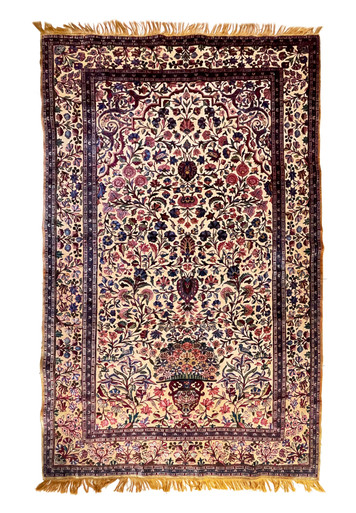
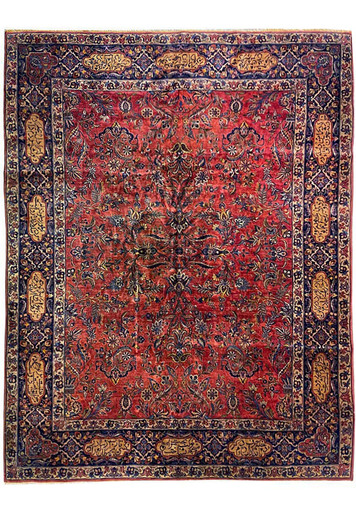
Very old Persian rugs are exceptionally rare today, not least because they already represented great value at the time they were made. It is no coincidence that practically all surviving rugs from the Safavid period are now in large museums and collections. They cannot be classified by their place of manufacture, because the same templates were evidently used in different workshops, because no technical differences exist between them, and because the end products therefore share the same characteristics, for example the large dimensions and the use of silk and precious metal threads. The largest manufactories of the Safavid period were in Tabriz, Kashan, Kerman, Herat, Isfahan and Joshaghan, and in general only very superficial differences can be established between them. Tabriz is distinguished by an unusual chromatic severity and a certain rigidity of pattern. Kashan, by contrast, produced more imaginative and open rugs and used almost exclusively silk. Herat and Isfahan are difficult to tell apart, since both used the same floral elements, though Herat is perhaps typified by a greater liveliness of composition and Isfahan by an over-rich, almost baroque character. The best, if still incomplete, classification therefore follows the patterning.
Medallion Rugs
These rather narrow but large-surfaced pieces, on average four to five meters long, show a field densely set with arabesques and flower motifs, often also populated by animal and human figures. At the center a differently shaped medallion dominates. It can be star-shaped, circular, indented or pointed-arch, but always sets itself off from the background by its size and contrasting color. In most cases it closes with two pendants along its length, to give the rug an axis of symmetry. Usually parts of further medallions are present in the corner spandrels of the field; these may have a different form from the central medallion, but in every case are meant to suggest the infinite repetition of the pattern. The rather wide borders show floral elements or, frequently, cartouches bearing inscriptions. The medallion rug developed in the early 16th century, coinciding with the rise of the Safavid dynasty, the most important centers being Tabriz, Kashan, Kerman and Herat, and it became the most important type of Persian rug for all later periods as well.
Animal and Hunting Rugs
Thanks to the greater freedom of expression that the Safavid rulers granted under the influence of Shiite Islam, Persian artists in the 16th century created two further, very similar and decidedly successful rug types. The animal rugs lack a central medallion; instead they impose a particular viewing direction on the beholder. Over the whole field, arabesques or, more frequently, naturalistically formed shrubs and other plants are scattered, and among them move the most varied kinds of animals, set off by color from the ground. Wild animals are sometimes shown in combat, along with mythical or fantastic creatures and even domestic animals. Originally these figures had not only a decorative but also a symbolic meaning, pointing to a higher world and order. These animal rugs were made above all in four specialized manufactories: Tabriz, where the animals dominated over the floral elements, Herat, where the reverse was the case, and also Kashan and Isfahan. The hunting rugs are in reality a special form of the medallion rugs. Their field patterning includes not only the usual close arabesques and naturalistic flower forms, but also scenes with lance- or bow-bearing riders pursuing or fighting their prey. In working out these rugs the artists drew inspiration from miniature painting and contemporary literature, but also observed the splendid life of the court, and in their depiction they alluded symbolically to the Garden of Eden and to paradise. The manufactories of Kashan were probably the ones above all specialized in knotting these rugs.
Garden Rugs and Rugs Depicting Trees and Shrubs
These two pattern types are closely connected in both theme and symbolic content. Both allude to paradise and used as their models, in an otherwise semi-desert environment, the green parks and gardens of the rulers' palaces. The garden rug depicts, as if in ground plan, streams, springs and small lakes that divide the field into four, six or eight compartments, each of which houses realistically rendered plants and flowers. The waters are occasionally populated by fish and waterfowl in naturalistic depiction. The surviving rugs were probably knotted in Kerman and go back to the 17th century, with an increasing stylization of forms taking place in the course of the 18th. From the same centuries comes a more strongly geometric interpretation of the garden rug with less lively colors; this type arose in Kurdistan and is distinguished by very schematic compartments with small polygonal medallions and strongly stylized plant elements. The rugs depicting trees and shrubs were developed in the 16th century and can be regarded as an altered version of the garden rugs, but without animal depictions. Various trees, chiefly cypresses and willows, alternate with flowering shrubs in the central field, and a central medallion may also be present. In rugs of the 17th century a symmetrical composition in horizontal rows predominates. This pattern type probably comes from East Persia, and a more strongly geometric variant also exists, in which plants alternate with rows of small medallions; the weaving area is again Kurdistan, the period of origin lying between the end of the 16th and the beginning of the 17th century.
Vase Rugs
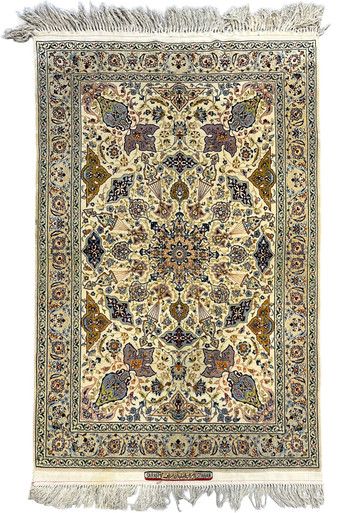
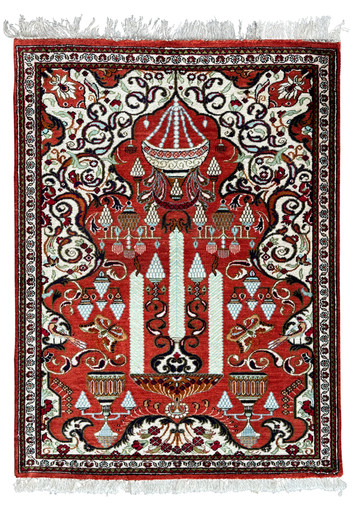
Vase rugs can be viewed in only one direction: in the lower part of the central field very long flower stems spring, mostly from delicate vases, and extend to the upper edge of the field. They intersect at regular intervals and thereby create a more or less curvilinear lattice that runs over the entire field, and this lattice determines the distribution of the leaves, palmettes and flower forms. The vase rug probably arose toward the end of the 16th century during the rule of Shah Abbas I the Great, the production being attributed to the manufactories of Joshaghan and Kerman. There is also a second sense of "vase rug": pieces made by the so-called "vase technique," whose mark is three weft threads per row of knots, the two outer wefts being drawn taut while the central weft remains loose. This produces a spatial layering of the wefts that becomes clear as a ribbing on the back of the rug. Because the oldest rugs made by this vase technique also showed the corresponding patterning of flower-filled vases, the name stayed with them, yet many rugs knotted by the vase technique show quite different patterns and belong, for example, to the medallion rugs or the garden rugs. They are attributed, with some uncertainty, to Kerman, and their dating is much disputed, reaching from the end of the 16th to the beginning of the 18th century. Rugs with the true vase design, incidentally, need not necessarily also be knotted by the vase technique.
Rugs with Flower Depictions
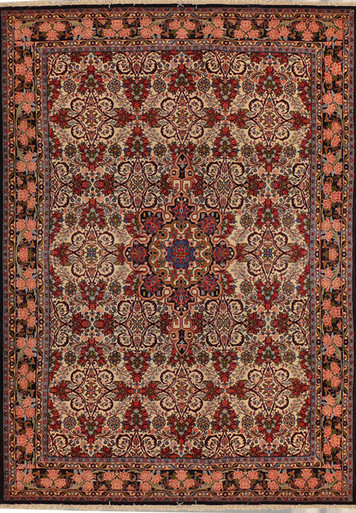
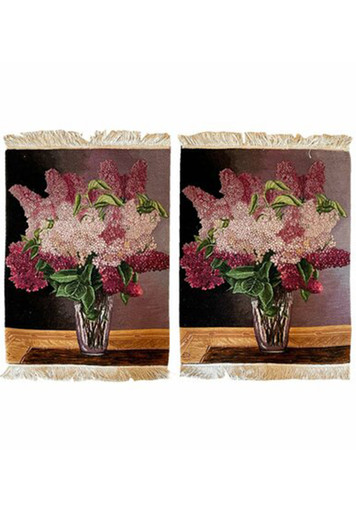
To this group belong numerous examples, among them very well known and highly prized pieces. The pattern extends over the whole field. In size and color contrast with the red ground, differently oriented palmettes, lanceolate leaves and frequently cloudbands dominate, while smaller floral elements connected to one another by thin arabesques and tendrils provide a further loosening. Only rarely do birds and other small animals appear, and then more in the background. The borders are generally very dark, in a hard-to-define tone between blue, green and black, and mostly show the Herati motif, that is, large blossoms or palmettes with large lanceolate leaves at the sides. The floral pattern of these rugs arose toward the end of the 16th century, was very successful and spread widely, so that one cannot say with certainty where the rugs come from. The examples of this kind were formerly all attributed to Isfahan, but today one inclines more to Herat. In both cases, however, these are only trade names chosen for convenience, since other centers of production cannot be ruled out with certainty. The city of Herat in particular is credited with the development of one of the most common decorative elements on such rugs, the Herati motif. Originally it consisted of a palmette or rosette surrounded by only two large, serrated, sickle-shaped leaves. From this arose the field-filling Herati pattern, which spread widely in numerous variants, especially in the Persian production of the 19th and 20th centuries. In this connection the Indo-Isfahan, or generally the Indo-Persian, rugs must be mentioned. They are witnesses that the pattern of these flower rugs spread to India as well, and it is assumed that many Indo-Persian rugs were made by Persian knotters in India. A sure distinction between examples knotted in India or in Persia is not possible. Persian pieces perhaps show a greater calligraphic sensibility, underlined by the black outlines of the figures, and a more pronounced taste for decided color tones, while on Indian rugs we see patterns with light outlines or none at all, and a characteristic lacquer-red color predominates. The flower patterns, knotted from the end of the 16th well into the 18th century, were among the most successful designs of the Safavid period, and in the 19th century the pattern arrangement was rediscovered and is still knotted on a large scale today.
Polish Rugs
The Polish rugs, also called Shah Abbas rugs, include numerous pieces in the largest European collections. They all show the same stylistic features as those rugs exhibited in 1878 at the World's Fair in Paris, which then belonged to the Polish count Czartoryski; in addition, some pieces bore the coats of arms of Polish noble families as decoration. This gave rise to the term "Polish rugs," which is actually inaccurate, since these are pieces of a special Persian production. Characteristic of the Polish rugs are the precious materials, for example the pile of silk as well as gold and silver threads at especially important points of the pattern. Characteristic too is the considerable variety of pattern, with arabesques, tendrils, palmettes and cloudbands, either regularly scattered over the whole field or arranged around one or more central medallions. Common to the Polish rugs are the delicate colors, with yellow, pink, light blue and light green predominating. In a certain contrast to this refinement stand the rather coarse knotting, the on the whole little original patterning, and the reduced calligraphic sensibility. But precisely these features show that these were special products, created from the outset for distant, rather unknowing users. They were thus intended for export, but in view of their undeniable value not as trade goods, rather as splendid and prestigious gifts for the most important European princely courts. These "diplomatic" rugs were first created under the rule of Shah Abbas I the Great, after whom they are partly named, and the period of manufacture reaches from the end of the 16th to the end of the 17th century. They were attributed to the manufactories of Kashan and Isfahan, though great uncertainties remain regarding the differences between these two provenances.
Portuguese Rugs
As Portuguese rugs we designate pieces with a peculiar patterning that sets itself apart from the rest of Safavid production. The rugs show a central, stepped, multi-layered medallion with close arabesques and animal depictions. Typical are the figuratively patterned corner spandrels, in which scenes of seafaring are shown with waves, fish, swimmers and above all large sailing ships with crew and passengers in European dress. The presence of these figures suggests an origin from the Indian city of Goa, a long-established Portuguese colony, and the peculiar patterning, clearly different from the rest of Safavid production, also suggested an export to Europe and orders placed by the Portuguese. Execution could have taken place in Goa or in South Persian manufactories with which the Portuguese maintained close commercial relations in the 17th century. Be that as it may, the provenance of these pieces is not yet settled, and North Persia is also still discussed. These unique, vividly patterned and large rugs all go back to the 17th century, and their patterning was used again as a model by the manufactories of Tabriz in the 19th century.
Production in the 19th Century
After the invasion by the Afghans in 1722, Persia entered a long period of political and cultural obscurantism. After this crisis, which lasted the whole of the 18th century, the Persian art of rug knotting experienced a renaissance in the second half of the 19th century. Old and new urban manufactories were opened, sometimes at the instigation of the West, as in the case of the workshops of the English firm Ziegler in Tabriz and Sultanabad, which began operating in 1883. The old Persian pieces that have survived in fairly large number were for the most part created in famous urban manufactories, a smaller number being made by nomadic tribes.
Urban Production
This production is marked by the more or less faithful resumption of the spatial arrangements and patterns of the "classical" Safavid period, undertaken in order to bring the great past back to life after the period of decline and to satisfy the growing demand of the Western market. The urban pieces are nonetheless in no way a worthless production, even if they lost some value through a lack of originality and creative power and above all through an ever stronger commercial orientation. From the antique production were preserved the generally balanced, lyrical character, the use of numerous, never garish colors, and the typical careful attention to pattern and line, with the figures showing black outlines. The predominant style is clearly curvilinear or floral, though in certain weaving areas geometric interpretations, abstract or stylized, are not rare. The most common rug type, which finally became the most representative of all Persian production, is the medallion rug: the central medallion is roundish or oval or shaped like flower petals and rests on a ground with arabesques, palmettes, leaves, blossoms and often small depictions of real or fantastic animals of the most varied kinds. The hunting and animal rugs are also popular, and there is no shortage of rugs with superimposed medallions or pieces with different motifs repeated in rows or arranged checkerboard-fashion over the whole field. Prayer rugs now also appear, showing mihrabs with curved gables and naturalistic floral patterns, but the production of such pieces was very limited and meant merely to satisfy Western demand, since the prayer rug was in fact a cultural import in Persia, where rugs always had a more artistic and social than religious function. Among the patterns preserved in geometric or curvilinear form we find the Mina Khani, the Zil-i-Sultan, the Kharshang, the Afshan, but above all the boteh, which from the 18th century on found its way into the patterning as decoration of the central field and the borders, as well as the Herati. This last motif derives from a simple 16th-century prototype and was probably fully formed in the 18th century; it consists of a complicated system of blossoms and lanceolate leaves around a lozenge figure and is now used predominantly in the central field. As patterns for the borders, besides the Herati, the boteh, cartouches and the Medachyl border are above all to be named.
The Western Influence
Toward the end of the 19th century, two rug types developed that were influenced by Western taste and culture and had some success. The first is the figural rug, depicting individual mythical scenes from literature or the Persian epics, as well as particular episodes from Persian history. In other cases we see scenes from the hunt or daily life, or even portraits of famous men or of the person who commissioned the piece. The borders generally show cartouches with various inscriptions and lyrical verses, and longer inscriptions explaining the depicted scene are also found inside the field. All these scenes clearly betray the influence of local miniature painting but also of Western engravings, prints and photographs, recognizable above all in the will to realistic depiction, especially as regards proportions and surroundings. At the end of the 19th century the human figure thus appears for the first time in a leading role on the rug. It no longer loses itself on a background densely patterned with arabesques and tendrils, but stands at the center of scenes that look painted. Since the knotting technique, because of the geometric nature of the knot, cannot render scenes fully realistically, and since these figural rugs were entirely foreign to the previous tradition, a very peculiar rug type arose that by no means everyone loves and prizes. Among the numerous weaving centers, Kashan and Kerman stood out above all. The second rug type of the 19th century took its bearings from the floral patterning of 18th-century French works, so that large compositions with roses, peonies and other naturalistically depicted blossoms in the form of bouquets or vigorous sprays were taken into the rugs. These were knotted in pastel tones, with a preference for light yellow, beige (especially for the ground) and above all pink in all its shades. Senneh was one of the most important centers of production for this type.
Nomad Production
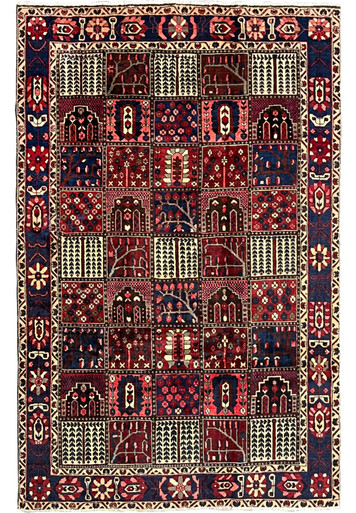
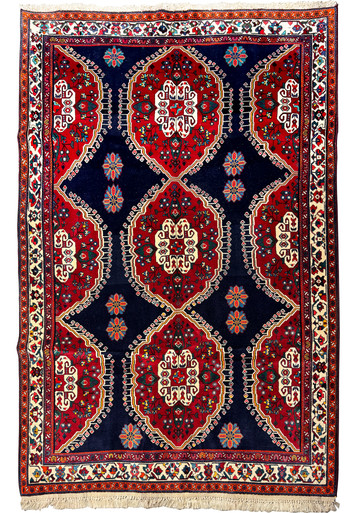
In Persia too the nomad rugs always remained bound to traditional tribal life and were at first immune to commercial temptations. For this reason Persian nomad rugs today stand higher in esteem in many European countries than the classical Persian rugs from the urban manufactories. The old Persian nomad rugs are marked by abstract or stylized geometric patterns and differ from the corresponding rugs of other areas by their generally more elaborate, denser patterning, often due to the influence of urban motifs, while the colors appear, as elsewhere, lively and rich in contrast. A special position in this respect is held by the Baluch rugs, distinguished by somber, dark colors. For all Persian nomad rugs the problem arises that we cannot yet state the origin with certainty, above all because of the size of the territory and the nearness of other important centers of production with which exchange naturally took place, namely Anatolia, the Caucasus and Turkestan. They are therefore assigned not to precisely defined groups or villages, but more generally to larger tribes or to the areas in which these tribes live.
The Main Weaving Regions
In contrast to the nomad rugs, the pieces created in urban manufactories and workshops can be classified by their origin on the basis of their stylistic and technical features. In general the extensive and varied urban and nomad production of Persia, like that of Anatolia, can be divided into large geographical areas, which in turn comprise various regions and centers. The most important and most representative Persian provenances are treated below.
Northwest Persia
Tabriz. Tabriz is an old weaving center, and the renaissance of the Persian manufactory in the 19th century proceeded from this city. Its rugs are distinguished by knotting with symmetrical knots (in contrast to the Safavid period, when the asymmetrical knot was used), by the use of a particularly rough and strong wool, and by the habit of shearing the pile low to medium in height. In general, pronounced craftsmanship is characteristic of Tabriz production, especially in the silk rugs. Stylistically it shows a particular precision in detail, even if the patterning on the whole is not very original and goes back to the classical models. Most common is the medallion rug with parts of identical medallions in the spandrels, but there are also vase rugs, animal rugs and even prayer rugs of the Ghiordes type, and a small minority show various figural scenes. The borders generally show the Herati motif, cartouches with inscriptions, and cloudbands; typical of Tabriz are the narrow outer guard borders with small floral motifs. The colors are not very significant for identification: blue, ivory and terracotta-red predominate, and on rugs for the Western market, pastel colors.
Heris. The 19th-century production (wool) certainly goes back to the antique production, even if no corresponding evidence exists. It is distinguished not only by the symmetrical knot and the format tending toward the square, but above all by its particular style: the classical Persian flower motifs are translated into decidedly geometric forms, the pattern underlined by two or more outlines in different colors. Most often the arrangement provides a large central, star-shaped medallion with four or eight rays, with geometric motifs in the spandrels. The borders are decorated with the likewise geometricized Herati motif and, as a result, often show the turtle motif, along with small, variously composed polygons. Characteristic too is the color rendering, which, unlike the rest of Persian production, prefers large uniform fields; the most-used tones are rust-red, ivory, light yellow, blue and light blue. A small number of commercial silk rugs were also knotted in Heris, mostly prayer rugs with finely worked niches, complicated floral elements and trees of life.
Medallion rug from Heris. 19th century. The geometric style, the four- or eight-pointed star medallion and the stylized Herati border make this provenance easy to recognize.
Karadagh region. In this problematic area lives a mixture of peoples with nomadic and semi-nomadic production. The rugs have an elongated format and are knotted with the symmetrical knot; stylistically they stand close to Caucasian rugs. The geometric patterning normally makes use of several superimposed medallions or a single central medallion, in any case resting on a ground strewn with small polygons or geometricized plant elements. Typical of the border are the Caucasian oak-leaf motif, octagonal stars or stylized flower stems. The ground shows especially dark blue and brown colors, while the medallions and the main patterns are rendered in livelier tones such as red, ivory, yellow and light blue.
West Persia
Senneh. On the Western market the provenance Senneh is known for its high knot density, and the term Senneh knot for the asymmetrical knot derives from it, although the rugs have always been knotted with the symmetrical knot. Thanks to special techniques and the low shearing of the pile, Senneh production is distinguished by tiny drawings that fill the whole field, above all small Herati or boteh motifs repeated in rows in infinite repeat. Herati motifs are also found inside central, often concentric, hexagonal or lozenge-shaped medallions, or in several superimposed medallions. Only toward the end of the 19th century did the knotters create new patterns to Western taste, especially French-looking bouquets. The main border normally shows the Herati motif. In the ground, blue, black and ivory predominate, while the drawings are mostly held in yellow, red, light green and cream tones.
Bidjar. For these rugs too the symmetrical knot is used. On the whole they show a great variety of pattern, for example a central medallion with the Mina Khani motif as well as the Kharshang motif. The classical Safavid patterns are rendered in a stiff, rectilinear manner, especially the vase motifs, the arabesques and the flowering tendrils. The colors form clear contrasts: on the generally dark ground the bright red, light blue, yellow or green patterns stand out distinctly.
Hamadan region. This production is easy to distinguish by technical and stylistic features. The symmetrical knot is used; the rugs show a high pile and above all a compact structure, because only a single weft lies between two rows of knots. Most often the rugs carry one central or several superimposed medallions, characteristically of lozenge or hexagonal form, completed by two pendants and often showing geometricized Herati motifs inside. The general formal language is geometric and linear, the borders too being decorated as a rule with polygonal or stylized plant motifs. Almost always a Medachyl border is present, as well as a camel-colored outer border, this color also appearing in the ground of the central field.
Malayer region. This is a complex zone: the north tends stylistically toward Hamadan, with rectangular medallions and small motifs throughout the field, while the east tends toward the Saruks and Farahans, with a more pronounced central medallion and larger, more complex floral patterns. The formal language nevertheless remains geometric, even though both the symmetrical and the asymmetrical knot are used. Floral patterns are widespread, above all the Zil-i-Sultan motif, occurring over the whole field or alternating with lozenge-shaped medallions. The colors are very lively, with a preference for red and blue.
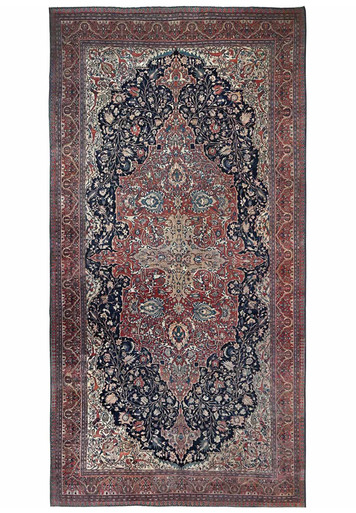
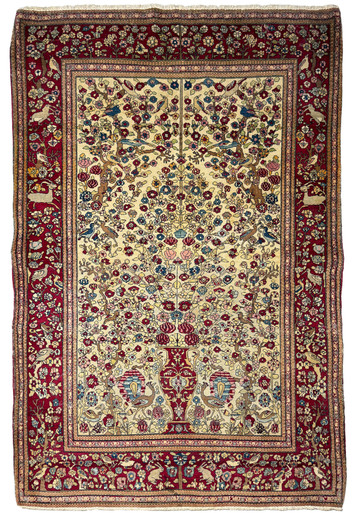
Farahan region. These rugs are knotted above all with the asymmetrical knot and show two different types. In the first, Persian decorative motifs of floral origin are scattered over the whole field, above all tiny geometric Herati motifs. The second, more striking type is an exceptionally balanced medallion rug: in the center the medallion dominates, containing flower motifs and often surrounded on the outside by a kind of ray-wreath, while the rest of the field is little patterned and shows only a few scattered floral elements. Above and below the central medallion, fragments of two further identical medallions are seen. These rugs were hotly desired in Europe, especially in Victorian England. As a further mark, the ground of the field shows a red or beige color.
Saruk (also Sarough). These rugs are in most cases knotted with the asymmetrical knot and are very easily recognized by the typical linear version of the traditional Persian flower motifs. Inflorescences, leaves and buds thereby appear frozen, yet at the same time unfold a special effect. This highly original linear character becomes, in the last years of the 19th century, increasingly curvilinear and naturalistic. Most common are rugs with a central medallion, which can be very large and hexagonal on the one hand, or smaller, roundish or rather lozenge-shaped on the other, furnished with pendants and spandrels. There are also prayer rugs and rugs with floral elements throughout the field. The borders are normally decorated with stylized Herati motifs, often transformed into the turtle form. The colors generally appear very pleasant and found much applause on the Western market. The ground of the field is generally ivory, beige, red or blue; among the decorative motifs, yellow, light blue, brown or a typical pink tone, also called dughi, predominate.
Serabend. Rugs of this origin, only rarely knotted with the symmetrical knot, are easily recognized by their particular pattern: tiny botehs that cover the entire field in rows, their tips all looking in the same direction or turned 180 degrees by rows. The outlines of the botehs are either rectilinear and continuous, or appear discontinuous and are then formed by tiny adjacent blossoms. Also typical is the main border, which consists of a characteristic tendril of serrated leaves containing once again botehs and further floral elements. The ground of the central field is always red, while the botehs and the other patterns are preferably executed in white, blue, black and yellow.
Southwest Persia
Lori. This nomadic or semi-nomadic production, difficult to define, shows great variety, and both the symmetrical and the asymmetrical knot were used. Many pieces show a lattice-like structure with stylized plant motifs, or display tiny geometric motifs arranged in rows over the whole field. The colors are at first fairly light and lively and become, from the beginning of the 20th century, dark, with red and blue dominating.
Bakhtiari. The rugs of these nomadic or semi-nomadic tribes are knotted with the symmetrical knot and show above all the so-called Bakhtiari motif: the field is regularly divided into squares, octagons or lozenges containing stylized plant motifs such as trees, shrubs and flowering branches. The most-used colors are blue, red, yellow and green.
Central Persia
Veramin. This weaving center arose only in the 19th century and therefore has no long workshop tradition, but does have a particular pattern: the whole field is covered by Mina Khani motifs, whose origin remains in the dark. The knotting was done with the asymmetrical knot. In the border we generally meet the Herati motif, often stylized and transformed into the turtle motif. The colors as a rule follow tradition: blue predominantly for the ground of the central field, while white, red, yellow and light blue are often the base colors for the floral pattern.
Kashan. The city of Kashan is an old center of Safavid production and still belongs among the best known and most prized provenances. The rugs are very densely knotted with asymmetrical knots and are marked by at least one weft thread dyed light blue, the newer pieces using the classical patterning with a central medallion. Although most Kashans belong to the medallion rugs, they often show a floral or zoomorphic patterning over the whole field, always very complex. The medallion takes various forms, often with many lobes, and has pendants as decoration as well as parts of further medallions in the spandrels. The ground on which it rests is densely strewn with arabesques, palmettes, leaves and other plant elements, often joined by small birds and other animals, which make the rugs appear soft and flowing. Among the small-format pieces the prayer rugs stand out, with a light ground enlivened by trees of life, vases with bouquets and animals. Toward the end of the 19th century figural scenes appear, drawn above all from old Persian legends, and in the same years the famous waq-waq tree reappears as a motif, depicted as a field-filling interlace of branches ending in realistic or monstrous animal or human heads. The borders show very varied floral patterns, always inspired by Safavid models. The colors are lively and normally set a contrast between the brighter, luminous field and the darker, generally dark-blue main border; the ground of the field is almost always red or ivory, the patterns appearing in pastel colors. Toward the end of the 19th century these contrasts gradually flatten, beginning with the border, which is increasingly colored gray, beige, ivory or pink.
Joshaghan. Here too we have an old Safavid weaving center, credited with the development of the vase rug, though this is much disputed. Joshaghan rugs are knotted with the asymmetrical knot, datable from the 18th century, and show above all two pattern types, both arising from stylization of the Safavid vase pattern. In the first, small blossoms spring from a lattice-like net of flower stems; this arrangement becomes ever more stylized until, in the second half of the 19th century, it disappears completely and only blossoms arranged in lozenges still recall it. In the second, the lattice net consists of the elongated stylized leaves of one of the countless Herati motifs, with small blossoms as further decoration. In the borders stand stylized floral elements, the background usually dark red, while the numerous decorative elements are held in blue, light blue, white or yellow.
South Persia
Fars region. The rugs from this extensive area are also called Shiraz in the trade, after the most important trading place. In reality they are knotted by two great nomad tribes, the Qashqai (or Kashkai) and the Khamseh, but since these show very similar features one often cannot distinguish them with certainty (at least in 19th-century production), so one generally uses the name of the whole area as the designation of origin. The rugs are as a rule knotted with the asymmetrical knot and show a central lozenge-shaped medallion or several superimposed, similarly formed medallions. The rest of the field is strewn with small geometric motifs (polygons, eight-pointed stars) or highly stylized animals, for example the morghi motif, which also occurs among the nomadic Afshars. Influences of Safavid knotting show in elaborate medallions and more composite motifs, such as arabesques and flowering tendrils translated into the geometric style. At the short ends, outside the normal borders, additional characteristic narrow borders with colorful rectangles are often found. The rugs of the Qashqai show, as a superficial distinguishing mark, a more curvilinear tendency and a preference for dark colors, while the Khamseh turn out lighter and more linear. Characteristic of the whole area is the frequent appearance of the lion in the pattern, in rather naive and stylized forms; this animal once inhabited the region and still serves as a symbol of strength and rule.
Afshar. With the name of the largest tribe in the area one generally designates the nomadic or semi-nomadic production in the region south of Kerman. The rugs are knotted with the symmetrical or asymmetrical knot and show very varied patterns: some follow tribal tradition, others are influenced by the decorative motifs of the nearby urban workshops. Thus we see a single cross-shaped medallion or superimposed lozenge-shaped medallions on a field strewn with small floral elements or stylized animals. These stand beside motifs foreign to tribal tradition that repeat in rows, for example small floral medallions, Kharshang motifs and above all botehs, often in the "mother-and-daughter" version, a smaller boteh enclosed by a larger. Characteristic of the nomad production is the morghi motif, shared with the Fars area, showing small stylized hens generally set in close rows around the central medallion. The Zil-i-Sultan motif sometimes appears over the whole field. The borders as a rule show stylized or tendril-form rosettes. The Afshars love the contrast between a dark, generally blue background and lighter, luminous patterns above all in red, white, yellow and green, without quite setting black aside.
Kerman. This famous old weaving center from the Safavid period, where probably the vase technique and perhaps also the vase-rug pattern arose, still counts among the most sought-after provenances. Especially valuable are the examples made in the village of Kerman Ravar, though they are very hard to identify unambiguously. Kerman rugs are easy to distinguish by technique and style. The asymmetrical knot is used, with three wefts for each row of knots, of which the middle one is dyed pink in older pieces and light blue in later ones. Stylistically these rugs are marked by their extremely elaborate and curvilinear design, and in the pieces from the end of the 19th century the tendril and arabesque ornaments can hardly be surpassed. In contrast to Kashan, there is a great number of different field arrangements, some following the Safavid tradition, others not: central medallions with strongly lobed outlines on a field with numerous arabesques and naturalistic floral elements; rugs with numerous trees, above all cypresses, and shrubs in a lattice on a field filled with botehs or bouquets; prayer rugs with realistic bouquets or trees of life; figural rugs with scenes from the hunt or various tales, often negatively influenced by Western taste. At the beginning of the 20th century the knotters also created central medallions with naturalistic rose bouquets showing clear French influence. A further, almost constant feature is the numerous framings of the field with five or seven borders, decorated with tendril ornaments or small botehs. The colors are very varied and especially balanced, with many tonal gradations: in general various reds, beige, blue or ivory dominate on the central field, light blue, pink and green in the patterning.
East Persia
Khorasan region. This extensive area formerly also included the city of Herat, an important weaving center in Safavid times. The area can boast an old tradition, and the widespread Herati pattern probably arose here. The rugs are knotted with the asymmetrical knot and are distinguished by a technical peculiarity: every six to seven rows of knots, four or more wefts are inserted, which shows on the back of the rug as a grooved pattern. The most important patterns comprise central or concentric medallions or the field-filling use of the Herati motif, as well as small floral motifs. The main border usually shows Herati motifs, botehs or cartouches. Among the field colors, yellow, blue or red predominate; in the patterns, as a rule, yellow, green, light blue and white.
Mashhad. To this center the trade attributes the best rugs of the Khorasan area, though manufactories existed here long ago. Mashhads exist since the end of the 19th century and are knotted with the asymmetrical knot. The most common arrangement provides roundish or elongated medallions with pendants and floral elements, the field decorated with Herati motifs, flowers or naturalistic palmettes, and very often spiral tendrils and elaborate arabesques. The quarters of the field are marked by individual pendants on a light field (white or ivory), of pentagonal or almond form, sometimes connected to the central medallion by tendril ornaments or arabesques. In the main border the Herati motif or interlaced flower stems appear. The coloring is generally as in the rest of Khorasan, predominantly yellow, blue and red for the field and yellow, green and light blue for the patterns, but with a special preference for white to ivory tones. In some pieces the jufti knot is used, which indeed originates from this region.
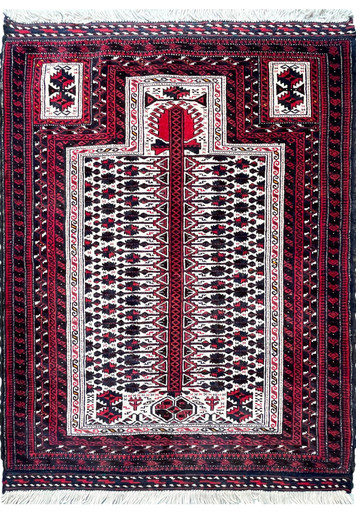
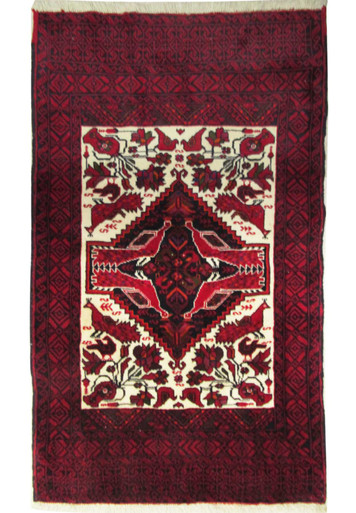
Baluch. The rugs knotted in the border area with Afghanistan are named after the nomadic and semi-nomadic tribes there. The Baluch rugs are knotted only in exceptional cases with the symmetrical knot and are distinguished by their particular softness and above all by their characteristic colors: only a few, rather dark colors are used, above all various reds, brown and blue as ground, white, light green and yellow in the patterns, as well as the typical use of a dark aubergine tone. Because of its somber coloring the Baluch was for a long time not especially popular in the West, but today it finally finds favor, with precisely this genuine quality being emphasized. The patterning mostly extends over the whole field. The Baluch are naturally influenced by the decorative motifs of the surrounding areas, so that we meet, for example, rows of polygonal or lozenge-shaped guls of Turkmen type, with or without hooks. Patterns belonging to the urban knotting tradition of Persia also occur, for example the Herati and the Mina Khani, both translated into the geometric formal language. Especially to be named are the prayer rugs with their long rigid mihrabs and rectangular gable: on a camel-hair-colored ground they mostly show two-colored trees of life, a straight trunk with branches diverging at right angles bearing stylized leaves or blossoms. There are also prayer rugs in which the niche is surrounded by animals such as camels. In these pieces, still made today, the original character of this provenance comes out especially clearly. The main border is normally decorated with geometric elements of various forms.
Historical text adapted with permission of Orbis Verlag.
Patterns and Style
Every part of a rug, the borders, the central field and the end finishes, can carry a pattern, arranged according to set compositional schemes. One distinguishes a directed, an undirected and a centralized arrangement. The directed arrangement has a single axis of symmetry and imposes a particular viewing direction on the beholder; figural rugs can have this structure, but the most widespread example is the prayer rug, whose niche, the mihrab, orients the worshipper toward Mecca. The undirected arrangement can be viewed from any side: the field has no single focal point but consists of continuous, identical or very similar elements repeated until they fill the whole field, what is called an infinite repeat. The centralized arrangement also reads from any direction but has a central, especially important element, the medallion, around which the lesser elements group, the medallion often ending in two mostly drop-shaped pendants.
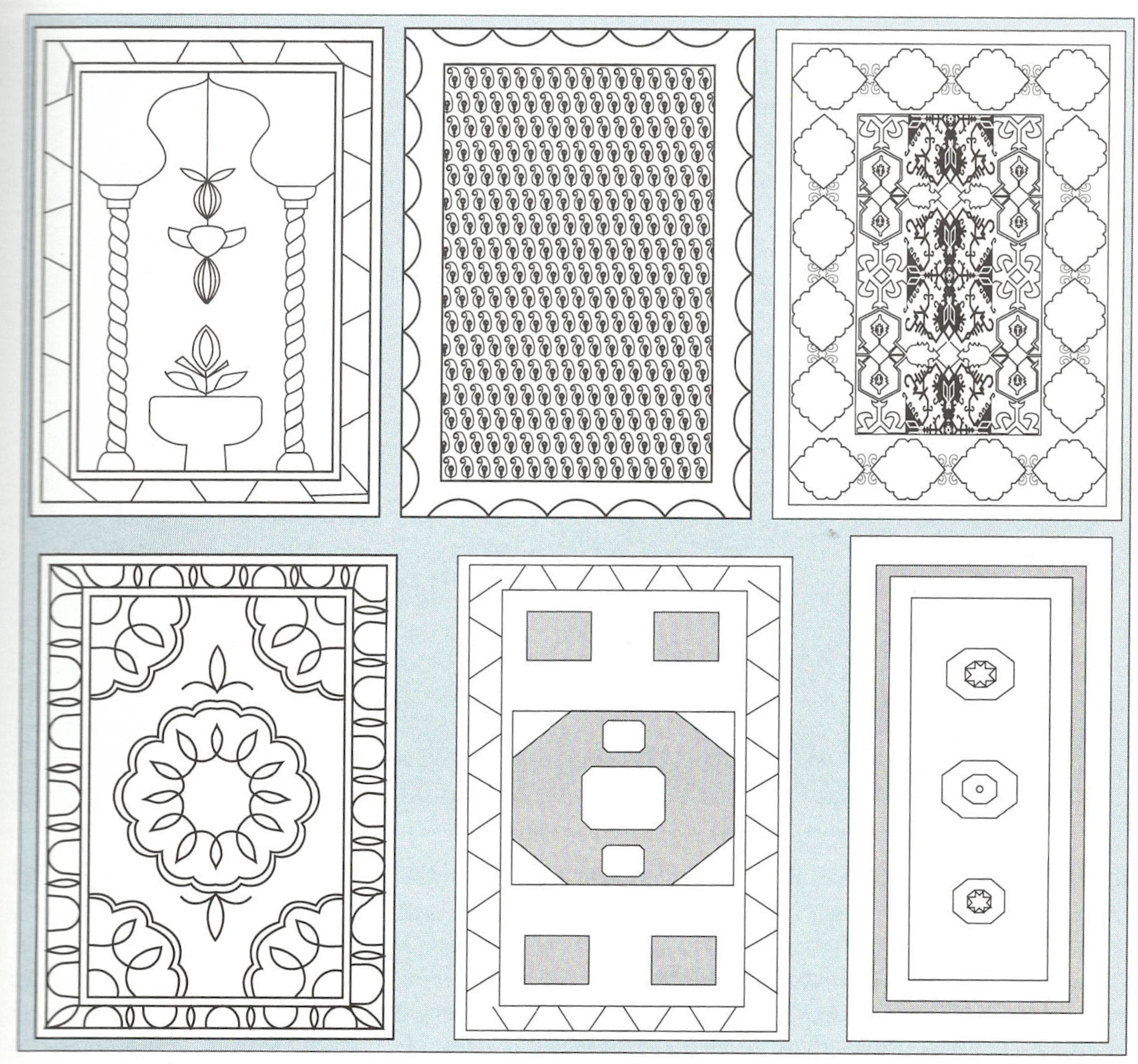
Common layouts: prayer (directed), all-over repeat (undirected), and central-medallion (centralized) arrangements.
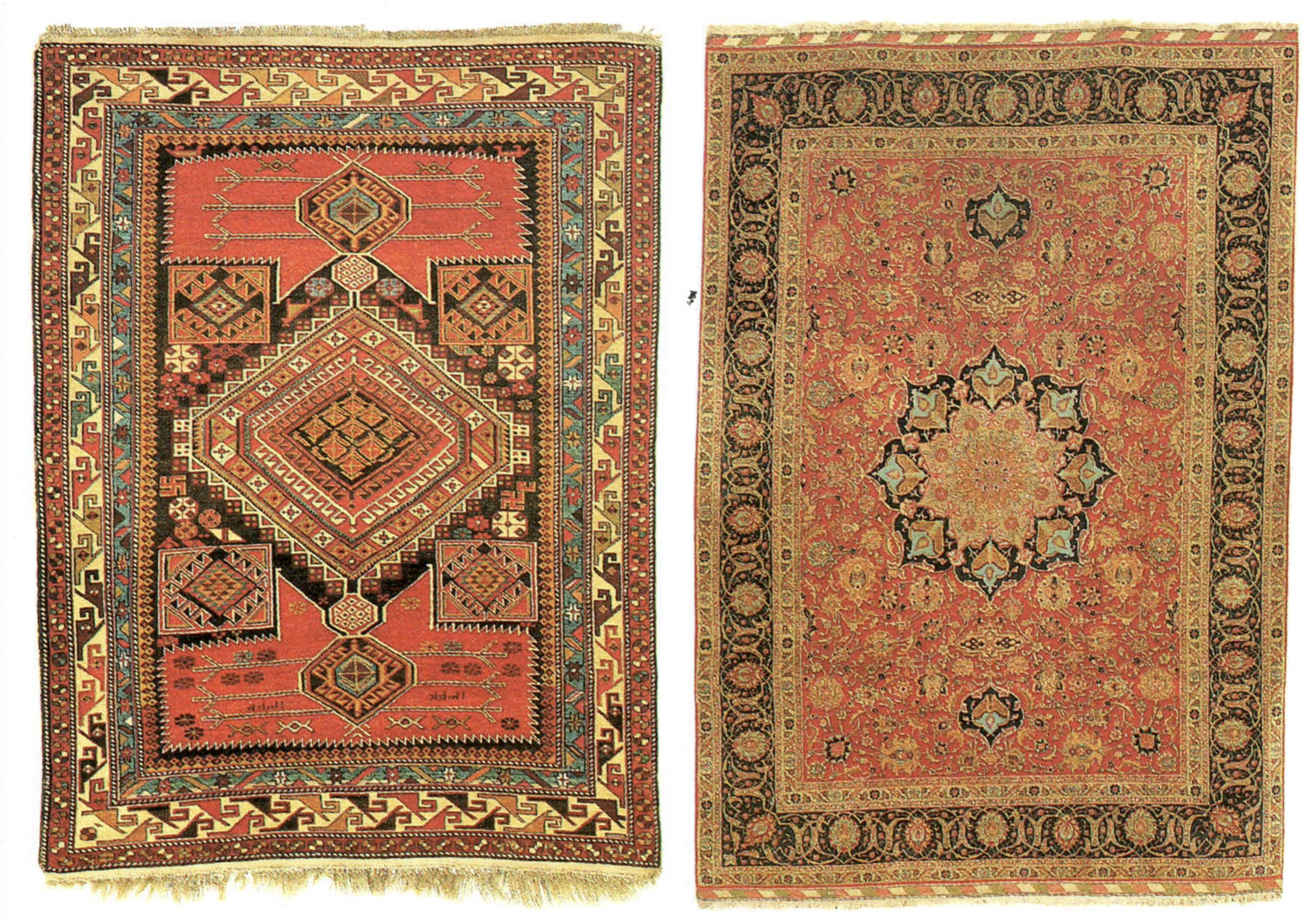
Left: a Caucasian Shirvan. Right: a Persian Tabriz medallion rug, the classic centralized arrangement.
Two basic styles can be distinguished, founded on the kind of line used. The geometric style uses the straight line, in horizontal, vertical and diagonal segments; it is usually knotted with the symmetrical knot, lends rugs an immediate, elementary, sometimes primitive character, and is the style of the small workshops and of the nomad peoples, who pass their patterns down orally from generation to generation. Its strongholds are Anatolia, the Caucasus and Central Asia. The floral style, which arose toward the end of the 15th century and developed in 16th-century Persia, uses the curved line and is therefore also called curvilinear; it generally uses the asymmetrical knot, which by its smaller size and irregular form is better suited to even the finest curved lines. It produced patterns determined above all by plant forms, giving rugs a complex, small-scale character. Here the master knotter, in Persian (Farsi) the ustad, plays a great role as the creator of the rug, while the knotters carry out his design, which made cartoons as knotting templates necessary.
The decoration itself comprises a great variety of elements. One group consists of smaller geometric patterns, for example eight-pointed stars, octagons, swastikas, crosses, concentric polygons and hooked lozenges, which appear anywhere on the rug, mainly to fill empty areas and support the main elements. A further, very rich group comprises leaves and blossoms. The blossoms divide since ancient times into two types: the oval or roundish symmetrical rosettes, and the palmette, the most important Persian motif of all since the 16th century. The palmette is of ancient origin and consists of a blossom with a single plane of symmetry, resembling a fan, an artichoke, a bud or a vine leaf; in the 17th century an especially fine version arose, named after the ruler of that epoch, the Shah Abbas palmette. According to their most frequent occurrence, the further motifs divide into field motifs and border motifs.
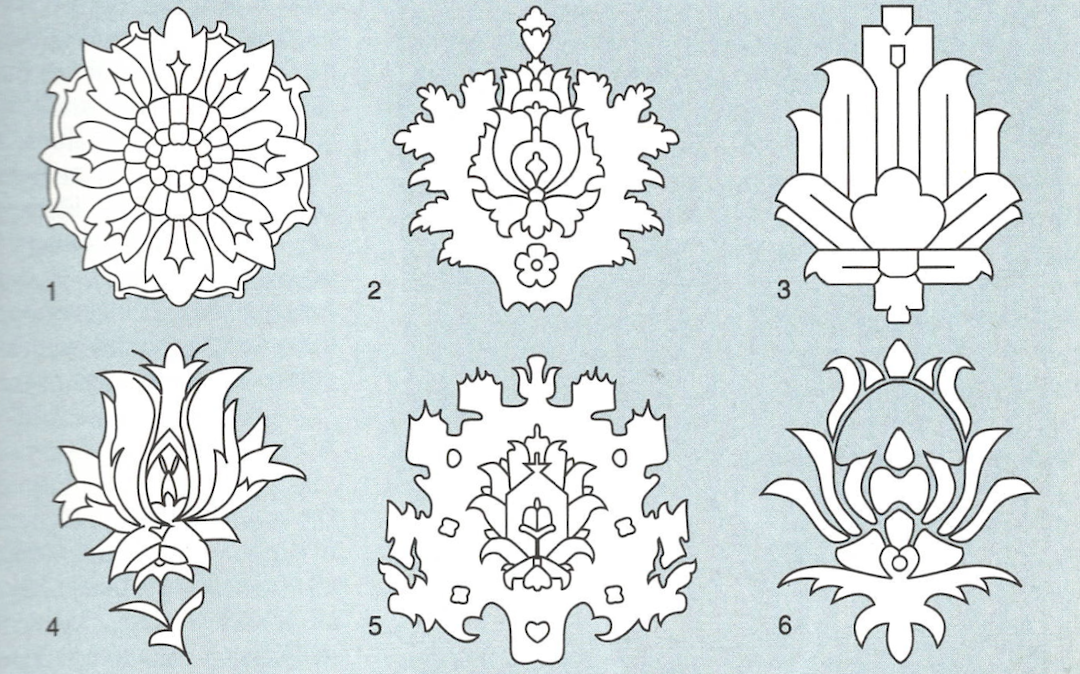
Rosette and palmette forms. The palmette has been the most important Persian motif since the 16th century.
The Symbolism of Color
The symbolism of color is its own quiet language. A short overview of the meaning and the making of the colors:
Red
Red, the dominant color in most kinds of rug, means joy, happiness, wealth and fire, and is used in many shades from yellow-red through cherry, scarlet, carmine and wine-red to rust-red and red-brown. It was most often made from madder, but also from henna, barberry and safflower, from scale insects and from blood.
Blue
Blue, the color of the sky and of splendor and also used as a protective color, appears in many rugs as the chief counter-color to red. In the Orient it has been produced from indigo for thousands of years through a complex fermentation process; in Europe it was won from woad. Very dark blue is in some places regarded as the color of mourning.
Yellow
Yellow, from the lightest tone to yellow-red and orange-yellow, is made from many natural products, chiefly plant-based. Saffron is the best known but also the most expensive; dyer's broom and chamomile give yellow in many variations, sumac leaves and stems with alum give a rich yellow, and the darkest yellow comes from pomegranate skins.
Orange
Orange, a mixture of red and yellow, can also be won directly as a bronze-yellow from buckthorn berries with copper vitriol. It counts as a symbol of piety and devotion, but is rarely used over large areas.
Green
Green, a mixed color of yellow and blue (for example from weld and indigo), is the color of the Prophet and symbolizes paradise and hope. Because the sacred color should not be trodden underfoot, green is rare as a ground color, but is used in many shades for working out individual motifs.
Brown
Brown stands for the mother of the earth. It is made either from natural undyed wool, camel and goat hair, or by dyeing with green walnut shells, oak bark and onion skins.
Black
Black is seldom used over large areas, partly because it means mourning, grief and death. Natural wool from black sheep, or wool dyed with gallnut decoction and iron oxide, is used for fine detail; such wool decays after decades into the so-called color rot, which eats the pile down to the foundation and creates a relief effect, usually reducing the rug's value.
White
White too is seldom used over large areas and tends rather toward ivory or cream. The purest white comes from natural wool or silk, and it manifests purity and freedom from sin.
Symbols and Their Meaning
In the Orient the rug carries not only practical tasks but also a deep symbolic meaning, representing a special, magical space. The borders correspond to the earthly sphere, the realm of the human, and frame the central field, which represents the universe, the heavenly and the divine. Over the centuries many symbolic elements lost their original meaning and turned into simple abstract forms, while others kept their shape or at least remained recognizable. The most important are these.
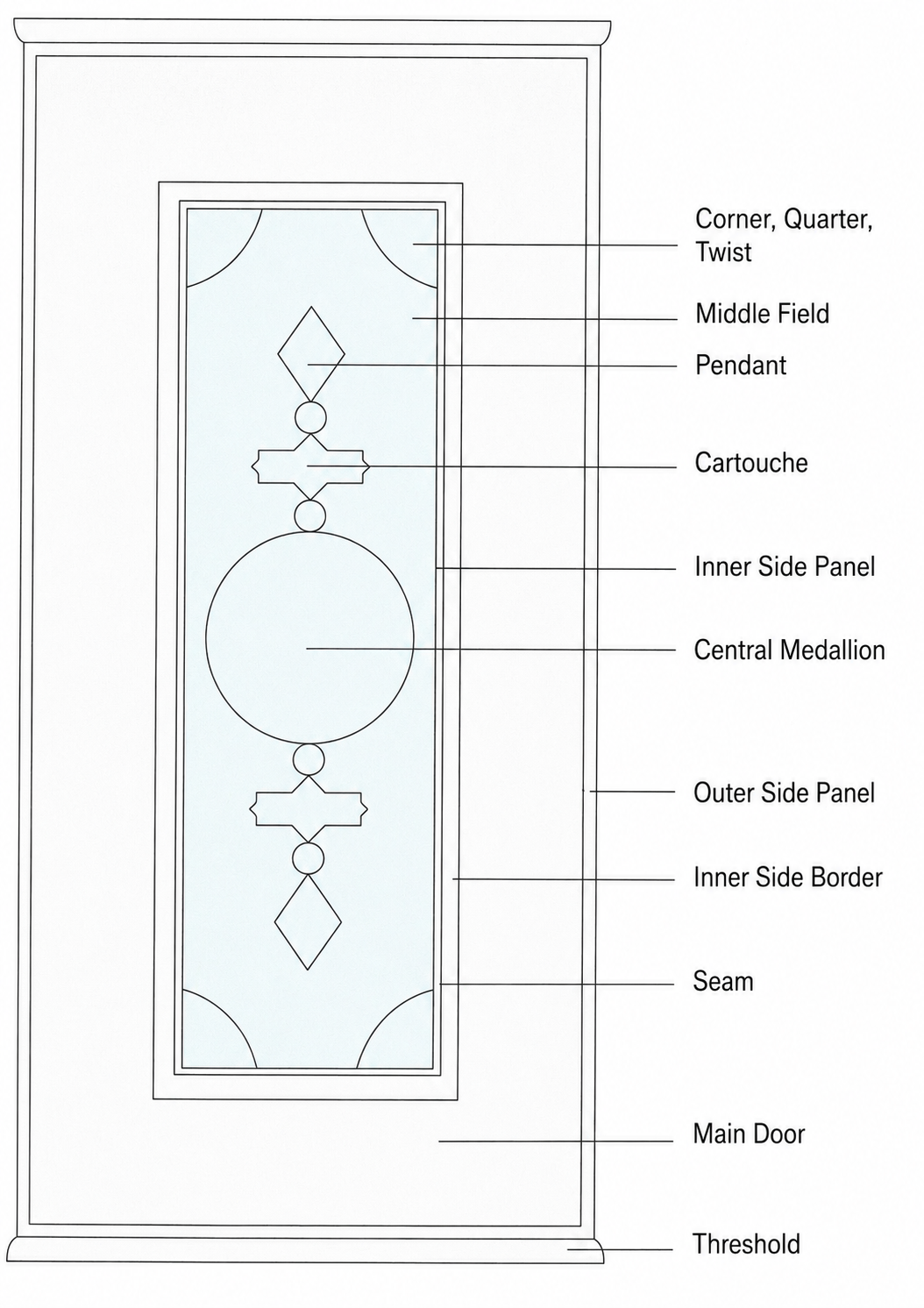
The anatomy of a rug: the main border frames the central field; within it sit the central medallion with its pendants, the cartouches, the inner and outer guard stripes and the seams, down to the fringes.
The Tree of Life
The tree of life appears very often on Oriental rugs. When many trees are shown together, the rug depicts a garden; large single trees are found above all on East Turkestan rugs of the 17th to 19th centuries. In stylized or naturalistic form the tree occurs in nearly every weaving region, because everyone in the Orient knows its meaning: it is the tree of life, a symbol of fertility, continuity and the world axis, joining the underworld (the magical world), the earth (the world of men) and the sky (the divine world). With this meaning it is often found inside the mihrab of prayer rugs. Sometimes a pair of birds stands beside it, recalling union in marriage and so everlasting generation. Of Indian origin is the legendary waq-waq tree, whose branches and fruits turn into monstrous human and animal heads that all cry waq-waq. The tree is often replaced by flowers springing from a vase, with the same meaning.

Top: a pomegranate Yarkand, East Turkestan, late 19th century. Middle: a prayer rug from Kerman, Persia, 19th century. Bottom: a detail of the Marby rug, Anatolia, first half of the 15th century. The tree of life appears above in geometric, below in curvilinear form.
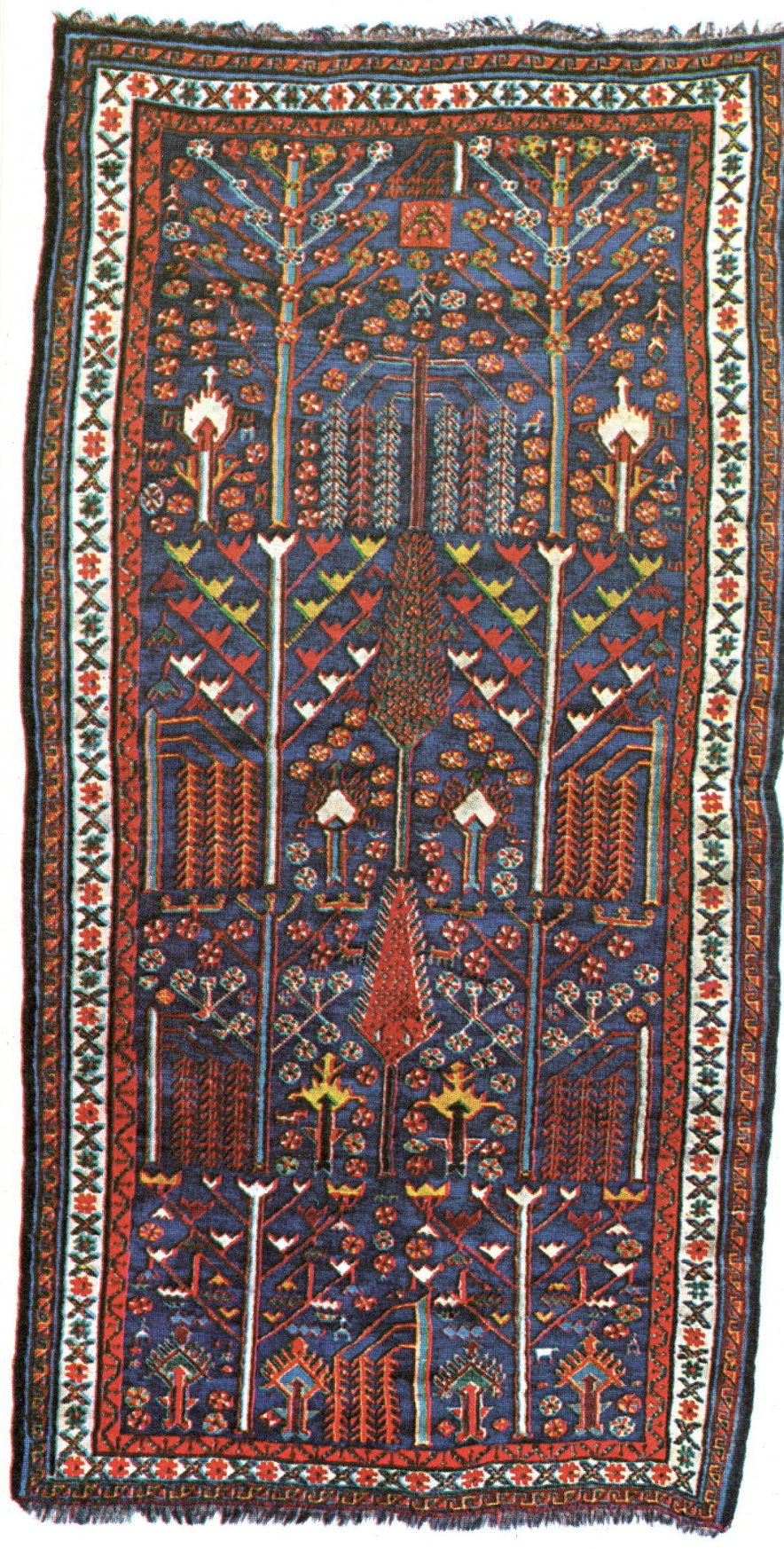
A Lori with stylized floral patterning, Persia, late 19th century, a characteristic example of the work of Persian nomads.
The Clouds
The cloud depictions go back to the Chinese cloud-head motif. Simplified into the cloudband, the tschi, it resembles the Greek letter omega and entered Anatolian and Persian rugs from the 16th century, used in the field but above all in the border. As the cloverleaf motif, the linear stylized version of the cloud-head, it appears on antique Caucasian and especially East Turkestan pieces. Both underline the idea of a gateway to heaven, since the field meant the protection of God. A further cloud-related motif is the tschintamani, also called the thunder-and-lightning pattern, of three balls over two wavy lines; its origin is disputed, perhaps the seal of Tamerlane, perhaps an old Buddhist symbol, more likely an imitation of the spotted hide, such as a leopard's, worn by shamans in their rites.
The Central Medallion
The medallion sits at the center of the field, framed by borders, and so can only represent the divine sun. This meaning shows in the geometric polygonal medallions of Anatolia and the Caucasus (often in the 4+1 arrangement) as well as in the roundish, lobed, curvilinear Persian forms. It is no accident that many end in two pendants (sun and moon) or are accompanied by four quarter-medallions in the corners, which reinforce the symbolism as sun gates that approach and guard the center.
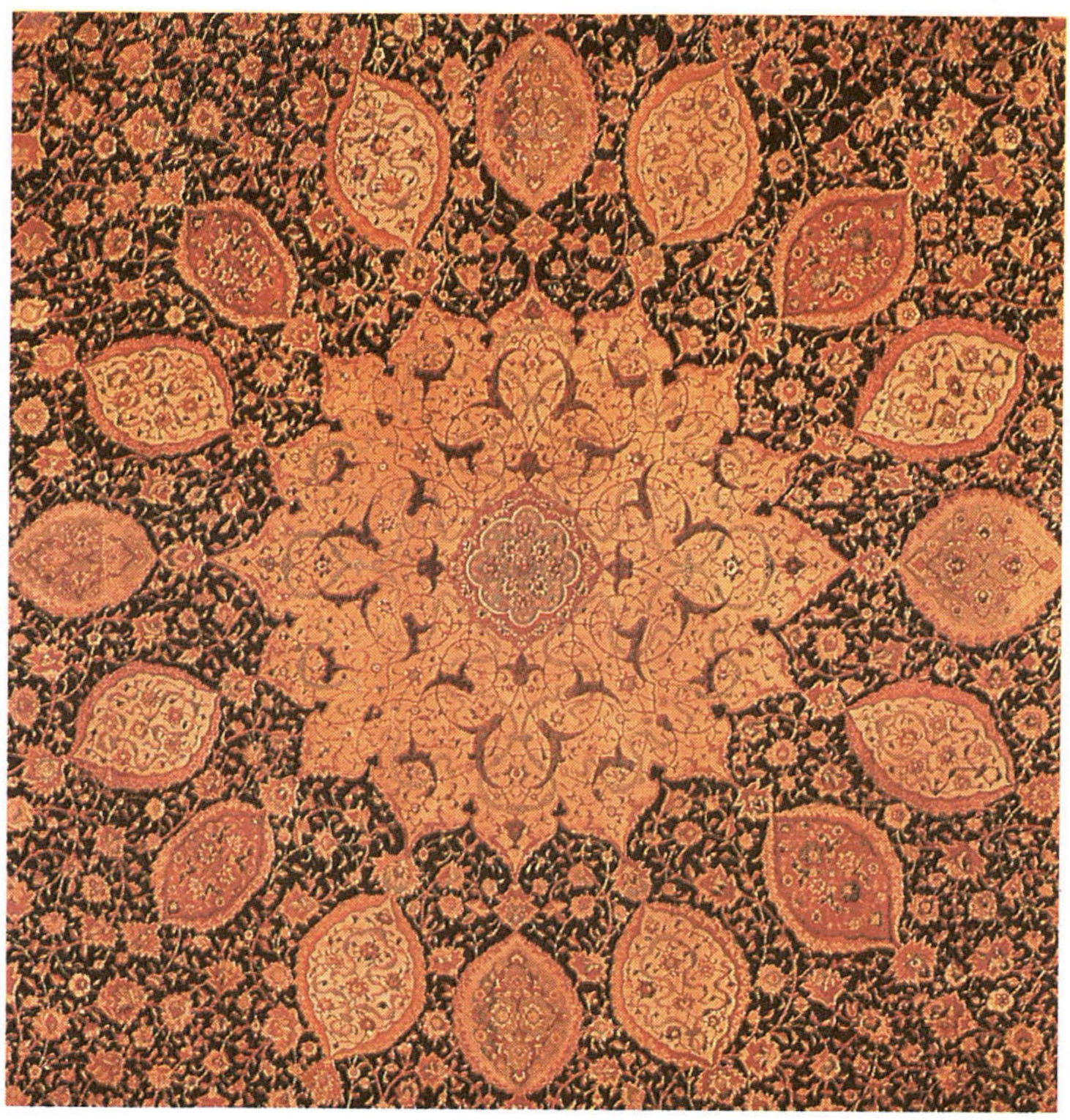
The central medallion of the Ardebil, radiating like the sun with sixteen pendants.
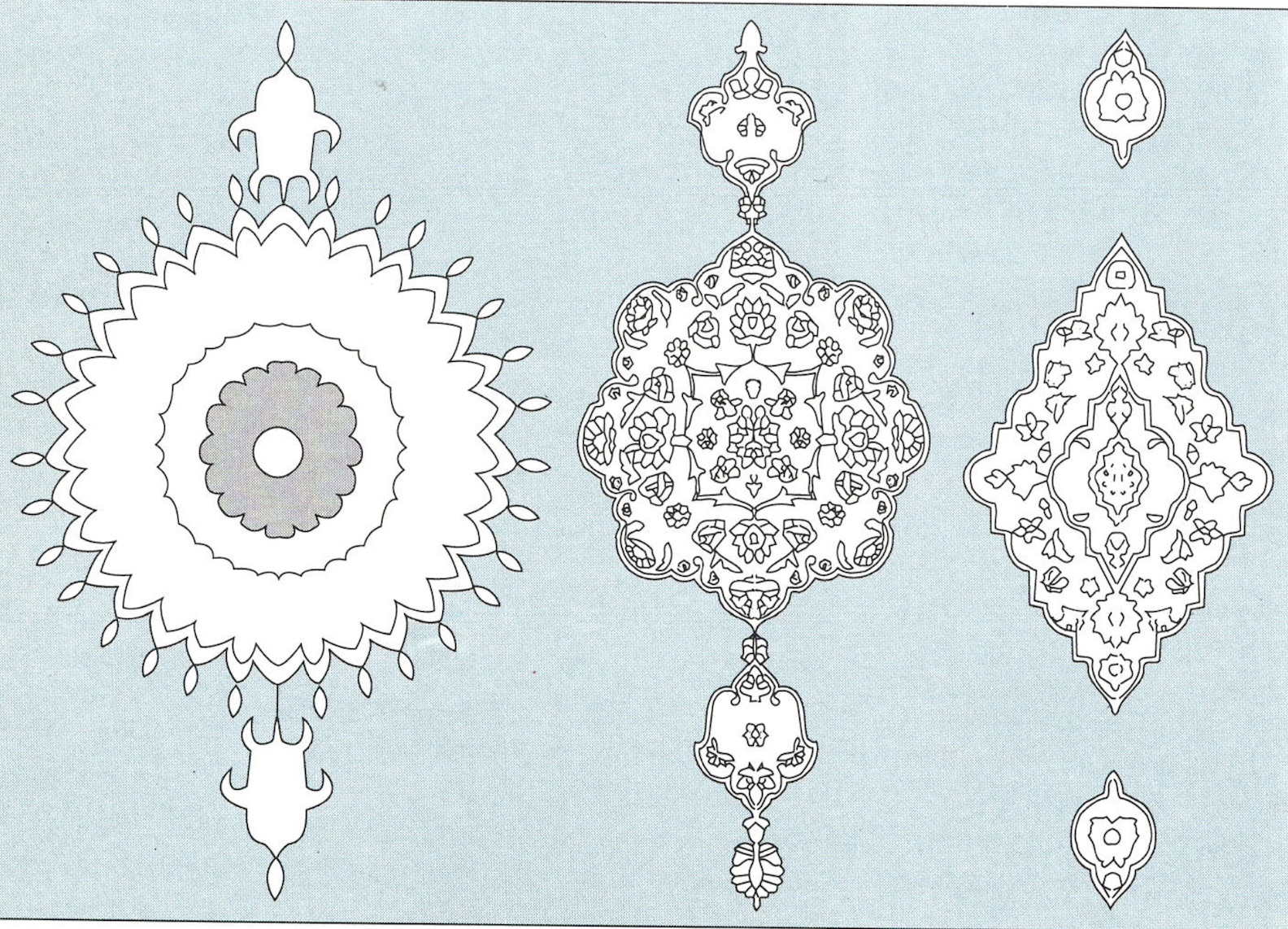
Three medallions with pendants typical of Persian rugs, from left to right: circular and concentric; round with indentations; lozenge-shaped with indentations.
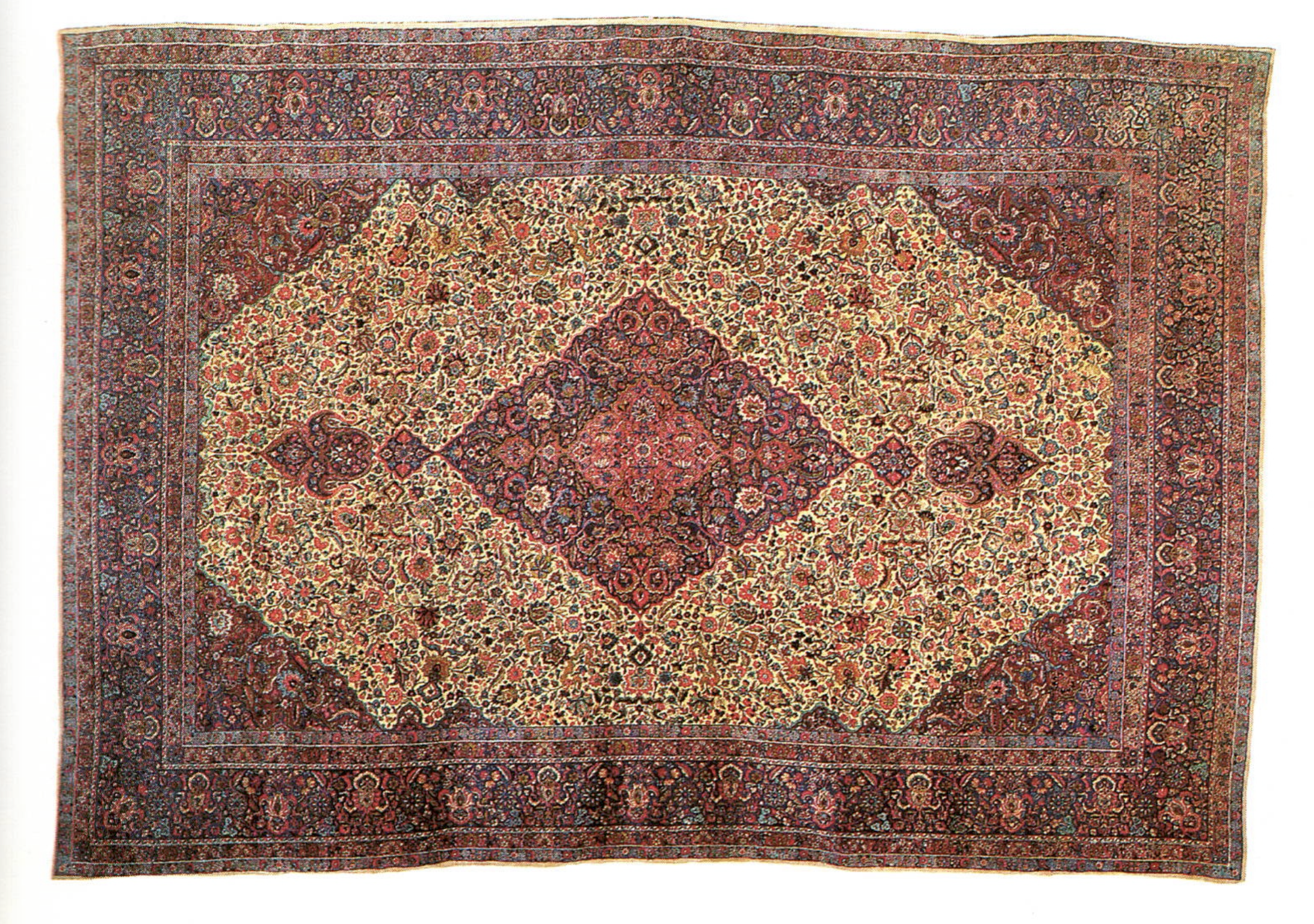
A Persian Kerman, 19th century, with a central medallion on a finely flowered field.
Three Superimposed Medallions
This arrangement probably goes back to Buddhist symbolism and depicts the Buddha between two disciples, which is why the central medallion often differs in size and pattern from the two flanking ones. In polygonal form the three medallions appear frequently in the Caucasus and Anatolia, and they found special favor in East Turkestan, where the medallions are roundish.
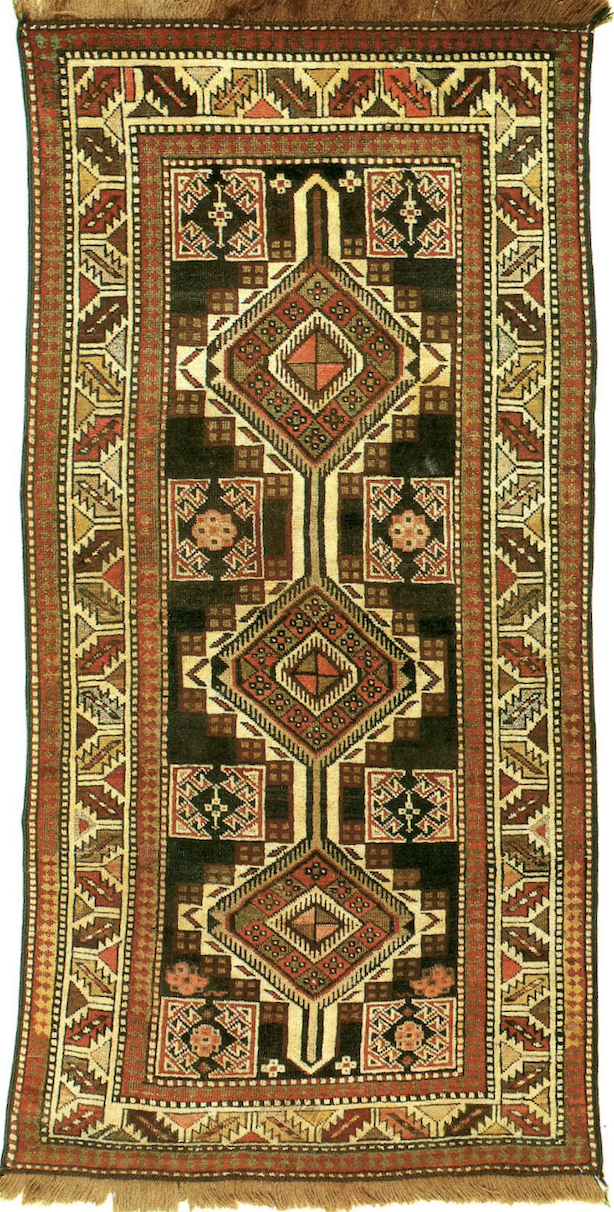
A Shirvan with three medallions, Caucasus.
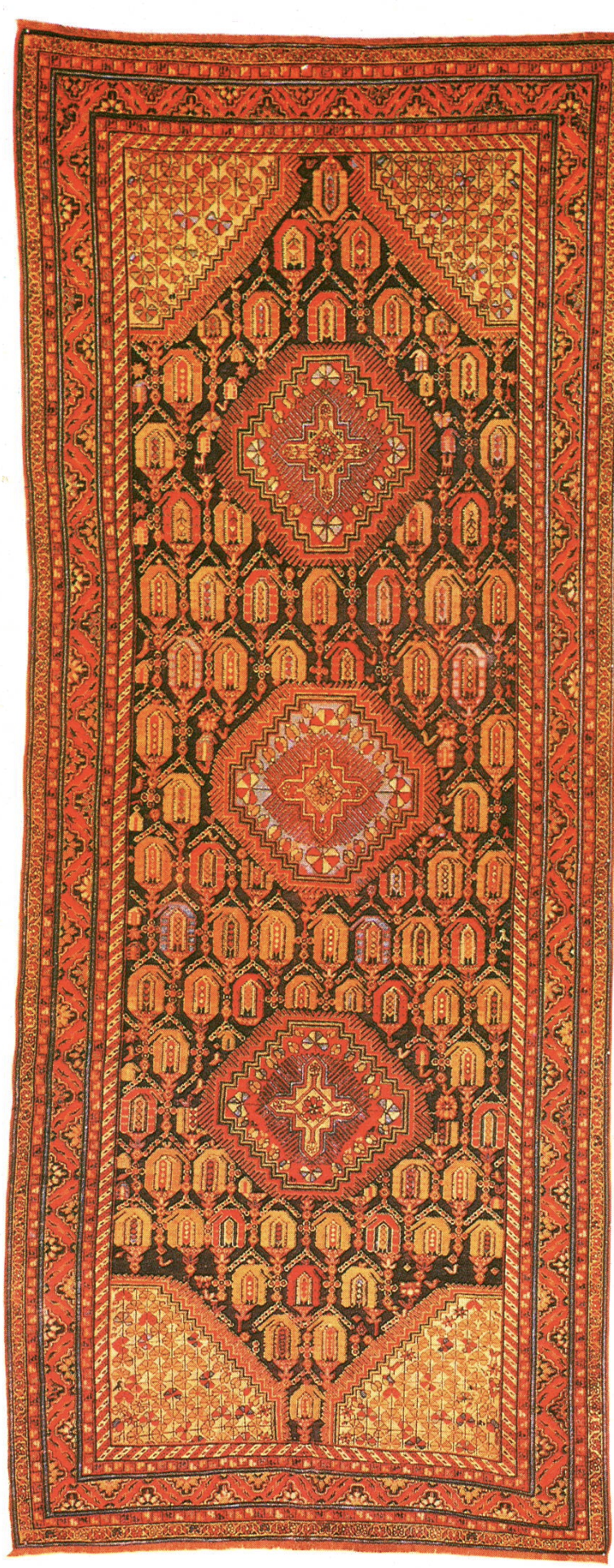
A Tschila with three medallions, Caucasus, 19th century. The blue ground is strewn with geometric, multicolored botehs.
The Prayer Rug
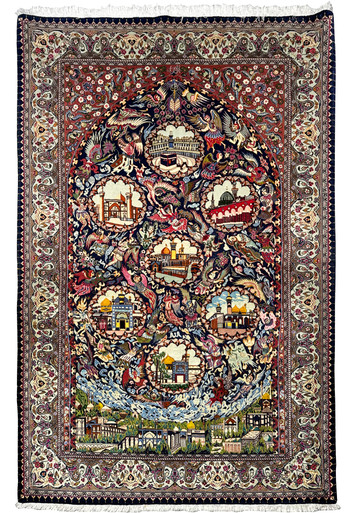
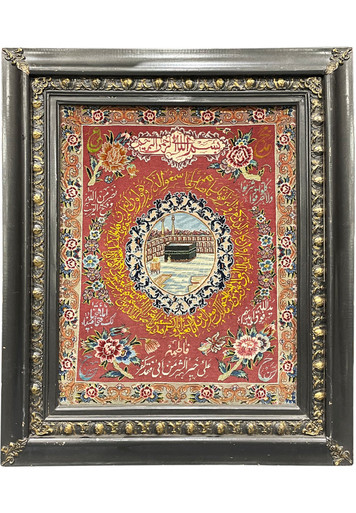
The prayer rug is the Islamic rug par excellence, in both symbolic and practical meaning, though a devout Muslim may kneel on any rug for prayer; once so used, that rug should serve only this purpose. The niche, the mihrab, orients the believer toward Mecca and echoes the mihrab in every mosque wall. It represents the gate of heaven, the entrance to knowledge and paradise that each must earn through daily prayer, and at the same time a place of refuge connecting the believer with the divine. As a sacred space it is often adorned inside with the tree of life or a flower-filled vase, and with ewers for ritual washing that allude to the water of eternal life. From the gable hangs the mosque lamp, a symbol of the divine light. On some Caucasian and Persian pieces two hands appear at the corners of the niche, variously read as the hand of Fatima, the five pillars of Islam, a contraction of the letters for Allah, or simply a guide for where to place the hands in prostration. The design arose in 15th-century Anatolia, which always remained its heartland.
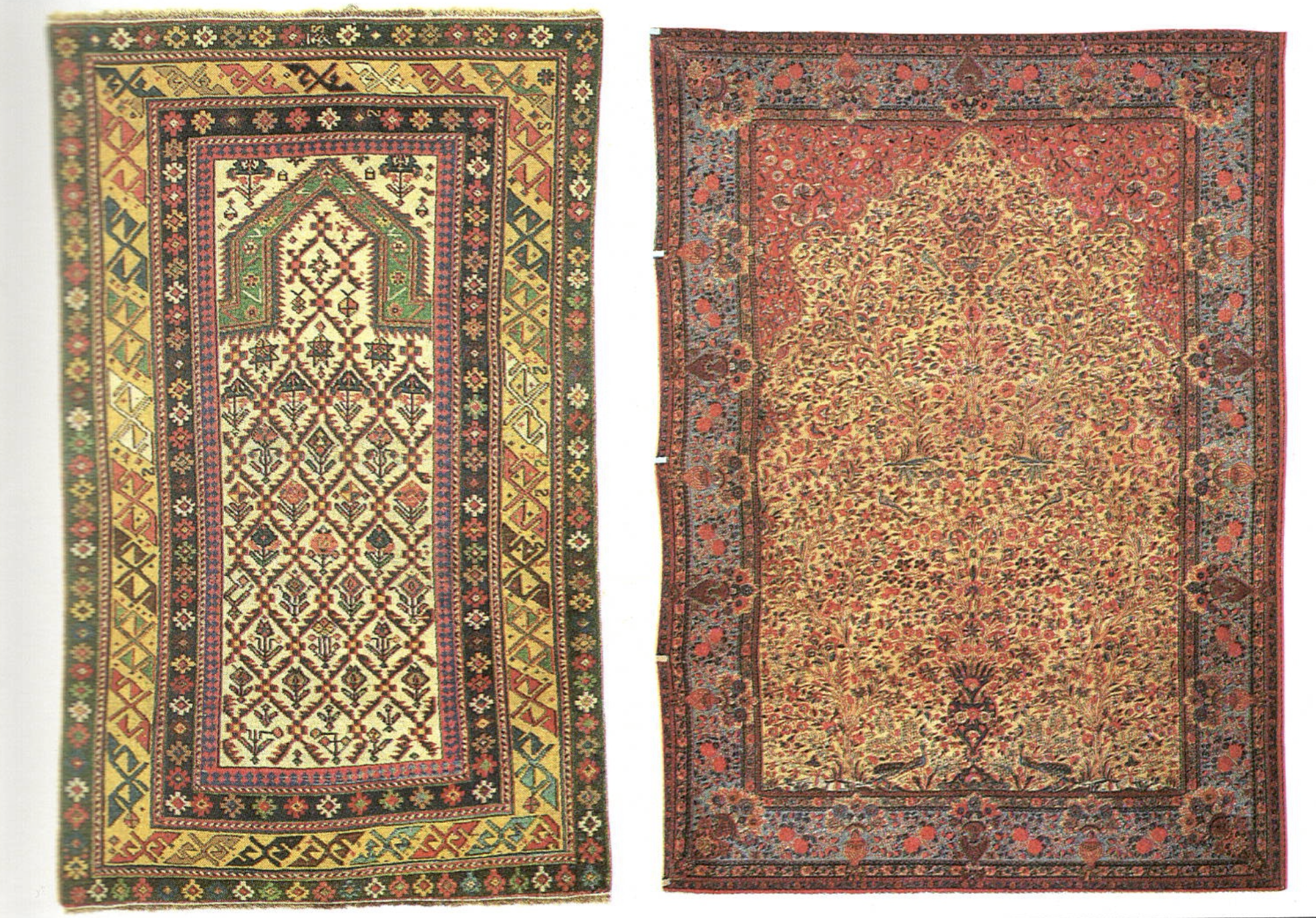
Left: a Caucasian Shirvan prayer rug. Right: a Persian Kashan prayer rug.
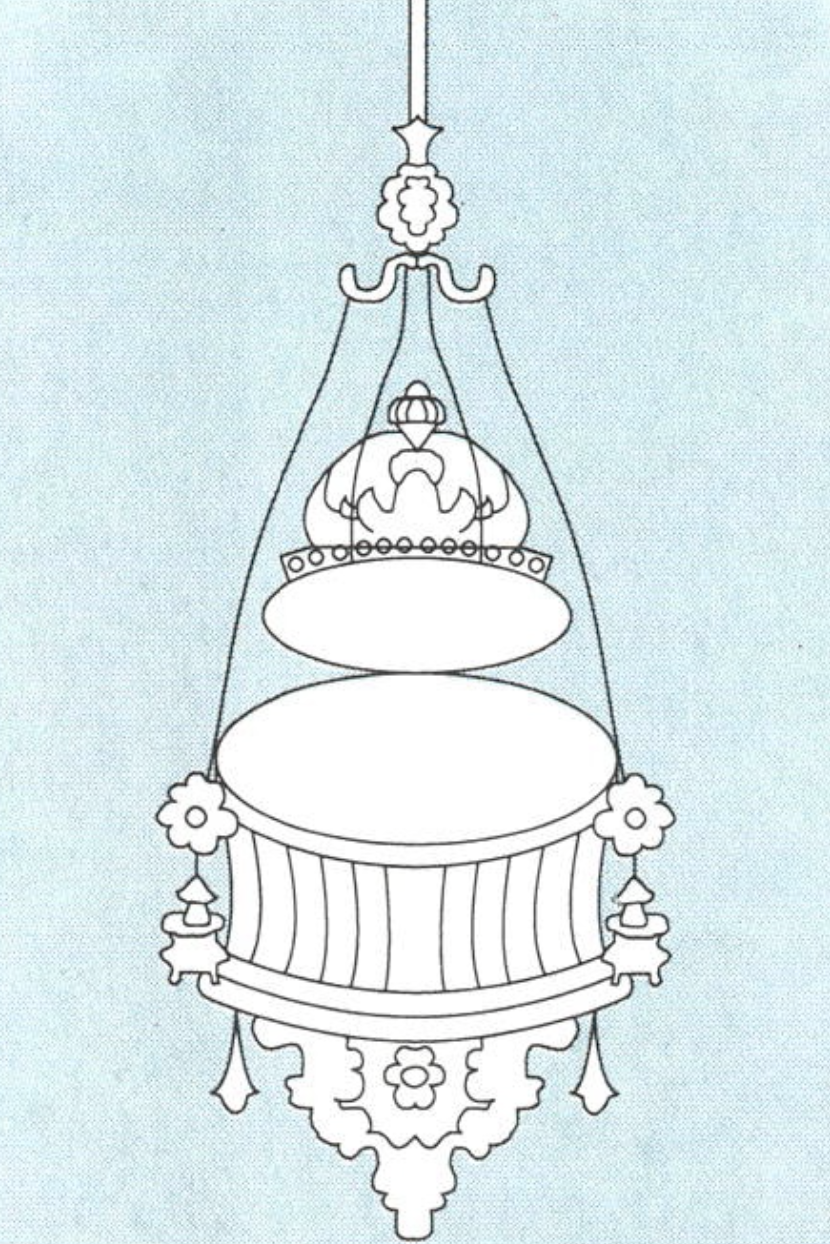
The mosque lamp that hangs from the gable of the mihrab, a symbol of the divine light.
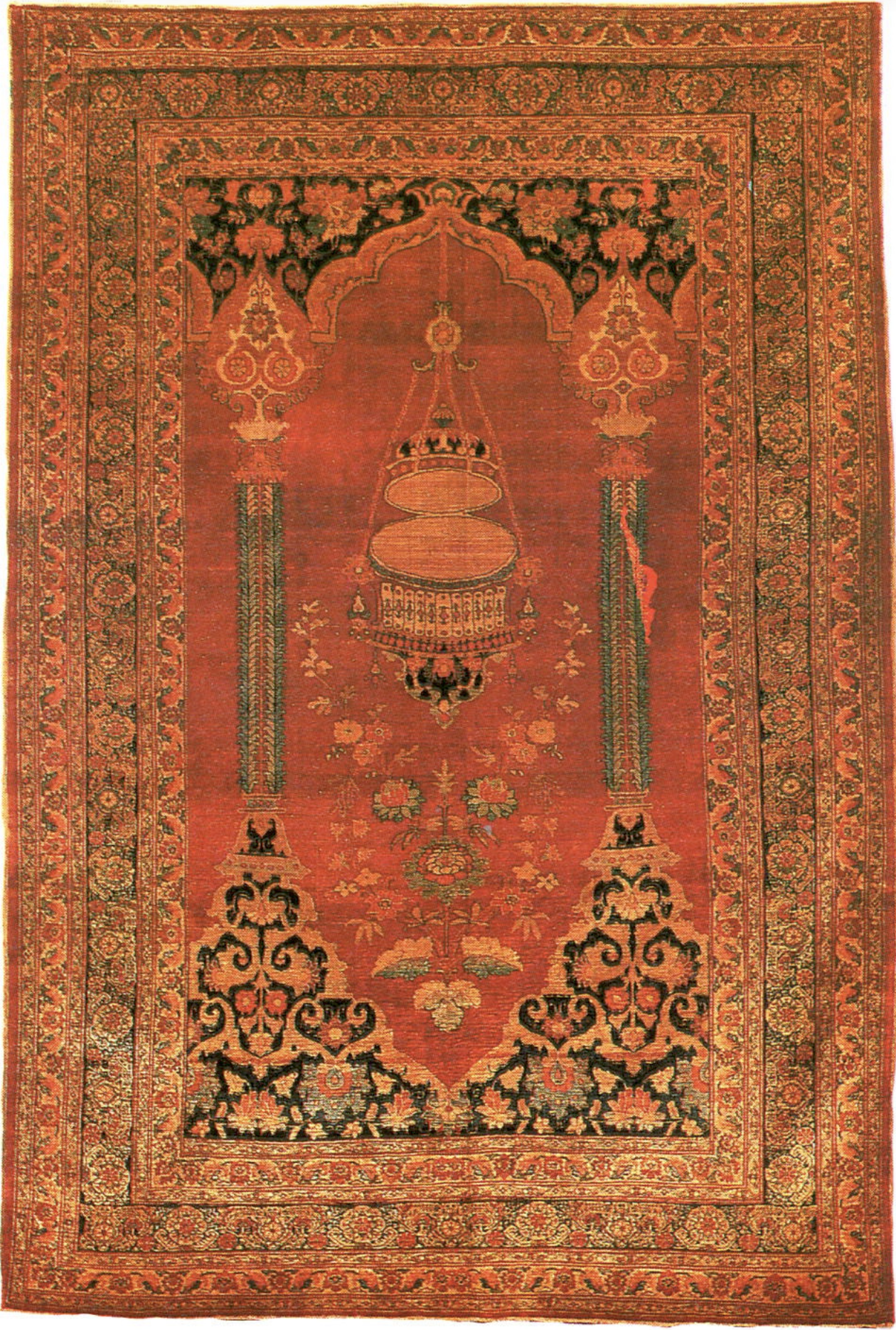
Prayer rug from Heris, Persia, 19th century, with the lamp hanging in the niche.
The Garden
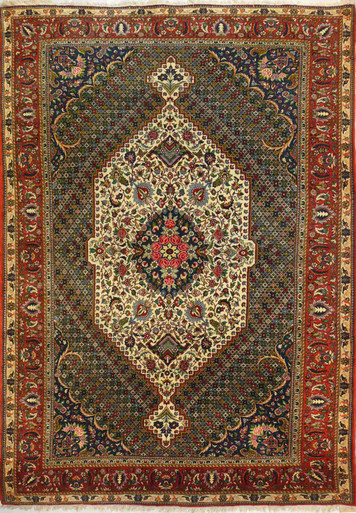
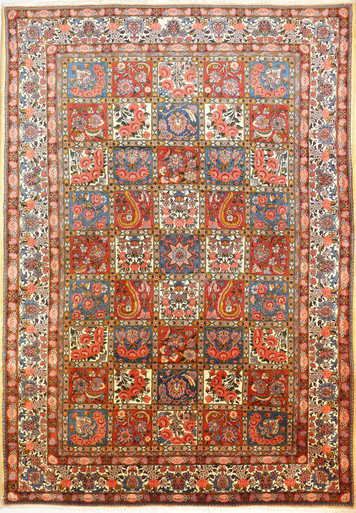
In every culture the garden is bound up with the idea of paradise; indeed the word paradise goes back to the Persian pairidaeza, an enclosed garden or park. For Islam too the idealized garden, where all blooms and the four rivers of life flow, is the reward of the faithful. To depict it, 17th-century Persian artists drew on the gardens of the shahs, divided by water channels into rectangles and squares, giving the regular garden pattern of beds, trees, flowers and often animals. Garden rugs were knotted above all in Kerman and Kurdistan, and the pattern spread east to the Mughal courts of India in more naturalistic variants, while Ottoman court art, bound by the Sunni ban on images, stayed apart.
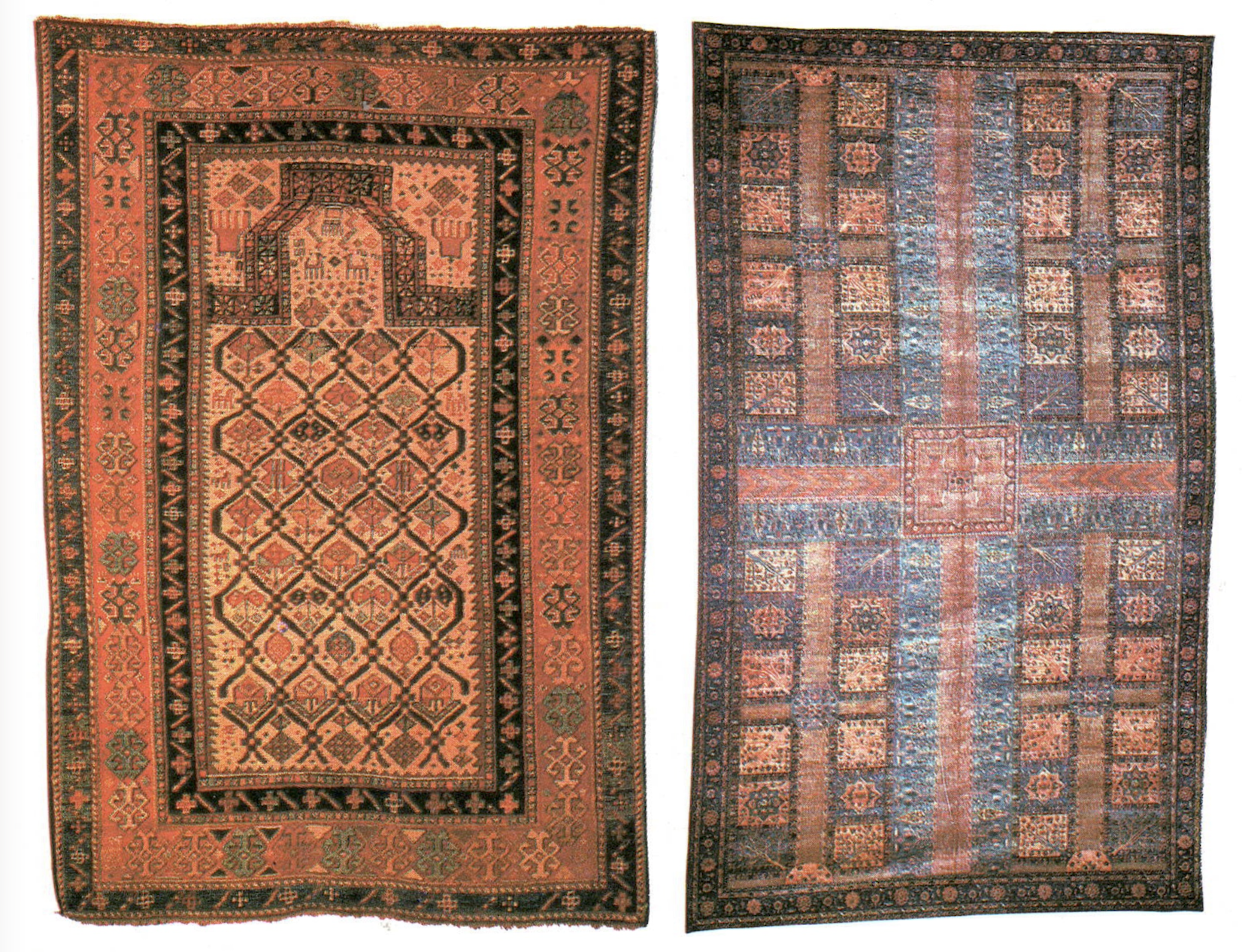
Left: a Shirvan prayer rug, Caucasus, 19th century. Right: a garden rug, Northwest Persia (Kurdistan), 18th century, its layout reflecting a Persian garden with watercourses and rectangular beds.
The Human Figure
Notably, the human figure carries no symbolic meaning. Within the iconoclastic culture of Islam, which forbade images of man, it could not be otherwise: orthodox Sunni teaching expressly forbade figural depiction as a road to idolatry and an inadmissible imitation of divine creation, and the Anatolian artists of the Ottoman court always kept to this. The Shiite Persian artists of the Safavid period took a less strict view, allowing figures in spiritual or contemplative contexts, which is why naturalistic human and animal figures appeared more and more on 16th-century Persian and later Indian rugs. On hunting rugs human figures thus appear without special meaning, never taking a leading role; like the flowers and arabesques around them, they serve only to depict an idealized universe.
The Hunt
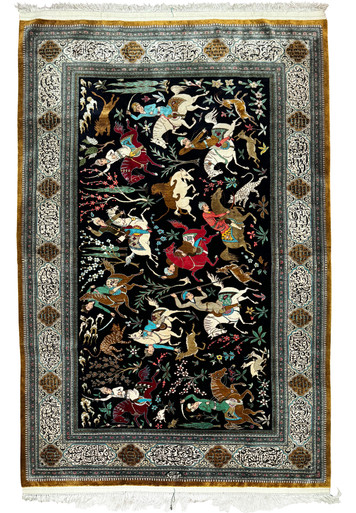
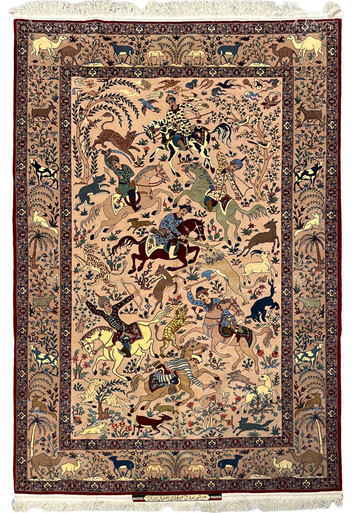
The hunt is closely tied to the theme of the garden. Much loved in the Orient as a symbol of skill, strength and mastery of nature, it was essentially reserved for the shah and his court and carried a spiritual meaning linked to paradise. On hunting rugs we see armed riders and their prey on a field densely set with arabesques, tendrils and floral elements. These rugs were created at the Safavid courts, especially in Isfahan, and were later imitated more naturalistically by Indian artists at the Mughal courts.
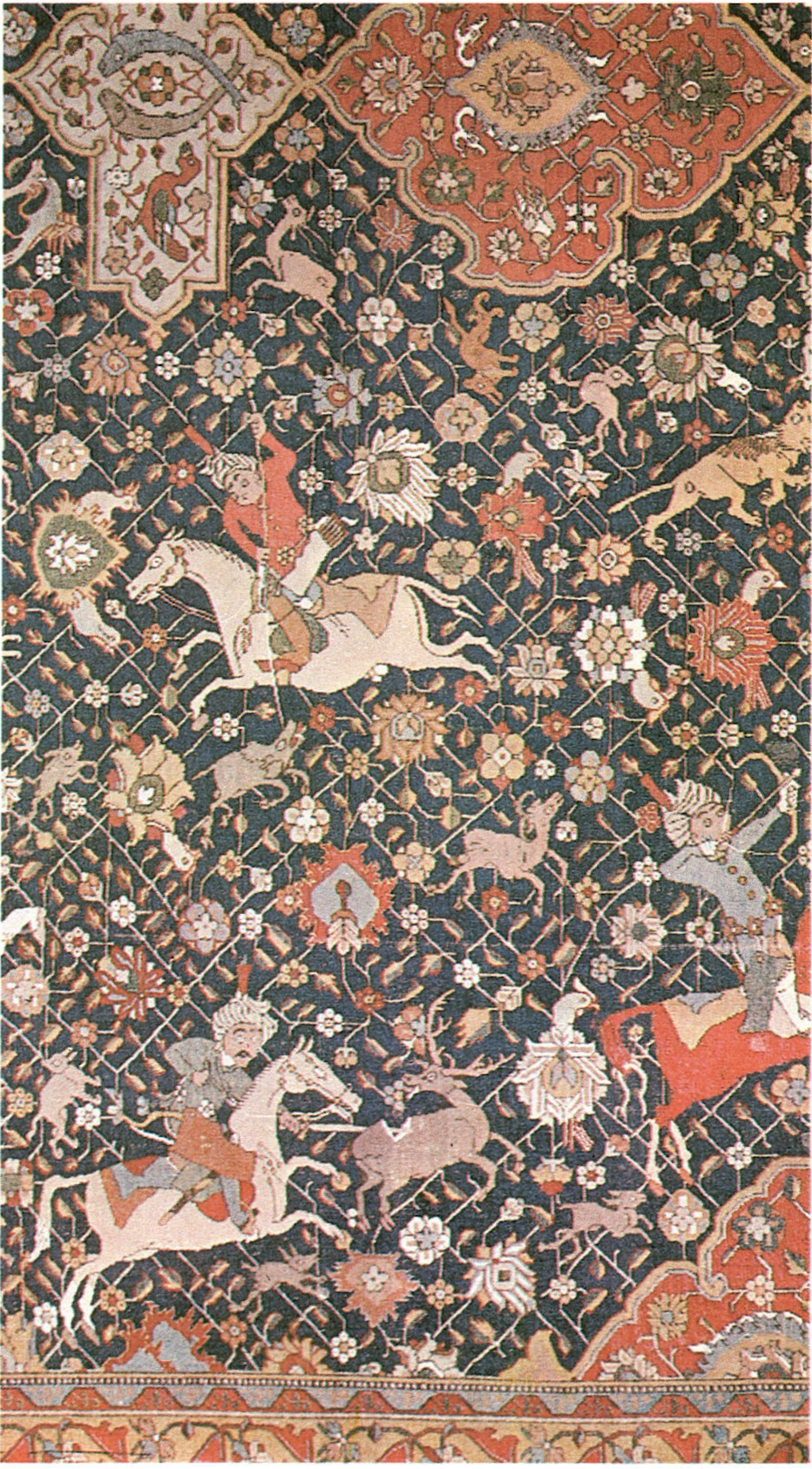
Detail of a hunting rug: armed riders and their prey on a densely flowered field.
The Animals
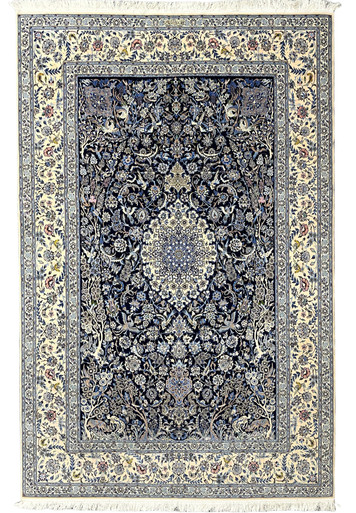
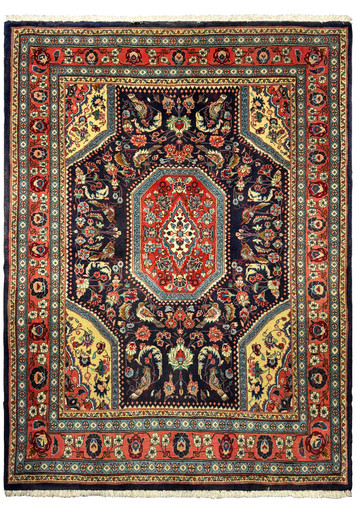
Animal depictions may show real or fantastic creatures. Noble real animals such as deer, horses and leopards are often shown in combat on a floral ground on Persian rugs of the Safavid period, hence the name animal rugs; domestic animals appear as secondary, geometrically stylized elements in nomad work. Real and fantastic animals shown fighting symbolize the inevitable struggle between good and evil, between earthly creatures and cosmic forces, and so the balance of creation. The theme came from China and spread through Central Asia in the 14th and 15th centuries. Of old Chinese origin are two fabulous beings, the dragon (a symbol of omnipotence) and the phoenix (an emblem of immortality); as a pair they symbolize the marriage union or a combat alluding to cosmic harmony, and they inspired the old Caucasian dragon rugs.
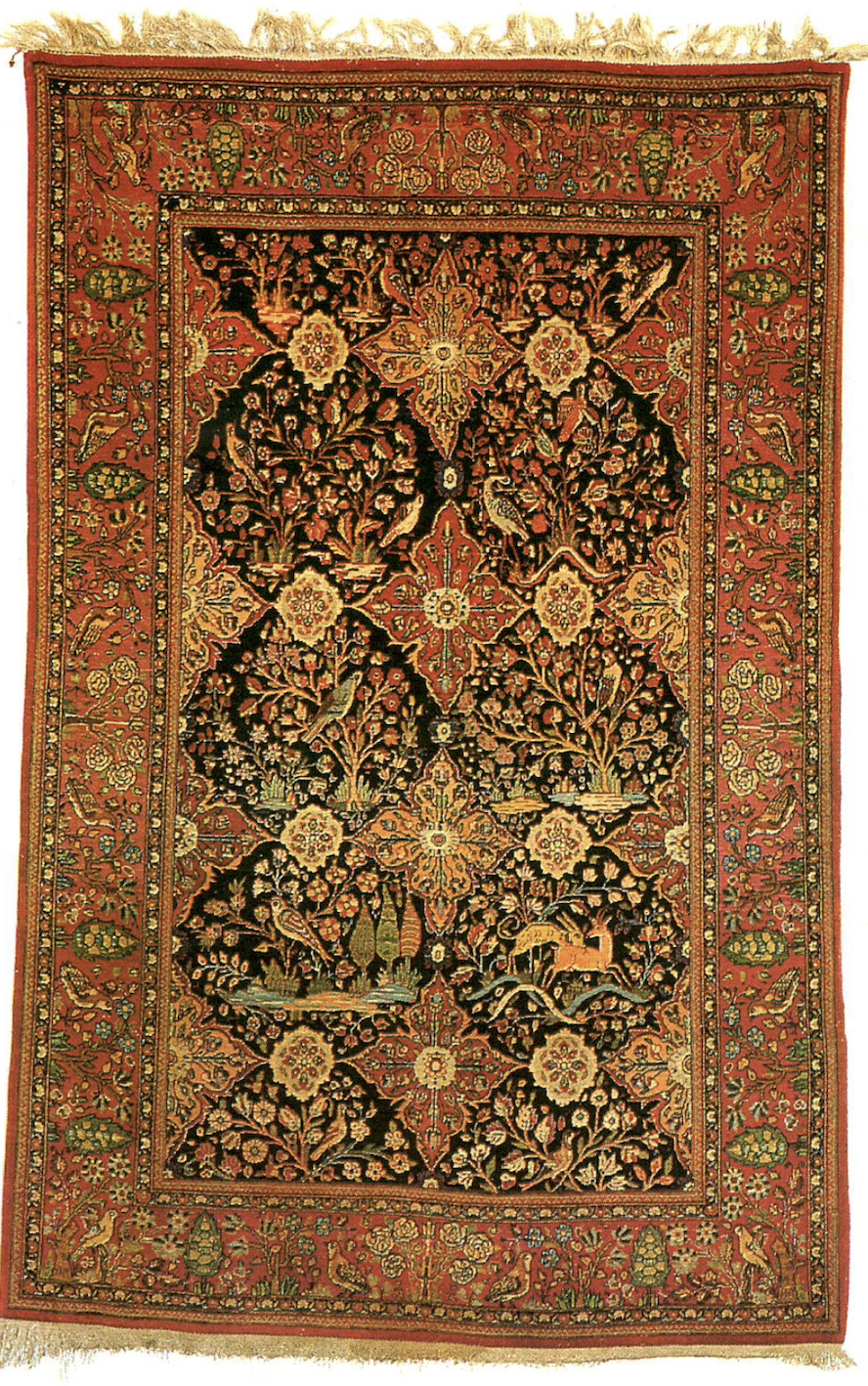
A Kashan with an animal pattern, 19th century.
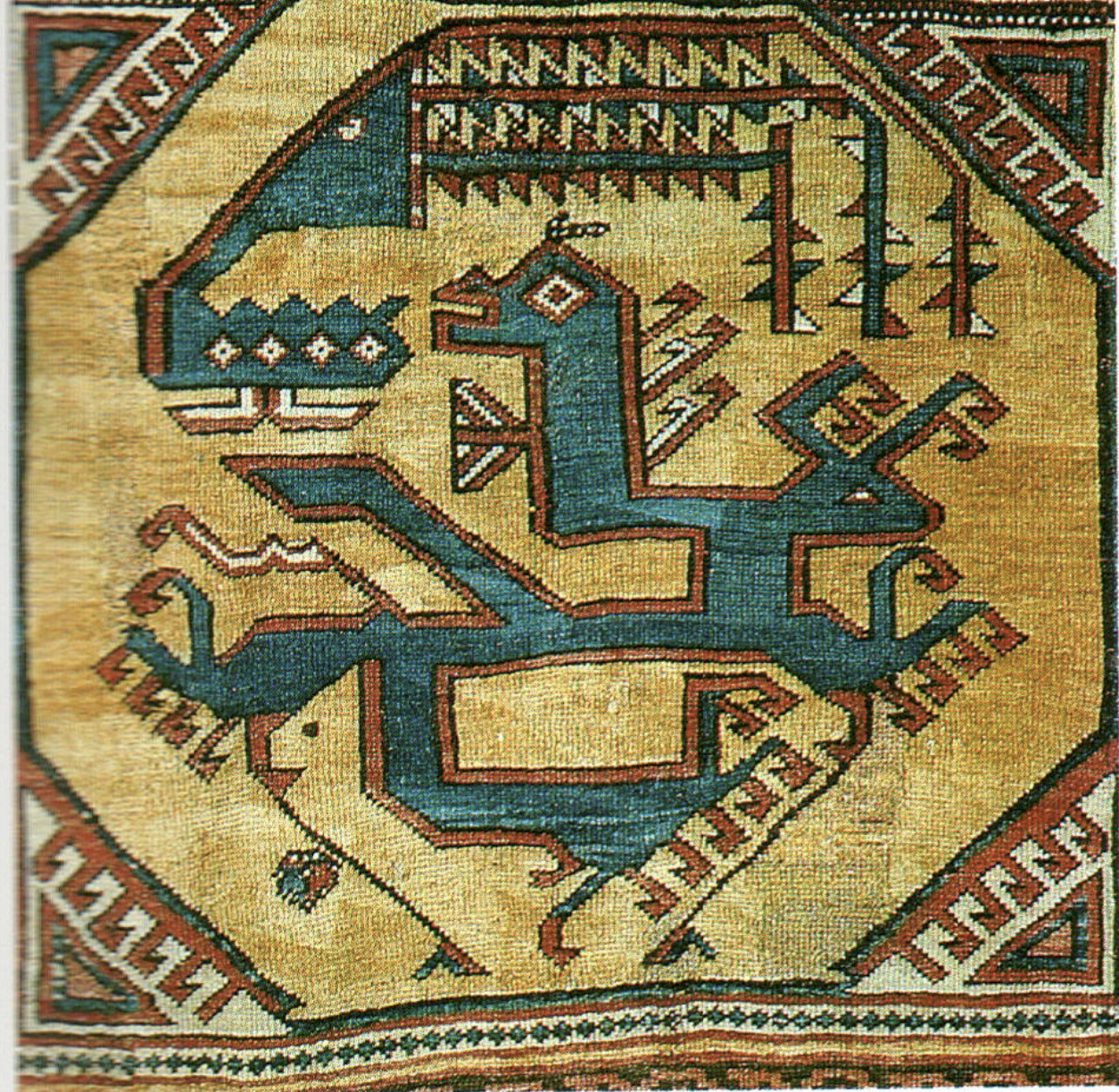
A Caucasian dragon rug, with the dragon as a symbol of omnipotence.
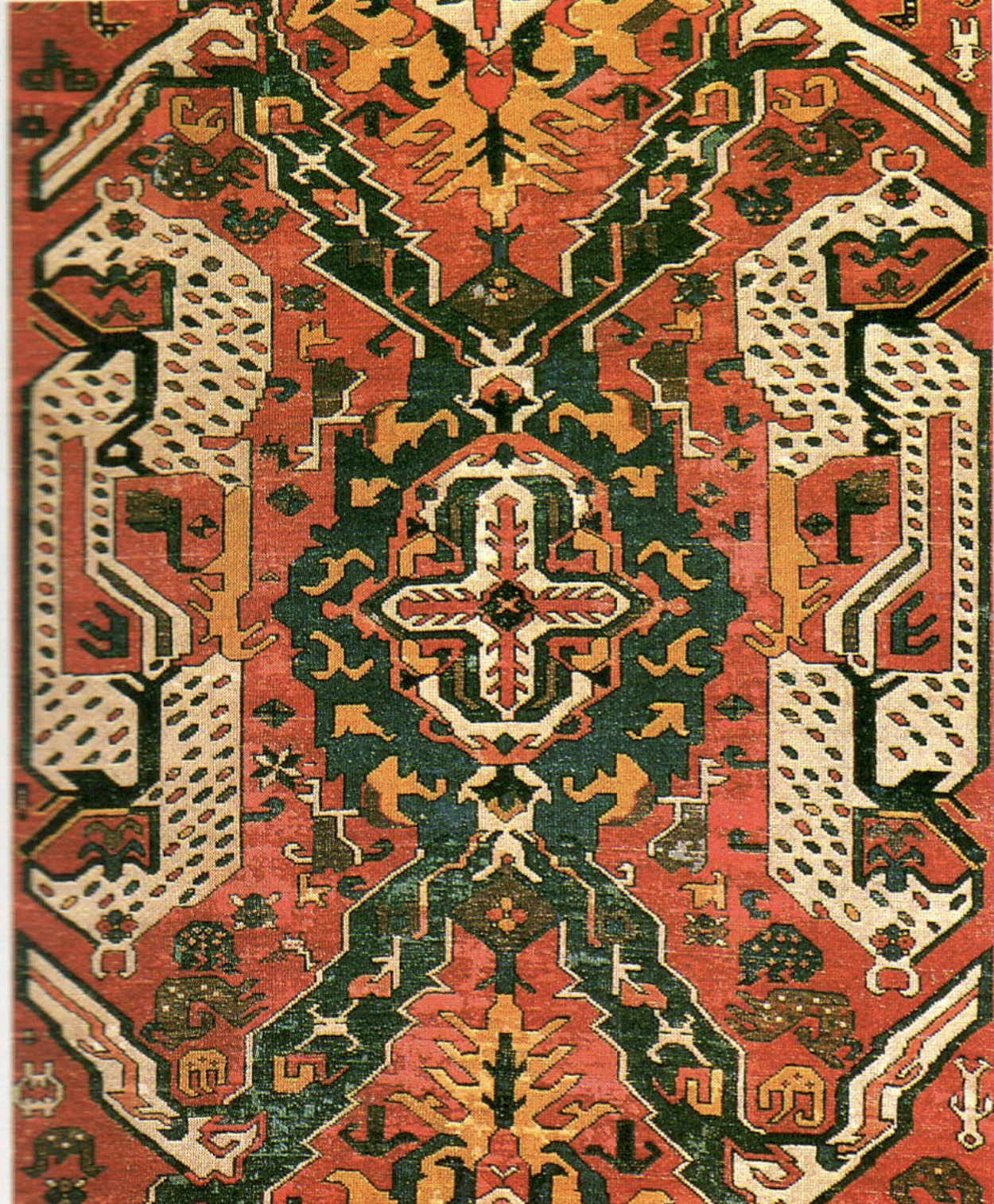
Mirrored, confronting dragons, alluding to the balance of cosmic forces.
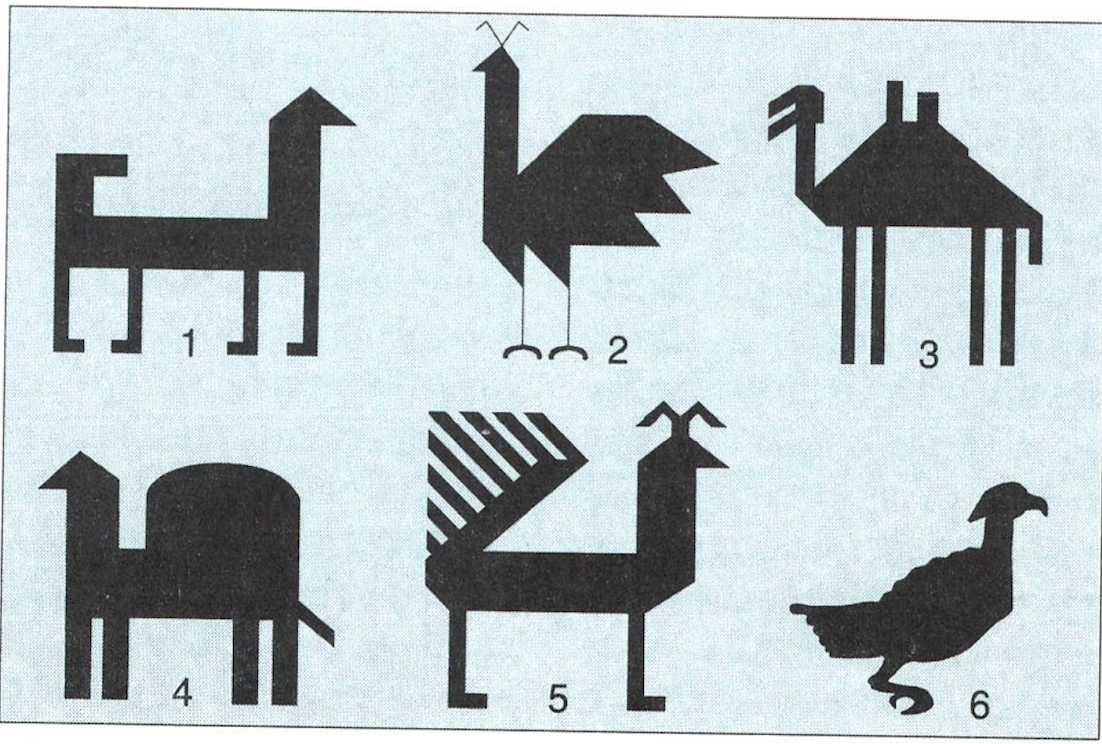
Geometrically stylized animals as they appear as secondary motifs in nomad rugs.
The Arabesque
The tendril-like arabesque is common to all Arab art, born of the image-shunning tradition of Islam that allows only non-figural pattern. Its continuous rhythm, endlessly repeatable, eases contemplation, while its abstract forms avoid the danger of idolatry: the arabesque is a line without beginning or end, expressing the search for the divine and so for the truly limitless, and its repeatability suits the horror vacui proper to Islam. On rugs the arabesque belongs in the field, in two versions: the geometric, a broad, regularly articulated interlaced band especially typical of the antique Anatolian production of Usak; and the floral, curvilinear version of fine, strongly wound lines in a delicate net, which arose in 16th-century Persia and became a foundation of the new floral style.
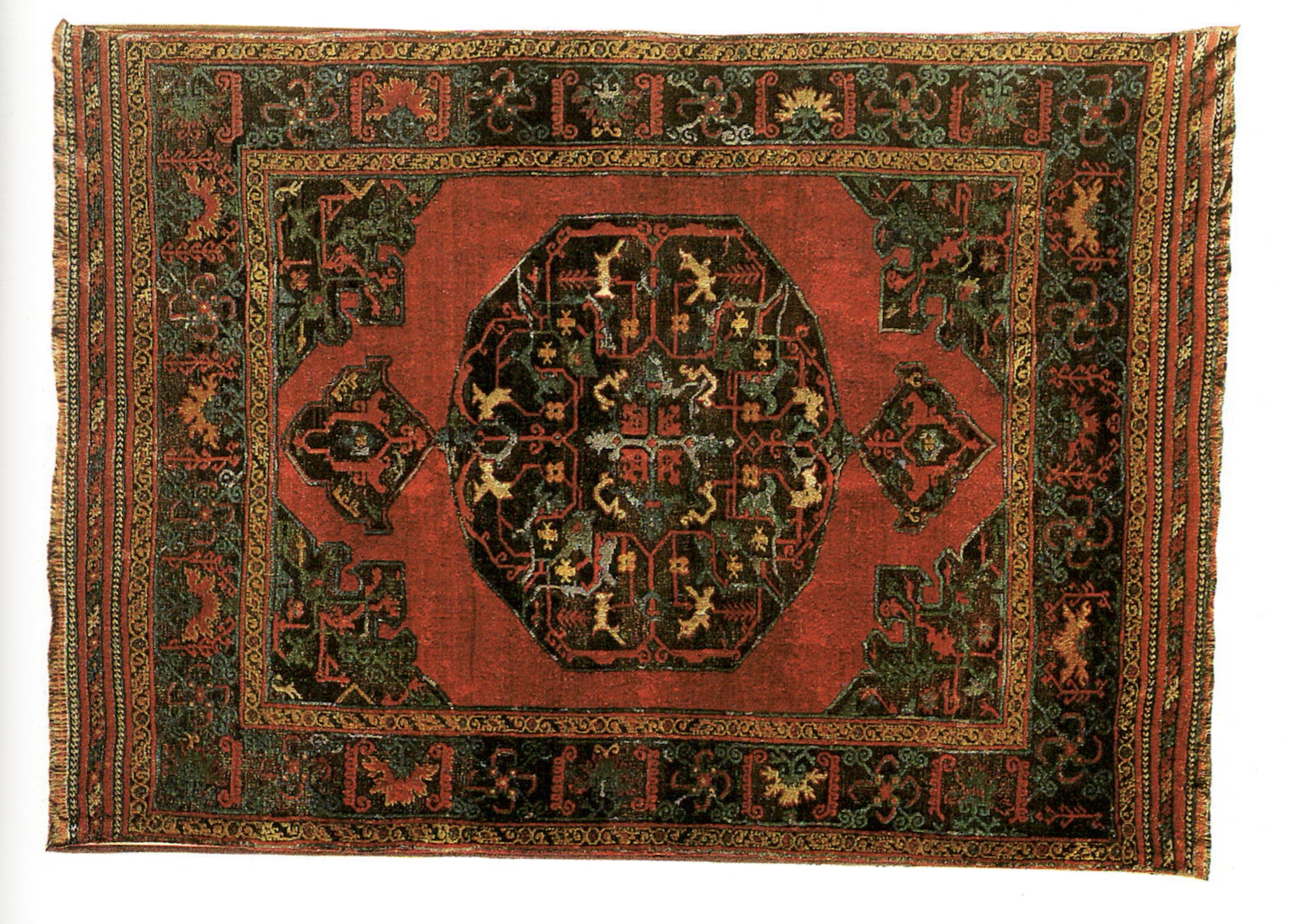
An antique Anatolian Oushak, 16th century, with the geometric, interlaced version of the arabesque.
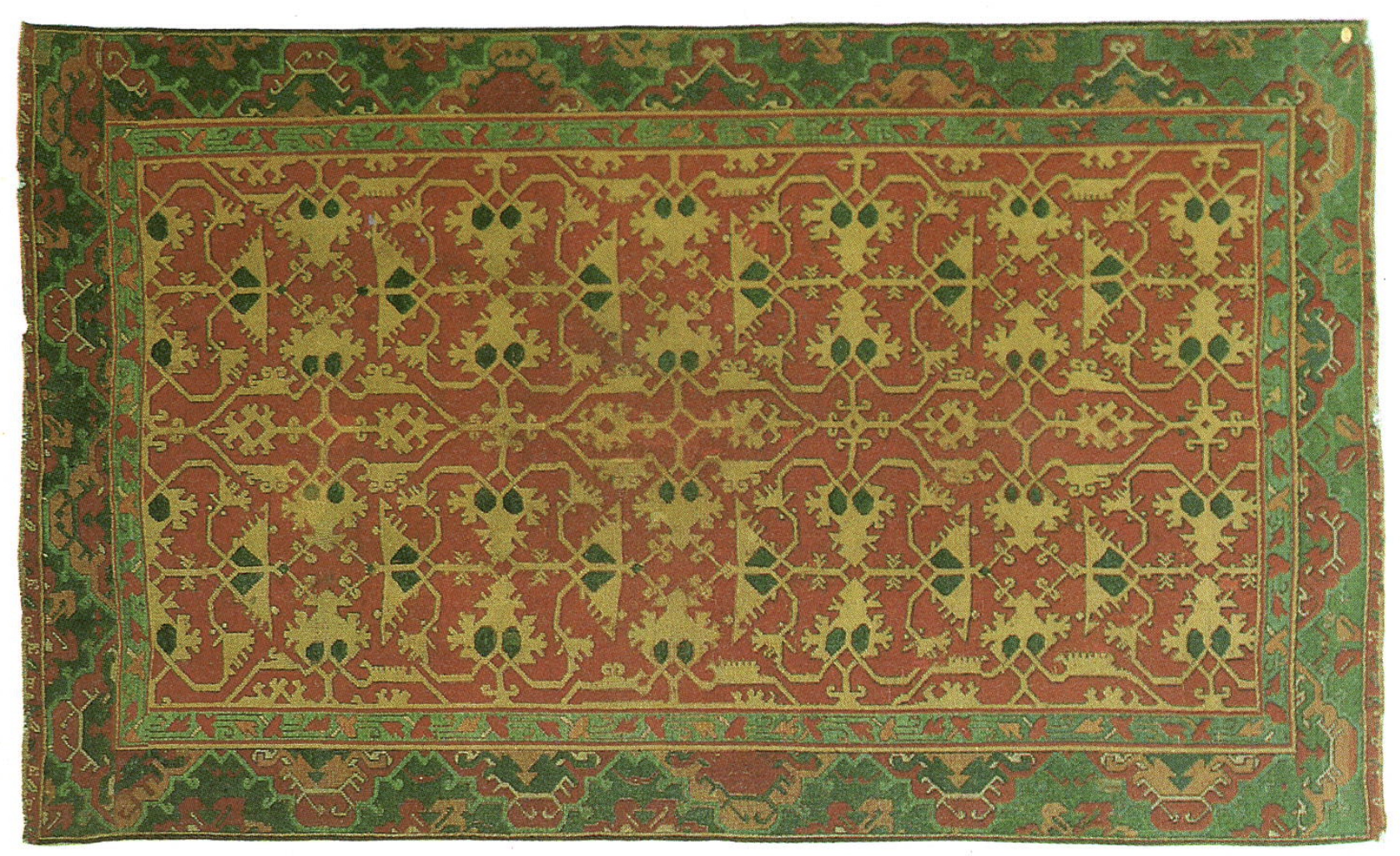
An Oushak arabesque of the kind recorded by the Venetian painter Lorenzo Lotto, after whom these rugs are named.
Motifs in the Field
These elements can be the only motifs in the central field, arranged in rows, mirror-image or otherwise regularly, or they can appear together with larger elements such as medallions or smaller ones such as rosettes and stars. The most common are the following.
Boteh
Boteh and Herati are among the most widespread motifs of the Oriental rug. The boteh is generally rather small and recalls in form a drop or the tip of a cypress bent to one side, and in the West it is widely known as the paisley. The most varied meanings have been ascribed to it, from the almond to the flame of the holy fire of the Zoroastrian religion, the tear of Buddha, the feather, the conifer cone, or the eye as protection against the evil eye. Even if its origin lies in the dark, the meaning of its Persian name, "bouquet," shows the direction in which to look: the boteh probably comes from the plant world. In geometric or curvilinear form it is often scattered in great number in parallel rows over the central field, and also appears alongside other motifs. It first appears on rugs of the 18th century and spread in the 19th, above all in Persia but also in Anatolia and the Caucasus. It is also used in the border.
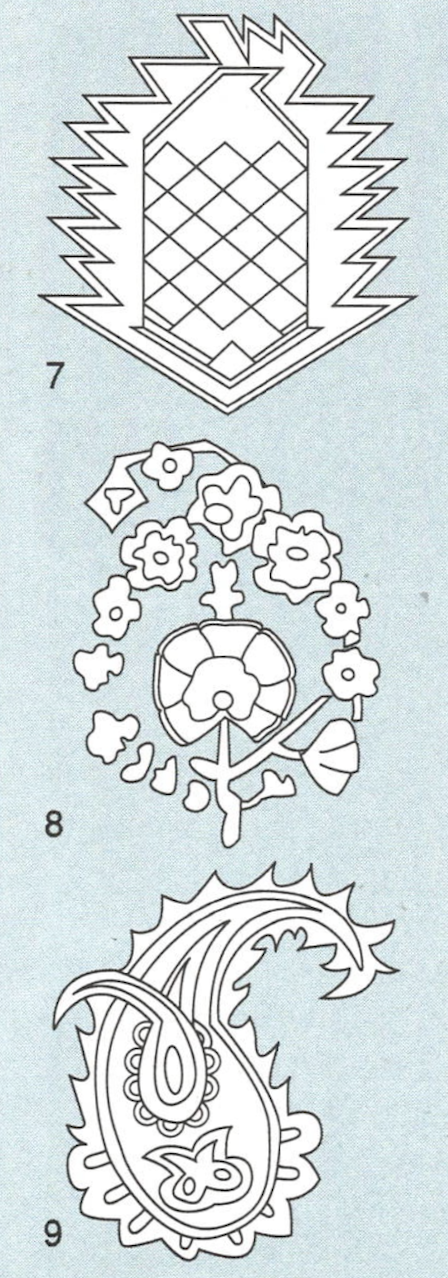
The boteh (paisley) in geometric and floral forms.
Herati (Mahi)
The Herati motif is as widespread in the Orient as the boteh, but older, having arisen already in the 16th century in Safavid Persia. The name goes back to its probable city of origin, Herat. It is interpreted differently by different knotters and so is often not easy to recognize. It is formed by a complex interplay of floral elements: four blossoms, generally four palmettes, stand at the four corners of a lozenge often formed from their stems; inside the lozenge sits a small roundish blossom, and outside stand four sickle-shaped lanceolate leaves. Because of their narrow form these leaves also recall small fish, which is why in Persian the motif is also called mahi, meaning "fish." The Herati can be the only decorative element, repeating regularly over the whole field, or it can combine with other elements on medallion rugs. Knotted over time in geometric or naturalistic ways, it counts as the most versatile of all pattern elements, most widespread in Persia since the 16th century, above all in Herat and Isfahan. It also appears in borders.
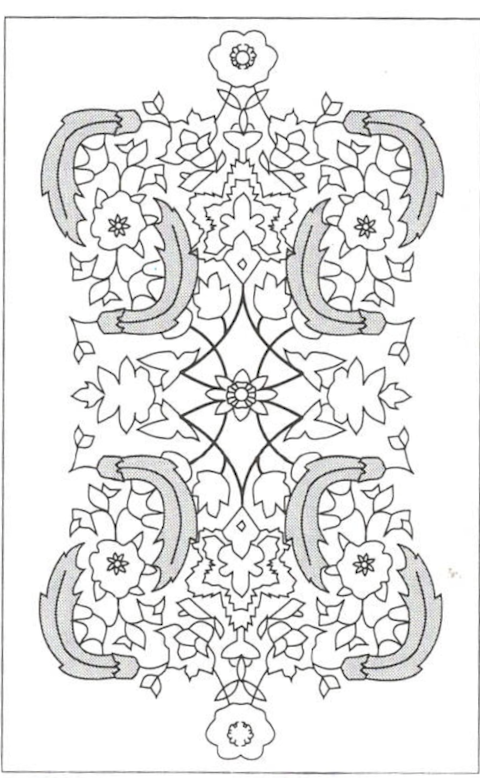
The Herati, or mahi (fish), motif and how it is built up.
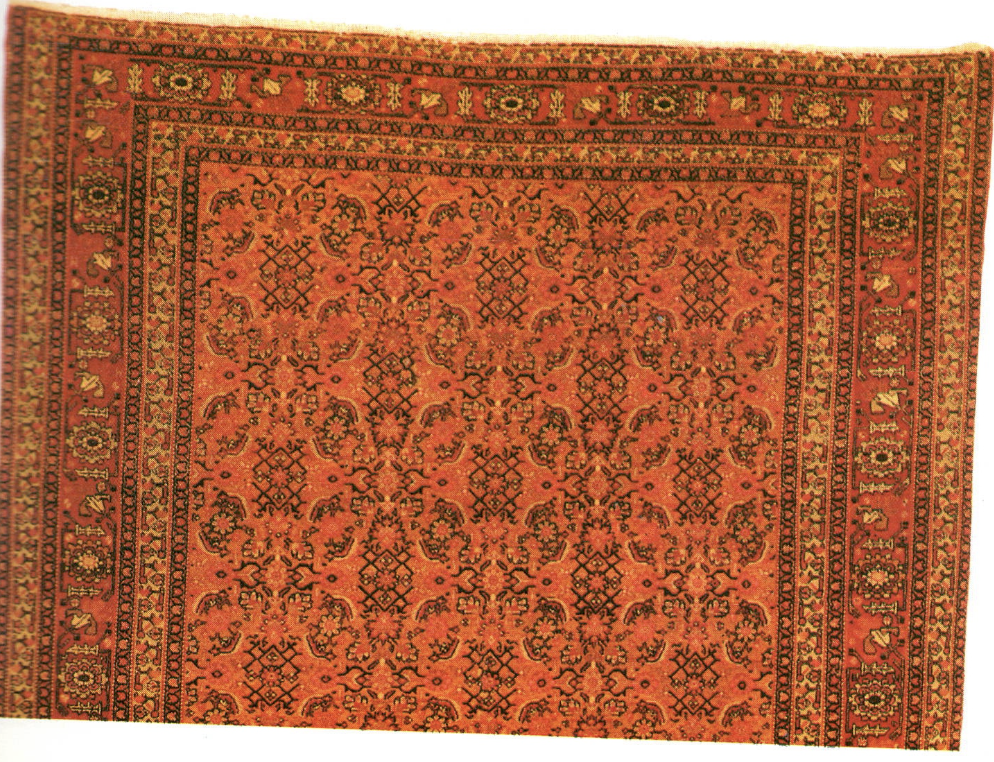
A 19th-century Senneh with an all-over Herati field.
Gul
The gul (or gol) is a small octagonal, hexagonal or lozenge-shaped medallion with various outlines, straight, indented, hooked or serrated. It is divided into four by color and contains small geometric figures inside, such as variously decorated eight-pointed stars, squares, lozenges and rectangles. Its origin is uncertain, with interpretations ranging from the rose to the footprint of the elephant or camel; the name gul, which in Turkish means "rose," points to a plant origin, while on Turkmen rugs the gul probably goes back to old tribal emblems. It is the typical element of West Turkestan production, filling the whole central field in parallel rows, and is often erroneously called the Bukhara motif in the trade, after the city that was the trading, not the production, center of these rugs. The gul takes quite different forms according to the Turkmen tribe, with corresponding special names.
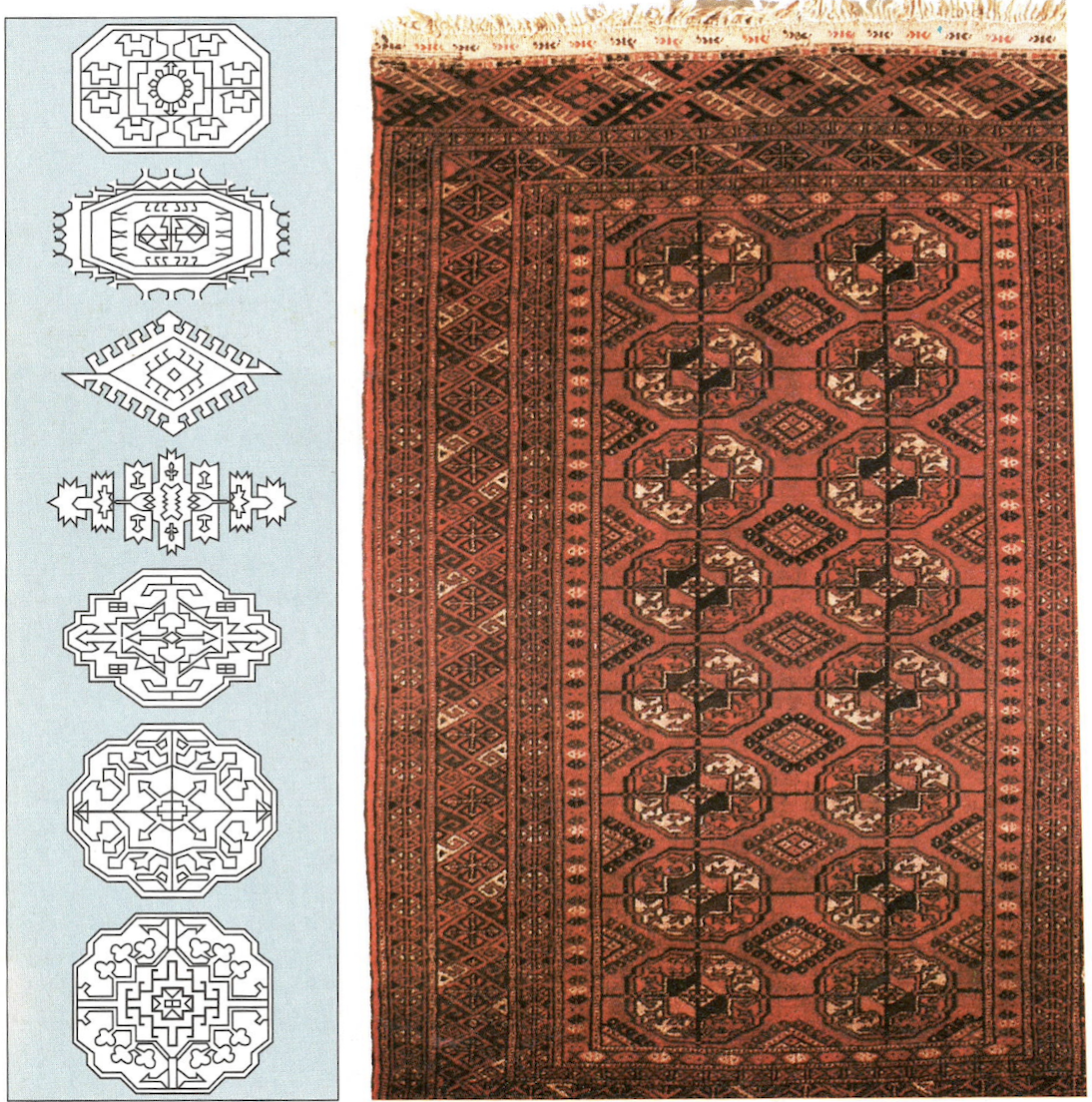
Left: various Turkmen guls. Right: a detail from a West Turkestan Tekke, 19th century.
Cloudband
This old Chinese motif, the tschi, consists of an omega-shaped, more or less broad, winding band. In the central field it appears in regular arrangement with varying orientation, but always together with other plant elements such as palmettes and arabesques, from which it is often hard to distinguish, standing out only occasionally by its larger size. The tschi appears already in floral Persian and Indian rugs of the 16th century, but found its greatest use in the border.
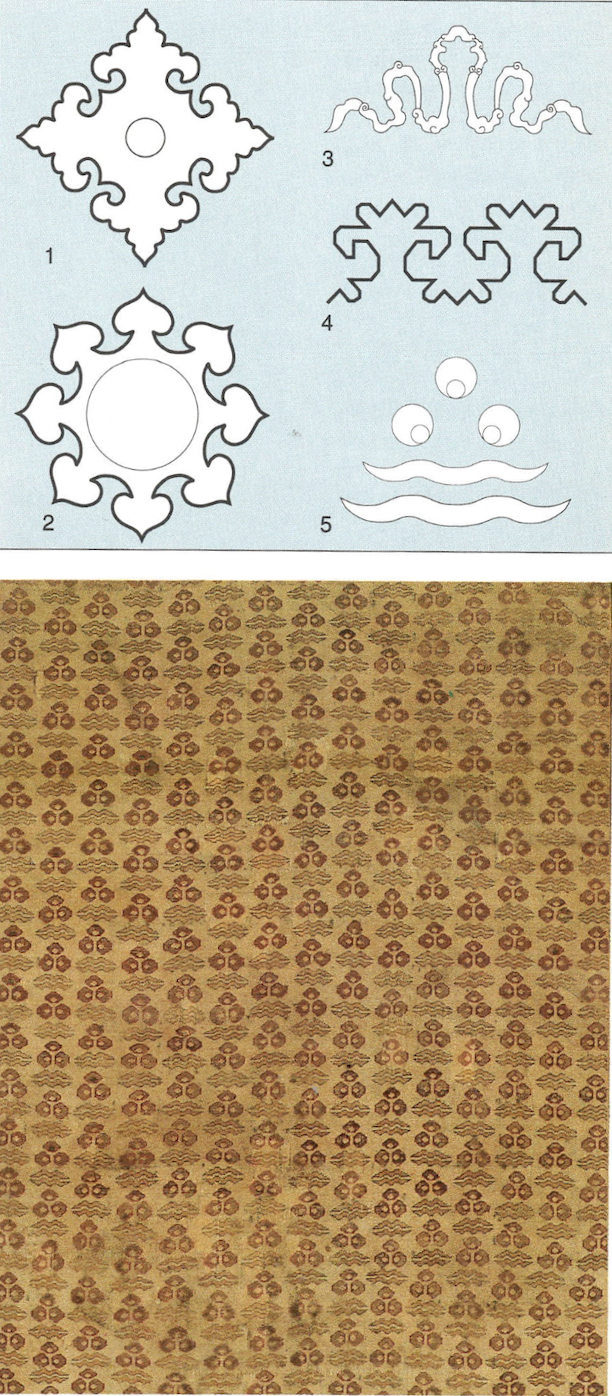
Cloudband and leaf motifs, with a 17th-century Oushak below.
Tschintamani
The tschintamani is also of symbolic origin. It consists of three balls arranged pyramid-fashion with two wave-shaped lines beneath. In the central field it is arranged in staggered rows, imposing a particular viewing direction, and as a dark element on a light ground it lends antique pieces from Usak in Anatolia a special charm.
Top: the tschintamani motif in field-wide use. Bottom: the three elements of the kharschang motif.
In-and-Out Palmette
This motif, known by its English name, is found on rugs with floral drawing. The palmettes form a row, directed alternately inward and outward, and together with secondary elements such as cloudbands or arabesques cover the whole field, or take their place in the main border. The in-and-out palmette arose in 16th-century Persia and found much favor, used again and again in later centuries in simpler versions with simplified outlines.
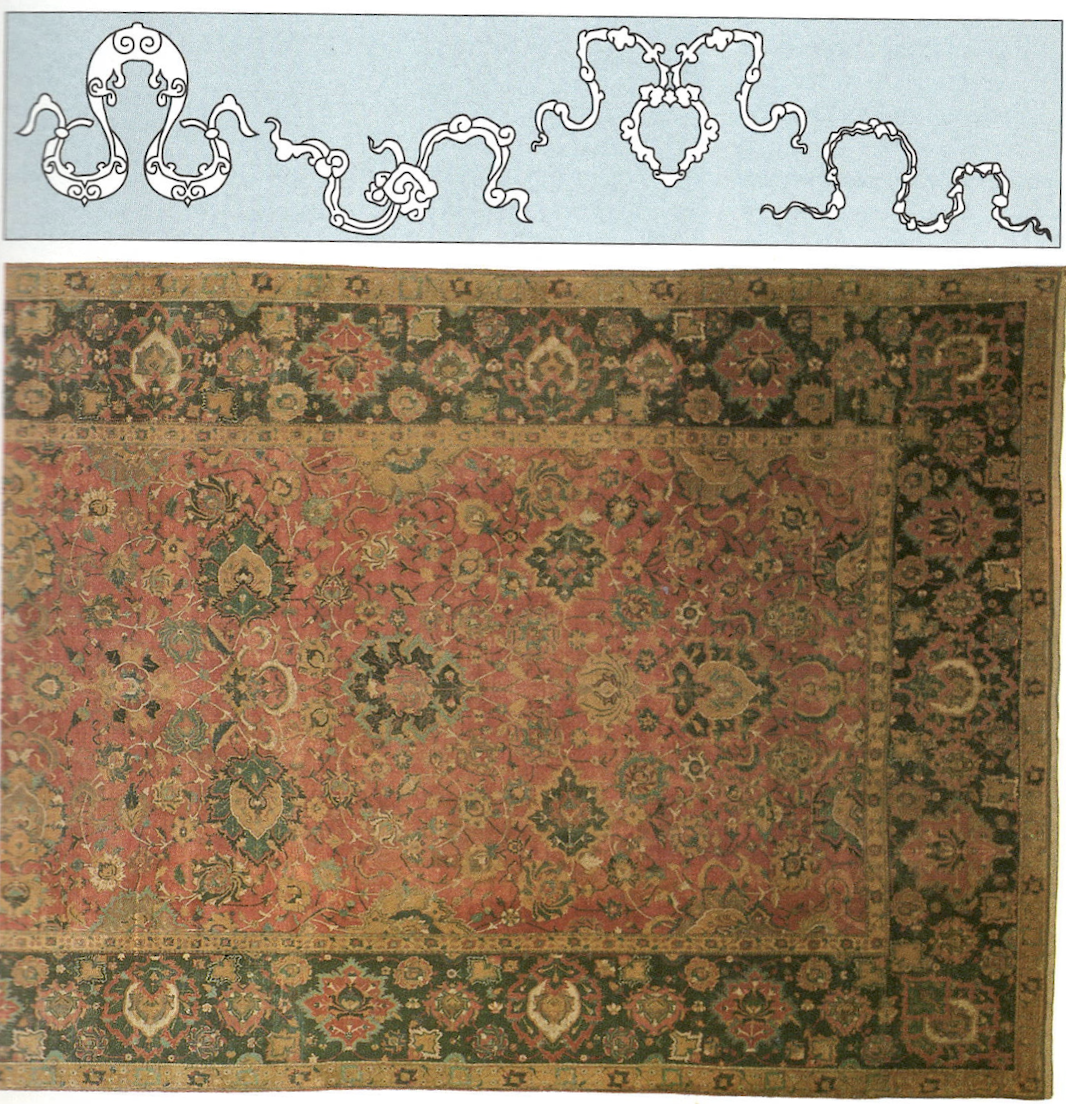
Top: cloudband patterns. Bottom: in-and-out palmettes in the main border of a Persian rug, Herat, early 17th century.
Kharschang
This is a complex motif arranged in parallel rows in the central field, composed of three main elements: a palmette with rigidly articulated outlines, a lozenge-shaped diagonally placed blossom from which four straight stems spring, each ending in a forked plant form, and a final element resembling a cogwheel. The name kharschang ("crab") refers to the slightly zoomorphic form of the characteristic palmette. The motif probably goes back to Persian models of the 16th century, developed in the 18th century in North Persia (Kurdistan and Azerbaijan) and the Caucasus, and was over time, especially in the 19th century, dissolved into at most two connected elements; the geometricized variant became typical of some Caucasian pieces, above all from the Kuba and Baku areas.
The kharschang motif and its three elements: palmette, lozenge blossom, and cogwheel form.
Afschan
This pattern closely resembles the Kharschang but is more strongly simplified. Pairs of rosettes and palmettes alternate in parallel rows, with forked plant elements springing from the palmette tips and surrounding a tiny blossom. The Afschan stems from the same 16th-century model as the Kharschang and likewise spread in the 18th century between North Persia and the Caucasus, used in the 19th century above all in the Caucasus in increasingly geometricized and enlarged forms, as the rugs from Kuba and Baku show.
Mina Khani
The Mina Khani motif consists of four identical roundish blossoms resembling daisies, arranged in a lozenge and joined by a delicate stem, with a further smaller blossom (also interpreted as a jewel) at the center of the flower-lozenge. The motif repeats over the whole field, creating a kind of lattice structure. It developed in the 18th century from a 16th-century prototype; its area of origin is unknown, with Kurdistan and Khorasan in question, and from the 19th century on it became the characteristic element of rugs from the Persian city of Veramin.

Top left: a Caucasian Kuba showing the Afschan motif. Right: Afschan and Mina Khani schematics. Bottom: a Veramin with the Mina Khani field.
Zil-i-Sultan
This motif is easy to recognize even in more or less naturalistic versions, since it consists of a flower vase with two small birds on either side, generally repeated over the whole field. It evidently arose in 19th-century Persia for a member of the ruling court, since literally translated it means "shadow of the sultan," a designation said to refer to the crown prince Zellol (1786 to 1825) of the Qajar dynasty or to one of the sultan's advisers. It comes from the 19th century and spread in West Persia, especially in the Malayer area.
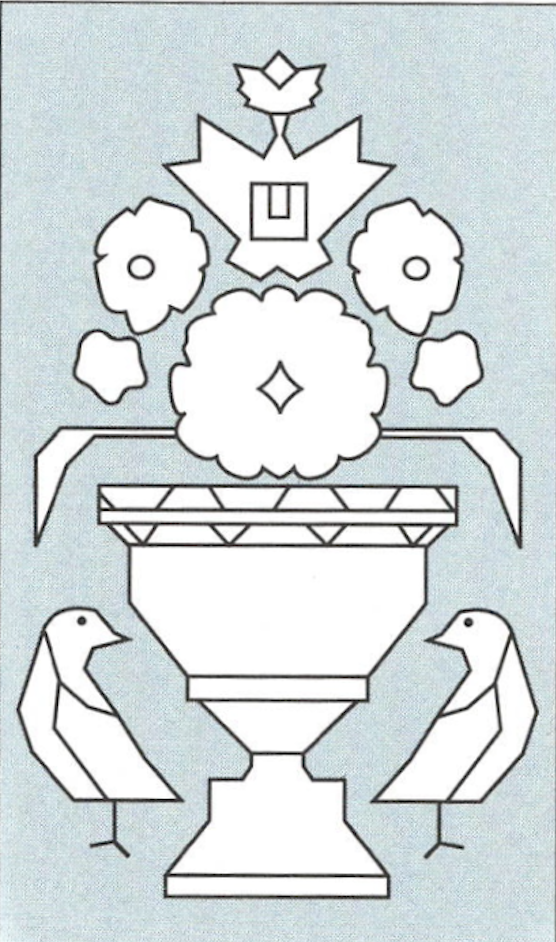
The Zil-i-Sultan motif: a central flower vase with a bird on either side.
Motifs in the Border
These motifs are in no way secondary. They complete the patterning and, through their colors and forms, decide the artistic balance the rug must hold. Because they were less subject to cultural change and fashion than the field motifs, they often offer welcome help in identifying and dating a rug. The outer zones contain numerous frames, ideally seven: wide borders, often only a single one, and numerous narrower guard stripes. The border motifs too show great variety; the most important follow.
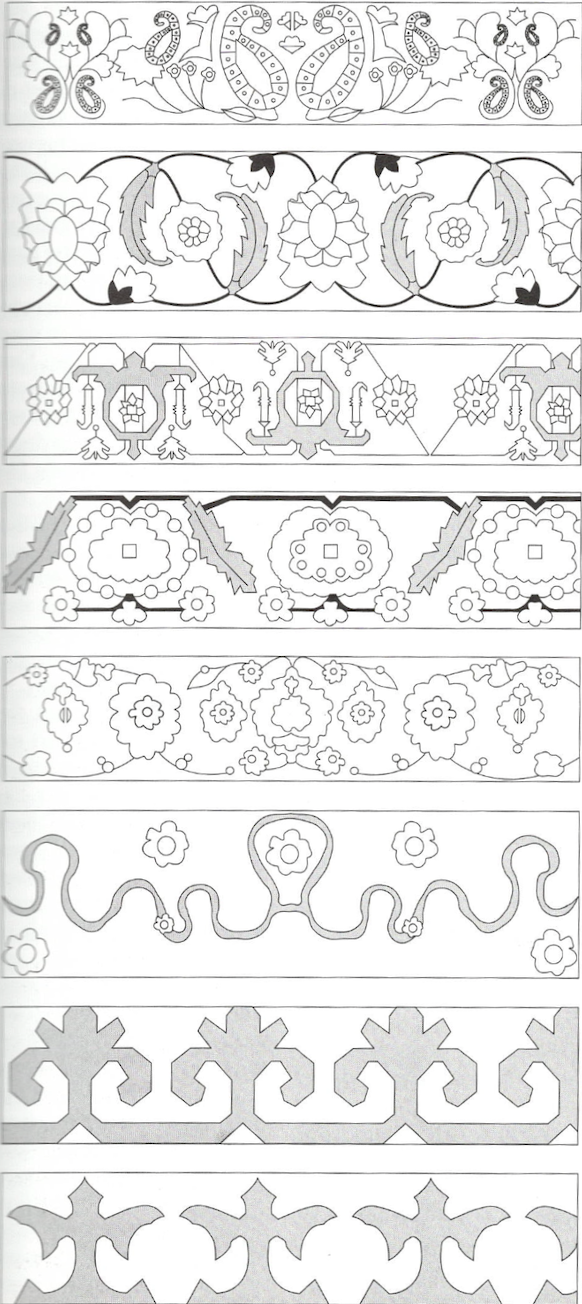
Border elements, top to bottom: boteh, Herati, turtle, geometric Herati, in-and-out palmettes, cloudband, cloverleaf, Medachyl.
Cloverleaf
The cloverleaf motif is derived from the cloudband. Decisive here are mutually identical elements that resemble cloverleaves or stylized lines. They are arranged continuously one after another and interpenetrate each other like positive and negative, showing an alternating orientation now to one side and now to the other. To this belong contrasting colors as well, for example red and yellow or red and blue. Depending on the knotting region, the pattern is interpreted quite differently. It is found already on early rugs of Anatolia and the Caucasus region; it is characteristic above all of East Turkestan, where it occurs over large areas along the main border.
Medachyl Border
The Medachyl border is probably a simplification of the preceding motif, from the nineteenth century. The Medachyl is a reciprocal border: by this is understood two identical rows of pattern running in opposite directions and interpenetrating, in different colors. The Medachyl border can be extremely stylized and reduced to simple lozenge shaped arrows. We then speak of a crenellation border. A still further simplification leads to a succession of small two colored triangles (triangle border). The Medachyl border is never conspicuously developed in the individual rug and has a wide geographical distribution. It adorns above all rugs of the geometric style, especially of the Caucasian production.
Running Dog
This decorative motif too belongs in all probability to the great family of those elements derived from the cloudband. It consists of two differently colored rows that interpenetrate and relate to each other as mirror images (reciprocal border). The drawing of the running dog is very varied. In the typical case it consists of more or less large, crooked hooks in which people wanted to recognize the heads of dogs. The running dog can, however, also be formed merely as a geometric, wavy pattern. No symbolic or historical meaning attaches to the name. With the running dog, less important borders are adorned, above all in the Caucasus region. In the northeast Caucasus, by contrast, the pattern appears in enlarged, more finely worked form in main borders.
Kufic Border
This is one of the most widespread and oldest motifs, for we see it already on Anatolian rug fragments from the thirteenth century. The name goes back to the original model, namely the Kufic script, which spread above all among the Turks during the Seljuk period. It transformed itself into a purely decorative element whose script character is hardly recognizable any longer. The size and the form of the Kufic border depend very strongly on the area of production. But it always has a more or less pronounced geometric character. It appears in the main border and is found above all on Caucasian and Anatolian rugs, especially on the antique Holbein rugs.
Cartouches
The cartouches too represent an early motif. They originally stem from the relief leather bindings of Quran editions, where four or many cornered frames contained holy verses. These cartouches were taken up into Persian rugs or Mamluk rugs in the sixteenth century. In doing so they often lost the inscriptions, which were replaced by geometric or floral elements. Only in prayer rugs did they keep their role as ornamental frames for holy verses. The cartouches show more or less geometric, elongated forms and appear in the main borders of many rugs. They are especially typical of the antique Transylvanian rugs, made in Anatolia between the first half of the seventeenth and the beginning of the eighteenth century.
Chubukli
This easily recognized motif is typical of Anatolia. The main border consists of several long, narrow stripes (in general seven) in two alternating colors, with dots or tiny blossoms at regular intervals providing a loosening up. The motif was introduced in Anatolia at the beginning of the nineteenth century and spread in the second half of that century. It is typical above all of the rug production of Ghiordes and Kula.
Sawtooth Pattern
This motif consists of two elongated, geometric leaves with a serrated edge and, between them, a y shaped element that in the typical case recalls a drinking glass, but in reality represents a stylized tulip. This motif repeats itself in various colors on a generally light ground and thereby forms the main border. The sawtooth pattern is typical above all of the Caucasus (the "oak leaf border"), for example of Kazaks from the nineteenth century.
Kotschanak
The Kotschanak motif is a square or rectangular hook motif, partly closed and partly open. Because of its form it is also called the ram's horn, since two mirror image hook drawings always stand together. Two ram's horns are always joined to one another, and inside this pattern we see octagons, crosses or other small geometric elements. The Kotschanak motif belongs to the most variable and most widely distributed patterns of the Oriental rug. To a particular degree, however, it appears on West Turkestan rugs. In the central field it appears only occasionally, and then only singly and scattered.
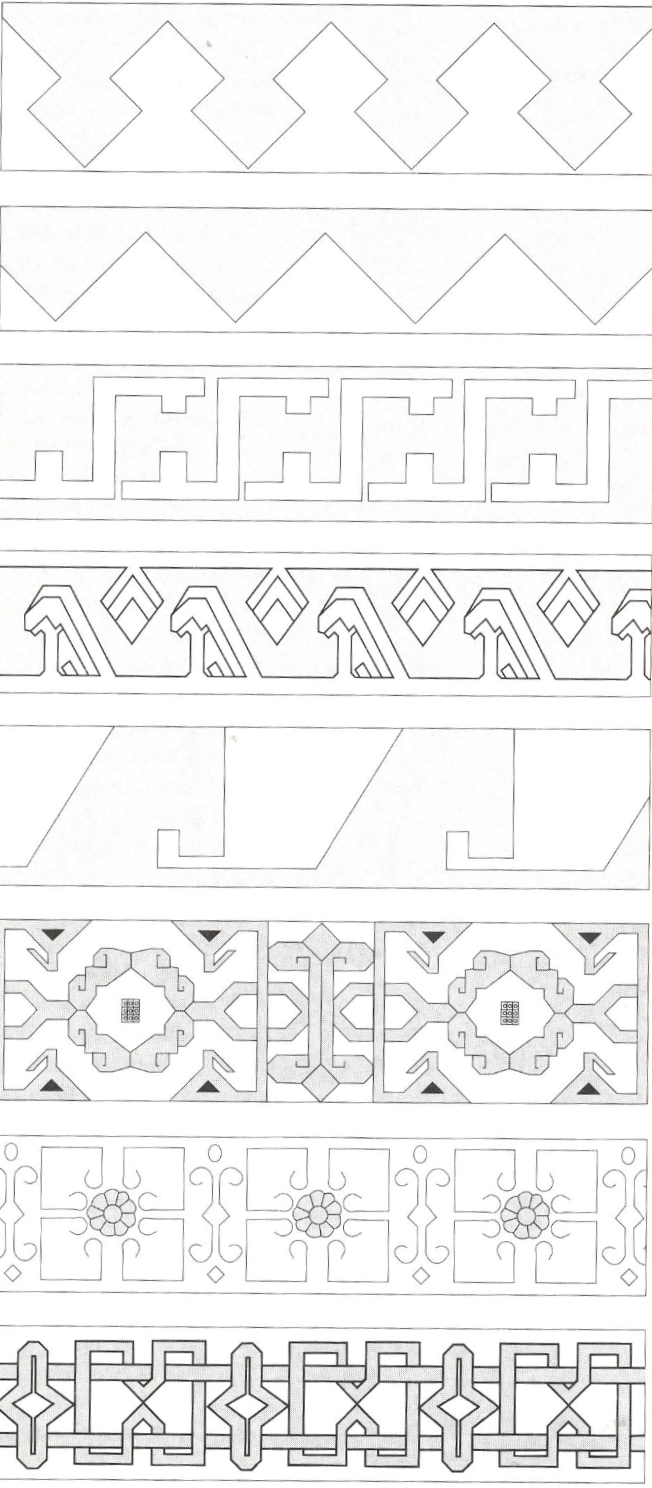
More border elements: simplified Medachyl and crenellated borders, triangle border, Chinese meander, running dog, and the classic Kufic interlace of the Holbein rugs.
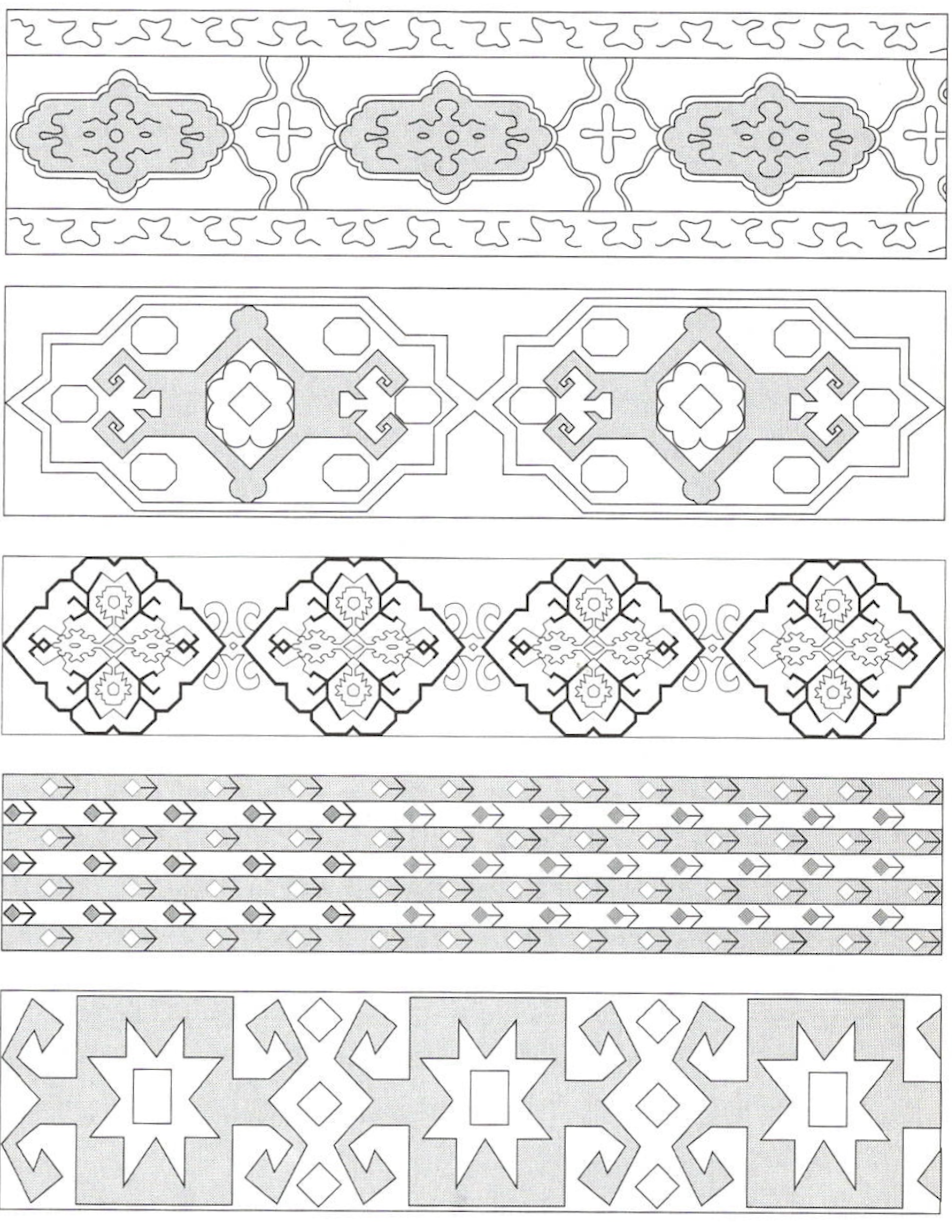
Cartouche borders in the Persian, Transylvanian and Lotto (Usak) versions, with the tschubukli and kotschanak motifs.
The kotschanak, or ram's horn, motif.
Another version of the kotschanak motif.
Shirvan with three medallions. Caucasus, 19th century. Note the main border with the sawtooth pattern and the two surrounding Medachyl borders.
Historical text adapted with permission of Orbis Verlag.
Materials and How to Test Them
The preferred material for knotting a Persian rug is mostly the hand-spun wool from the fleece of the sheep. It is tough, firm and has a natural sheen. But wool is not simply wool: the more barren the region in the highlands and hill country of Iran where the flocks graze, the better the wool. The age of the sheep also plays a role, the best wool coming from the one- to two-year-old animal. Where the warp and weft of the foundation are not of cotton or silk, long-fibered wool from the shoulder of the sheep is taken for them. For the pile, which consists of hundreds of thousands of knots tied into the foundation, fluffy, full, elastic but firm wool is used, spun thick- or thin-haired according to the kind and quality of the rug.
After shearing, wool that has matted must be reconditioned, as must older wool that is to be reused. This is done with a bow-like tool: the string is struck, and the vibration loosens the wool, frees it of foreign matter and divides it into fractions. This process, called pashmzani (wool beating), is also applied to cotton and forms a trade of its own. A master of his craft can even produce different tones by striking the string, and sings to this music. Sadly this old trade is increasingly displaced by machines.
Among other materials, besides camel hair, used regionally in wool rugs, and goat hair for warp, weft and selvages, natural silk above all should be mentioned. It is often used in wool rugs for individual motifs or to outline them, achieving a special sheen effect. In some places, however, high-quality rugs are knotted entirely from pure silk, serving chiefly as wall decoration.

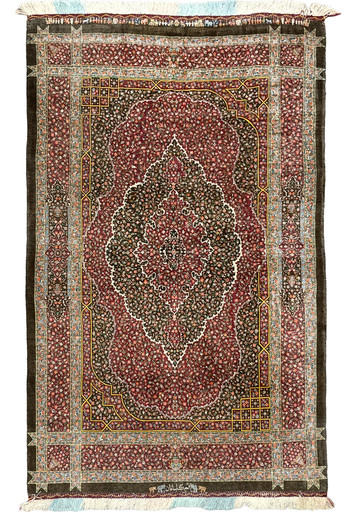
Knowing which material was used for the foundation, whether cotton, wool or silk, is important. One must be especially warned against cotton stretched with synthetic fibers: such rugs sometimes warp and become wavy. Since even the practiced eye cannot always detect this, the burn test serves as a simple check. A single thread drawn from a fringe is held to a flame, and each fiber behaves differently:
Wool burns slowly, crackles, balls into dark lumps, and smells of burnt hair; the flame often goes out and the thread must be relit.
Silk burns almost odorlessly to ash and does not crackle.
Cotton burns continuously with a faint woody smell and leaves a gray ash thread that crumbles easily.
Synthetic fiber (mixed with cotton) burns meltingly, with a sooty flame.
Historical text adapted with permission of Orbis Verlag.
Caring for Your Rug
A handmade rug is built to be lived on. The best thing you can do for it is use it. Everything below is simply about keeping a piece that can last generations in good health.
Everyday Care
Vacuum about once a week, always in the direction of the pile, using a plain suction head rather than a rotating beater bar, which thins the pile and fringes over time. Two or three times a year, turn the rug over and vacuum the back as well. If grit or sand works its way down into the foundation, get it out promptly even if it means going against the pile, since those sharp particles cut the wool from below. A new rug should be vacuumed only lightly at first, so its surface can settle and compact through normal use. Rugs that are walked on regularly benefit from being rotated every four to six months so the pile wears evenly.
Spills, Moisture and Stains
Blot any watery spill by diluting it and lifting it straight out with absorbent paper or cloth; do not rub hard. Dry the rug promptly afterward, and never leave it spread on a damp floor or beneath a standing vase, since trapped moisture is one of the worst dangers to a genuine rug and leads to mildew and dry rot of the foundation. Keep flower boxes and pots off the rug for the same reason. Until pets are fully house-trained, keep them away as well, since animal urine both rots the foundation and causes discoloration that is usually permanent. Be wary of degreasing detergents, cleaning foams and alkaline stain removers: they strip the wool of its natural protective oils, after which it loses luster and grows brittle and far more prone to soiling.
Light and Position
Keep a rug out of harsh, direct sunlight; the awnings over Persian terraces protect the rugs as much as the people. Avoid placing a corner right at a doorway, where the constant first step in and out will, over years, compress or stretch that spot until a once-rectangular rug looks crooked. The same happens if you keep tugging a rug straight by one corner. Lay it on a smooth floor rather than on top of wall-to-wall carpet, where it tends to ripple, and use a proper pad or underlay: it keeps the rug from slipping or waving on parquet, marble or carpet, protects the back, and can meaningfully extend the life of a valuable piece.
Washing, Storage and Repair
Roughly every decade, have the rug professionally washed, since ground-in dirt destroys both foundation and pile; you will notice the damage the day a fringe tears when you tug it. A good professional wash lifts most soiling, helps restore the original luster, and prolongs the rug's life. Small rugs can be cleaned gently at home, but never with chlorinated water: two spoonfuls of mild detergent per bucket of water with a splash of vinegar is the right mixture, rubbed softly across the pile direction and dried immediately. When a rug is not in use, roll it around a tube rather than folding it, and tuck in moth protection; rugs in quiet, poorly ventilated corners are the ones most at risk of moths. Quality rugs cannot be repaired at home, so bring worn or damaged areas to a specialist, and the sooner the better, because once the structure is broken a rug can come apart with surprising speed. When a piece has finally earned its retirement from the floor, hang it on the wall with the fringes facing inward, and it will give you pleasure for many years more.
Every rug at Rugs.net is hand-knotted, authentic, and imported directly. No middleman, no markup games, just real rugs at real value.
Shop All Rugs Silk Rugs Wool Rugs
Questions? Call 855-576-7705