Kashan is one of the four pillar cities of the Persian carpet tradition, alongside Tabriz, Isfahan, and Qum. It is also, for most people in America, the city that defined what a Persian rug looks like. The deep red field, the navy and ivory central medallion, the four corner pendants, the dense wool, the formal symmetry: that mental image is not generic. It is specifically a Kashan, and it became the default Persian rug in the Western imagination for reasons that reach back nearly five hundred years.
The city sits in the central Iranian plateau, in Isfahan Province, roughly halfway between Tehran and Isfahan along the old Silk Road. Its rug-weaving tradition has produced everything from the legendary silk and metal-thread Polonaise carpets of the seventeenth-century Safavid court, to the celebrated Mohtasham masterworks of the late nineteenth century, to the workshop pieces of the Pahlavi golden age, to the contemporary commercial Kashan rugs woven for the global furnishing market today.
This guide explains the full picture. The history, the construction, the design vocabulary, the master workshops, the pre-revolution and post-revolution eras, and the practical checks any buyer can use to evaluate a Kashan rug before purchase. UNESCO inscribed the traditional skills of carpet weaving in Kashan to the Intangible Cultural Heritage Lists in 2010. That recognition tells you what kind of object you are looking at when you look at a real Kashan.
History of Kashan Rug Weaving
Kashan’s place in textile history predates the Persian carpet as we now know it. The city was already a major silk and brocade center in the medieval Seljuk period, with documented production of fine silk fabrics going back to the eleventh century. Its position on the trans-Persian trade routes connected it to Central Asian wool, Mesopotamian indigo, Anatolian cochineal, and the broader luxury textile economy that funded courtly craft for centuries.
When the Safavid dynasty rose in 1501 and Shah Abbas the Great moved his capital to Isfahan in the early seventeenth century, Kashan was a natural choice for one of the principal royal carpet manufactories. The famous Polonaise carpets, woven in silk pile with silver and gold metal threads, were commissioned through Kashan and Isfahan workshops and exported to European nobility throughout the seventeenth century. The most documented case is the 1601 commission from the Polish king Sigismund III Vasa, who sent an Armenian agent named Sefer Muratowicz to Kashan specifically to order eight carpets with the Polish royal coat of arms woven in. The carpets were delivered to Krakow in 1602. Western art historians later misattributed similar pieces to Polish workshops, which is how the name “Polonaise” stuck even after the error was corrected.
The Safavid collapse in 1722 and the long political instability that followed under the Afsharid, Zand, and early Qajar periods sent Kashan weaving into decline, along with most of the Persian carpet industry. By the mid-nineteenth century the craft in Kashan had been reduced to local-market production. The revival came through a single legendary workshop.
Hadji Mollah Mohammad Hassan Mohtasham, working in Kashan from roughly 1880 until the early 1900s, single-handedly re-established the city’s reputation. He sourced extraordinarily soft Merino lamb’s wool, in many accounts imported as worsted yarn from Manchester, paired it with a fine cotton foundation, kept knot densities tight, used natural dyes at a time when synthetic anilines were rapidly replacing them across Persia, and revived the classical Safavid medallion-and-arabesque design vocabulary with a level of drawing precision the craft had not seen in a century. The result is the antique Mohtasham Kashan. Today these pieces are among the most collected antique Persian rugs in the world, and a fine Mohtasham in the right size routinely sells at auction for six-figure prices.
Through the first half of the twentieth century Kashan production scaled significantly. The Pahlavi era under Reza Shah and Mohammad Reza Shah, from 1925 to 1979, is now widely regarded as a second golden age of Persian rug production. Reza Shah established the Iran Carpet Company in 1935 to bring weaving under government oversight and quality control, and the period from the 1940s through the 1970s produced workshop Kashans that are now the backbone of the antique and semi-antique Kashan market in America.
The 1979 Iranian Revolution was a hard break. Production did not stop, but the industry changed permanently. Post-revolution Kashan rugs are still being woven, in many cases by the same family workshops, but the average quality bar moved toward more accessible price points. Both eras produce real Kashan rugs. Understanding which era you are looking at is the most important thing a buyer can know.
Construction: Materials, Knots, and Density
Foundation. A real Kashan is built on a cotton foundation, both warp and weft. Cotton holds tension consistently under loom stress, which is what allows the very fine drawing the city is known for. The cotton foundation is also why a Kashan lies flat across the full length of a 9 x 12 or 10 x 14 piece, with no buckling or shrinkage waves that cheaper wool-foundation rugs develop over time.
Pile material. All authentic Kashan rugs are hand-knotted with wool pile. The quality distinction is in the grade of that wool. The finest pre-revolution and Mohtasham-era pieces use Kork wool, the soft undercoat fiber clipped from the lamb’s neck and throat, which has high natural lanolin, exceptional luster, and a softness that develops into a deeper sheen over decades. Mid-tier and modern Kashan production uses good quality body wool: still genuine, still hand-knotted, still durable for generations, but without the silken hand of the top Kork grade. A small subset of fine Kashans also incorporates silk highlights in the pile at floral detail areas, creating selective luminosity that catches the light as you walk past the rug.
Knot type. Kashan weavers use the asymmetric or Persian knot (Senneh knot), tied around one warp thread and looped under the adjacent one. The asymmetric knot allows finer design resolution than the symmetric Turkish knot, which is part of why Kashan achieves the smooth arabesque curves and continuous floral forms its design language requires.
Knot density (KPSI). This is the single most useful number for evaluating a Kashan. Knots per square inch ranges enormously across the quality spectrum and maps almost exactly to quality tier and price tier.
| KPSI Range | Quality Tier | Typical Characteristics |
|---|---|---|
| 80 to 150 | Commercial | Post-revolution, good wool, full design vocabulary, accessible price |
| 150 to 250 | Good Workshop | Solid city-rug construction, often Pahlavi-era, full design vocabulary |
| 250 to 400 | Fine Workshop | Kork wool likely, precise arabesque, pre-revolution typical, patina |
| 400 to 600 | Very Fine / Mohtasham Tier | Kork wool, sometimes silk highlights, master drawing, collector quality |
| 600+ | Mohtasham / Antique Masterwork | Mohtasham, Dabir, signed antique pieces, museum and auction tier |
How to check KPSI yourself: Flip the rug over. Pick one square inch on the back and count the knots vertically and horizontally. Multiply. A commercial Kashan at 100 KPSI looks visibly coarse on the back. A fine workshop piece at 350 KPSI looks dense and nearly photographic. A Mohtasham-era antique at 500+ KPSI feels almost printed. Two minutes with a tape measure tells you more than any label.
Designs, Patterns, and the Kashan Color Palette
The Central Medallion and Pendant Layout
This is the canonical Kashan and the rug most American buyers picture when they imagine a Persian rug. A central medallion, usually a flattened diamond or lobed cartouche, sits on a deep red, navy, or ivory field. Above and below the medallion are smaller pendants that establish a vertical visual axis. Four corner spandrels mirror quarter-sections of the medallion. The remaining field is filled with an allover floral arabesque of Shah Abbasi palmettes, curling vines, and small leaves. The border is multi-banded, with a wide main border carrying a continuous floral scroll framed by narrower guard borders on each side. Everything is drawn symmetrically across both axes. This layout traces directly back to the Safavid court cartoons of the sixteenth century and is the visual default for Persian rug in the global imagination.
The Allover Floral Layout
Some Kashans skip the central medallion entirely and carry an allover repeat across the whole field, a continuous floral or paisley scroll tiling edge to edge. An allover Kashan reads as less formal than a medallion Kashan and is often a better choice for rooms with strong furniture covering part of the rug, because the eye is not pulled to a fixed center that needs to be exposed. Allover Kashans in deep red with ivory and navy floral work are some of the most versatile decorating rugs in the entire Persian collection.
The Tree of Life
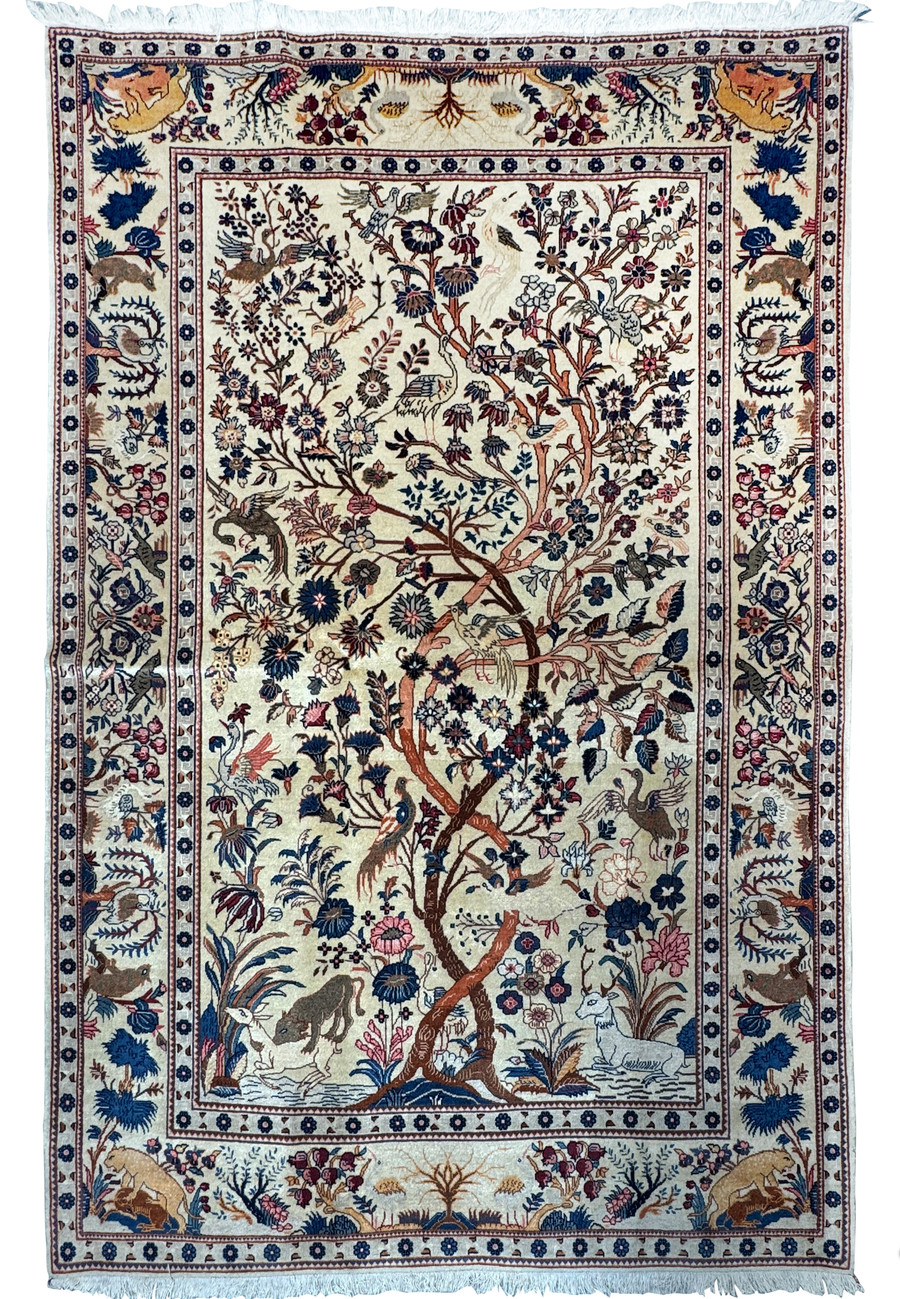
A smaller subset of Kashan production, especially in antique-era weaving, is devoted to the Tree of Life design. The motif shows a stylized tree rising from a vase or pedestal at the base of the rug, with branches spreading symmetrically and birds, blossoms, and sometimes small animals nestled among the leaves. The design has deep Zoroastrian and Islamic roots, read variously as a paradise garden, a symbol of fertility, and a representation of the world axis. Tree of Life Kashans are typically scatter or small room size and were historically woven as wall hangings as much as floor pieces.
The Kashan Color Palette
The classic Kashan palette is built on three foundational colors: deep red, navy blue, and ivory. The red ground is most common, drawn from madder root and softening with age to a brick-to-burgundy tone. The blue ground is rarer and more formal, drawn from indigo and mellowing from saturated to midnight. The ivory ground is rarer still, undyed wool that gains a warm champagne tint. Around these foundation colors a Kashan workshop deploys sky blue, salmon, soft pink, gold, olive green, and accents of black or deep brown, all from the traditional natural dye vocabulary of madder, indigo, weld, pomegranate, and walnut husk.
Pre-revolution Kashans built on natural dyes have a tonal depth and aged patina that synthetic-dye production cannot replicate: the colors shift and deepen over decades rather than fading uniformly. Post-revolution commercial Kashans typically use chrome-mordant synthetic dyes, which produce reliable saturation and excellent colorfastness. Both approaches produce beautiful rugs. The difference is trajectory over time, not beauty in the room today.
The Great Workshops and Master Names
The signature tradition is less prominent in Kashan than in Mashad or Tabriz. Many Kashan pieces are unsigned, identified by workshop convention rather than inwoven name. But a small number of master names define the upper tiers of the tradition and are worth knowing.
Mohtasham
The defining name in modern Kashan history. Hadji Mollah Mohammad Hassan Mohtasham operated his workshop from approximately 1880 to the early 1900s and is credited with single-handedly reviving the Kashan tradition. Authentic Mohtasham Kashans are characterized by extraordinarily soft Merino-grade wool, tightly controlled knot densities often above 500 KPSI, natural dyes that have aged into deep harmonized tones, and a level of drawing precision in the medallion and arabesque that approaches calligraphy. A signed or attributed Mohtasham is a museum-tier object. Even an unsigned but attributable late-nineteenth or early-twentieth-century Kashan in the Mohtasham style commands a serious premium.
Dabir-ol Sanaye (Dabir Kashan)
Another of the leading late Qajar and early Pahlavi Kashan workshops. Dabir pieces are known for very fine knot counts, deep classical palettes, and careful master drawing. A Dabir signature in the border of a Kashan is, like a Mohtasham, a meaningful provenance marker that places the rug in the upper collector tier.
Pre-Revolution Workshop Kashan (Unsigned)
The bulk of pre-revolution Kashan production came from a wider field of city workshops that did not sign their work but produced rugs to consistent high quality standards under the Mohtasham and Dabir influence. These are the rugs most American buyers see when they shop antique or semi-antique Kashan. A clean Pahlavi-era unsigned Kashan in good condition is one of the best values in the entire Persian rug market.
Modern Workshop Kashan (Post-Revolution)
Contemporary Kashan production continues in a broader, more accessible form. Modern Kashans use the same general design vocabulary, the same wool-on-cotton construction, and many of the same workshops by family name. They are real Persian Kashan rugs made by skilled weavers, priced to be honest about what they are. A well-made modern Kashan will last for generations.
Outliers: Indo-Kashan, Pakistani Kashan, and Machine Kashan
The Kashan name has been borrowed by weaving traditions all over the world. Indo-Kashan and Pakistani Kashan rugs use the same general medallion design and a similar hand-knotted construction, but they are not Persian and are not woven in Kashan. The wool is typically drier, the dye work more uniform, the drawing more mechanical. Machine-woven Kashan-design rugs come out of Belgian and Turkish power looms. None of these are Persian Kashans. They are Kashan-style rugs woven elsewhere, and the price difference reflects that entirely.
Pre-Revolution vs. Post-Revolution: What Changed
Both eras produce real Kashans. Which one is right for you depends on what you actually want from the rug. The differences are real, measurable, and directly reflected in market pricing.
Pre-Revolution (1880 to 1979)
✓ Natural dyes: madder, indigo, pomegranate, walnut
✓ Hand-spun Kork wool at the highest grade
✓ Master workshops fully intact: Mohtasham, Dabir
✓ KPSI commonly 250 to 600+ in fine production
✓ Designs from centuries-refined cartoons
✓ Colors develop patina and harmonize over decades
✓ Supply finite; values trending upward
Post-Revolution (1979 onward)
• Genuine hand-knotted wool rugs built for broader market
• Good quality body wool; Kork reserved for finer pieces
• Lower average KPSI reflects accessible price point
• Traditional designs maintained across all tiers
• Synthetic chrome-mordant dyes, excellent colorfastness
• Available in current sizes for modern American homes
• Excellent value for buyers who want a real Persian rug
Both categories have genuine value and both deserve to be evaluated on their own terms. A post-revolution Kashan is a real hand-knotted Persian rug, made by skilled weavers with real wool, drawn from the same design vocabulary as its ancestors, priced to be honest about what it is. A pre-revolution Kashan is a piece of a craft tradition at its peak, with patina, with collector trajectory, with knowledge that it cannot be re-made. Knowing which you are looking at and paying the right price for it is what matters.
Antique and Pre-Revolution Kashan Rugs at Rugs.net
Antique workshop pieces and pre-revolution Kashans with the patina, drawing precision, and materials of the tradition at its peak. Free shipping to all 50 states. Free returns.

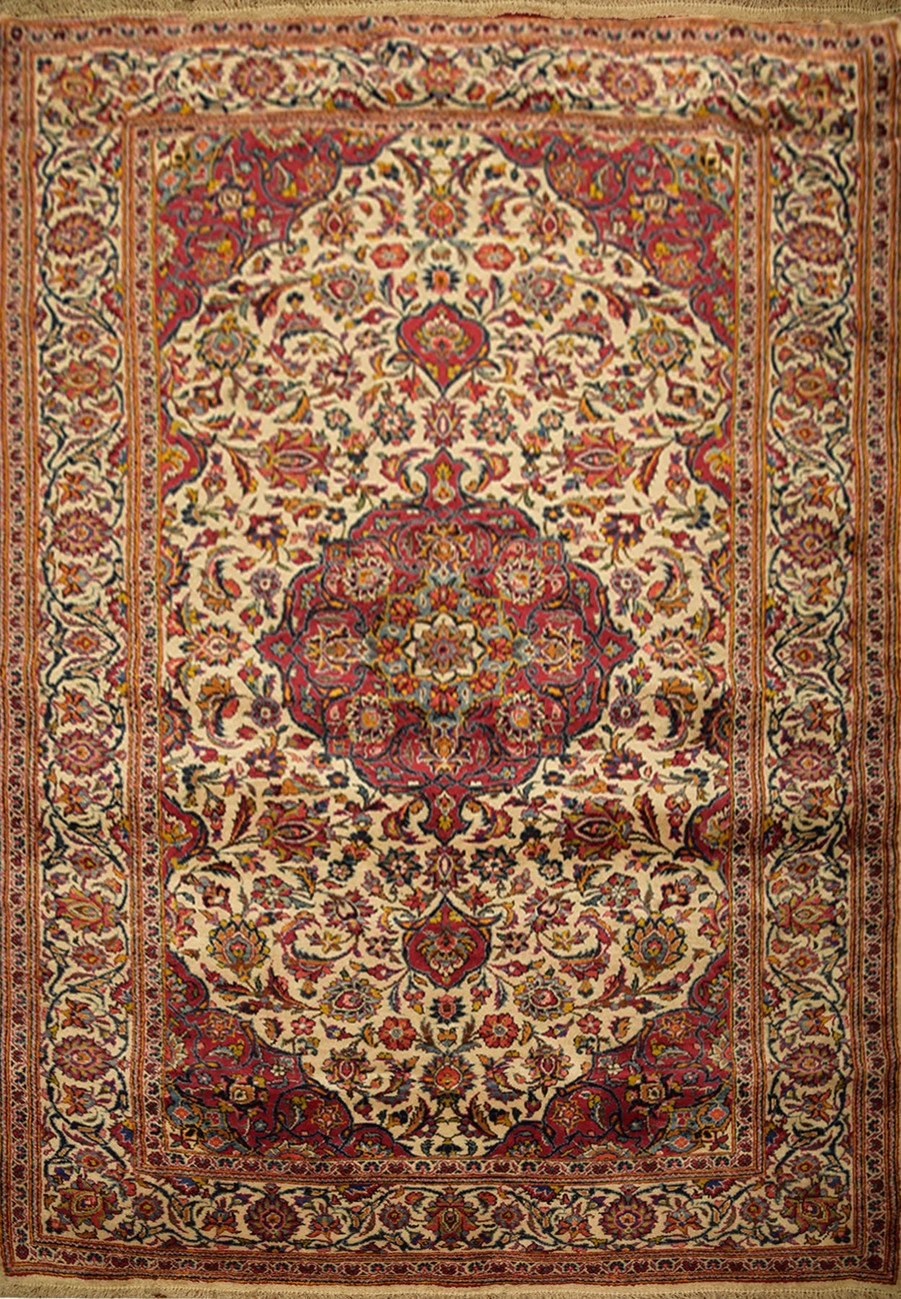
Good Workshop and Modern Kashan Rugs
These are exactly what real city-workshop Kashans should be at accessible price points. Genuine hand-knotted Persian rugs made with real wool, drawn from the classical Kashan vocabulary, woven by skilled hands. Excellent everyday rugs with real longevity in the room-defining sizes most American homes actually need.


How to Identify and Evaluate a Kashan Rug
Check the back. A genuine hand-knotted Kashan shows the full pattern on the back, with individual asymmetric Persian knots visible as a clean offset grid. The colors on the back are nearly as clear as on the front in fine pieces. There is no glued or stitched backing material. The fringes are continuations of the warp threads, not separately sewn on. If you lift a corner and see sewn-on fringe or a latex or canvas backing, the rug is not hand-knotted, regardless of what the label says.
Count the knots. Count knots on the back in one square inch, both vertically and horizontally, and multiply. 80 to 150 KPSI is commercial. 150 to 250 is good workshop. 250 to 400 is fine workshop, typically pre-revolution. 400+ is collector quality. 600+ is Mohtasham tier. This single number tells you more than any salesman’s pitch.
Feel the pile. Kork wool is warm under the hand, soft, slightly waxy from natural lanolin, and visibly lustrous when you tilt it to the light. Standard body wool feels more matte but still soft and substantial. Bamboo silk or art silk feels slippery and cool with an unnaturally bright sheen, which is the dead giveaway for a synthetic fiber being passed off as silk. Polyester or polypropylene feels plasticky and creates a crinkling sound when squeezed.
Read the drawing. A real Kashan from a serious workshop has drawing that holds at every scale. The curls of the arabesques flow smoothly without stepping. The medallion outlines are precisely symmetrical along both axes. The four corner spandrels mirror each other across the rug. The border corners turn cleanly. A copy or village imitation shows small drift, awkward asymmetries, and clumsy passages, especially in the spandrels and where the border meets at the corners.
Look for abrash. Abrash is the slight tonal variation in a field color caused by natural dye lot differences. In a pre-revolution Kashan dyed with madder or indigo, you will often see soft horizontal bands of slightly different red or blue tone running across the field. This is not a defect. It is the fingerprint of natural dyeing and one of the most reliable indicators of genuine age and traditional production. Synthetic-dye post-revolution pieces show perfectly uniform color with no abrash.
Ask the dealer directly. A real Kashan should come with a clear story: era, workshop or attribution, dye type, wool type, condition history. A seller who cannot or will not give you that information either does not know what they are selling or does not want you to know. Either way, walk.
Kashan vs. Other Persian City Rugs
| City | Typical KPSI | Scale | Character |
|---|---|---|---|
| Kashan | 120 to 600+ | Scatter to large | Formal medallion, deep red and navy, the visual default |
| Isfahan | 200 to 1000 | Standard sizes | Refined, ivory and warm tones, Kork and silk, signed masters |
| Qum | 300 to 1200 | Scatter to medium | Often full silk, jewel palette, treated as art objects |
| Tabriz | 80 to 1000 | Standard to large | Diverse designs, structured, northwest influence |
| Nain | 300 to 1000 | Standard sizes | Fine, pale palette, Kork and silk, arabesque |
| Mashad | 60 to 840 | Large format specialty | Grand medallion, deep reds and navies |
| Bijar | 100 to 600 | Standard sizes | Iron rugs of Persia, exceptionally dense, last centuries |