| Size in ft: | Width: 2'7" x Length: 13' |
| Size in Inch: | Width: 31" x Length: 156" |
| Size in meters: | Length: 3.96 x Width: 0.79 m |
| Colors: | Ivory, Navy Blue, Rust, Beige, Light Blue, Coral, Gold |
| Shape: | Runner |
| Woven: | 100% Hand-knotted | Handmade |
| Foundation: | Cotton |
| Pile: | Wool and Silk |
| Age: | Recent | Contemporary weave |
| Signature: | Woven cartouche at both ends | Reads "Esfahan" |
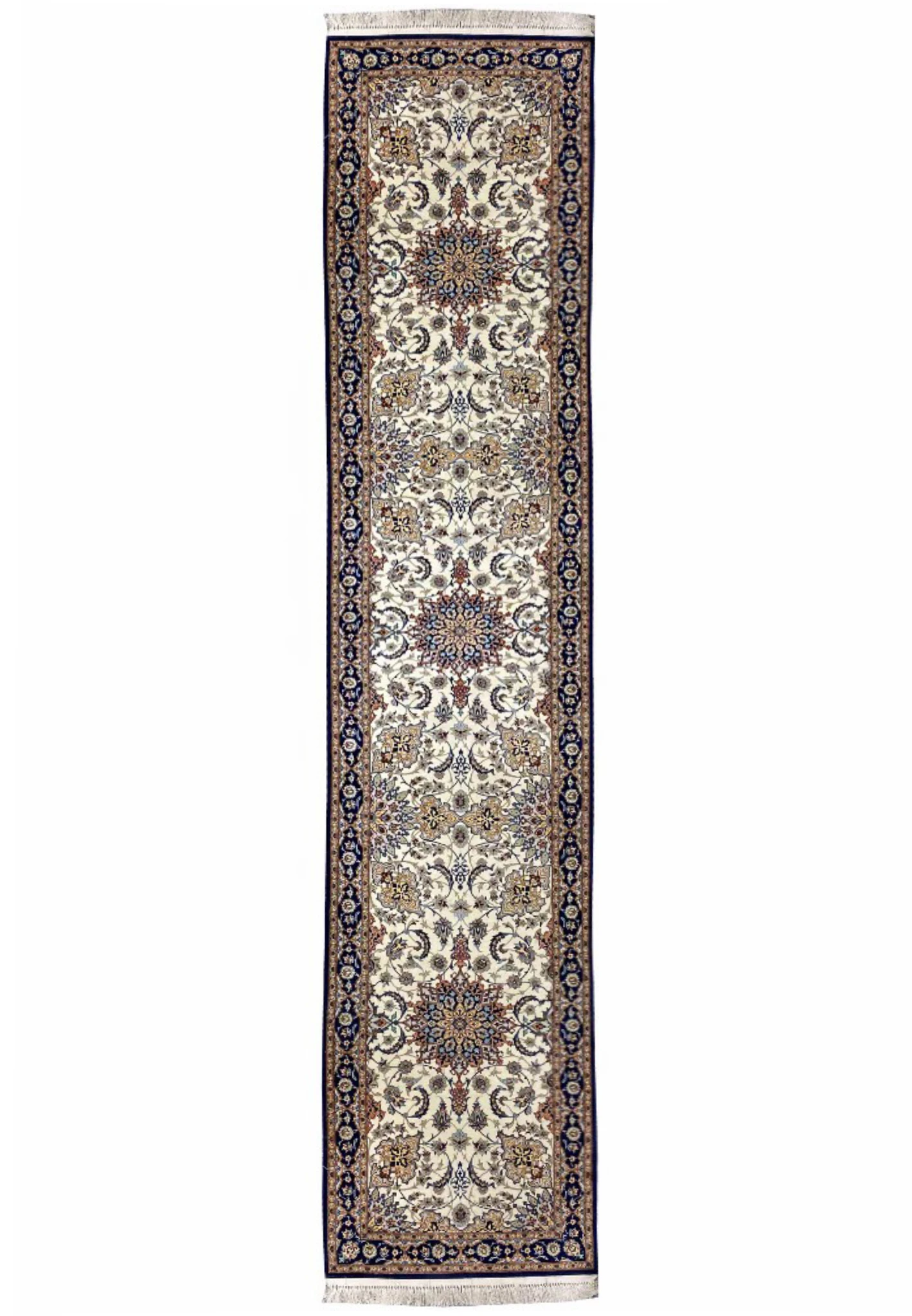
| Design: | Esfahan | 3 repeating star medallions | All-over floral vinework |
| Origin: | Persian Isfahan | Made in Persia |
| Condition: | Perfect | Full even pile |
2'7" x 13' Persian Isfahan Runner Rug | Ivory Wool and Silk Floral Medallions | Signed Cartouche
A 13 foot Isfahan runner is a workshop commission, not something a weaver produces on speculation, and this one shows why: 31 inches of width carrying a full city-workshop floral drawing without a single crowded passage. The pile is wool with silk worked into the highlights, knotted on a cotton foundation, and the weaver signed the piece in a woven cartouche at each end. The pile stands full and even, the selvedges are tight, and the cotton fringe has never been trimmed back, so this is a rug that has been stored rather than walked on. Rugs.net ships it with a certificate of authenticity. At this narrow width and this length it belongs in the class of Persian hallway runners that are genuinely hard to find in fine city weaves.
Design and Motifs
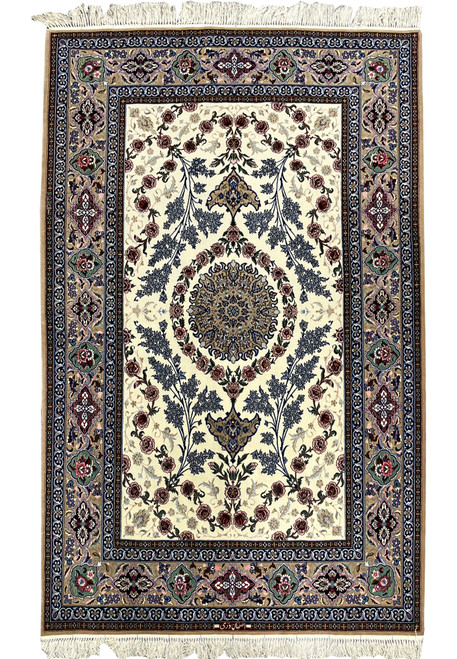
The layout repeats 3 star medallions down the length of the field, each one an 8 point form on a deep navy ground with a gold rosette at its heart, ringed by small light blue leaves and closed off by rust arabesque cartouches at every point. Between the medallions the ivory field carries a continuous system of thin curling vines, split palmettes, lotus heads and tiny rosettes, with paired gold and navy quatrefoil ornaments set at the field edges to act as corner anchors where a normal rug would have spandrels. The main border is navy, filled with alternating palmettes and lotus blossoms linked by a rust meander, and it is framed on both sides by narrow beige guard stripes of running vine. The drawing is symmetrical across the width and mirrored end to end, so the runner reads correctly whichever direction you walk it.
A Detailed Look at the Colors
The field is a clean warm ivory, closer to unbleached cream than white, and it is the reason the rest of the palette reads so clearly. Against it the borders and medallion grounds go to a deep inky navy blue, the darkest value in the rug. The mid tones do the work: rust and terracotta in the arabesques and the border meander, soft coral and salmon in the palmette petals, a pale powder blue in the leaves and cloud bands, sage grey in the small field rosettes, and butter gold in the medallion centers and the quatrefoil ornaments. Deep burgundy and small flecks of green appear as outlines and leaf tips, and beige and putty tones link the guard stripes to the field. The silk is where you see it in person rather than in photographs, catching light along the vine outlines and petal edges so those lines look lit from within while the surrounding wool stays matte.
Isfahan Origin and Weaving Quality
Isfahan sits in central Persia and has been the reference point for court quality weaving since the Safavid workshops of the 16th century. Its reputation rests entirely on drawing: the curved line, the flowing vine, the precision of a petal edge, and none of that is possible without a very small knot. That is the test a runner like this has to pass, because a narrow format gives the weaver nowhere to hide a stretched motif. Here the vines stay round, the medallion points stay sharp, and the border repeat holds its rhythm across all 13 feet. The signed cartouche at both ends places it in the workshop tradition rather than village production, which is the norm for serious Persian Isfahan rugs of this grade, and the fine cotton foundation keeps the rug flat and stable along its full length.