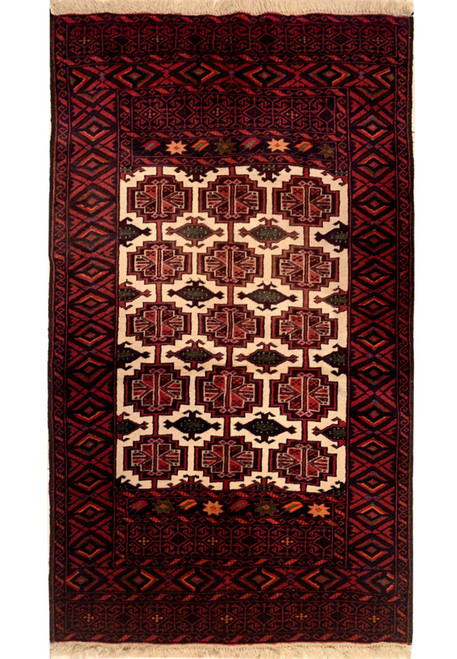
| Exact Size in ft: | Width: 3' x Length: 4'4" |
| Size in Inch: | Width: 36" x Length: 52" |
| Size in meters: | Length: 1.32 m x Width: 0.91 m |
| Some of many colors: | Crimson red, deep red, ivory, cream, black, dark navy, soft brown, camel, with subtle accents of rust orange |
| Woven: | 100% Hand-knotted | Handmade |
| Foundation: | 100% Wool |
| Pile: | 100% Wool |
| Pile Height: | 0.3 inch |
| Shape: | Rectangular |
| Style: | Tribal Prayer Rug |
| Origin: | Persian Baluch | Made in Persia |
| KPSI: | 120 - 140 |
| Condition: | Excellent | Never used |
3' x 4'4" Persian Baluch Tribal Prayer Rug | Tree of Life Mihrab | Crimson and Ivory | Hand-knotted Wool
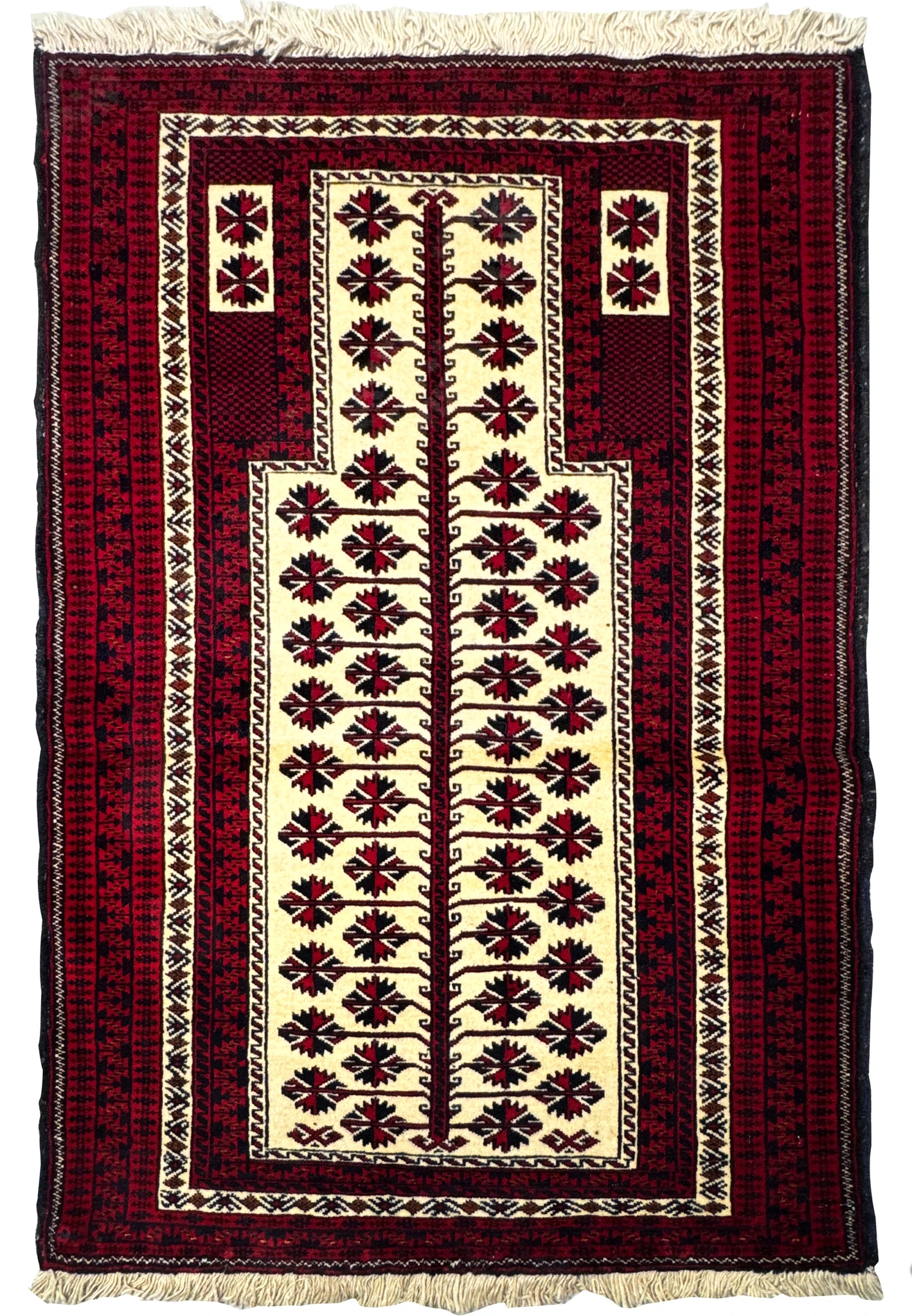
This 3' x 4'4" Persian Baluch is a true tribal prayer rug, hand-knotted by Baluchi nomads in the borderlands of eastern Iran on an all-wool foundation, with an all-wool pile at 120 to 140 KPSI and a low 0.3 inch pile height typical of working prayer rugs. The composition is dominated by a stepped mihrab arch enclosing a tall stylized tree of life rendered in geometric snowflake-like blossoms, set against a luminous ivory ground and framed by deep crimson borders. Two small floating panels in the upper spandrels mark the place where the worshipper's hands are laid during prayer. Baluch rugs are among the most authentic tribal weavings in the Persian world, and this one is unusually well-preserved.
Design and Motifs
The layout is a classic Baluch janamaz, the tribal prayer rug used by nomads to mark a clean ritual space wherever they happened to be. The dominant motif is the stepped mihrab arch, a geometric and terraced version of the niche found in mosque walls that points the worshipper toward Mecca. Inside the mihrab, a tall vertical stem rises from the bottom of the field and branches into roughly twenty pairs of stylized blossoms that resemble snowflakes or eight-pointed stars. This is the Baluch rendering of the tree of life, an ancient pre-Islamic Persian symbol of immortality and the connection between earth and heaven that nomadic weavers absorbed into their prayer rugs. Above the shoulders of the mihrab arch, two small ivory cartouches each contain two of the same star-blossom motifs and serve as hand panels, the spots where the worshipper places their palms during prostration. The dark ground above the arch represents the celestial space the prayer is directed toward. The wide outer border carries multiple narrow bands of repeating geometric pattern, including the classic Baluch zigzag latch-hook stripe, micro-checkerboard fields, and tiny tribal stars, with a final ivory guard stripe of running latch-hooks framing the whole composition. Every motif here belongs to the Baluch tribal vocabulary, where geometry replaces the curvilinear floral language of city workshops.
Colors and Placement
The palette is built on the unmistakable Baluch contrast of deep saturated red against natural undyed ivory, with black providing structural outline. The central mihrab field is rendered in warm ivory cream, the natural color of the local Baluchi sheep wool, undyed, which makes the field glow against the surrounding red borders. The tree of life stem and its connecting branches are drawn in dark crimson, while each star-blossom is filled with alternating crimson red, black, and ivory in a tight balanced palette. The two upper hand panels share the same ivory ground as the mihrab and carry the same red-and-black blossoms in miniature. The dark spandrels above the arch are woven in deep aubergine-black, which reads almost as midnight from a distance and provides the strongest tonal contrast in the rug. The main outer borders run in saturated tribal crimson, broken up by ivory zigzag guard stripes drawn in black-and-white latch-hook pattern, with tiny rust-orange and brown accents scattered through the border bands. The selvages are wrapped in the same dark navy that frames the spandrels, and the cotton fringes at top and bottom finish in natural ivory, giving the rug a clean tribal frame.
Persian Baluch Rugs and Construction
The Baluch are a semi-nomadic people whose traditional homeland straddles the rugged border region between eastern Iran (Sistan and Khorasan provinces), western Afghanistan, and southwestern Pakistan. Unlike the great Persian city workshops, Baluch weavers have always worked on small horizontal ground looms set up wherever the tribe pitched camp, which is why almost every authentic Baluch piece is a small-format rug, prayer rug, or saddlebag rather than a room-size piece. Baluch weavers use almost exclusively local wool for both the foundation and the pile, which gives their rugs a soft, slightly woolly hand and that characteristic deep, slightly muted color saturation. This rug is hand-knotted at 120 to 140 KPSI on an all-wool foundation, with the asymmetric Persian senneh knot used throughout, and a low 0.3 inch pile height that reflects its origin as a working prayer rug rather than a decorative showpiece. The math comes out to roughly 186,000 to 217,000 individual hand-tied knots across the 1.21 square meter surface. A piece this size at this density typically represents three to four months of work for a single tribal weaver, often done in stages between seasonal moves. The all-wool foundation makes Baluch rugs slightly more flexible and pliable than cotton-foundation pieces, which is exactly what nomadic weavers needed in a textile they could roll up, pack onto an animal, and unroll five times a day for prayer.