
| Size in ft: | Width: 3'4" x Length: 3'4" |
| Size in Inch: | Width: 40" x Length: 40" |
| Size in meters: | Length: 1.02 x Width: 1.02 m |
| Colors: | Creme, ivory, white, teal, burgundy, blue, navy blue, gray, brown, light brown |
| Shape: | |
| Woven: | 100% Hand-knotted | Handmade |
| Foundation: |
Cotton |
| Pile: | |
| KPSI: | |
| Origin: | |
| Condition: | Excellent | Never used |
3'4" x 3'4" Persian Nain Octagon Rug | Rare Star Shape | Ivory Ground | 260-280 KPSI
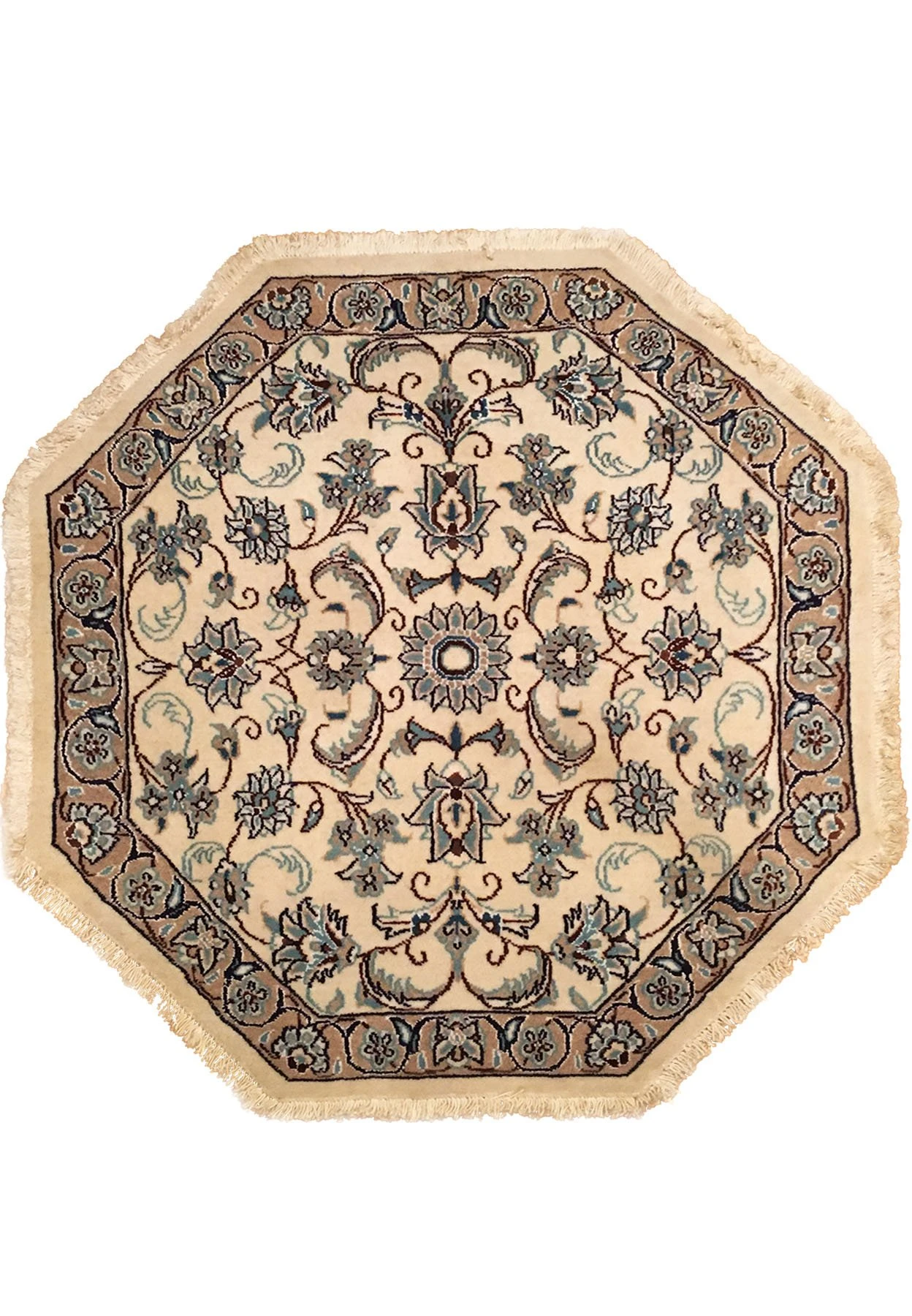
Octagons are genuinely rare in Persian weaving. A loom is built for a rectangle, so an 8 sided rug means the weaver has to plan the corner reductions into the cartoon from the first row and hold the symmetry across every one of the 8 sides as the width changes. Almost nobody bothers. This one comes out of Nain at 260 to 280 knots per square inch on a wool foundation, wool pile, 40 inches across the flats, and it has never been used. It ships with a certificate of authenticity.
Design and Motifs
The octagon format changes how the drawing has to work. A rectangle lets a weaver run a border straight and turn 4 square corners, but an 8 sided piece needs the border to turn twice as often, each time at a shallower angle, and the field pattern has to radiate from the center outward rather than repeat along a length. What that produces is a design that reads the same from every side of the room, with no top or bottom, which is exactly why octagon Persian rugs work so well under a round table or in the middle of an entry. Nain weaving is built for this kind of problem: the town's whole reputation rests on curvilinear drawing and on holding fine detail cleanly, and at 260 to 280 knots per square inch there is enough resolution here to carry the vine and blossom work all the way into the angled corners without the line breaking up.
The Color
The palette is the light Nain register rather than the heavy classical one. Creme, ivory and white carry the ground and the outlining, which is what keeps a small rug from feeling dense, and the pattern is drawn in teal, burgundy, blue and navy blue with gray, brown and light brown filling the shading. That mix is unusually easy to place. The creme and ivory keep it neutral against almost any floor, pale oak, dark walnut or stone, while the teal and burgundy give it enough color to register as a deliberate piece rather than a beige filler. Navy and gray do the quiet work of separating the motifs from the ground so the drawing stays legible at 40 inches across.
Nain and the Weaving
Nain sits on the edge of the central Persian desert, east of Isfahan, and it is a comparatively young weaving town. Production only began seriously in the 1930s, when the local fine textile trade collapsed and the workshops turned their looms to rugs. Because they came out of a cloth-weaving tradition rather than a village rug tradition, Nain weavers went straight to high knot counts and fine drawing, and within a generation the town was ranked alongside Isfahan and Qum. This piece carries that DNA in a shape you will almost never see from the region. Our complete guide to Persian Nain rugs covers the grading system and what separates the workshop pieces.


