
| Size in ft: | Width: 4'3" x Length: 6'2" |
| Size in Inch: | Width: 51" x Length: 74" |
| Size in meters: | Length: 1.88 x Width: 1.30 m |
| Colors: | Ivory, Gold, Coral Red, Sage Green, Olive, Teal Blue, Pink, Brown |
| Shape: | Rectangular |
| Woven: | 100% Hand-knotted | Handmade |
| Foundation: | Cotton |
| Pile: | Flat Weave | No Pile | Wool |
| Age: | 17th Century | Antique |
| Design: | Scenery | Pastoral Landscape | Floral Garland Border |
| Origin: | European Tapestry | Made in Europe |
| Condition: | Excellent | Perfect |
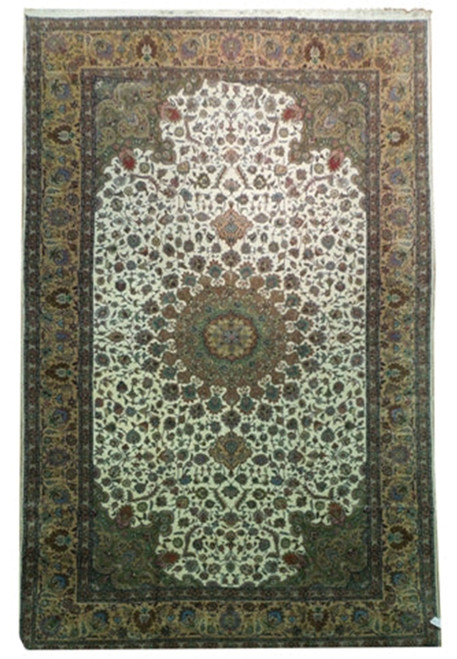
4'3" x 6'2" European Tapestry Rug | Pastoral Scenery with Shepherd Couple and Sheep | 17th Century Flat Weave
This 4'3" x 6'2" European tapestry is a woven picture rather than a pile weave, flat across its whole surface, and it tells a quiet pastoral story: a young man in a coral jacket and blue waistcoat reclining on the grass, a woman in a gold silk dress turned toward him, 3 sheep grazing around them, a dog asleep at their feet, and a hillside village dissolving into an ivory sky. Our records date the piece to the 17th century, and the drawing supports serious age, since the shading of the faces, the folds of the dress and the atmospheric haze behind the trees are the work of a weaver following a painter's cartoon thread by thread rather than a repeating grid. The condition is excellent and the surface reads clean and even into all 4 corners, with the original backing cloth and blue selvage bands intact. It ships with a certificate of authenticity. At this scale it works as framed wall art, as a table cover, or laid in a low traffic spot where other 4x6 rugs would go, and a genuine antique tapestry this small is far harder to find than a large one.
Please Note About the Photographs:
The first photograph shows the tapestry turned a quarter turn, so the figures appear to lie on their side. The scene is woven to read horizontally, exactly as it appears in the full view and in the detail photographs that follow. Nothing is distorted or damaged, it is simply a rotated photograph of a landscape format panel.
Design and Motifs
The field is a single continuous scene with no repeat anywhere in it. A broad oak rises at the right edge, its trunk crossing the sky, and behind it sits a low stone wall with a ram standing beside it. To the left the ground falls away to water, then to farm buildings with red tile roofs, then to faint mountains. The figure group sits at the center on an open patch of pale grass: the shepherd stretched out with one leg extended, his sleeping hound in front of him, the shepherdess seated upright with her hands folded, a ewe resting behind them. Large pale leaves and curling blue tipped reeds fill the lower corners and frame the scene the way a painter would use foreground foliage. The border is built in 3 stages. A thin orange fillet closes the field, then a dark brown band carries a running garland of acanthus scrolls, cream daisies, yellow ribbon knots and full pink roses, one rose set square in each corner. A plain teal blue flat woven band finishes the outer edge. The 8 petal rosettes and the scrolled corner cartouches in that garland are the same vocabulary used on French tapestry surrounds of the period.
Color Palette: Gold, Coral and Sage Against an Ivory Sky
The palette is soft and tonal, built out of naturally faded vegetal shades rather than strong contrast. The sky is a warm ivory that shifts to grey and dusty lilac near the horizon, and that light ground is what makes the whole panel feel open on a wall. The trees run through an unusually wide range of greens: bright chartreuse and lemon on the sunlit leaf tips, sage and olive in the mass of foliage, and a deep blue green, almost black in places, in the shadows. The woman's dress is the loudest note, a saffron gold worked with amber, ochre and cream highlights so the silk appears to catch light, over an ivory chemise and a wine red bodice. The man answers it in coral red and rose madder with a slate blue waistcoat, white stockings and tan shoes. The sheep and the dog are woven in cream, buff and pale apricot. In the border, brown and dark chocolate carry the garland, with butter yellow ribbons, blush pink roses, cream flowers and small green leaves, and the outer band is a clear teal blue that reads almost denim in the fold photograph. Browns, rust and mossy greens anchor the lower field.
Origin and Weave: A European Flat Woven Tapestry
This is a European tapestry, made in Europe, and it is a different craft from the knotted pieces most collectors know, which is worth understanding before you buy. There is no pile and no knot count to quote. Instead the colored wool wefts are packed by hand across a fixed warp and only where that color belongs, so the picture is the fabric itself, which is why the reverse shows the same image in reverse and the surface stays thin, flexible and light enough to hang. The ribbed texture visible in the close photographs is the warp showing through, the sign of a true tapestry weave rather than an embroidered or printed panel. That technique is also the reason the shading works: a skilled workshop weaver blends 2 tones together in the same pass to model a cheek or a fold of gold silk, and it is slow, painterly work. If you want to understand what separates this type of weaving from knotted pile goods, read the difference between Persian and Oriental rugs, and for the structural clues that place a piece in a period, see our guide on how to date an Oriental rug. Antique tapestries of this quality were commissioned pieces, woven a few inches a day, and this one has survived with its scene, its garland border and its blue outer bands complete.