
| Exact Size in ft: | Width: 4'5" x Length: 7'2" |
| Size in Inch: | Width: 53" x Length: 86" |
| Size in meters: | Length: 2.20 m x Width: 1.36 m |
| Some of many colors: | Brick red, terracotta, ivory, cream, midnight navy, sky blue, mustard gold, olive green, soft camel, accents of pink and rust orange |
| Woven: | 100% Hand-knotted | Handmade |
| Foundation: | 100% Cotton |
| Pile: | 100% Kork Wool |
| Pile Height: | 0.35 inch |
| Shape: | Rectangular |
| Style: | Geometric Allover octagonal stars |
| Origin: | Persian Qum | Made in Persia |
| KPSI: | 400 |
| Condition: | Excellent | Never used |
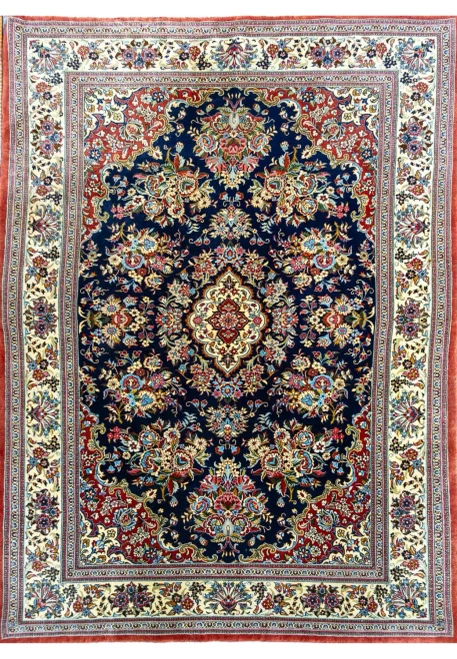
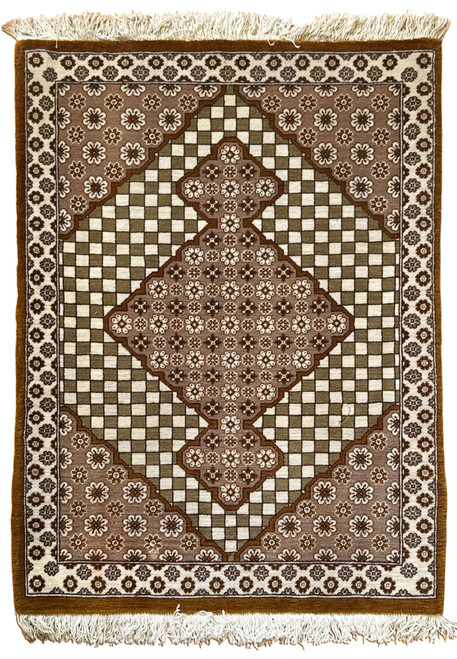
4'5" x 7'2" Persian Qum Kork Wool Rug | Geometric Allover Tribal | Ivory and Brick Red | 400 KPSI
This 4'5" x 7'2" Persian Qum is hand-knotted from pure kork wool, the rare ultra-fine fleece taken from the throat and underbelly of the lamb, on a cotton foundation at an exceptional 400 knots per square inch. The composition departs from the curvilinear floral style typically associated with Qum and instead presents a fully geometric allover field, drawn in the Caucasian-influenced tribal vocabulary that Qum master workshops occasionally produce for collectors who want the fineness of a Qum weave with the bold visual energy of a Shirvan or Kazak. The ivory ground is densely populated with octagonal star rosettes, arrow-tipped palmettes, and serrated diamond medallions, all contained within a wide brick-red main border carrying the same geometric vocabulary at larger scale. Read more in our introduction to Persian Qum guide.
Design and Motifs
The layout is a fully covered geometric allover field, a design vocabulary that originated in the Caucasus mountains and traveled south into Iran where city workshops, including Qum, occasionally render it at master quality. There is no central medallion in the conventional sense; instead the field is built from a vertical sequence of large stepped diamond compartments, each one anchored by paired octagonal star rosettes (called "gul" in tribal weaving) flanked by arrow-tipped palmettes and serrated leaves. Between each major compartment, narrow horizontal bands carry rust-red rectangular cartouches filled with smaller star motifs, creating a rhythmic pulse from one end of the rug to the other. Tiny scattered geometric figures, including stylized birds, comb motifs, and eight-pointed stars, fill every interstitial space across the ivory ground. The wide outer main border carries a row of large square cartouches alternating between ivory and brick-red grounds, each containing a serrated diamond rosette inside a stepped frame, in the unmistakable Caucasian Shirvan border tradition. Multiple narrow guard stripes border the main field, including a sky-blue running latch-hook stripe and an ivory zigzag minor border. The overall effect is tribal energy at city-workshop fineness, the kind of piece that catches the eye of serious collectors precisely because it breaks the expected Qum vocabulary while maintaining Qum-level technical execution.
Colors and Placement
The palette is built on a luminous ivory ground with deep brick-red and midnight navy doing the structural work, accented by a chorus of secondary blues, golds, and greens. The main field is rendered in soft cream wool, almost candlelit in tone, against which the dark navy octagonal star rosettes and brick-red palmettes sit with strong tonal contrast. Each octagonal gul carries a small ivory eight-pointed star at its core, surrounded by mustard gold, sky blue, and rust accents woven into the petals. The serrated diamond medallions running through the center of the field shift between brick-red and navy grounds, with golden yellow zigzag arrows pointing outward and small accents of olive green and pink touching the inner figures. The horizontal bands separating the major compartments are rendered in saturated brick-red with mustard gold and ivory geometric infill. The four corner zones of the rug do not break the pattern but allow the allover composition to extend uninterrupted to the borders. The main outer border runs in the same ivory ground as the field, carrying alternating brick-red and ivory square cartouches with diamond rosettes drawn in navy, mustard, and pale blue. The narrow inner guard stripe is a sky-blue band of running latch-hooks, and the very outermost minor stripe is a tiny zigzag in ivory and red. The selvages are wrapped in brick-red wool, and the ivory cotton fringes finish both ends of the rug with the clean precision typical of Qum master construction.
Persian Qum Rugs and Construction
Qum is the youngest of Persia's great weaving cities. Large-scale rug production only began there in the 1930s, but the city established itself within a single generation as the finest workshop tradition in modern Iran, drawing master weavers from Kashan, Isfahan, and Tabriz to a holy city long associated with pilgrimage and royal patronage. Qum is best known internationally for its pure silk floral rugs, but Qum kork wool pieces are equally prized, and Qum master workshops occasionally produce in alternative vocabularies, including this geometric Caucasian-influenced style, to demonstrate the full range of what their weavers can execute. Kork is the throat and underbelly fleece of the lamb, the softest and longest-stapled wool the animal produces. It is hand-spun extremely fine, takes dye with silk-like luster, and ages into a soft sheen that ordinary mountain wool cannot match. This rug is hand-knotted at 400 KPSI, which translates to roughly 620,000 knots per square meter, and over 1.8 million individual hand-tied knots across the full 2.94 square meter surface. The pile is a moderate 0.35 inch high, struck for a balance between visual depth and the sharp pattern definition that Qum workshops are famous for. The Persian senneh asymmetric knot is used throughout, allowing tight definition of the geometric edges and clean rendering of the small interstitial figures. Construction of a kork Qum at this density typically represents ten to fourteen months of work for a single weaver. Read more in our introduction to Persian Qum guide.