
| Exact Size in ft: | Width: 4'10" x Length: 7'3" |
| Size in Inch: | Width: 58" x Length: 87" |
| Size in meters: | Length: 2.23 m x Width: 1.47 m |
| Some of many colors: | Antique ivory, soft cream, brick red, terracotta, midnight navy, sapphire blue, sky blue, forest green, deep teal, soft pink, rose, camel, mustard gold, accents of black |
| Woven: | 100% Hand-knotted | Handmade |
| Foundation: | 100% Cotton |
| Pile: | Kork Wool with Silk Highlights |
| Workshop: | Shureshi Workshop, Isfahan |
| Designer: | Mirza Agha Emami |
| Shape: | Rectangular |
| Style: | Directional Vase and Medallion with Facing Peacocks |
| Origin: | Persian Isfahan | Made in Persia |
| Age: | Approximately 100 years old | Antique |
| Knot Density: | 10 x 10 per cm | 100 knots per cm² |
| KPSI: | 640 - 650 |
| Condition: | Very good antique condition |
4'10" x 7'3" Antique Persian Isfahan Shureshi Workshop Rug | Mirza Agha Emami Design | Directional Vase and Medallion with Facing Peacocks | 100 Years Old | 650 KPSI
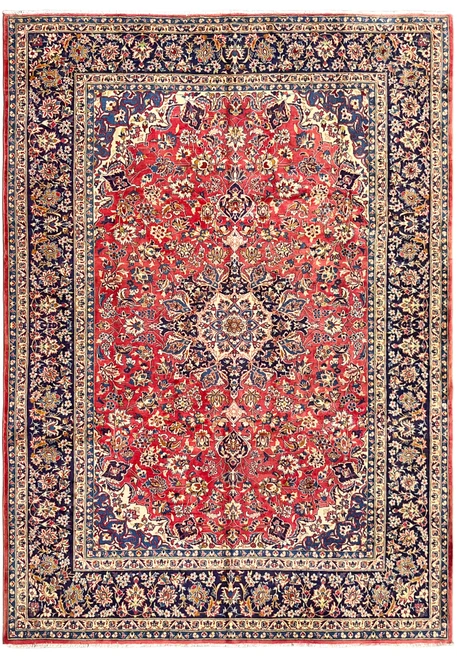
This is a documented collector's piece, a 4'10" x 7'3" antique Persian Isfahan rug woven approximately 100 years ago in the legendary Shureshi workshop of Isfahan, with a directional vase-and-medallion composition attributed to Mirza Agha Emami, the most influential Isfahan carpet designer of the early 20th century. The rug is hand-knotted in fine kork wool with silk highlights on a cotton foundation at an exceptional 10 x 10 knot density per centimeter, equivalent to 645 KPSI or 1 million knots per square meter. Inside the central red medallion are two facing peacocks, the signature animal motif of Shureshi production. The rug is in very good antique condition with full pile across the field. Read more in our complete guide to Isfahan rugs.
Design and Motifs
The composition is a classical Isfahan directional toranj-and-goldan layout, a vertically oriented design type that reads as a vase of flowers rising from the lower field toward a central crowned medallion. At the heart of the rug sits an elongated lobed cartouche medallion drawn in deep brick red, framed in a serrated sapphire-blue contour, with a small finial at top and bottom. The medallion is filled with curling vines and palmettes, and inside the lower half of the medallion stand two facing peacocks rendered in forest green and teal with sky blue breasts and pink accent crests, their tails arching upward to fill the medallion's interior. Facing peacocks inside the medallion are one of the most recognized signature motifs of the Shureshi workshop and a hallmark Mirza Agha Emami detail, drawn from the Safavid garden tradition where the peacock symbolizes immortality and royal paradise. Above the medallion sits a small crowning floral cartouche, and below it descends a vertical floral spine that terminates in a stylized vase or goldan flanked by two large paisley boteh forms in the lower field. Four additional large paisley boteh sit symmetrically in the upper and lower quadrants of the field, drawn in the elegant elongated Isfahan boteh style. The entire ivory field is filled around these elements with a delicate scrolling vinework carrying small palmettes, lotus blossoms, half-rosettes, sky-blue forget-me-nots, and tiny pink rosebuds in the impossibly fine drawing that defines first-tier Isfahan production. The wide brick-red main border carries a classical turning-vine repeat with alternating large palmettes and small floral cartouches, framed by ivory inner and outer guard stripes carrying small repeating rosette-and-vine motifs, and finished with a final narrow navy stripe.
Colors and Placement
The palette is the classical Isfahan formal trio of antique ivory, deep brick red, and midnight navy, lifted by sapphire blue, sky blue, forest green, soft pink, and mustard gold accents drawn in remarkably fine detail. The vast field is woven in a soft warm ivory kork wool that has aged into a luminous cream tone with the gentle natural patina that only a hundred years of careful keeping produces. Against this ivory ground, the central medallion glows in a saturated brick red made from natural madder dye, with the two facing peacocks rendered in deep forest green and teal wool, their breasts in sky blue, their tail crests touched with rose pink and ivory accents that some weavers achieved using small areas of silk highlighting for extra luster. The four large paisley boteh in the field are drawn in alternating sapphire blue and brick red outlines with their interiors filled in soft sky blue, ivory, and rose. The scrolling vinework that fills the rest of the ivory field carries palmettes in brick red and sapphire, lotus blossoms in deep navy and rose, sky-blue forget-me-nots, and small mustard-gold buds, all drawn at miniature scale. The wide main border carries the brick red ground forward, with the turning-vine palmettes rendered in sapphire blue, ivory, forest green, and rose, the small alternating rosettes in cream and sky blue. The ivory inner guard stripe carries a delicate rosebud-and-vine repeat in pink, sky blue, and navy. The selvages are wrapped in deep coral red wool, and the cotton fringes have aged into a soft natural ivory. The whole color story reads as a Persian formal garden at dawn, a controlled and sophisticated palette without the saturation excesses of less serious Isfahan production.
Persian Isfahan Rugs and Construction
Isfahan was the imperial capital of Safavid Persia in the 16th and 17th centuries, the city where Shah Abbas the Great established the royal court workshops that produced the finest carpets ever woven. After centuries of decline, Isfahan rug production was revived in the early 20th century by a small group of master weavers and designers who consciously returned to Safavid drawing standards. The Shureshi workshop, founded in this revival period, became the most prestigious Isfahan workshop of the 20th century, and Mirza Agha Emami became the most influential Isfahan carpet designer of his era, working closely with Shureshi on the workshop's most ambitious commissions. Pieces from this collaboration are among the most collected antique Persian rugs in the world today, regularly appearing in major auction houses and private museum collections. This rug, woven approximately 100 years ago, dates to the early Shureshi production period when the workshop was still using cotton foundations rather than the silk foundations that became standard in later Shureshi work, making it one of the foundational pieces of the workshop's documented output. The rug is hand-knotted at 10 x 10 knots per centimeter, equivalent to 100 knots per square centimeter or 645 KPSI, and approximately 1 million individual hand-tied knots across the full 3.25 square meter surface. The pile is fine kork wool, the rare ultra-soft throat fleece of the lamb, with small areas of silk highlighting woven into the lighter motifs to add subtle luster where it catches the light. The Persian senneh asymmetric knot is used throughout, allowing the workshop's signature miniature drawing of vines, peacocks, and palmettes at a level of detail comparable to Persian manuscript painting. Construction of a Shureshi piece at this density represents two to three years of work for a master weaver, and an antique Shureshi in this condition represents one of the most serious investment-grade Persian rugs available outside of museum collections. Read more in our complete guide to Isfahan rugs.