
| Size in ft: | Width: 6' x Length: 9'5" |
| Size in Inch: | Width: 72" x Length: 113" |
| Size in meters: | Length: 2.87 x Width: 1.83 m |
| Colors: | Burgundy, Magenta, Black, Teal, Sky Blue, Ivory, Gold, Lavender |
| Shape: | Rectangular |
| Woven: | 100% Hand-knotted | Handmade |
| Foundation: | Silk |
| Pile: | 100% Silk |
| Age: | New | Never used |
| Signature: | Woven cartouche in the ivory end border |
| Design: | Hereke | Radiating Petal Medallion | Paisley Vine Border |
| Origin: | Made in China |
| Condition: | Perfect | Never used |
6' x 9'5" Silk Hereke Design Rug | Burgundy Field with Teal Medallion | Signed & Never Used
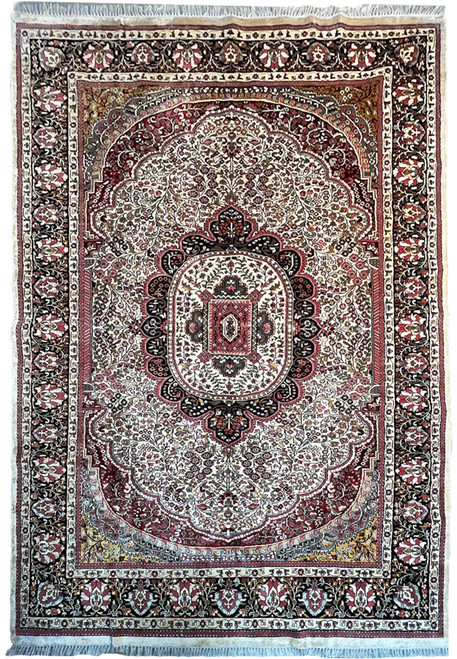
This 6' x 9'5" rug is knotted entirely in silk, front and back, and it behaves the way only a silk pile does: the burgundy field goes almost black when you walk one way around it and flares to wine and magenta when you turn. The drawing follows the Hereke tradition, a tightly controlled medallion composition with a paisley vine border, and the weaver finished it with a small cartouche signature set into the ivory end border. It has never been on a floor. Every piece we sell ships with a certificate of authenticity that records the weave, the fibre and the measurements, and at this size it sits comfortably in the same footprint as our other 6x9 rugs.
Please Note About the Photographs:
Silk reflects light differently depending on which end you view it from, so the field photographs as deep near-black wine in the straight overhead shot and as a brighter magenta in the angled and close-up images. Both readings are the same rug and the same dye lot. Nothing has been edited, faded or colour corrected, and the pile will shift tone in your room exactly the same way as the light moves across it.
Design and Motifs
The centre is a radiating petal medallion, a ring of long lancet-shaped lobes that fan out from a black knotted core like the spokes of a sunburst. Each petal is filled with its own miniature arabesque, scrolling vine and split-leaf tracery outlined in champagne gold, and the petals are separated by fine rose-pink hairlines so the eye can follow every single one. At the exact centre sits a dark interlaced rosette with a small red and gold flower at its heart, shown in close-up. Around the medallion the field is not empty: it carries a dense all-over curling vine in the same tone as the ground, so it reads as texture up close and as solid colour from standing height. The main border is a continuous paisley vine, large boteh forms with dotted outlines and flower heads tucked inside their curves, flanked by narrow floral guard stripes, a diamond and triangle stripe, and a final row of small rosettes that runs right up to the fringe. The signature cartouche sits in that outer rosette row at one end.
The Burgundy and Teal Palette
The field is burgundy laid over a near-black ground, which is why the vinework reads magenta and raspberry where the light catches it and drops to aubergine and black where it does not. Against that dark ground the medallion is deliberately cool: teal and peacock blue in the deepest petals, stepping up through turquoise and pale sky blue to almost white ivory in the petals at the top of the fan, with warm gold and cream picking out every scroll. The core rosette is charcoal black with ivory tracery and a single crimson and gold flower. The border reverses the balance, putting pale ice blue and soft lavender-grey in the main band with burgundy and black filling the paisley interiors, and the outer guard stripe is a pale mushroom-pink that frames the whole thing and softens the transition to the ivory silk fringe. It is a bold, saturated palette rather than a quiet one, and it works best in a room that already has some depth to it, dark wood, deep upholstery or a strong wall colour.
Hereke Drawing, Silk Weaving and Origin
Hereke is a design language before it is a place name in this context: a court-workshop style built on fine, curved line work and a medallion that has to be drawn with real precision or it falls apart. This piece was hand-knotted in China, where a great deal of the world's finest silk weaving is now done, and the workshop has held the drawing tight all the way through, including the hardest part, the corner resolution of the paisley border, which meets cleanly at all 4 corners. The close-up images show why silk is used for this kind of pattern: the knots are small enough to carry a scroll only 2 or 3 knots wide, and the fibre gives the tracery a shine that wool cannot. The back shows an even, tight weave with no slack rows. As an Oriental rug in pure silk at 6' x 9'5", it is as much a wall piece as a floor piece, and plenty of buyers hang this weight of silk rather than walk on it.