
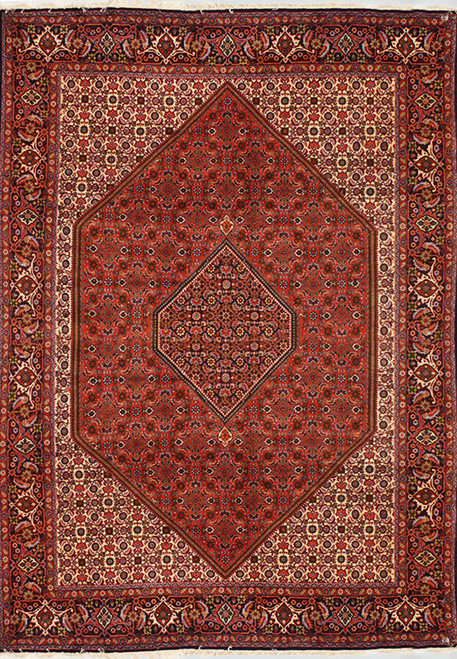
| Exact size in ft: | Width: 6'63" x Length 9'91" |
| Size in meters: | Length: 3.02 x Width: 2.03 |
| Some of many colors in this rug: | Navy Blue, Rusty Red, Beige, Dark Green, Brown, Blue, Green, Skin Color, Dark Red, Pink, Rose-Red, Purple, Light Blue, Wine Red |
| Woven: | 100% Handmade and Hand-knotted |
| Foundation: | Cotton |
| Pile: | Wool |
| Shape: | Rectangle |
| Style: | Traditional |
| Origin: | Persian Bijar |
| KPSI | 340 - 360 |
| Condition: | Excellent | never used |
Bijar rugs - strong, durable carpeting. Bijar Rugs are like tanks!!! You will love them as soon as it arrives in your Living room, Bedroom or Den.
Iran has been the worldwide leader in producing a wide variety
of high quality handmade rugs of distinctive designs for decades.
So many rugs have come from Iran that Persian Rug and Oriental Rug” has come to
mean the same thing to many people. There is a need to carefully differentiate between
the two however. Oriental Rugs; come from India, Pakistan, China, or elsewhere, but a
Persian Bijar Rug can only come from Iran.
They usually have all-over repeating Herati, as well as floras, ornate designs, and
medallions. Only the carpets and rugs from the designer Tajhavi and from the little
village Halvai are flexible enough to be easily folded. For the third group - the Afshar-
Bidjars - the weavers often use the famous Herati motif.
A well made Bijar Rug or carpet can go well with antique furniture, and also complement modern and contemporary furniture.
Ground colors are well balanced in a Bijar Rug; produced by blending subtle shaded
patterns. Dark blue and a strong red prevail. Brown and yellow are also common, but
green is rare. Some old rugs are woven with a combining of light and dark blue.
Persian Rugs have a unique weave that uses a balanced Turkish knot and double weft
tightly compressed, thus making them weighty and lasting rugs. The unique horizontal
thread system used in the Irani area originated the term Bijar structure. The strong
tightness of the wefts pulls the vertical threads into two layers, giving the carpet rigidity.
Because the fibers are always upright, it has a cushioned feel that makes it great to walk upon. For the part of the market that wants comfort, this is an important feature.
Most Bijar Rugs are woven by Kurd and Afshar weavers of the Gerus region around the
town in western Iran. This is one of the fertile areas of Kurdestan. Its climate is cold and
dry in winter and moderate in summer.
Although this small Kurdish town has a population of less than 10,000, its woven carpets have gained it an international reputation. This reputation has led to a clear division being made between the carpets woven in town workshops and the Tekab-Bijar, which are woven by an Afshari tribe that live in the area.


