
A $50 Rug vs. a $5,000 Rug What You Are Actually Buying
Posted by Rugs.net on Apr 10th 2026
Walk into a big-box furniture store and you will find a 8 x 10 rug for $79. Walk into Rugs.net and you will find a handmade Persian rug of the same size for $1,800. Walk into a fine gallery in New York and the same footprint in a signed Isfahan or Qum silk might cost $25,000.
These are not three versions of the same product at different price points, the way a budget laptop and a premium laptop are still both laptops. They are three fundamentally different objects with almost nothing in common except that they go on a floor. Understanding why requires understanding what each one actually is: how it was made, what it is made from, how long it took, and what happens to it over time.
This guide explains the real difference. It is written by Rugs.net, a direct importer of authentic handmade Persian and oriental rugs, because we believe an educated customer makes a better decision, and because the difference is genuinely extraordinary once you understand it.
What a Machine-Made Rug Actually Is
A machine-made rug is a textile produced on a power loom, typically in a factory in Belgium, Turkey, or China, at a rate of hundreds of square feet per hour. The process is almost entirely automated. A computerized design file is fed into the loom, and the machine weaves or tufts the pattern at high speed using synthetic fibers, usually polypropylene, polyester, or nylon, though some use synthetic blends marketed as “wool-look.”
Most machine-made rugs sold today are not technically woven at all. The majority use a process called tufting: a mechanical gun punches synthetic yarn through a pre-made backing fabric, creating loops that are then cut to create pile. The tufted structure has no structural integrity on its own, which is why you will always find a latex or glue backing on hand-tufted and machine-tufted rugs. The backing holds the pile in place because the pile is not structurally tied to anything. It is, in the most literal sense, glued on.
The implications of this construction method define everything about what a machine-made rug is and how it ages:
What Happens to a Machine-Made Rug Over Time
Year 1 to 2: Looks acceptable
The synthetic pile holds its initial appearance. Color is consistent, surface looks uniform.
Year 2 to 4: Crushing and matting begins
Synthetic fibers have no resilience memory. High-traffic areas flatten and stay flat. The pile does not spring back.
Year 4 to 7: Latex backing begins to deteriorate
The glue that holds the pile begins to break down, particularly in warm or humid conditions. Pile starts to shed. The rug may begin to smell.
Year 7 to 10: End of usable life
The rug has matted, faded, shed significant pile, and the backing is failing. Most machine-made rugs are discarded well before this point.
Residual value: Zero
A machine-made rug has no resale value at any age. It goes to landfill. It is a consumable, not an asset.
This is not a criticism. A $79 rug is not pretending to be anything other than what it is: a short-term decorative floor covering at a very low upfront cost. The problem arises when a $200 or $500 machine-made rug is sold with language like “heirloom quality” or “traditional design” that implies a category of value it cannot deliver. At $200, you are still buying a consumable object with a lifespan of three to seven years.
What a Handmade Rug Actually Is
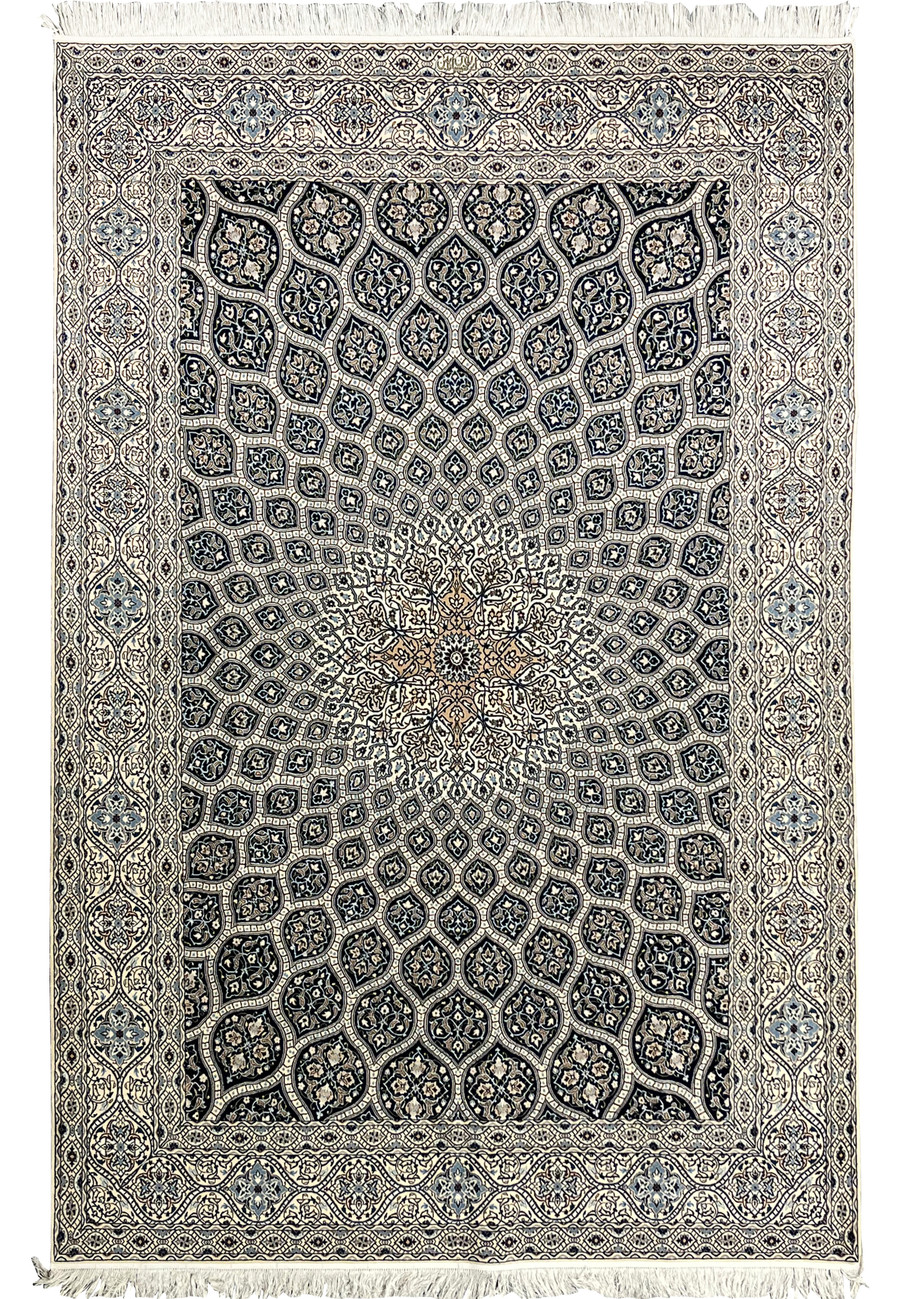
6'9 x 10 Persian Nain Habibian 6 LA Kork and Silk Gombadi Rug. Every detail in this rug was tied by hand, one knot at a time, by a master weaver in Nain, Iran. A piece like this takes between 12 and 18 months to complete.
An authentic hand-knotted rug is made by a human being sitting at a loom, tying individual knots of wool or silk around the warp threads of the foundation, one at a time, across the entire surface of the rug. Nothing in this process is automated. Every knot is placed by hand, cut by hand, and packed down by hand.
The density of this knotting is measured in KPSI: knots per square inch. A basic handmade tribal rug might have 40 to 80 KPSI. A fine city rug like a Kashan or Isfahan typically has 150 to 300 KPSI. The finest Nain 6 LA pieces run 300 to 500 KPSI. A museum-quality Qum silk rug can reach 700 to 900 KPSI. At 900 KPSI, there are 900 individual hand-tied knots in every single square inch of the rug. A 4 x 6 rug at that density contains over 31 million knots, every one of them tied by a human hand.
The time required to produce this is the fundamental economic reality behind the price. A skilled weaver working full-time can tie between 8,000 and 14,000 knots per day depending on the design complexity and their experience. At those rates:
| Rug Type | KPSI | Time to Weave (9x12) | Total Knots |
|---|---|---|---|
| Persian Tribal / Village | 40 to 80 | 4 to 8 months | 4 to 8 million |
| Persian City Rug (Kashan, Mashad) | 120 to 200 | 10 to 18 months | 12 to 20 million |
| Fine City Rug (Isfahan, Nain 6 LA) | 200 to 400 | 18 months to 3 years | 20 to 40 million |
| Collector Piece (Qum Silk, signed Isfahan) | 400 to 900+ | 3 to 7 years | 40 to 90+ million |
These are not approximations. A signed Isfahan rug at 300 KPSI in a 9 x 12 format contains approximately 30 million individual hand-tied knots and takes a skilled weaver working full-time somewhere between 18 months and three years to complete. The price of that rug reflects that labor. When you pay $8,000 for a piece like that, a significant portion of what you are paying for is thousands of hours of extraordinarily skilled human work.
The Materials: Polypropylene vs. Kork Wool and Silk
The fiber difference alone explains much of the price and performance gap. Machine-made rugs use synthetic materials almost exclusively. Fine handmade rugs use wool, silk, or both.
Machine-Made: Polypropylene
Petroleum-derived plastic fiber. No natural resilience. Flattens under foot traffic and stays flat.
Colors fade under UV within 2 to 4 years. Cannot be properly washed. Generates static.
Non-biodegradable. Ends up in landfill.
Handmade: Kork Wool and Silk
Kork wool: the finest natural fiber in rug production. Natural lanolin repels moisture and stains.
Natural crimp gives wool memory: springs back after compression for decades. Colors deepen with age.
Fully biodegradable. Increases in value with age.
Silk is used in the finest Persian rugs either as the sole pile material (in Qum silk rugs) or as highlight threads woven into a wool pile to catch light and define detail. Pure silk allows knot densities that wool cannot achieve, which is why the most intricate designs in Persian rug history are woven in silk. A silk pile also has a directional quality, meaning it appears to change color as you view it from different angles, an optical property called lustre play that no synthetic material can replicate.
The natural dyes used in fine handmade rugs, derived from pomegranate rind, madder root, indigo, and other plant and mineral sources, have a depth and complexity that synthetic dyes cannot reproduce. Natural dyes also age in a specific way: rather than fading evenly to a washed-out version of the original color, they develop a patina called abrash where slightly different dye lots create subtle tonal variation across the field. This variation, once understood, is recognized as a marker of authenticity and actually increases in visual interest over time.
What Each Price Tier Actually Gets You
Here is an honest breakdown of what you are buying at each price level, stated plainly.

The True Cost Calculation Over 25 Years
The most common objection to a quality handmade rug is the upfront cost. But consider the 25-year cost comparison for a living room rug:
| Option | Cost per Purchase | Replacements in 25 yrs | 25-Year Total Spent | Value at Year 25 |
|---|---|---|---|---|
| Machine-made $200 | $200 | 4 to 5 replacements | $800 to $1,000 | $0 |
| Machine-made $500 | $500 | 3 to 4 replacements | $1,500 to $2,000 | $0 |
| Handmade Persian $2,500 | $2,500 | 0 | $2,500 total | $3,000 to $4,500 |
| Fine Handmade Persian $6,000 | $6,000 | 0 | $6,000 total | $9,000 to $15,000+ |
A $2,500 handmade Persian rug bought today costs less over 25 years than buying four $500 machine-made rugs, and ends that period as an asset worth more than you paid for it. This is the economic reality that gallery pricing obscures and that direct importer pricing makes genuinely accessible.
The Things That Cannot Be Manufactured
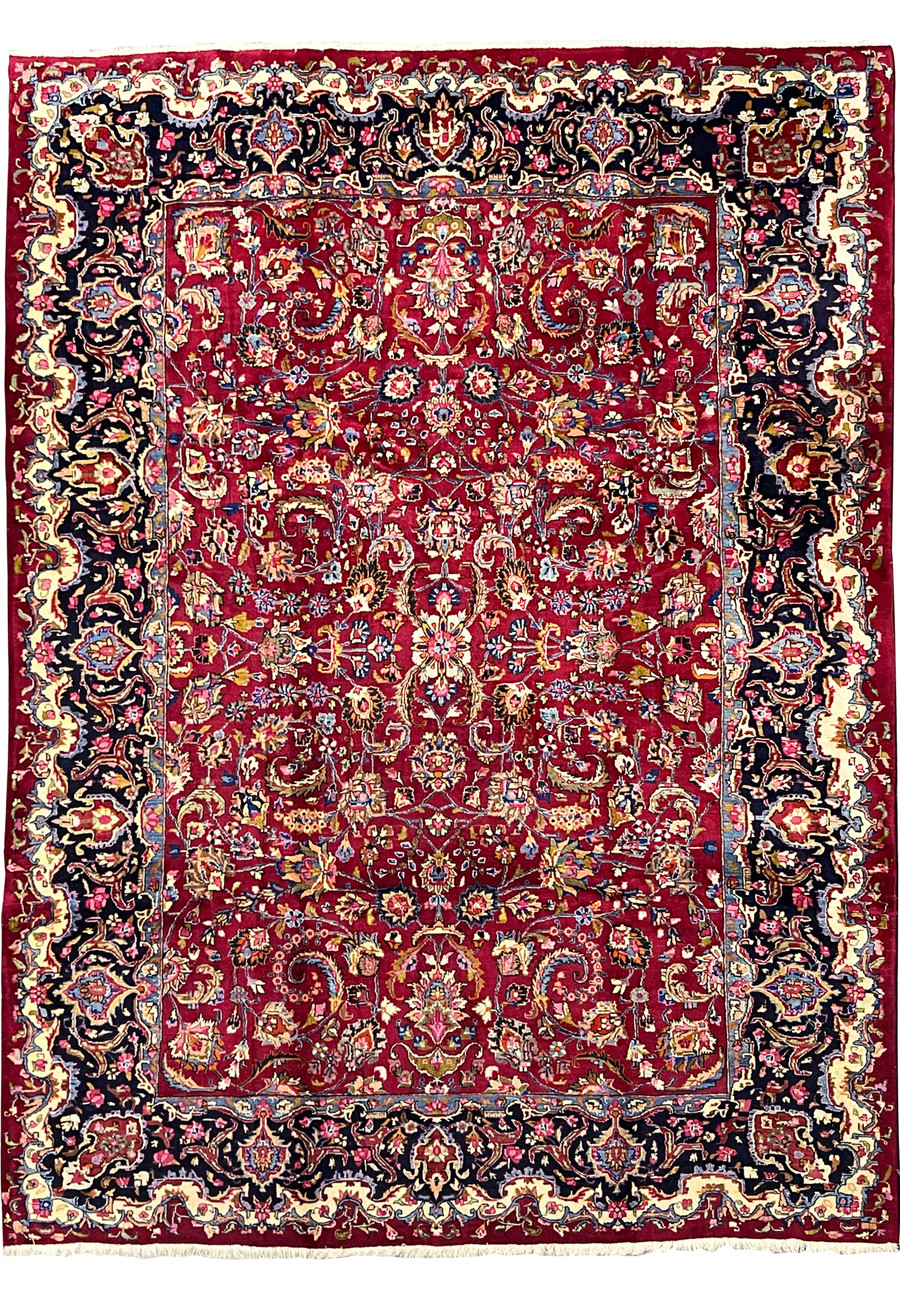
8 x 11 Persian Mashad Signed Makhmal Baf Rug. The Makhmal Baf workshop signature carries centuries of accumulated design tradition. No algorithm produces this. It is the work of human hands guided by human knowledge passed between generations.
Beyond the quantifiable differences in labor, materials, and longevity, there are qualities in a handmade Persian rug that simply cannot be manufactured at any price. These are the qualities that make a room with a fine rug feel different from a room without one in a way that is immediately felt but difficult to articulate.
The first is human presence. A handmade rug was made by a person over many months. Every inch of it passed through human hands and was shaped by human decisions, from the color choices to the tiny variations in knot tension that give the surface its organic quality. This presence is not sentimentality. It is a real physical property of the object: the slight irregularity, the subtle color variation, the sense of a surface that was built rather than printed. It communicates itself to anyone who looks closely at a fine rug, even if they cannot name what they are responding to.
The second is design depth. The great design vocabularies of Persian rug weaving, the arabesque, the Herati, the Mahi, the Shah Abbas floral, the Gombadi dome medallion, were developed and refined over centuries by thousands of designers and weavers working in an unbroken tradition. When a master weaver in Nain executes a Gombadi medallion design today, they are working within a design language that was already ancient when it was first woven into a rug. The depth and density of meaning in that design is not something that can be produced by feeding a pattern into a machine. A machine-made rug with a “Persian-inspired” pattern is to a real Persian rug what a photograph of a landscape is to the landscape itself.
The third is time. A rug that took three years to make carries three years of human attention in every square inch. That concentration of time and skill is physically present in the object. A rug made in three hours carries three hours. You feel the difference, even if you cannot measure it.
How to Tell What You Are Actually Buying
The rug market has significant terminology confusion, much of it deliberate. Here is how to read what you are actually looking at:
Hand-Knotted: The real thing. Each knot tied by hand around the warp threads. Check the back: the pattern should be nearly as clear as the front, with no backing material. This is what Rugs.net sells exclusively.
Hand-Tufted: Not hand-knotted. A mechanical gun punches yarn through a backing fabric by hand. The result requires a latex glue backing to hold together. Often sold as “handmade” in a technically defensible but misleading way. Lifespan 5 to 10 years. No resale value. Avoid if you want something that lasts.
Hand-Woven: Can mean kilim (flat-weave, no pile) or hand-knotted pile. Kilims are genuinely hand-woven and durable but are a different product from a pile rug. Check whether the rug has a pile surface before assuming this means hand-knotted.
Machine-Made: Power loom production. The back will be uniform and fabric-like, often with a printed or woven label. The pattern on the back will not match the front clearly. Usually has a jute, canvas, or synthetic backing material. Honest retailers label these clearly.
Persian-Style / Oriental-Inspired: Marketing language meaning the design is derived from Persian or oriental patterns but the rug is machine-made in synthetic fiber. Not authentic, not handmade, not Persian. This language appears on rugs sold at every price point from $30 to $2,000.
Why Rugs.net Changes the Equation
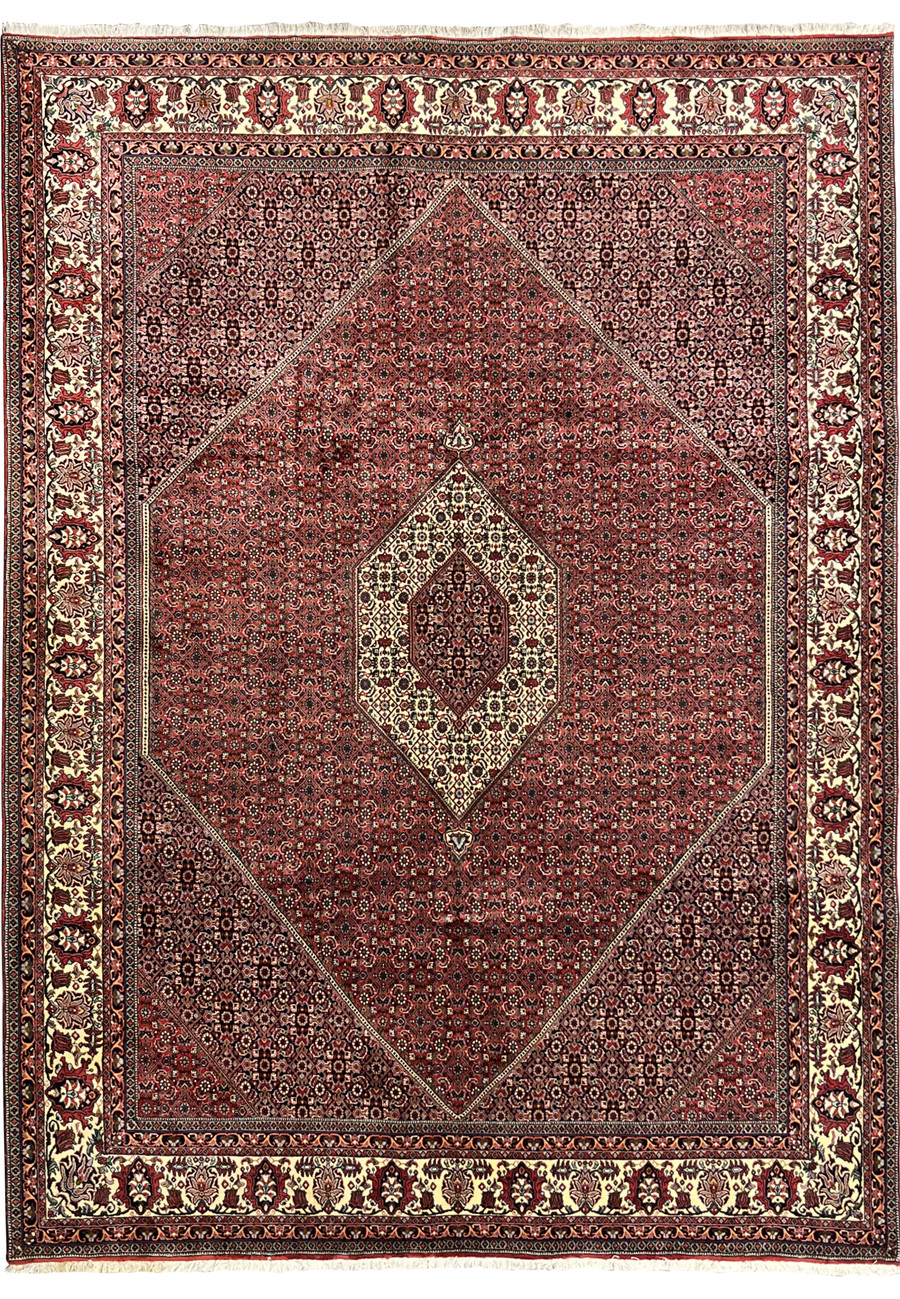
8'2 x 11'4 Persian Bijar Iron Rug. This is what authentic hand-knotted construction looks like: dense, tight, even knotwork in natural wool, built to outlast everything else in the room. At direct importer pricing this piece is accessible to buyers who would never consider a gallery.
The traditional retail model for fine handmade rugs involves a chain from Iranian weaver to exporter to importer to wholesale dealer to gallery, with each link in the chain adding a markup of 30 to 100 percent. By the time a rug reaches a gallery showroom in a major US city, it may have accumulated three to five layers of markup on top of the original weaver price. A rug that cost $600 at the source may be priced at $6,000 in a gallery.
Rugs.net eliminates that chain entirely. We are a direct importer based in Freeport, New York. We source directly from dealers and workshops in Iran, Turkey, Afghanistan, and other rug-producing countries, and sell directly to you. The result is that the price range for genuinely fine handmade rugs shifts dramatically. Pieces that a traditional gallery would price at $5,000 to $8,000 are available at Rugs.net for $1,500 to $3,000. The rug is identical. The markup chain is not.
Combined with free shipping to all 50 states, free returns, and a 10% price beat guarantee, this makes the decision to buy a genuine handmade rug a rational financial choice for a much wider range of buyers than the gallery model ever served. You do not need to spend $10,000 to own a rug that will outlast your children. You need to spend $1,500 to $3,000, buying directly from a source that has removed the middlemen from the chain.