
Chinese Art Deco Rugs: A Vanished Golden Age
Posted by Rugs.net on Apr 6th 2026
Rugs.net · Complete Guide
Chinese Art Deco Rugs
A Vanished Golden Age: Hand-Knotted Masterpieces from Beijing and Tianjin, Made Between the 1920s and the Late 1960s and Never Produced Again
By Rugs.net Specialists · Antique and Vintage Rug Experts

There is a category of handmade rug that most people have never heard of, yet it represents one of the most extraordinary chapters in the entire history of textile art. Chinese Art Deco rugs were produced for roughly four decades, from the early 1920s through the late 1960s, in the workshops of Beijing and Tianjin. When production stopped, it stopped permanently. No new examples have been made since. Every single piece that exists today is a direct survivor of that specific window in history, and each one carries within its wool and cotton the story of a China that no longer exists.
This article tells the full story: why these rugs were created, how they connect to some of the most turbulent events in modern Chinese history, what makes their materials and construction so distinctive, why the Art Deco period produced a specific aesthetic that remains one of the most sophisticated in the world of oriental rugs, and why owning one today means owning something that can never be replaced.
We also feature the full selection of authentic Chinese Art Deco and vintage Beijing rugs from our collection at Rugs.net, with the actual main picture of each piece shown directly in the article.
In This Guide
- 01 China Before the Revolution: The Economic and Cultural Context
- 02 How Art Deco Came to China: The Western Trade Connection
- 03 Beijing and Tianjin: The Two Great Weaving Centers
- 04 Cotton Foundation and Wool Pile: Why the Materials Matter
- 05 The Design Language of Chinese Art Deco Rugs
- 06 The Colors That Define the Style
- 07 Production Ends: The Cultural Revolution and the Last Rugs
- 08 Why These Rugs Are Pieces of History
- 09 Special Highlight: The 9 x 12 Beijing Dragon Rug
- 10 Special Highlight: The Art Deco Runner (Extremely Rare)
- 11 All Pieces from Our Collection
China Before the Revolution: The Economic and Cultural Context
To understand Chinese Art Deco rugs, you have to understand the China that produced them. The late Qing dynasty and the early Republic of China period, spanning roughly the 1890s through the 1930s, was a time of extraordinary tension between tradition and modernization. China was simultaneously one of the most ancient and sophisticated civilizations on earth and a country being pulled into direct contact with Western industrial capitalism at extraordinary speed.
The port cities of Beijing, Tianjin, and Shanghai became zones of intense cultural and commercial exchange. Foreign traders, diplomats, and merchants created a demand for luxury goods that could bridge Chinese craftsmanship and Western aesthetic sensibilities. Chinese artisans, who had centuries of experience with silk, wool, and decorative textile arts, found themselves presented with a new kind of market that valued their skill while asking for a new vocabulary of form and design.
The economic conditions of this period are crucial. Before mass production reached China's interior, skilled labor in the major cities was abundant and costs were low relative to Western standards. This combination of extraordinary craft skill, available labor, and competitive economics made China the ideal place to produce high-quality handmade goods for export to the Western market. Rug production was perfectly positioned to benefit from exactly this combination of factors.
Chinese weavers had been producing rugs for centuries, primarily for imperial use and local aristocratic markets. The designs were dense with symbolism: dragons, phoenixes, clouds, lotus flowers, bats associated with good fortune, and geometric border patterns that carried specific meanings within the Confucian and Taoist traditions. What happened next would transform this tradition completely while drawing from its deepest roots.
The China that produced Art Deco rugs was a country undergoing one of history's most rapid transformations. The rugs made in this period carry that tension within them: ancient symbols rendered in a modern aesthetic, traditional craft techniques serving a new international market, Chinese hands weaving designs shaped by Western demand.
How Art Deco Came to China: The Western Trade Connection
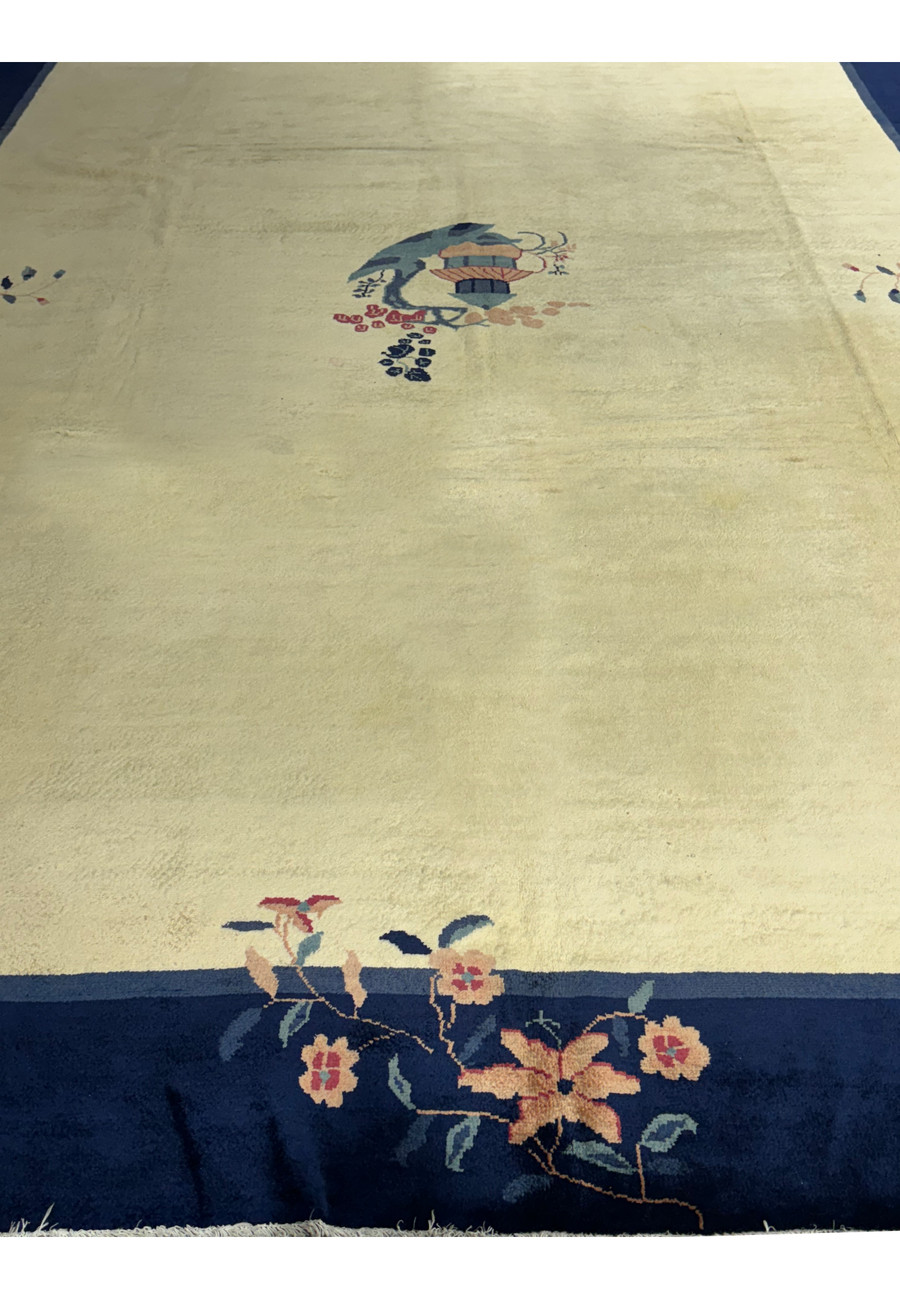
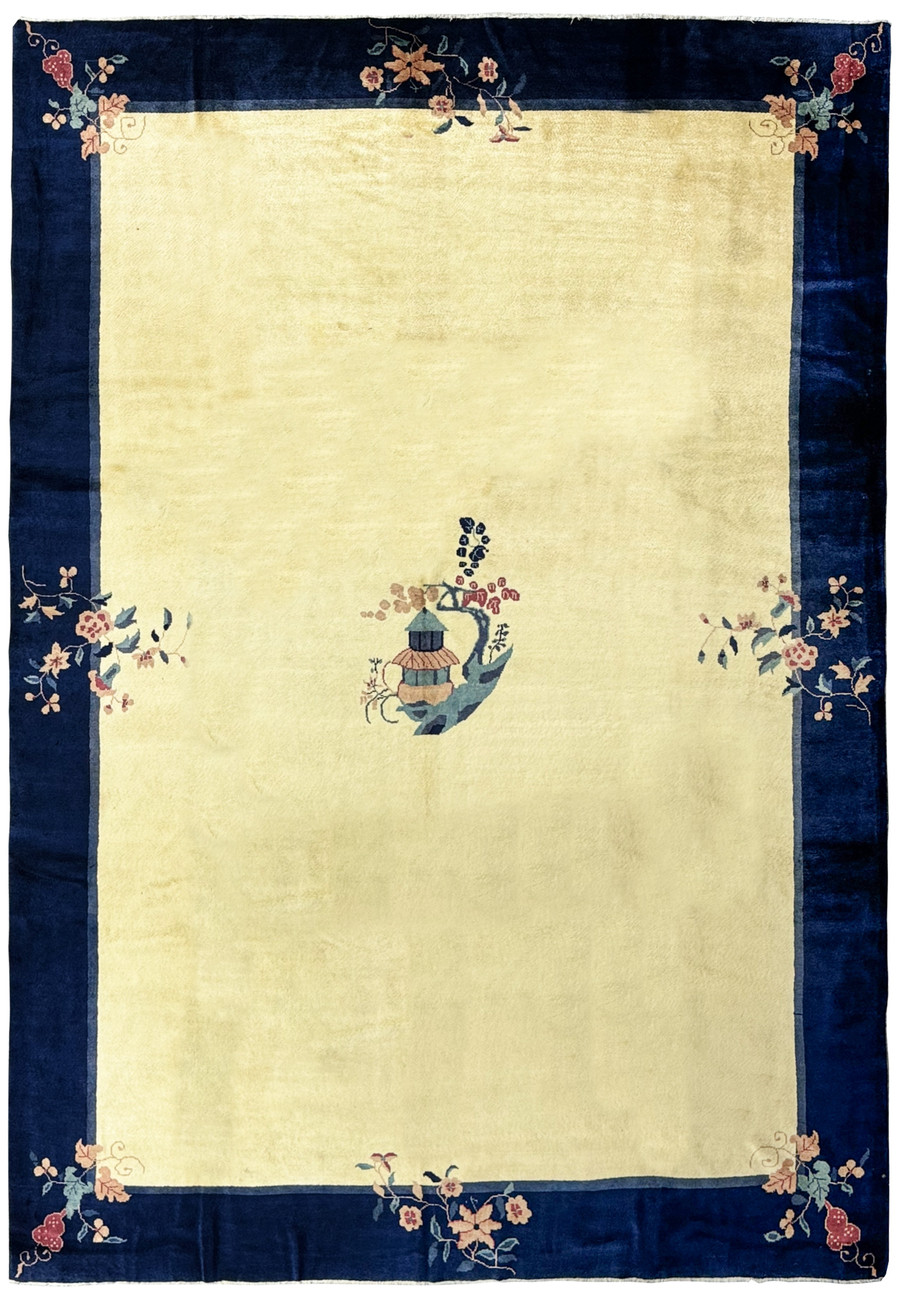
The central motif of our 10 x 14 Vintage Art Deco Rug. The stylized vase with floral accents represents the core aesthetic achievement of the Chinese Art Deco tradition: Chinese motifs rendered with a modernist restraint that bridges two entirely different visual cultures.
The birth of Chinese Art Deco rugs was triggered by a disruption happening far from China. World War One devastated the established rug trade routes between the Middle East and the Western markets. The Persian, Turkish, and Caucasian workshops that had supplied European and American buyers with traditional handmade rugs found their supply chains broken and their labor forces decimated. The American and European markets, suddenly starved of the luxury floor coverings they had come to expect, needed an alternative source.
American traders, particularly working out of the port city of Tianjin in northeastern China, recognized an extraordinary opportunity. China had the craft skill, the labor, the raw materials, and the economic conditions to produce high-quality handmade rugs at a scale and price point that the disrupted Middle Eastern trade could not match. The most significant figure in this transformation was Walter Nichols, an American entrepreneur who established weaving operations in Tianjin that would eventually employ thousands of workers across fourteen factories.
Nichols and his contemporaries did not ask Chinese weavers to replicate Persian or Turkish styles. Instead, they commissioned designs that responded directly to the Art Deco movement sweeping Western design culture in the 1920s and 1930s. Art Deco, with its love of geometric simplification, bold outlines, restrained color, and the elevation of craft to high art status, turned out to be perfectly aligned with the strengths of Chinese decorative tradition. The open compositions, the symbolic motifs, the clean borders, the dialogue between filled and empty space: all of these were qualities that Chinese artistic traditions had valued for centuries.
The result was not a copy of either tradition. Chinese Art Deco rugs are genuinely neither Western Art Deco design nor traditional Chinese rug design. They are something new that grew from the meeting of both, and that unique cultural synthesis is one of the things that makes them so visually distinct and historically significant. So many rugs produced by the Nichols enterprise became known generically as "Nichols rugs" within the trade, a testament to how completely he defined the category.
Chinese Art Deco rugs exist because a world war broke the old trade routes. The disruption of one tradition created the space for something entirely new. This is how many of the most significant moments in decorative arts history begin: not in calm evolution, but in the collision of necessity and opportunity.
Beijing and Tianjin: The Two Great Weaving Centers
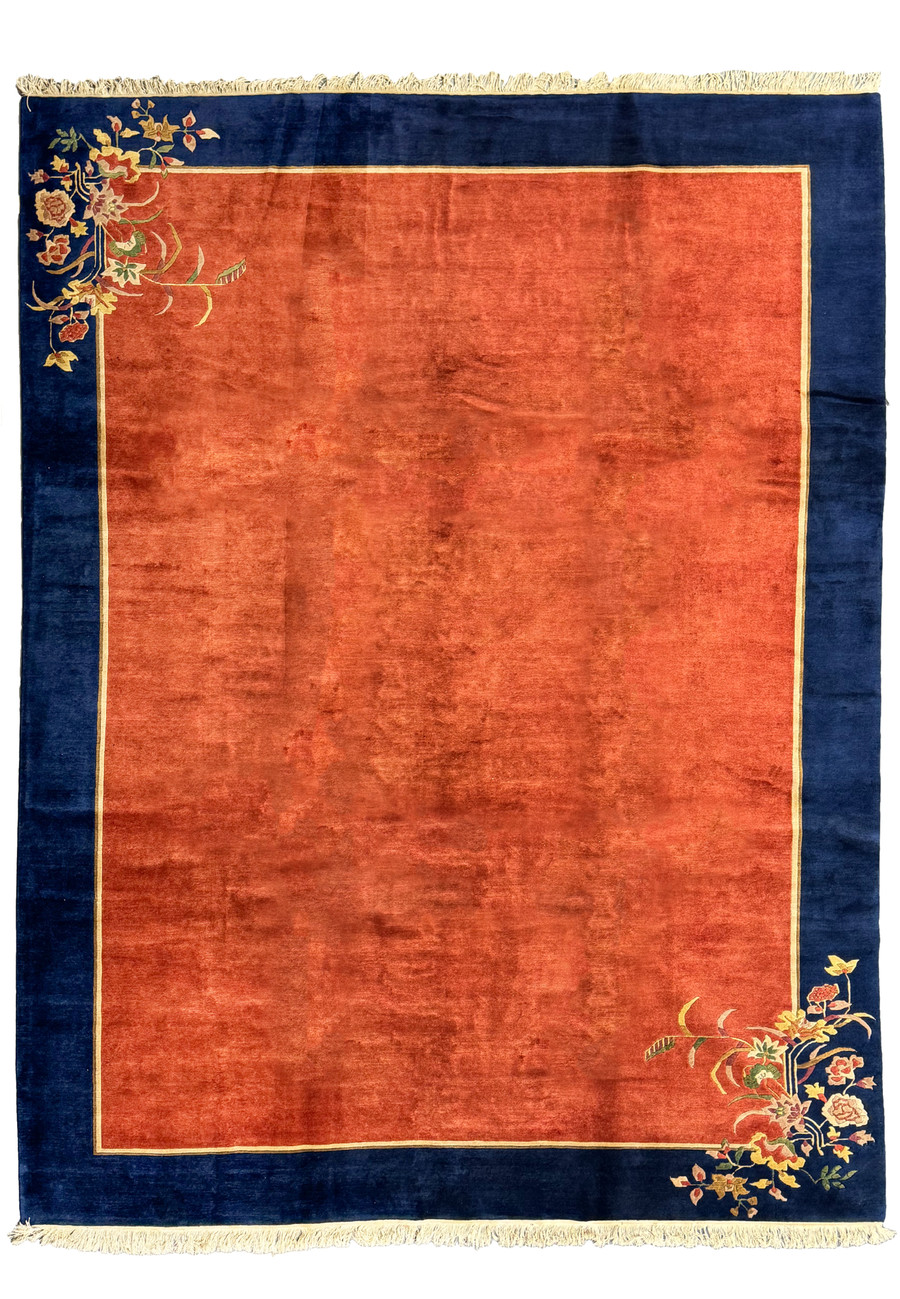
The bold terracotta field and deep navy border of our 10'2 x 13'4 Modern Oriental Art Deco Rug is one of the most classic Beijing color combinations. This palette was developed by the Beijing workshops and remains immediately recognizable as the signature visual language of the tradition.
While Tianjin was the initial commercial hub, the Beijing workshops developed their own distinct tradition that became the standard against which all Chinese Art Deco rugs are judged. Beijing, as the historic imperial capital, had access to the finest craftsmen and the deepest reservoir of traditional Chinese decorative knowledge. The Beijing style tends toward greater refinement, softer colors, and a more sophisticated dialogue between the design elements and the open ground of the rug.
Tianjin production was more commercial and varied, driven by export demands that sometimes called for bolder colors and more densely packed compositions. The Tianjin workshops operated at enormous scale, particularly under the Nichols organization, and produced rugs across a very wide range of qualities and sizes. The best Tianjin pieces rival anything made in Beijing. The lesser examples show the compromises that come with large-scale production.
Both centers used the same fundamental construction: a cotton foundation with a wool pile, hand-knotted using the Chinese or Senneh knot, then subjected to a washing and shearing process that gave the finished rugs their characteristic surface quality. The washing process, sometimes using chemical treatments, softened the colors and gave the pile a lustrous sheen that is one of the most immediately recognizable qualities of an authentic vintage Beijing or Tianjin rug.
Shanghai also contributed to the Art Deco rug tradition, particularly in the production of rugs for the luxury hotel and export markets that boomed in the 1920s and 1930s as Shanghai became one of the world's most cosmopolitan cities. The Shanghai aesthetic tends to be the most Western-influenced of the three centers, sometimes veering closer to pure Art Deco geometry than to traditional Chinese motifs.
Cotton Foundation and Wool Pile: Why the Materials Matter

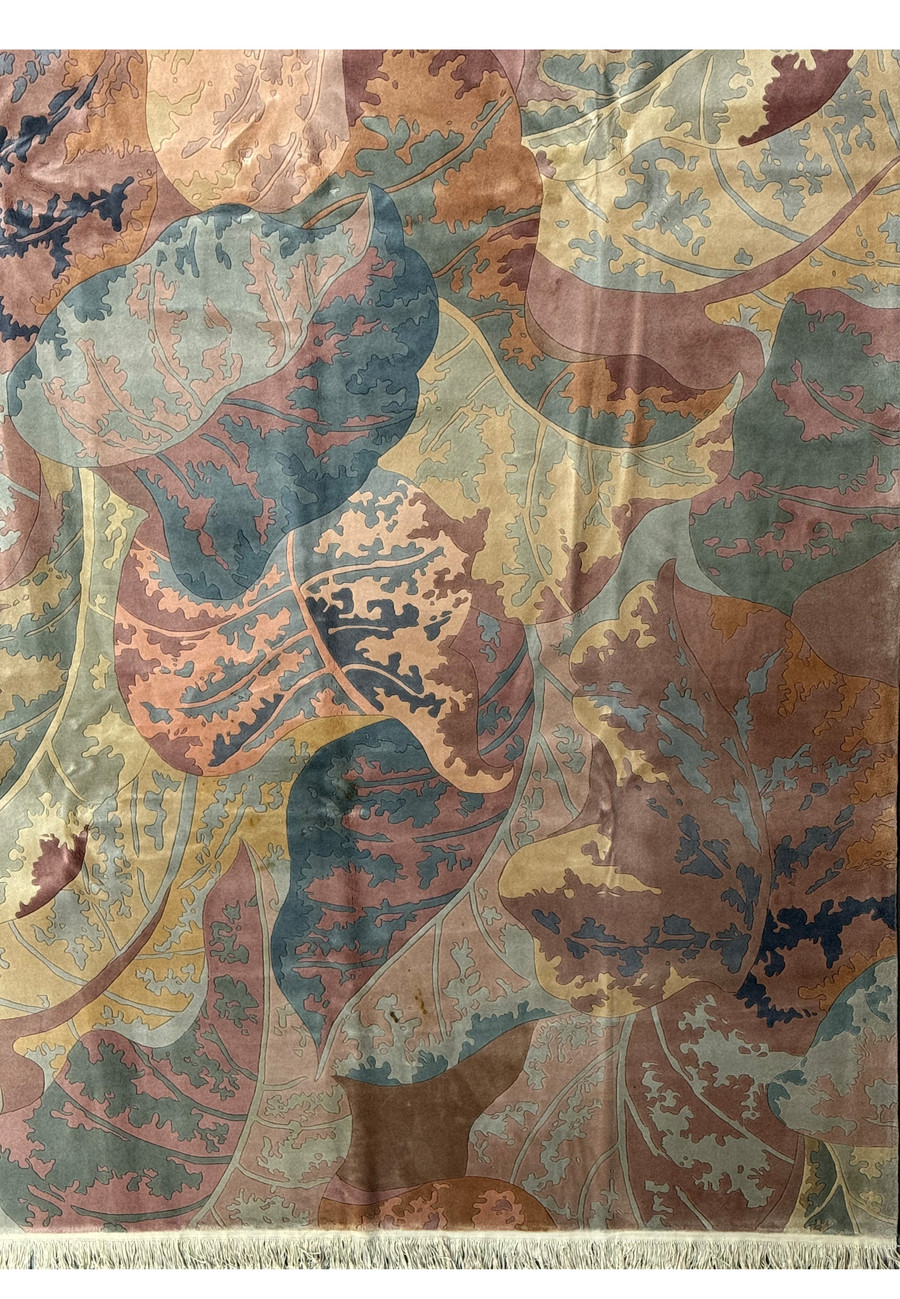
The 9'2 x 12'4 Modern Art Deco Beijing Wool and Silk Rug. The naturalistic leaf design and earthy palette are characteristic of the Beijing botanical compositions that were made specifically for Western export markets. The wool and silk pile on cotton foundation gives this piece the flat, lustrous surface that is the hallmark of the Beijing construction tradition.
The material construction of Chinese Art Deco rugs is one of their most distinctive characteristics, setting them apart from both Persian and Turkish oriental rugs in immediately tangible ways. Understanding the materials is essential to understanding the quality and character of any individual piece.
The Cotton Foundation
The overwhelming majority of Chinese Art Deco rugs were built on a cotton foundation, meaning both the warp threads and the weft threads are cotton rather than wool. Cotton produces a stiffer, more dimensionally stable foundation than wool. It lies flatter on the floor, resists stretching, and holds the structure of the rug more rigidly over time. A fine Chinese Art Deco rug on a cotton foundation will lie perfectly flat after decades of use in ways that many wool-foundation rugs cannot match. The cotton foundation is not a compromise. It is a deliberate choice that serves the aesthetic goals of the style: the clean, flat presentation that makes the design elements read with maximum clarity.
The Wool Pile
The pile of authentic vintage Chinese Art Deco rugs is wool, hand-knotted onto the cotton foundation and then sheared to a specific height that is generally lower and more even than in Persian production. The finest vintage pieces used high-quality Chinese wool or, in the most luxurious examples, imported New Zealand wool, which is longer-stapled, softer, and more lustrous than most domestic Chinese wools of the period. The wool pile was then subjected to a washing and chemical finishing process that softened the fibers, brightened the colors, and produced the characteristic silky sheen that is one of the most beautiful qualities of an authentic vintage Beijing or Tianjin piece. Some pieces, particularly from the later Beijing tradition, incorporate natural silk highlights into the wool pile, creating design elements that catch and reflect light differently from the surrounding wool areas.
Durability and Longevity
The cotton-and-wool construction of authentic vintage Chinese Art Deco rugs has proven extraordinarily durable. Pieces made in the 1920s and 1930s regularly survive in excellent condition today, a century later, because the cotton foundation resists rot and maintains its structural integrity, and quality wool pile resists wear in ways that synthetic fibers cannot. A vintage Beijing or Tianjin rug that has been properly cared for is likely to outlast any synthetic or machine-made floor covering by many decades.
The cotton-wool construction of Chinese Art Deco rugs is not simply a material choice. It is the physical expression of the aesthetic. Flat, stable, smooth, luminous. These are qualities the cotton foundation and the sheared wool pile deliver together, and they are qualities that make these rugs uniquely suited to modern interiors where other styles of handmade rug might feel too traditional.
The Design Language of Chinese Art Deco Rugs
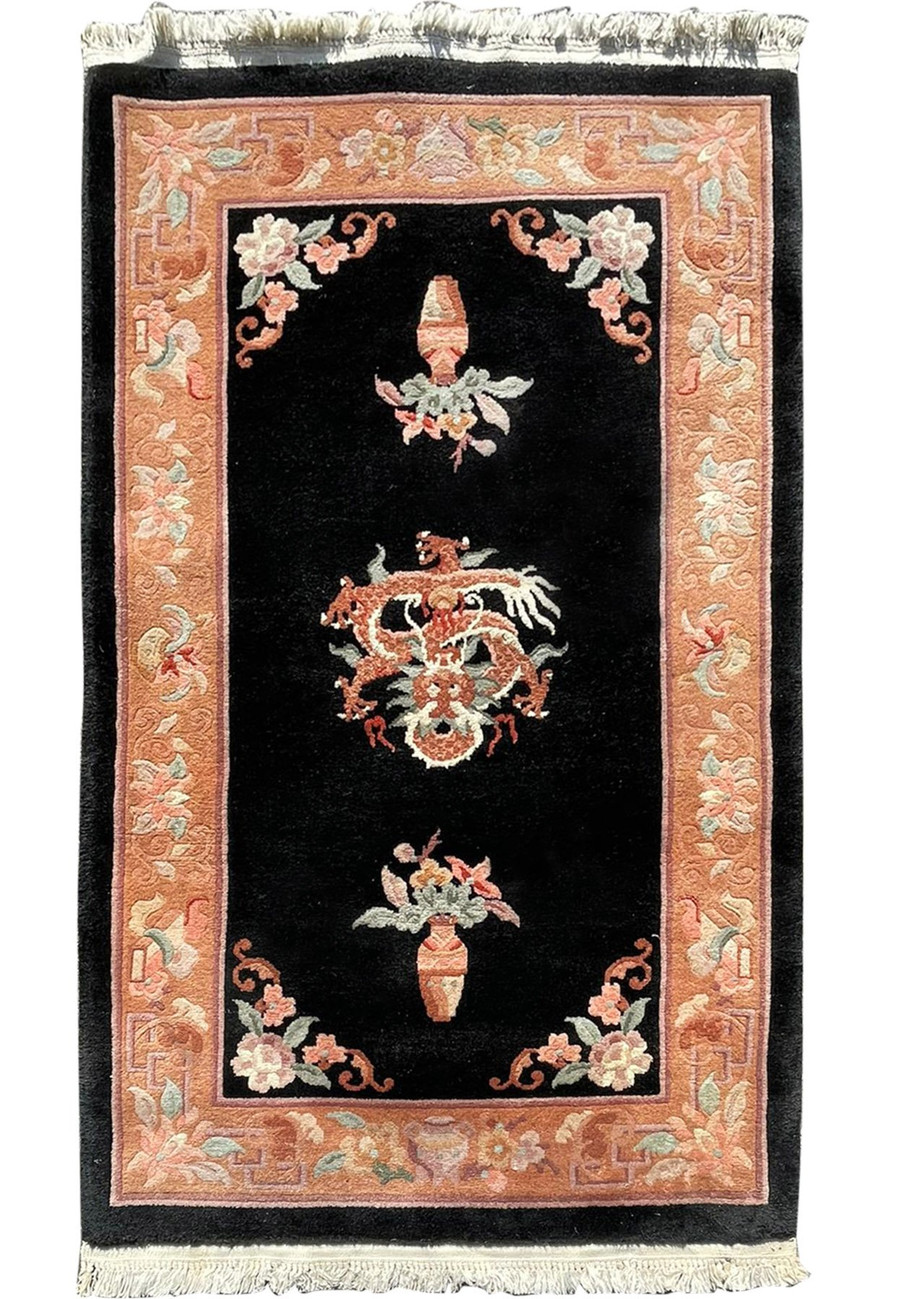
Our 3 x 5'5 Antique Oriental Art Deco Rug demonstrates the open-field design principle at its purest. The motifs float in open ground. There is no dense background pattern competing for attention. The design breathes.
The designs of Chinese Art Deco rugs are one of the most sophisticated and immediately recognizable bodies of work in the history of decorative textiles. They represent the successful fusion of two very different visual traditions: the symbolic, nature-based imagery of classical Chinese decorative art and the geometric, modernist aesthetic of 1920s Art Deco design.
The Open Field Composition
The most distinctive design feature of Chinese Art Deco rugs is the use of open ground. Unlike Persian rugs, where the entire field is typically filled with dense arabesque, floral, or geometric pattern, Chinese Art Deco rugs place their motifs against a largely empty background. This use of negative space is directly aligned with classical Chinese visual principles, which value the relationship between form and emptiness as a fundamental compositional tool. At the same time, it resonates perfectly with the Art Deco preference for bold, isolated visual statements over Victorian density of ornament.
The Symbolic Motif Vocabulary
Every motif in a Chinese Art Deco rug carries meaning drawn from centuries of Chinese symbolic tradition. Dragons represent imperial power, wisdom, and good fortune. Phoenixes symbolize grace, renewal, and the feminine principle. Lotus flowers represent purity and spiritual enlightenment. Peonies signify wealth and honor. Butterflies are messengers of joy and transformation. Bats, which look nothing like their Western counterparts in Chinese decorative art, represent the five blessings: longevity, prosperity, health, virtue, and natural death. The Greek key border motif bridges Eastern and Western traditions: it exists in both classical Chinese decorative art and ancient Greek design, and its appearance in these rugs reflects the genuine visual overlap between the two traditions.
Floral and Botanical Designs
Beyond the strictly symbolic motifs, Chinese Art Deco rugs produced enormous quantities of purely floral and botanical compositions. These were designed primarily for the export market and respond to Western tastes while retaining Chinese compositional principles. Chrysanthemums, peonies, cherry blossoms, and stylized botanical sprays appear in loose, naturalistic arrangements that have a lightness and freshness entirely different from the tightly disciplined floral fields of Kashan or Isfahan. These botanical compositions are among the most versatile and widely applicable of all Chinese Art Deco designs.
The Colors That Define the Style

The navy blue border against the cream field of the 10 x 14 Vintage Art Deco Rug. This is the defining color relationship of the Chinese Art Deco palette: warm, light ground against a deep cool border. The floral accents in soft pink, green, and gold complete one of the most harmonious color systems in the entire history of handmade rugs.
The color palette of Chinese Art Deco rugs is one of their most immediately distinctive and appealing features. It is different from every other major rug-producing tradition, and it sits with remarkable ease in modern interiors that other traditional rug styles might struggle with.
Cream, Beige and Ivory Grounds
The most characteristic field color of Chinese Art Deco rugs is a warm cream, bone, or ivory. This light ground is essential to the open composition aesthetic: motifs placed against a pale ground have maximum visual clarity, and the empty space between design elements reads as air rather than void. This light ground also makes Chinese Art Deco rugs unusually easy to live with in modern interiors, where they add warmth and visual richness without darkening a room.
Terracotta, Burnt Orange, and Warm Rust
Where Chinese Art Deco rugs use a warmer field color, terracotta, burnt orange, and warm rust tones are the most common. These colors have a richness and depth that reads beautifully in almost any interior setting, and they have proven to be among the most enduringly fashionable field colors in the entire handmade rug tradition.
Navy Blue Borders and Soft Accent Colors
The most common border color in Chinese Art Deco rugs is a deep navy blue or indigo. This color creates a classic and powerful contrast with the warm cream or terracotta grounds. The design motifs within the field typically use a restrained range of accent colors: soft gold and yellow ochre, sage and dusty green, muted rose and pink. These colors are never harsh or aggressive. They have been softened by the finishing process that all authentic vintage pieces underwent, giving them a patina that cannot be replicated in new production.
Production Ends: The Cultural Revolution and the Last Rugs
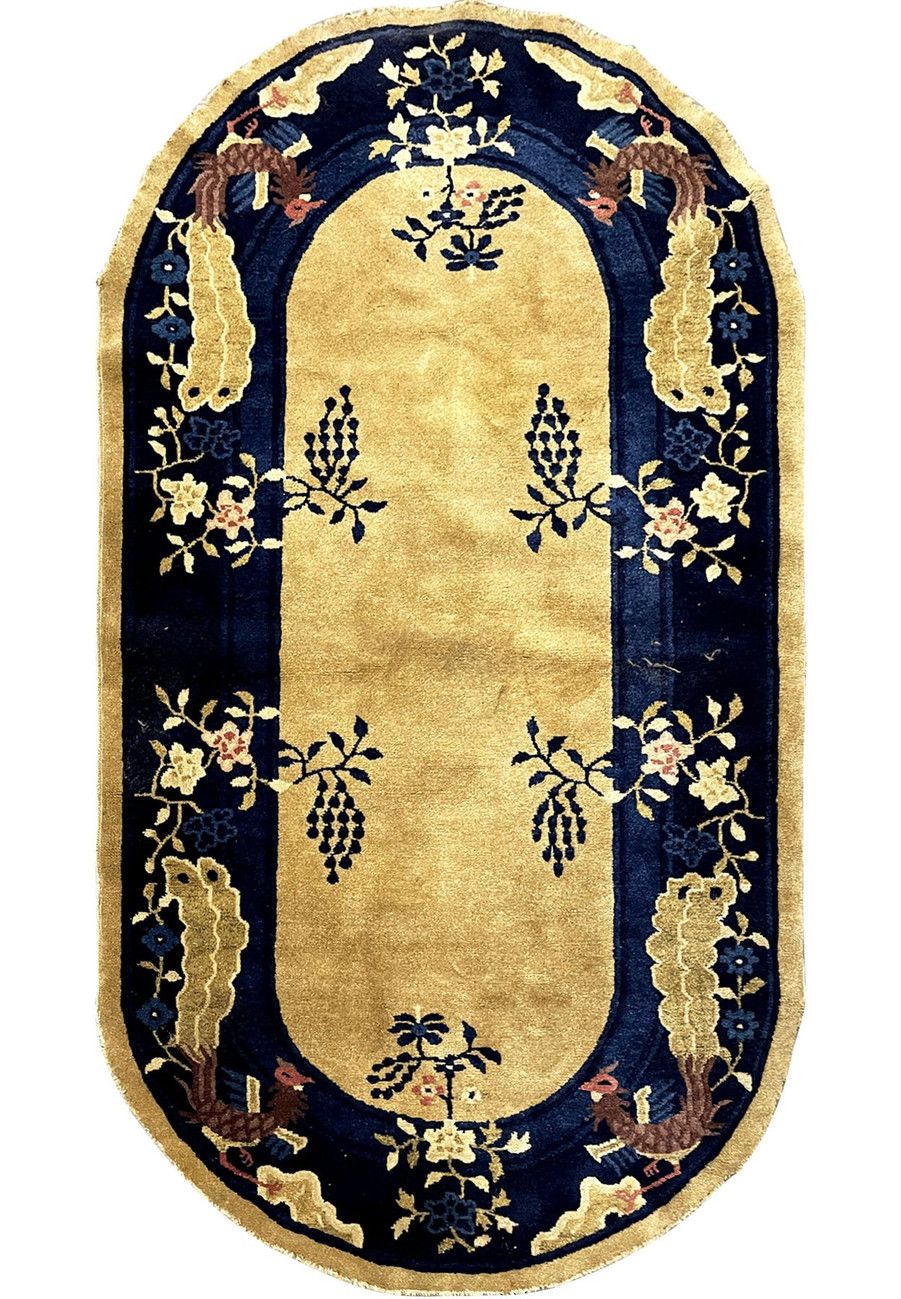
Our 3 x 6 Antique Oriental Art Deco Oval Rug. Oval format antiques from this tradition are extremely rare. This piece was made before the Cultural Revolution ended production permanently in 1966. It is a genuine artifact of a finished era.
The story of Chinese Art Deco rugs ends as dramatically as it began. By the late 1930s, the Japanese occupation of much of coastal China had severely disrupted production. The workshops that survived into the 1940s and through the establishment of the People's Republic of China in 1949 continued producing rugs for the export market, though the political climate increasingly shaped what designs were acceptable and what could be sent abroad.
The Beijing and Tianjin workshops continued operating through the 1950s and into the 1960s, producing rugs that maintained the basic construction methods of the Art Deco tradition while adapting their designs to the political requirements of the era. Some of these later pieces are among the most purely beautiful Chinese rugs ever made, combining the refined construction of the mature tradition with a visual restraint imposed partly by circumstance and partly by the natural evolution of the style.
The Cultural Revolution, which began in 1966, ended Chinese Art Deco rug production definitively. The Red Guards targeted traditional crafts, luxury production, and anything associated with either traditional Chinese culture or Western influence as enemies of the new revolutionary order. Both of those things defined Chinese Art Deco rugs: they were rooted in traditional Chinese symbolic culture and they had been produced specifically for Western export markets. The workshops were shuttered, the master weavers dispersed, and the tradition of producing this specific type of rug was broken beyond repair.
When China eventually reopened to the outside world in the late 1970s, the conditions that had produced the Art Deco rugs no longer existed. The master craftsmen who had held the technical and design knowledge of the tradition were gone. New production from Beijing and Tianjin would emerge in subsequent decades, but the specific window of the Art Deco tradition was permanently closed.
This is not a tradition that declined slowly or was replaced by something better. It was stopped by historical force. Every Chinese Art Deco rug in existence today is a survivor of that force, and the supply of authentic pieces is finite, fixed, and decreasing as examples are lost to damage or destruction. This is what makes them genuinely irreplaceable.
Why These Rugs Are Pieces of History

Small antique Chinese Art Deco pieces are windows into a vanished world. See our 2'3 x 4'4 Antique Oriental Art Deco Rug.
Owning an authentic Chinese Art Deco rug means owning a physical piece of a very specific and irretrievable moment in history. These rugs were made in a China that no longer exists, by craftsmen whose tradition was broken by revolution, during a period of extraordinary cultural synthesis between East and West that the subsequent century has never fully repeated. They carry all of that history in their wool, their cotton, their colors, and their designs.
From a purely practical standpoint, these rugs represent outstanding value compared to their counterparts in other traditions. A comparable-quality handmade Persian rug from the same period would typically command significantly higher prices in today's market. Chinese Art Deco rugs are still somewhat undervalued relative to their historical significance, their quality, and their beauty. This creates an unusual situation where genuine antique and vintage pieces of real historical importance are still accessible at prices that serious collectors in other fields would find remarkable.
These rugs also represent a remarkable marriage of interior design versatility and historical depth. Because of their open compositions, restrained color palettes, and modern aesthetic sensibility, they integrate into contemporary interiors more naturally than almost any other antique or vintage handmade rug. An antique Chinese Art Deco rug can anchor a minimalist space, enrich a maximalist one, provide warmth in a modernist setting, and add history to a traditional room.
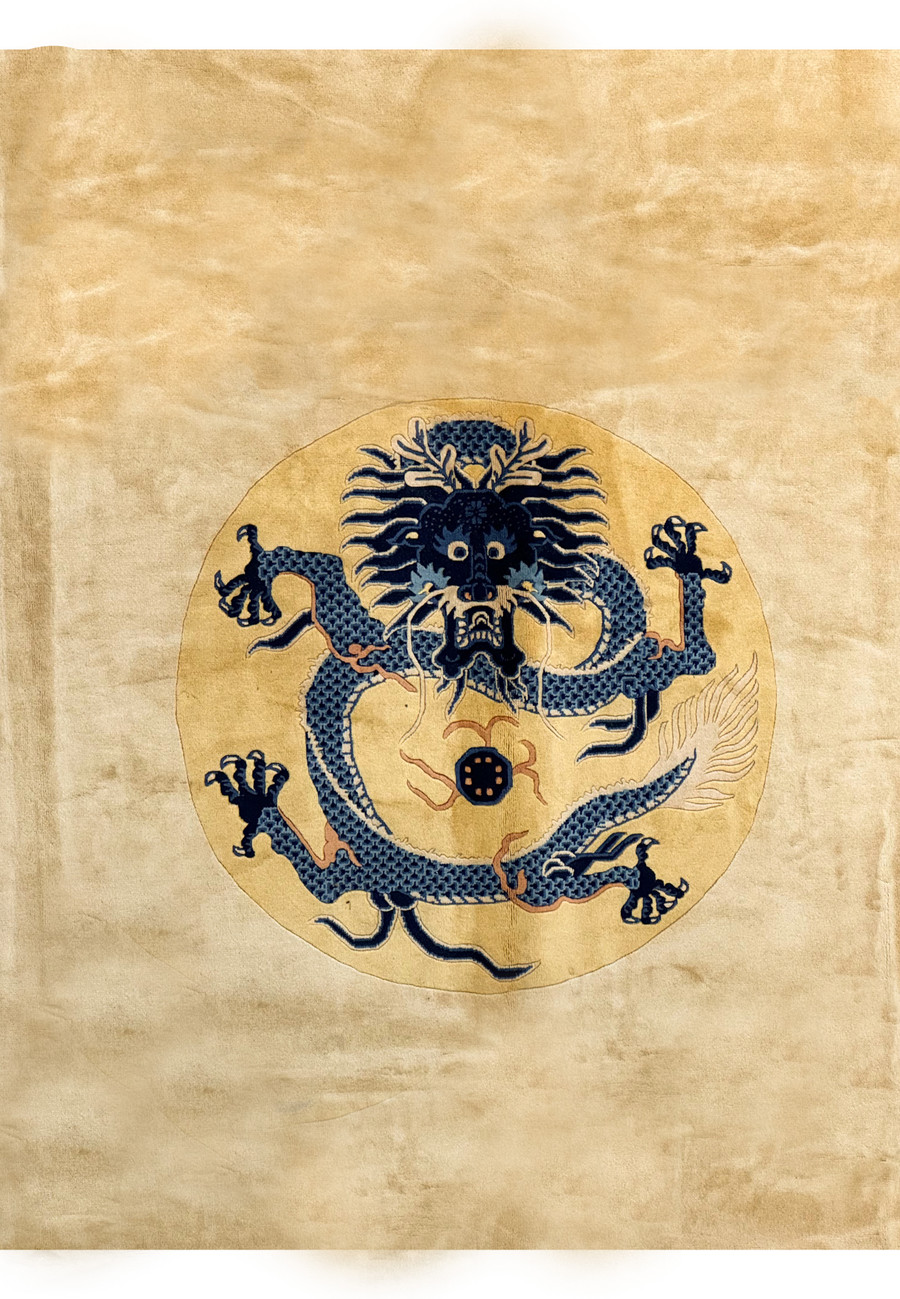
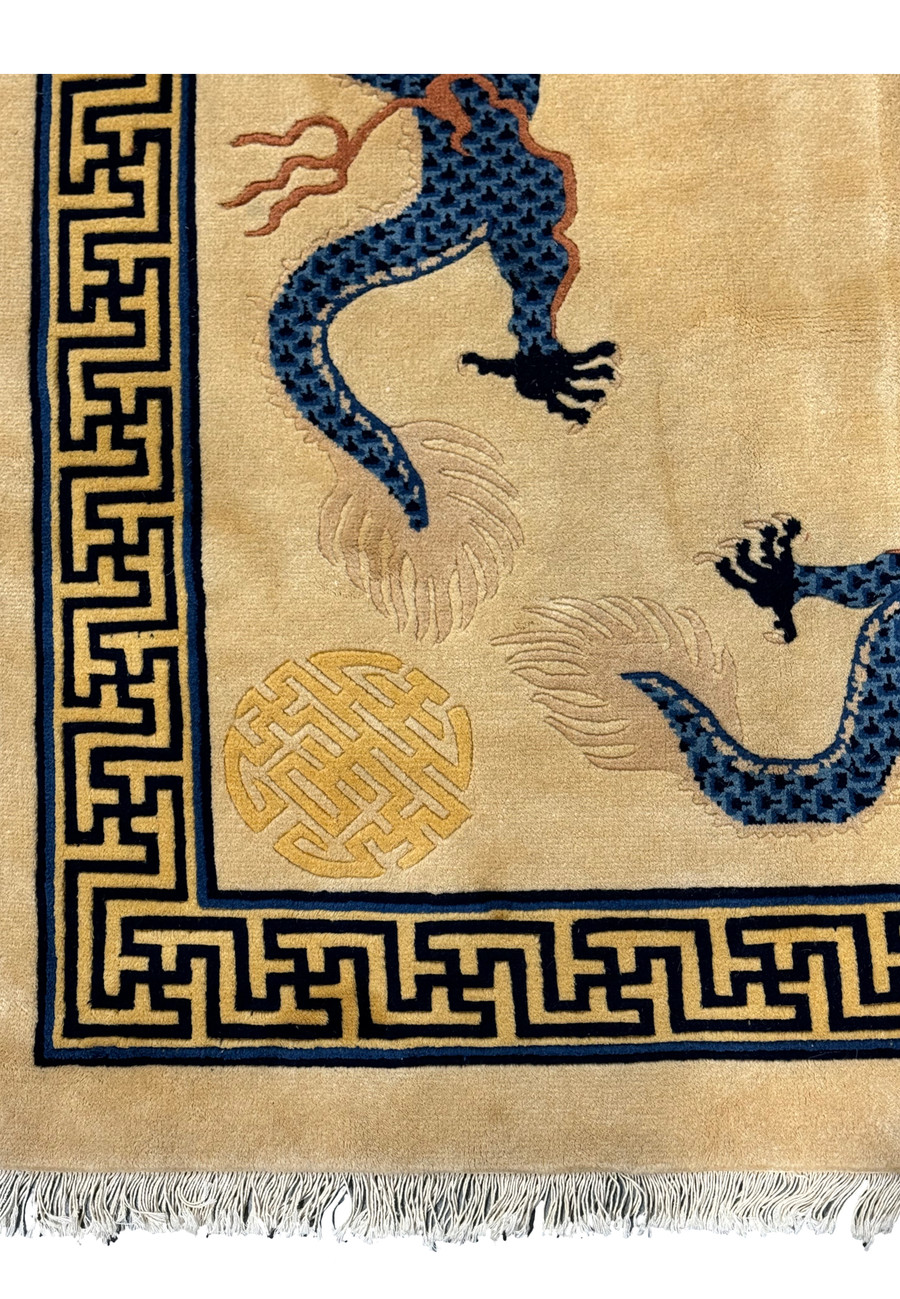
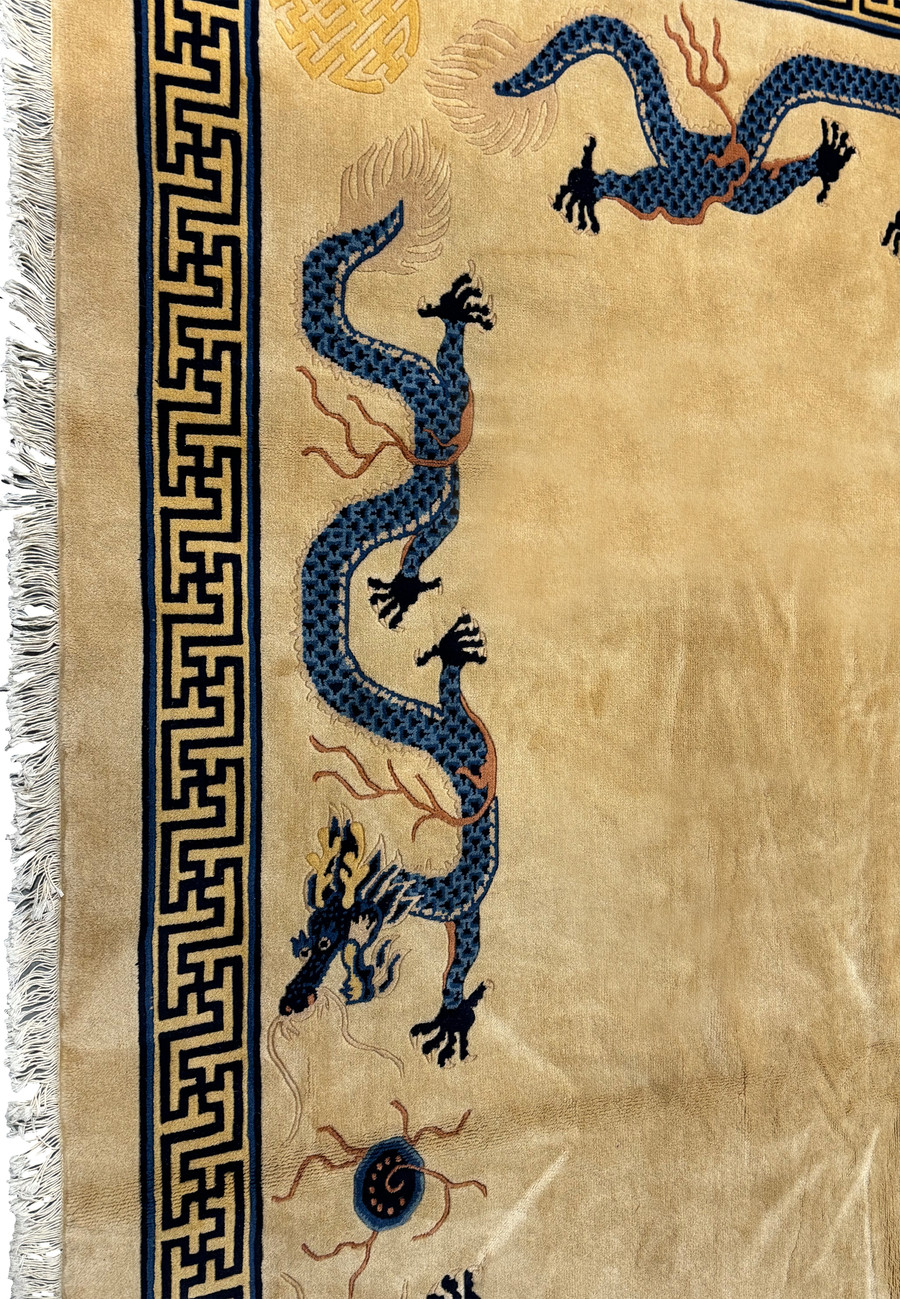
Special Highlight: 9 x 12 Beijing Dragon Rug
Editor's Choice: The Most Symbolically Powerful Piece in Our Collection

Special Highlight: Art Deco Runner (Extremely Rare)
Extremely Rare: Chinese Art Deco Runners Almost Never Survive


The 2'3 x 10 Oriental Art Deco Runner. At 2'3 by 10 feet, this runner was designed for a hallway or corridor. Runners in this tradition were used in high-traffic areas and suffered greater wear than room-size pieces, which is why surviving examples in good condition are so extraordinarily rare.
Authentic surviving Chinese Art Deco runners in good condition are genuinely rare objects. Room-size pieces in 8 x 10 to 10 x 14 were the primary production format. Runners were made in much smaller quantities and, because they were used in high-traffic areas, they suffered much greater wear. Our 2'3 x 10 Oriental Art Deco Runner is an exceptional survival, perfect for a hallway, kitchen, or passage where a room-size rug is not appropriate but where the beauty of an authentic piece of Chinese Art Deco history would transform the space entirely.
All Pieces from Our Collection
Every piece ships free to all 50 states with free returns, same-day dispatch on orders before 2 PM EST, and our price beat guarantee. All pieces are 100% authentic, directly sourced with no middlemen.

Interested in other styles of handmade oriental rugs? Our full collection also includes Persian traditional rugs, Bijar rugs, Isfahan rugs, Kashan rugs, Nain rugs, and Qum silk rugs. Every piece is 100% authentic, hand-knotted, directly imported with no middlemen.
A Tradition Closed by History. A Beauty That Endures.
Chinese Art Deco rugs were made between the 1920s and the late 1960s. No new examples will ever be produced. Every piece that survives is a direct artifact of one of history's most dramatic cultural collisions: ancient Chinese craft tradition meeting the modernist West, hand-knotted in cotton and wool, finished with a sheen that decades cannot diminish. These are not decorative objects. They are pieces of history that happen to be extraordinarily beautiful.
Every piece ships free to all 50 states with free returns, same-day dispatch, and our price beat guarantee. Questions about any piece in our collection? Call us at 855-576-7705.
Beijing Dragon Rug Art Deco Runner 10 x 14 Vintage