
Persian Rugs vs. Oriental Rugs What Is the Actual Difference?
Posted by Rugs.net on Apr 11th 2026
Walk into any rug store and you will encounter both terms within minutes. A sales tag might read “authentic Persian rug” next to one that reads “handmade oriental rug.” Advertisements for the same product will use both descriptions. Online listings mix the terms freely. And most buyers, understandably, assume they mean the same thing.
They do not. One term describes geography. The other describes a broader category that includes the first. Understanding the relationship between them is the single most useful piece of knowledge you can have before buying a handmade rug, because it tells you exactly what you are looking at, where it came from, and why the price is what it is.
At Rugs.net, every rug we sell is 100% authentic and 100% handmade. Our Persian rugs are genuinely from Iran. Our oriental rugs are genuinely handmade in other rug-producing countries. This guide explains exactly what that distinction means.
The Short Answer
This is the complete picture. Everything that follows explains why this distinction matters, what it means for the quality and character of the rug you are buying, and how to use this knowledge to shop intelligently.
What “Persian” Actually Means
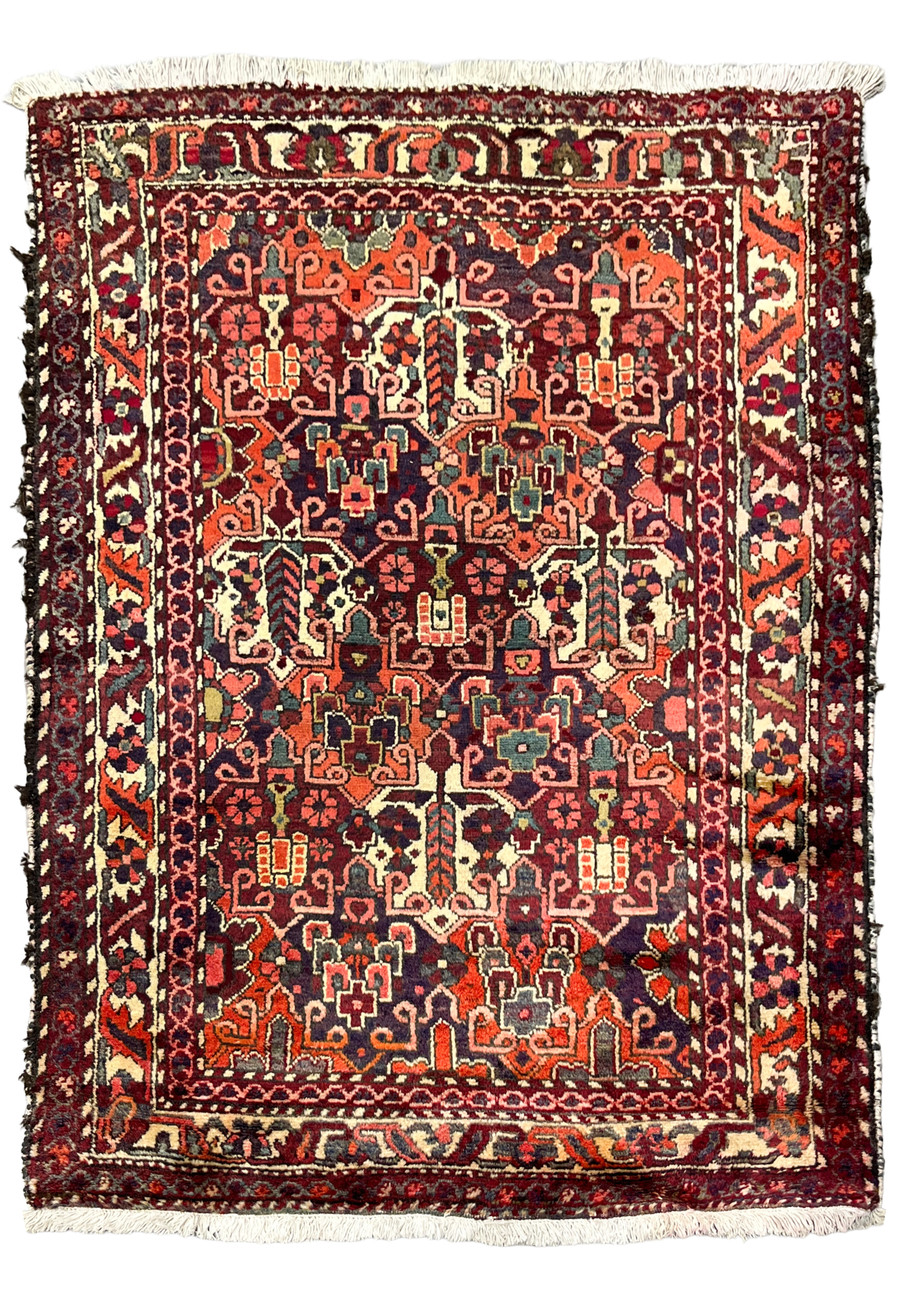
3'7 x 5 Antique Persian Bakhtiari Rug. Made in Iran. The word Persian on this rug’s label is a geographic certification: it was woven in the country historically known as Persia.
The word Persian refers to Iran, the country formerly known as Persia. A Persian rug is a handmade rug woven in Iran. The term carries no additional meaning beyond that geographic origin, but that origin carries an extraordinary amount of weight in the rug world.
Iran has been the dominant force in rug weaving for more than 2,500 years. The great weaving cities of Iran, Kashan, Isfahan, Tabriz, Mashad, Nain, Qum, Bijar, Hamedan, Sarough, produced the defining works of the entire art form. When Western collectors and dealers in the 19th century began systematically acquiring and cataloguing handmade rugs, it was Iranian production that set the benchmark for every standard of quality, design sophistication, and material excellence.
The major Persian rug categories include city rugs, woven in workshops in established weaving centers with high KPSI and formal designs; tribal and village rugs, woven by nomadic and semi-nomadic peoples using horizontal looms with bold geometric vocabulary; and antique pieces, rugs over 100 years old from any Iranian weaving tradition.
At Rugs.net, our Persian categories include Kashan, Isfahan, Nain, Qum, Bijar, Tabriz, Mashad, Sarough, Hamedan, and more. Every one of these is from Iran. Every one is genuinely handmade.
What “Oriental” Actually Means
Oriental is a broader geographic and cultural term that encompasses all handmade rugs produced across the rug-weaving belt of Asia and the Middle East. This is a region that stretches from Morocco in the west to China and Tibet in the east, and includes Iran, Turkey, Afghanistan, Pakistan, India, Nepal, the Caucasus region, Central Asia, and beyond.
Each country in this belt has its own distinct weaving traditions, its own design vocabulary, its own preferred materials and knot structures. The term Oriental rug does not imply a single style or standard; it describes a handmade textile tradition shared across a vast geographic area, within which Persian rug production occupies a central and historically dominant place.
Major Oriental Rug-Producing Countries and Traditions
Iran (Persia)
The oldest and most developed tradition. Kashan, Isfahan, Nain, Tabriz, Bijar, Mashad, Qum, Hamedan, Sarough, and hundreds of tribal and village types.
Turkey (Anatolia)
One of the oldest weaving traditions in the world. Turkish knot construction. Oushak, Hereke, Ladik, Kayseri, and the Kilim flat-weave tradition.
Afghanistan
Bold tribal production. Chobi (vegetable dyed) Peshawar style, Mori Afghan, Kazak, and the Turkmen-influenced Bokhara tradition. Often woven by Afghan and Pakistani artisans using Persian designs.
India
Agra, Jaipur, and Amritsar traditions. Often follow Persian design conventions in high-quality wool. India produces some of the finest large-format handmade rugs available at accessible prices.
China
A distinct design vocabulary: Art Deco influenced, sculptured pile, pastel palettes. Also produces high-end silk rugs. Chinese Art Deco rugs are a recognized collector category.
The Caucasus & Central Asia
Azerbaijan, Armenia, Georgia, and the Turkmen peoples. Kazak, Shirvan, Kuba, Bokhara styles. Bold geometric tribal compositions with strong primary colors.
The critical point is that all of these, including Persian rugs, fall within the Oriental rug category. When a dealer says “oriental rug” they are using a general term. When they say “Persian rug” they are specifying that the piece comes from Iran. The more specific the claim, the more verifiable it should be.
Persian vs. Oriental: Real Examples Side by Side
Both of the following rugs are handmade, authentic, and sold at Rugs.net. One is Persian. One is Oriental but not Persian. Looking at them together illustrates what the difference actually looks like in practice.
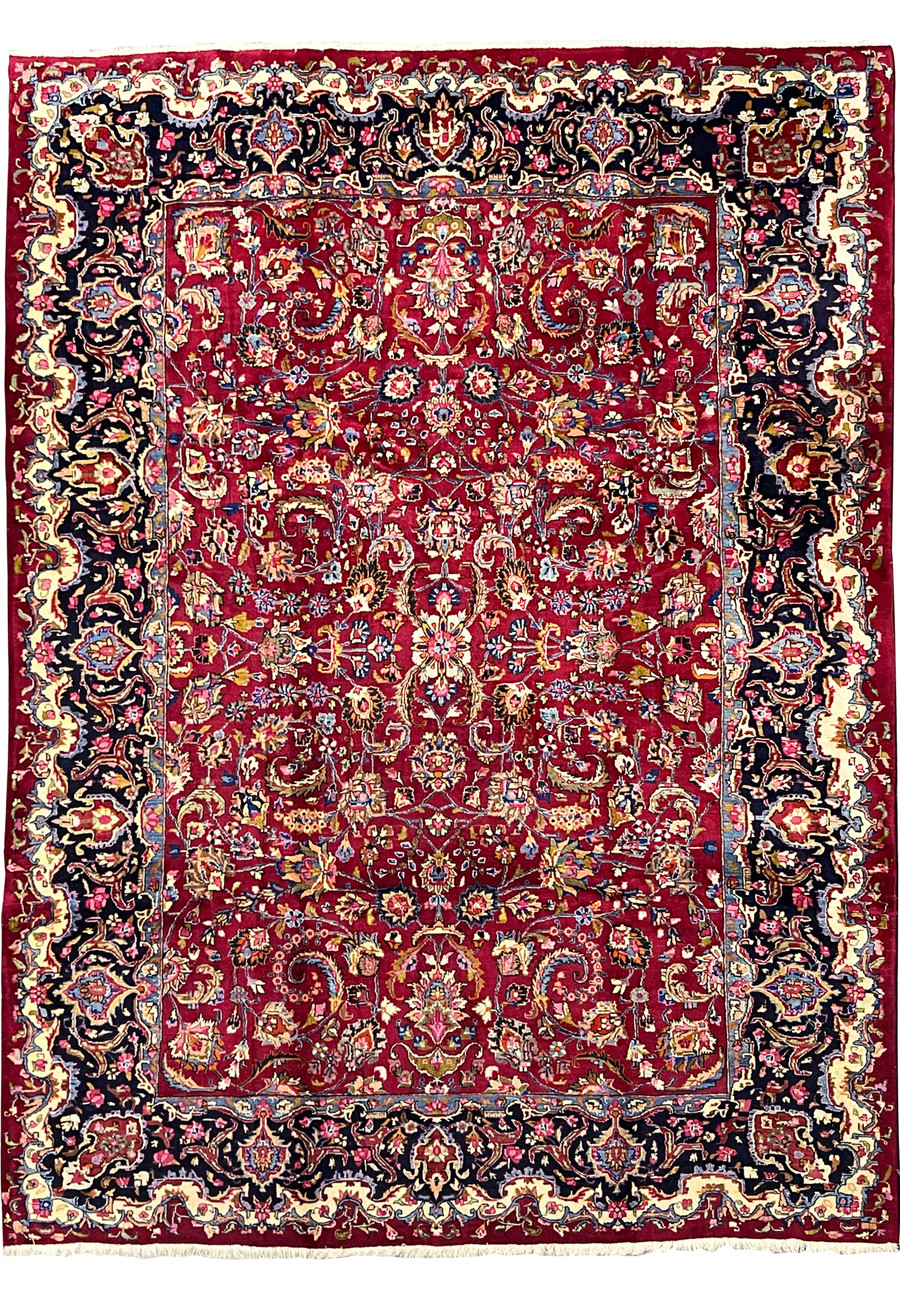
Persian Rug
8 x 11 Persian Mashad Signed Makhmal Baf
Origin: Mashad, Iran · Workshop-woven · Signed by master weaver · Kork wool
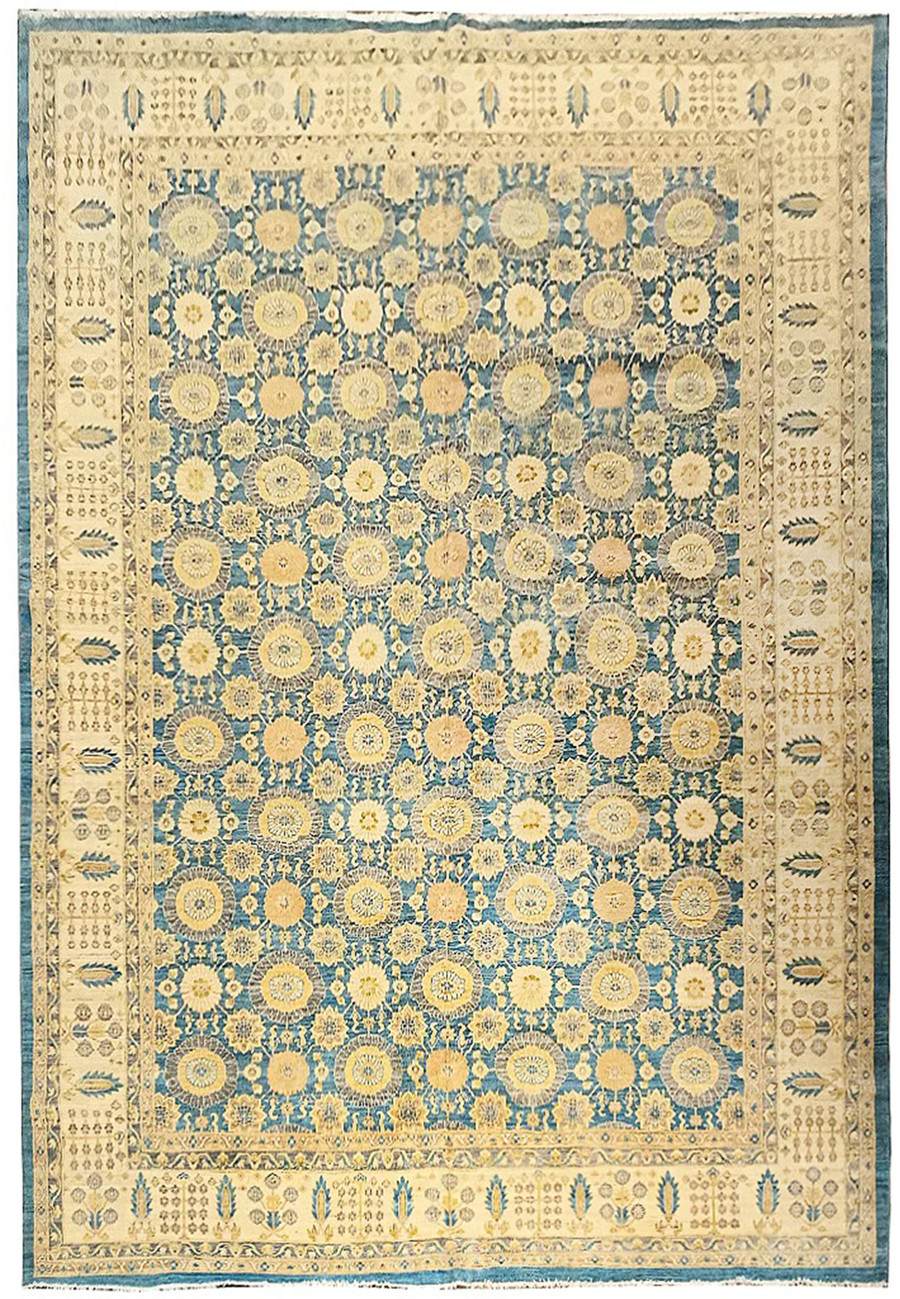
Oriental Rug (not Persian)
11'7 x 16'5 Chobi Peshawar Oversize Rug
Origin: Peshawar region, Pakistan/Afghanistan · Vegetable dyed · Chobi technique · Handmade wool
The Mashad rug on the left is Persian. It was woven in Mashad, Iran, in a workshop, by trained artisans following the city rug tradition of Khorasan province. The Makhmal Baf workshop signature woven into the border certifies its specific origin and quality. Everything about it, the design grammar, the dye palette, the wool quality, the knot structure, is rooted in the Iranian tradition.
The Chobi Peshawar rug on the right is oriental but not Persian. It was woven in the Peshawar region by skilled Afghan and Pakistani weavers using vegetable dyes in the Chobi style. The design draws from the Persian floral tradition, but the piece itself did not originate in Iran. It is a distinct tradition of its own, producing beautiful, high-quality rugs that honor the Persian design heritage while being rooted in a different geographic and cultural context.
Does Persian Mean Better Quality?
This is the question most buyers really want answered. The honest answer is: sometimes yes, sometimes no, and it depends entirely on what you are comparing.
A signed Isfahan by Seirafian, a master-grade Nain 6 LA in kork and silk, a pure silk Qum at 900 KPSI: yes, these represent the absolute pinnacle of the handmade rug tradition, and they are all Persian. No other country produces pieces at this specific level of technical achievement.
But a quality Indian Agra rug, woven in the tradition of the great Mughal court workshops, can match or exceed a standard-grade Persian city rug in both material quality and design sophistication. A fine Chobi Peshawar rug, vegetable-dyed and hand-knotted in the best Afghan workshop tradition, is a genuinely superior handmade rug. A Chinese Art Deco rug in silk is a collector-level piece with no Persian equivalent in its specific aesthetic category.
The practical rule is this: within the very highest tier of rug production, Persian city rugs dominate. Across the broad middle of the handmade rug market, quality is determined by specific construction, specific materials, and specific workshop or weaver, not by country of origin. The label Persian is a geographic fact, not a universal quality guarantee.

9 x 12 Gold Oriental Indian Agra Rug with Burgundy Border. Handmade in India in the Agra workshop tradition, which descends directly from the Mughal court rug workshops of the 16th century. Oriental, not Persian, but rooted in one of the world’s oldest and most distinguished weaving histories.
At Rugs.net, both our Persian and our oriental rugs are 100% authentic and 100% handmade. We are direct importers who verify origin and construction for every piece we carry. The distinction between Persian and oriental on our site tells you exactly where the rug was made, not which is more valuable.
How Persian and Oriental Rugs Actually Differ in Character
Beyond the geographic question, there are genuine differences in visual character, design vocabulary, and aesthetic tradition between Persian rugs and the other major oriental rug types. Understanding these helps you choose the right piece for your space.
Persian city rugs (Kashan, Isfahan, Nain, Tabriz, Mashad, Qum): The floral arabesque tradition. Intricate, formal, curvilinear designs with medallion formats, rich borders, and exceptional detail resolution. Warm ivory, crimson, navy, and gold palettes. The reference point for formal interior design. Wool, kork wool, and silk pile in fine city production.
Persian tribal and village rugs (Bijar, Hamedan, Yalameh, Bakhtiari, Baluch): The geometric tribal tradition. Bold, direct, angular designs with strong color and honest construction. These are the pieces that show the weaver’s personality most directly. Bijar, Hamedan, and Baluch rugs carry the energy of a tradition that was never made for galleries.
Turkish rugs (Oushak, Hereke, Anatolian village): A distinct visual vocabulary. Turkish designs tend toward geometric, with a characteristic spaciousness and earth-toned palette that is highly compatible with contemporary interiors. Turkish knot construction (symmetrical) produces a different pile texture than the Persian knot (asymmetrical). Oushak rugs in particular have become enormously popular in American interior design.
Afghan and Pakistani rugs (Chobi Peshawar, Bokhara, Kazak): The Chobi style uses vegetable dyes to produce muted, naturally faded-looking palettes in warm terracotta, sage, and ivory. The result is a rug that looks authentically aged from new, which makes it extremely versatile in a wide range of interior styles. Bokhara rugs with their characteristic gul (elephant foot) medallion pattern are one of the most widely recognized oriental rug designs in the world.
Indian rugs (Agra, Jaipur, Amritsar): India’s great rug workshops descended from the Mughal court tradition of the 16th century, which itself drew directly from Persian design. Fine Indian rugs therefore often look very similar to Persian city rugs, using the same floral arabesque vocabulary in high-quality wool. They typically offer better value at equivalent construction quality, making them an excellent choice for buyers who want the Persian aesthetic at a more accessible price.
French Aubusson rugs: A distinct Western tradition that occupies a special place in the oriental rug conversation. Aubusson refers to the flat-weave tapestry tradition of the Aubusson region of France. These are not knotted pile rugs; they are woven textiles with a smooth, flat surface and extremely refined floral designs. The aesthetic is European, specifically French baroque and rococo, and they sit in a formal interior context very differently from a knotted Persian. Beautiful and entirely their own category.
A Special Case: The French Aubusson
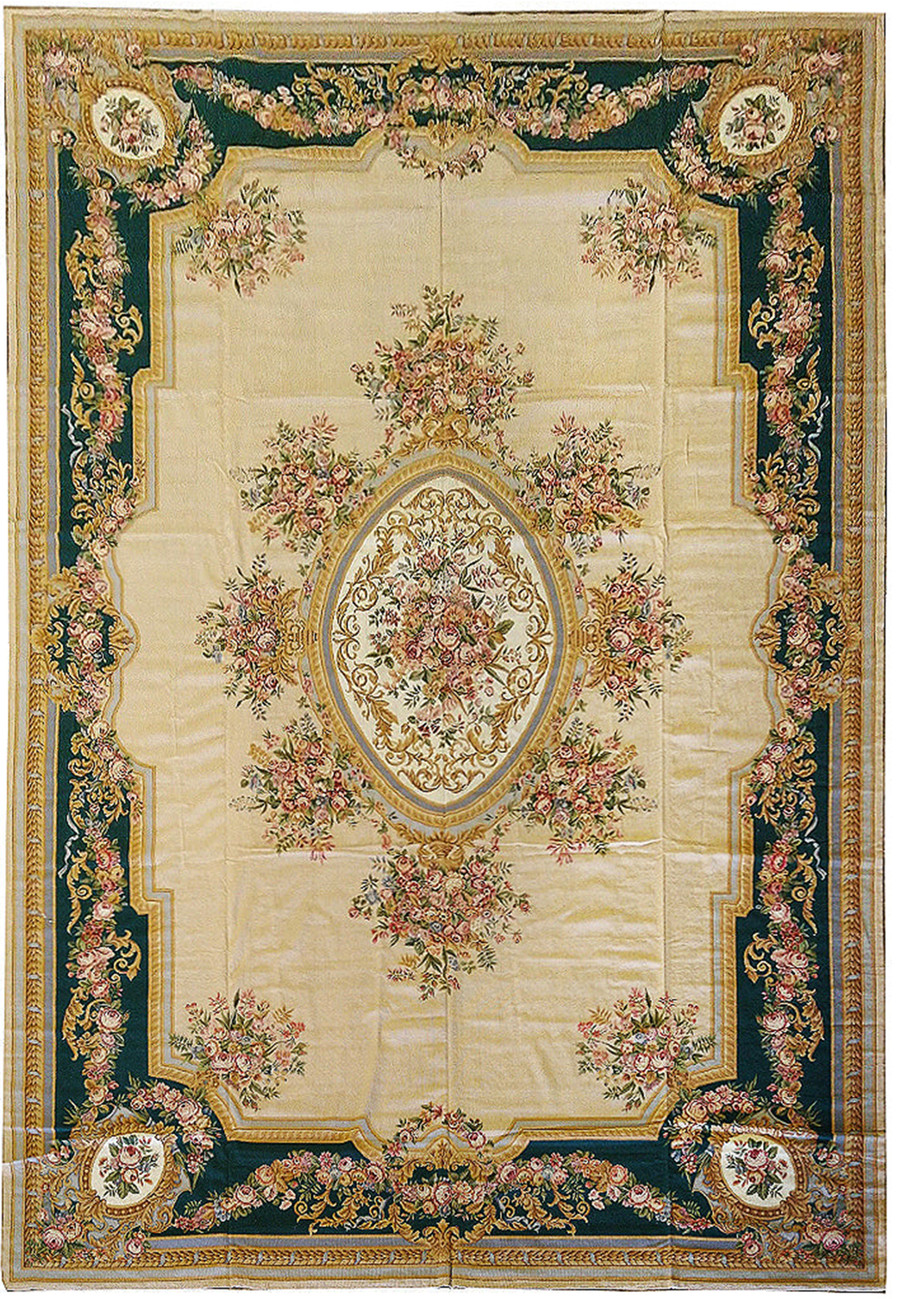
11'4 x 18 French Aubusson Rug, Beige Field with Emerald Green Floral Border. Technically classified as an oriental rug in the broadest sense, the Aubusson is its own distinct tradition. Flat-weave, French-influenced, and designed for formal European interiors. Not Persian, not pile, but handmade.
The Aubusson is worth addressing specifically because it represents how expansive the oriental rug category actually is. Strictly speaking, Aubusson rugs are not oriental at all, they are European. But in the rug trade, they are catalogued within the broader handmade rug world because they share the handmade, non-machine-produced character that distinguishes all quality floor coverings from mass production.
An Aubusson flat-weave has a smooth surface rather than a pile, uses the tapestry technique rather than knotting, and follows French rather than Asian design traditions. It is categorically different from both a Persian rug and an oriental pile rug. If you see one listed as an oriental rug at Rugs.net, understand that we are using the term in its broadest sense to mean a non-machine-made, non-Western-commercial textile of distinction.
So Which Should You Buy?
The answer depends entirely on what you want the rug to do. Here is a straightforward guide:
If you want the finest possible piece at the highest quality tier: Look at Persian city rugs. Isfahan, Nain 6 LA, signed Qum silk. These are the pieces that represent the absolute peak of the handmade rug tradition.
If you want a rug that will last 100+ years under heavy use: A Persian Bijar. The Iron Rug of Persia. No other rug in the world, Persian or oriental, has the same durability.
If you want a large-format room-size rug with Persian character at a more accessible price: Look at Indian Agra or fine Chobi Peshawar. Both offer genuine handmade quality in the Persian design tradition at prices below comparable Iranian pieces.
If you want something that works in a contemporary or transitional interior: Turkish Oushak or Chobi Peshawar. The muted, warm, naturally faded palettes of these traditions are among the most compatible handmade rugs with modern interiors.
If you want bold geometric tribal character: Persian Hamedan, Gholtogh, or Caucasian Kazak. The direct, honest energy of the tribal tradition translated into strong color and geometric form.
If you want a formal European aesthetic: Aubusson flat-weave. Nothing else has the same refined, baroque-influenced character.
Shop Persian and Oriental Rugs at Rugs.net
Every rug at Rugs.net is 100% authentic and 100% handmade. We are a direct importer based in Freeport, New York. Free shipping to all 50 states. Free returns. Ships within 24 hours.
Authentic rugs from Iran. Kashan, Isfahan, Nain, Tabriz, Bijar, Mashad, Qum, Hamedan and more.
Handmade rugs from Turkey, India, Afghanistan, Pakistan, China and beyond. All authentic.
The most iconic Persian city rug. Classic crimson and navy medallion. Workshop precision.
Warm ivory and gold kork wool. Among the finest Persian city rug production.
The strongest rug in the world. Wet-beaten construction. 100+ year lifespan.
Light ivory and indigo kork and silk. Among the most refined Persian production.
Pure silk at 700-900 KPSI. Museum-quality collector pieces.
The complete collection. 100% authentic. Direct importer pricing. Free shipping all 50 states.
By color: beige and ivory, red and burgundy, navy and blue, green. By size: large rugs, medium rugs, runners. Clearance.