

The Complete Guide to Bijar Rugs: The Iron Rugs of Persia and Why They Last a Lifetime
Posted by Rugs.net on Mar 29th 2026
Rugs.net · Persian Rug Guide
The Complete Guide to Bijar Rugs
The Iron Rugs of Persia: The Most Durable Handmade Rugs in the World
By Rugs.net Specialist Daniel Harouni · Persian Rug Experts
In the Persian rug world, every city has a reputation. Isfahan is celebrated for elegance. Kashan for classical beauty. Qum for technical perfection. But Bijar has a reputation that stands entirely apart from all of them: Bijar is the toughest rug ever made by human hands.
The nickname says everything. Dealers, collectors and weavers around the world call them the Iron Rugs of Persia. Not because of the way they look, though they are extraordinarily beautiful. But because of how they are built, how they feel, and how long they last. A Bijar rug does not just survive daily use over decades. It improves with it. A Bijar rug bought today is a rug your grandchildren will still be walking on, and it will look better in fifty years than it does the day it arrives.
This guide covers everything you need to know about Bijar rugs: the remarkable Kurdish heritage behind them, the unique wet-beating construction technique that makes them indestructible, the different styles and designs available, and how to find the right one from the Rugs.net collection.
In This Guide
- 01 Bijar: The Kurdish City That Built an Indestructible Rug
- 02 Why Bijar Rugs Are the Most Durable Rugs in the World
- 03 The Wet-Beating Technique: How Iron Rugs Are Made
- 04 Bijar Styles and Designs: A Guide to the Different Types
- 05 Bijar Diamond Medallion Rugs
- 06 Bijar Herati and All-Over Pattern Rugs
- 07 Bijar Floral Rugs
- 08 Bijar Botanical and Geometric Designer Rugs
- 09 Colors of Bijar Rugs
- 10 Bijar Rugs: A Lifetime Investment
- 11 Browse Our Bijar Collection at Rugs.net
Bijar: The Kurdish City That Built an Indestructible Rug
Bijar, also spelled Bidjar, is a city in the Kurdistan Province of northwest Iran. It sits in a rugged highland region where the Kurdish people have lived, herded their flocks and woven their rugs for centuries. The landscape is dramatic and demanding, and the rugs that came out of it reflect that character completely.
Kurdish weavers in the Bijar region developed a construction approach unlike anything practiced elsewhere in Persia. Where other weaving cities valued softness, flexibility and the ability to roll and transport a rug easily, Bijar weavers prized something different entirely: density, weight and structural integrity that bordered on the absolute. The result was a rug that felt less like a textile and more like a floor itself. Solid, immovable, permanent.
The Bijar weaving tradition is deeply rooted in Kurdish tribal culture, where a rug was not just a decorative object but a practical necessity designed to withstand the harsh conditions of highland life. That utilitarian seriousness is still present in every Bijar rug made today, even in the most refined and elaborately designed pieces. Beneath the beauty is always the iron.
Bijar rugs come from a people who built their lives in one of the most demanding environments in the Middle East. Their rugs reflect that: designed not just to look beautiful but to endure everything life puts in front of them.
Why Bijar Rugs Are the Most Durable Rugs in the World
The title Iron Rug of Persia is not marketing language. It is a technical description of what a Bijar rug actually is. To understand why Bijar rugs are in a completely different category of durability from any other handmade rug in the world, you need to understand three things: the construction method, the materials and the pile structure.
A typical Persian rug lasts 50 to 100 years. A Bijar, with its double weft foundation and dense Turkish knot construction, regularly lasts 150 to 200 years or more. There are antique Bijar rugs from the late 19th century still in daily use today, and still beautiful.
The Wet-Beating Technique: How Iron Rugs Are Made
The secret behind the Iron Rug's extraordinary density is a construction technique found nowhere else in the Persian rug world: wet-beating. This is the defining process that separates a Bijar from every other handmade rug in existence.
In standard Persian rug weaving, after each row of knots is tied and cut, the weft threads are passed through and beaten down with a comb to compact the structure. In Bijar weaving, the wool wefts are deliberately dampened with water before being beaten down. Wet wool is more pliable and compresses more tightly than dry wool. When it dries, it locks permanently in place at a density that cannot be achieved through dry weaving no matter how hard the weaver beats the comb.
The result of this process is a pile structure where each row of knots is so tightly locked in place by the compacted wet-beaten wefts that the individual knots cannot shift, loosen or pull free under any normal conditions of use. This is not just durability. This is permanence. The structure of a Bijar rug, once dried and set, is essentially fixed forever.
One practical consequence of this technique is that a Bijar rug is not flexible in the way other rugs are. You cannot fold a Bijar rug in half the way you can roll a Kashan or an Isfahan. The structure is too rigid. This is not a defect. It is proof of the construction. When a rug dealer or collector turns back the corner of a Bijar and sees that stiffness, they are seeing exactly what they paid for.
If you can fold a Bijar rug in half easily, it may not be a genuine Bijar. A true Iron Rug resists folding. That rigidity, uncomfortable for transport but extraordinary for longevity, is the direct result of the wet-beating technique that no other weaving city uses.
Bijar Styles and Designs: A Guide to the Different Types
Despite their reputation purely for toughness, Bijar rugs are also among the most visually diverse and beautiful rugs in the Persian tradition. The Bijar design vocabulary is wide, drawing from both classical Persian court design and the bold geometric energy of Kurdish tribal weaving. Here are the main design categories you will encounter.
| Design Style | Description | Character |
|---|---|---|
| Diamond Medallion | Bold geometric diamond at center surrounded by floral field | Powerful, symmetrical, commanding |
| Herati (Mahi) | All-over repeating fish-in-diamond rosette pattern | Classic, rich visual texture across the entire field |
| Floral Medallion | Central medallion with elaborate floral field | Refined, classical, works in formal interiors |
| Botanical and Geometric | Mix of organic botanical motifs with structured geometry | Designer-friendly, works in both classic and modern rooms |
| All-Over Floral | Dense repeating flowers across the entire field | Lush, warm, traditional Persian |
| Tribal and Village | Bold angular geometry with Kurdish tribal character | Raw energy, visual boldness, expressive |
Do not let the Iron Rug reputation make you think Bijar rugs are purely utilitarian. The design range is extraordinary. A finely designed Bijar Diamond Medallion rug belongs in the same conversation as the most beautiful pieces from Kashan or Isfahan. The difference is that it will still be there in 200 years.
Bijar Diamond Medallion Rugs
The Diamond Medallion is perhaps the most iconic Bijar design. A bold, sharply defined geometric diamond sits at the center of the field, often flanked by matching corner pieces. The diamond's geometric precision reflects the Kurdish tribal tradition, while the dense floral arabesque field surrounding it shows the influence of classical Persian court design. The result is a composition that manages to be simultaneously powerful and refined.
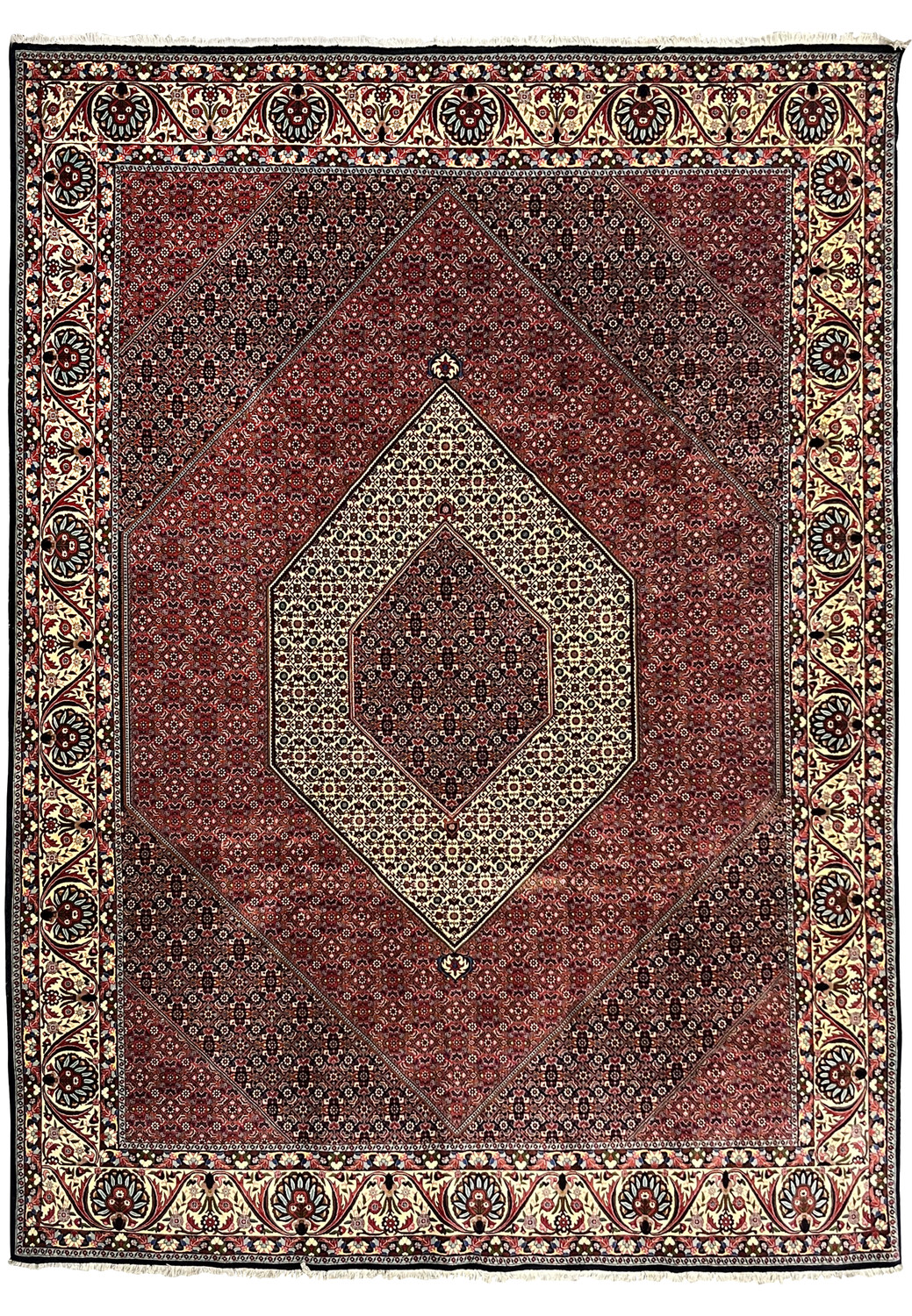
Diamond Medallion Bijar rugs work exceptionally well in large formal rooms. The bold central composition centers perfectly under a dining table or seating arrangement and the geometric energy of the diamond reads clearly from a distance, making it one of the most visually effective designs for large spaces.
Bijar Herati and All-Over Pattern Rugs
The Herati pattern, also known as the Mahi or fish pattern, is the most traditional and widely used all-over design in the Bijar repertoire. It consists of a repeating module: a rosette at the center of a diamond, with curved lancet leaves along the diamond sides that suggest fish swimming in water. Repeated across the entire field, it creates a dense, rhythmic visual texture that is simultaneously intricate up close and beautifully unified from a distance.
In a Bijar, the Herati pattern takes on a particular weight and presence that lighter rugs cannot match. The dense pile and tight construction give the pattern a sculptural quality. Running your hand across a Bijar Herati feels different from any other rug. The pile is firm, the surface is dense, and the pattern has a physical presence that reflects light and shadow in a way a softer pile cannot.


Bijar Floral Rugs
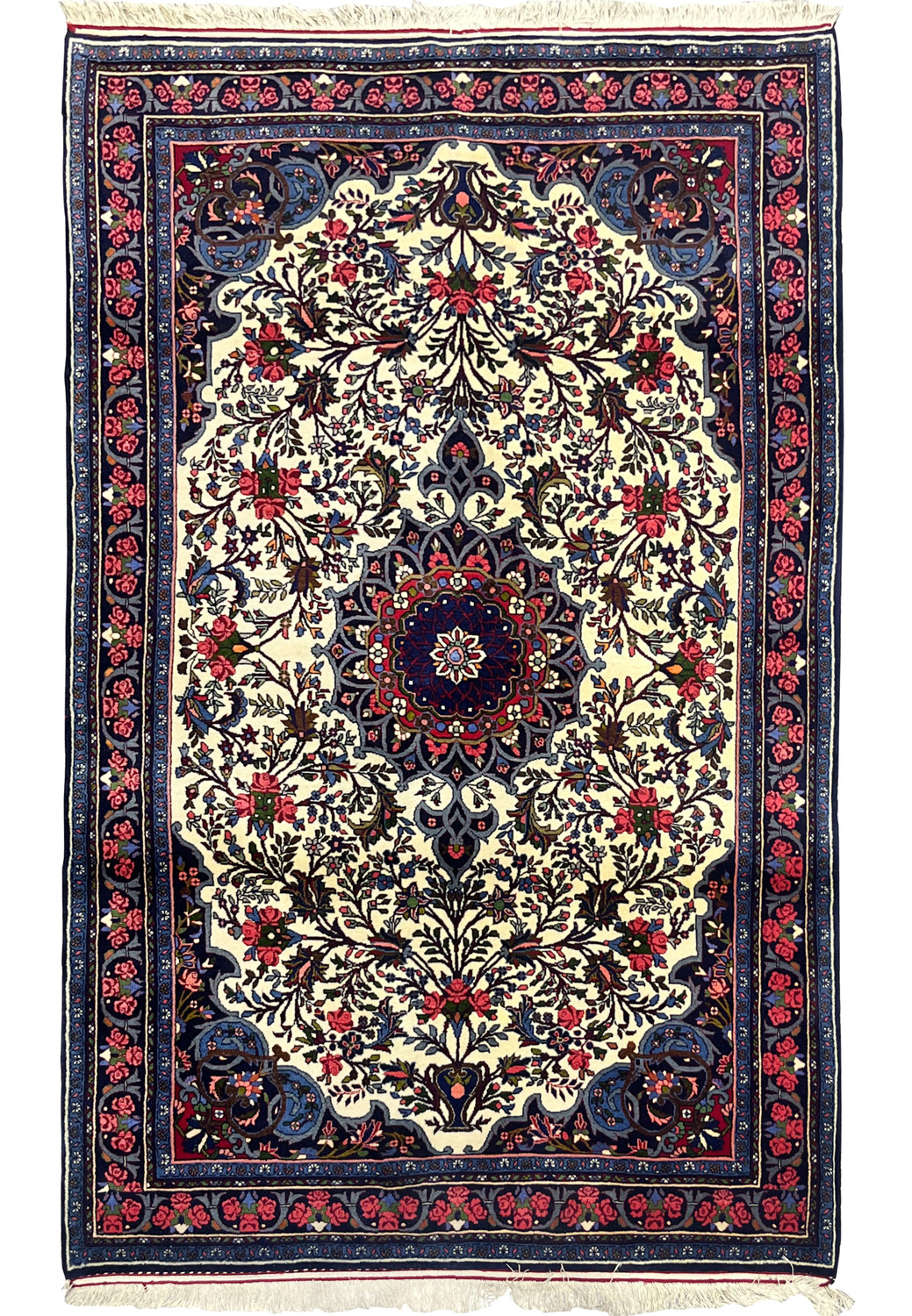
Not all Bijar rugs carry the bold geometric weight of the diamond medallion or the dense all-over Herati. The Bijar tradition also includes beautifully floral pieces where the organic language of flowers, vines and botanical motifs takes the lead. These rugs bring the warmth of the classical Persian floral tradition to the unmatched structural foundation of the Iron Rug construction.
Bijar floral rugs combine the softness of a full floral vocabulary with the permanence only Bijar can deliver. They are among the most versatile pieces in the Bijar range, working naturally in both traditional and contemporary interior settings.

Bijar Botanical and Geometric Designer Rugs
One of the most interesting and increasingly sought-after categories of Bijar rug is the botanical and geometric designer style. These pieces blend the natural world of vines, leaves and botanical forms with the structural geometry of the Kurdish weaving tradition, creating compositions that feel simultaneously ancient and remarkably current.
Designer Bijar rugs appeal strongly to buyers who love the idea of a handmade Persian rug but want something that feels less formally traditional. The botanical geometric style works beautifully in contemporary interiors, in rooms with clean-lined furniture, and in any space where a purely geometric or purely floral rug might feel either too cold or too ornate.

If you have always loved the idea of a handmade Persian rug but worried it would feel too traditional for your home, a botanical geometric Bijar designer rug is the answer. It has the soul of a Persian rug and the versatility of a contemporary design. And it will outlast every other rug in your home by decades.
Colors of Bijar Rugs
Bijar rugs are known for a color palette of exceptional richness and saturation. The natural dyes used in traditional Bijar weaving penetrate deeply into the high-quality Kurdish wool, producing colors that are more vivid and permanent than in most other Persian rug types. These colors do not fade. They mellow beautifully over decades into tones of even greater depth and character.
| Color | Role in the Rug | Character |
|---|---|---|
| Deep Red or Wine | Primary field ground in most classic pieces | Commanding, warm, deeply Persian |
| Midnight or Navy Blue | Medallions, borders, major design elements | Deep and authoritative, creates contrast |
| Ivory and Cream | Design highlights, palmettes, arabesque details | Creates contrast and visual lift against dark grounds |
| Forest or Olive Green | Leaf motifs, border accents | Adds natural depth, earthy and grounding |
| Burnt Orange and Rust | Field in some pieces, accent details | Warm and tribal, reflects Kurdish highland palette |
| Gold and Camel | Rosette highlights, border details | Adds warmth and richness to the overall palette |
One of the most remarkable qualities of Bijar colors is how they age. The rich natural dyes in a genuine Bijar rug soften and mellow over decades into tones of extraordinary depth that are simply impossible to achieve in a new rug. A 30 year old Bijar often has more beautiful color than the day it was made. This is the nature of quality natural dyes in high grade Kurdish wool, and it is one of the reasons antique Bijar rugs command such strong prices at auction.
A new Bijar rug is beautiful. A 25 year old Bijar is extraordinary. The natural dyes soften into each other over time, creating a patina of color depth that cannot be manufactured. You are not just buying a rug. You are buying a future heirloom that gets better every year.
Bijar Rugs: A Lifetime Investment
When you buy a Bijar rug you are not making a purchase you will need to repeat. You are making a decision once, for the rest of your life, and very possibly for the generation after you. That is not a figure of speech. It is a description of what happens in practice.
Consider the true cost of floor coverings over a lifetime. A machine-made rug at $500 lasts five years before it looks worn out. You buy another. And another. Over 30 years you have spent $3,000 and thrown away three rugs. A Bijar rug at $3,000 is still beautiful in 30 years and will be for another 30 after that. It does not go to landfill. It becomes an heirloom.
The practical case for Bijar rugs is actually stronger in high traffic areas than anywhere else. Most people hesitate to put a beautiful rug in a hallway, a family room or a busy kitchen area because they worry about wear. A Bijar removes that hesitation entirely. The wet-beaten double weft construction is specifically designed for the conditions of daily life. It was designed by people whose lives depended on durable textiles, in an environment where soft or fragile rugs simply would not survive.
Put a Bijar in your busiest hallway and walk on it every day for the next 30 years. Check back and let us know how it looks. We already know the answer.
| Quality | Bijar Iron Rug | Machine-Made Rug |
|---|---|---|
| Construction | Double weft, Turkish knot, wet-beaten | Machine woven, single layer |
| Lifespan | 150 to 200+ years | 5 to 10 years |
| High Traffic | Ideal. Gets more beautiful. | Degrades quickly |
| Color Over Time | Deepens and mellows beautifully | Fades and deteriorates |
| Value | Holds and appreciates | Worthless within a decade |
| Heirloom | Passed down through generations | Thrown away |
No other rug on earth combines the beauty of a fine Persian design with the structural longevity of the Iron Rug construction. If you are going to buy one rug in your lifetime and never think about replacing it again, buy a Bijar.
Browse Our Bijar Collection at Rugs.net
At Rugs.net we carry one of the largest selections of authentic handmade Persian Bijar rugs available anywhere in the United States. Every piece is sourced directly from the Bijar region without middlemen, verified for authentic Iron Rug construction, and described honestly with full specifications. Every Bijar we sell ships free to all 50 states, comes with free home returns, ships the same day you order before 2 PM EST, and is backed by our guarantee to beat any competitor price by 10%.
| Featured Piece | Size | Style |
|---|---|---|
| 10 x 13'3 Bijar Iron Rug with Diamond Medallion | 10' x 13'3" | Diamond Medallion |
| 6'6 x 8'4 Persian Bijar Rug | 6'6" x 8'4" | All-Over Pattern |
| 7 x 10'4 Unique Premium Persian Bijar Rug | 7' x 10'4" | All-Over Pattern |
| 3'9 x 5'8 Persian Bidjar Rug | 3'9" x 5'8" | Accent / Floral |
| 7 x 10 Botanical and Geometric Bijar Designer Rug | 7' x 10' | Designer / Contemporary |
| 7 x 10'2 Persian Bijar: Very Fine, Extremely Durable | 7' x 10'2" | Fine All-Over |
| 4'3 x 6'8 Floral Persian Bijar Rug | 4'3" x 6'8" | Floral |
| View All Bijar Rugs at Rugs.net | All sizes | Full collection |
The Only Rug You Will Ever Need to Buy
No other handmade rug on earth combines the visual beauty of a genuine Persian rug with the structural permanence of the Iron Rug construction. A Bijar does not just fill a room. It anchors it. And it keeps anchoring it for the next 150 years while looking more beautiful every decade.
If you have children or pets, put a Bijar in your busiest room and stop worrying. If you have a high-traffic hallway that defeats every rug you put in it, put a Bijar there and never think about that hallway again. If you want one rug that you buy once, keep forever and pass on to your children, the answer has always been Bijar.
Every Bijar rug at Rugs.net is 100% authentic, sourced directly, and backed by free shipping to all 50 states, free returns with home pickup, same day shipping, and our price beat guarantee. Questions? Call us anytime at 855-576-7705.
Shop Bijar Rugs Call 855-576-7705