

Every serious collector of Persian rugs eventually arrives at the same conclusion about the Bijar: it is in a category by itself. Not because of its design, though the designs are exceptional. Not because of its color, though the color is among the deepest and most saturated in the entire Persian tradition. Because of what it is physically. The Bijar is the densest, heaviest, most structurally rigid hand-knotted rug produced anywhere in the world, the product of a construction method used exclusively in the Kurdistan Province of northwestern Iran and nowhere else on earth. Rug merchants have called it the Iron Rug of Persia for over a century. The name understates the case.
The city of Bijar, sometimes spelled Bidjar, sits in Kurdistan Province in the Zagros mountain range at an elevation of roughly 1,800 meters. Its Kurdish weaving community has produced rugs continuously for centuries, drawing on a design vocabulary that combines the formal floral traditions of the great Persian city workshops with the geometric and tribal instincts of the Kurdish weaving heritage. What makes Bijar extraordinary is not where it sits on the design spectrum but how it is built. The construction technique is unique, irreplicable, and the reason a Bijar rug laid in a room today will still be in that room, in daily use, a century from now.
The Wet-Weft Technique: How a Bijar Is Built
The construction of a Bijar rug is unlike anything else in the weaving world. Every other hand-knotted rug tradition inserts the weft threads dry. Bijar weavers do not. After each row of knots is tied, the weft thread is dampened with water before being inserted horizontally across the loom. The dampened weft becomes temporarily pliable in a way dry wool never is, allowing the weaver to pack it down against the knot row with a heavy comb using significantly more force than a dry-weft structure could withstand without distorting. As the dampened weft dries, it shrinks and contracts around the knots and warp threads, locking everything into a structure of extraordinary density and rigidity.
Most Bijar rugs are woven with two wefts between each row of knots rather than the single weft used in most other Persian city traditions. Combined with the wet-compression method, this double weft creates a foundation that is not merely dense but effectively indestructible under normal conditions. The finished rug cannot be folded flat without risk of cracking the foundation. It is transported rolled, never folded, and it lies flat on the floor with a rigidity that no other hand-knotted pile rug can match. This is why Bijar rugs are described as the heaviest Persian rugs of equivalent size: a Bijar 9 x 12 weighs noticeably more than a Kashan or Tabriz of the same dimensions.
The knot itself is the Turkish or symmetric knot (Ghiordes knot), not the Persian asymmetric knot used in most Iranian city rugs. The Turkish knot wraps symmetrically around two adjacent warp threads, which produces a slightly different pile geometry than the Persian knot and contributes to the characteristic density and slightly raised pile texture of a Bijar surface. The pile wool is typically the finest hand-spun Kurdish wool, which has a natural resilience and lanolin content that adds to the rug's durability and develops into a distinctive patina over decades of use.
Why you cannot fold a Bijar: The rigid double weft compressed while wet creates a foundation that behaves more like stiffened fabric than a standard textile. Folding puts stress on the weft threads that can cause the foundation to crack or crease permanently. Any Bijar you are offered that has been folded for storage should be inspected carefully along the fold lines before purchase.
Watch: Persian Bijar 9'10 x 13'1 in Action
History: Kurdish Weavers and the Zagros Mountains
The Kurdish people have woven rugs in the Zagros mountain region of what is now western Iran for centuries before any formal documentation of their production existed. The weaving culture of the Bijar area draws on this deep tribal heritage while also incorporating influences from the formal Persian court traditions that reached Kurdistan through trade and patronage. The result is a tradition that sits uniquely between the tribal and the urban: Bijar rugs have the structural quality of the finest city workshop production but the design freedom and color confidence of a tribal weaving culture that answers to its own aesthetic instincts.
The finest Bijar production has historically come not from the city itself but from the villages surrounding it, particularly Gholtogh and Senneh (modern Sanandaj), where the most skilled weavers maintained the strictest quality standards. This counterintuitive fact, that the best rugs of a named city tradition come from the villages around it rather than the city center, is worth knowing when evaluating pieces. Village Bijars from the great weaving families of the Gholtogh area represent the absolute pinnacle of this tradition.
Bijar rugs entered the Western market seriously in the late nineteenth century as European and American demand for Persian rugs expanded rapidly. Their extraordinary durability made them natural choices for heavy-traffic commercial spaces, hotel lobbies, and formal residential rooms where longevity was as important as beauty. The iron rug designation became firmly established in the trade during this period and remains the most accurate single description of what the Bijar is.
Oversize Bijar Rugs: Palace-Scale Iron Rugs


Oversize Bijar rugs at 12 x 17 and 13 x 20 feet are among the rarest pieces in the entire Persian rug market. The iron construction at palace scale: these are the rugs that defined grand interiors for generations.
Designs: The Garrus, the Mahi, and the Full Vocabulary
The Garrus Design
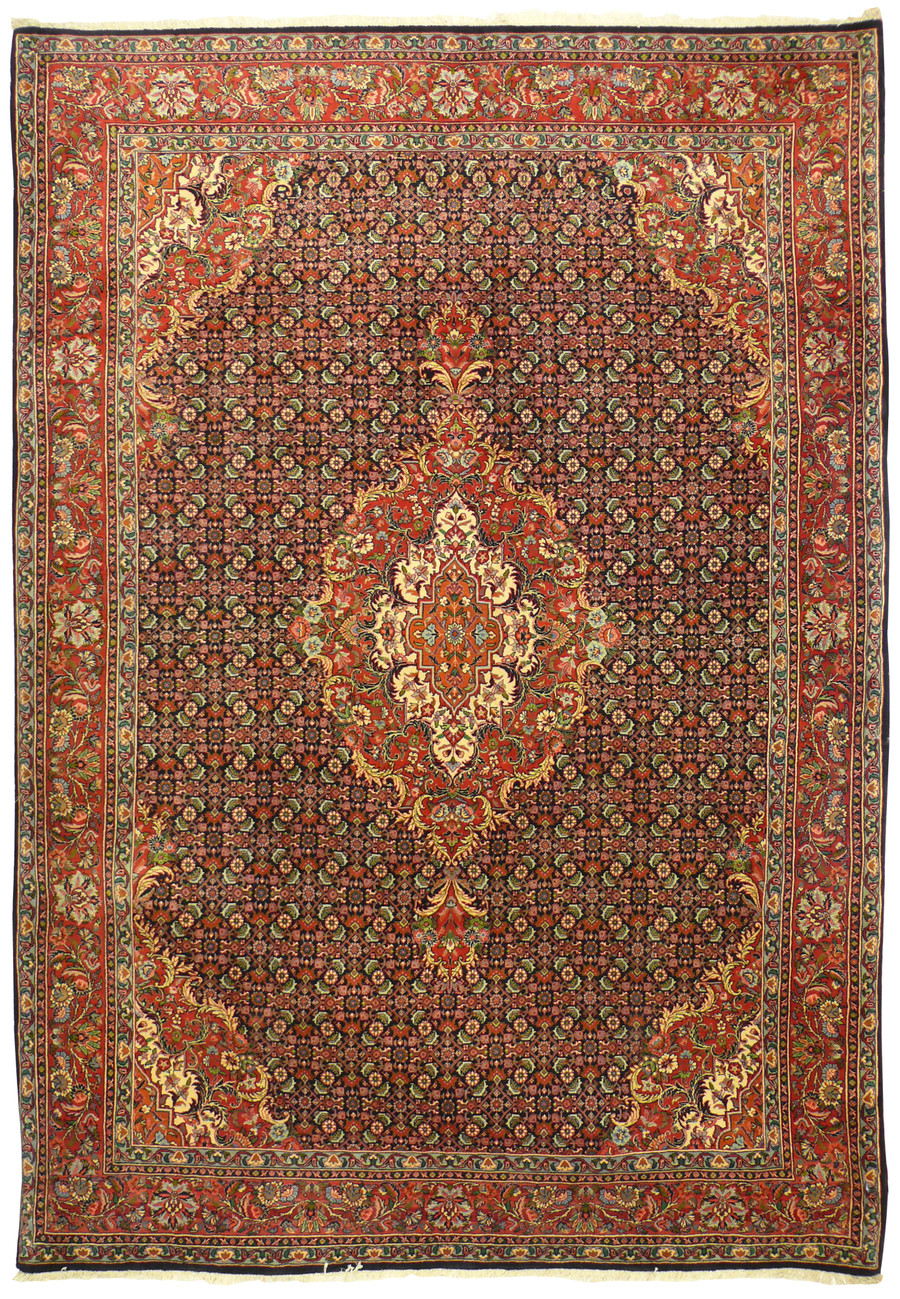
The Garrus is the signature Bijar design and one of the most recognizable patterns in the entire Persian rug tradition. Named after the Garrus district of Kurdistan, the design features a formal central medallion surrounded by an open field filled with large, boldly drawn floral motifs, roses, palmettes, and curving vines rendered with the kind of clarity that only a high-KPSI iron construction can achieve. The Garrus Bijar tends toward deep jewel tones: saturated navy, midnight blue, deep forest green, rich burgundy, and vibrant coral against fields of ivory or gold. The design is both tribal in its color confidence and formally structured in its composition, a combination that makes it one of the most visually compelling designs in the Persian repertoire.
The Mahi (Herati) Design
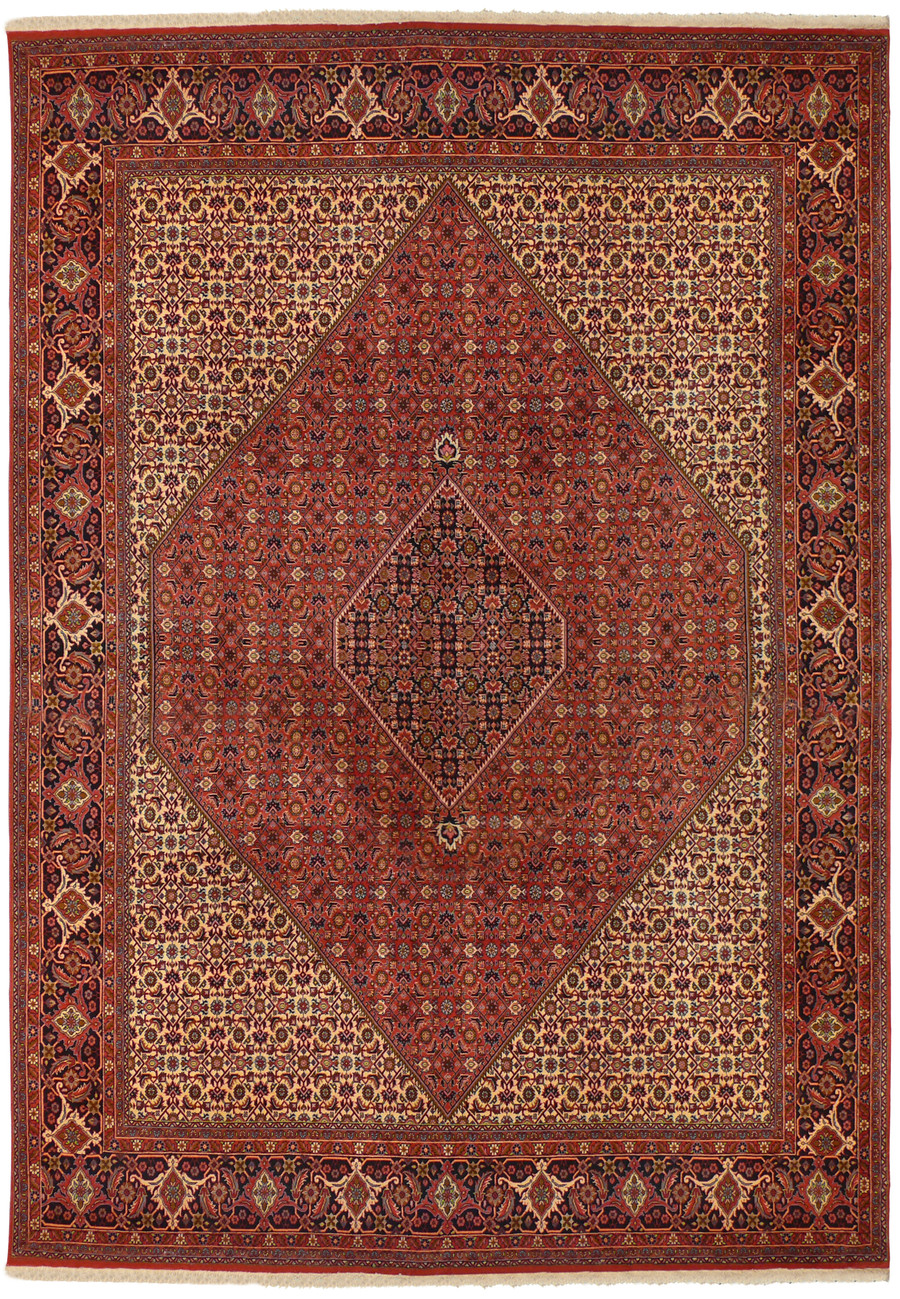
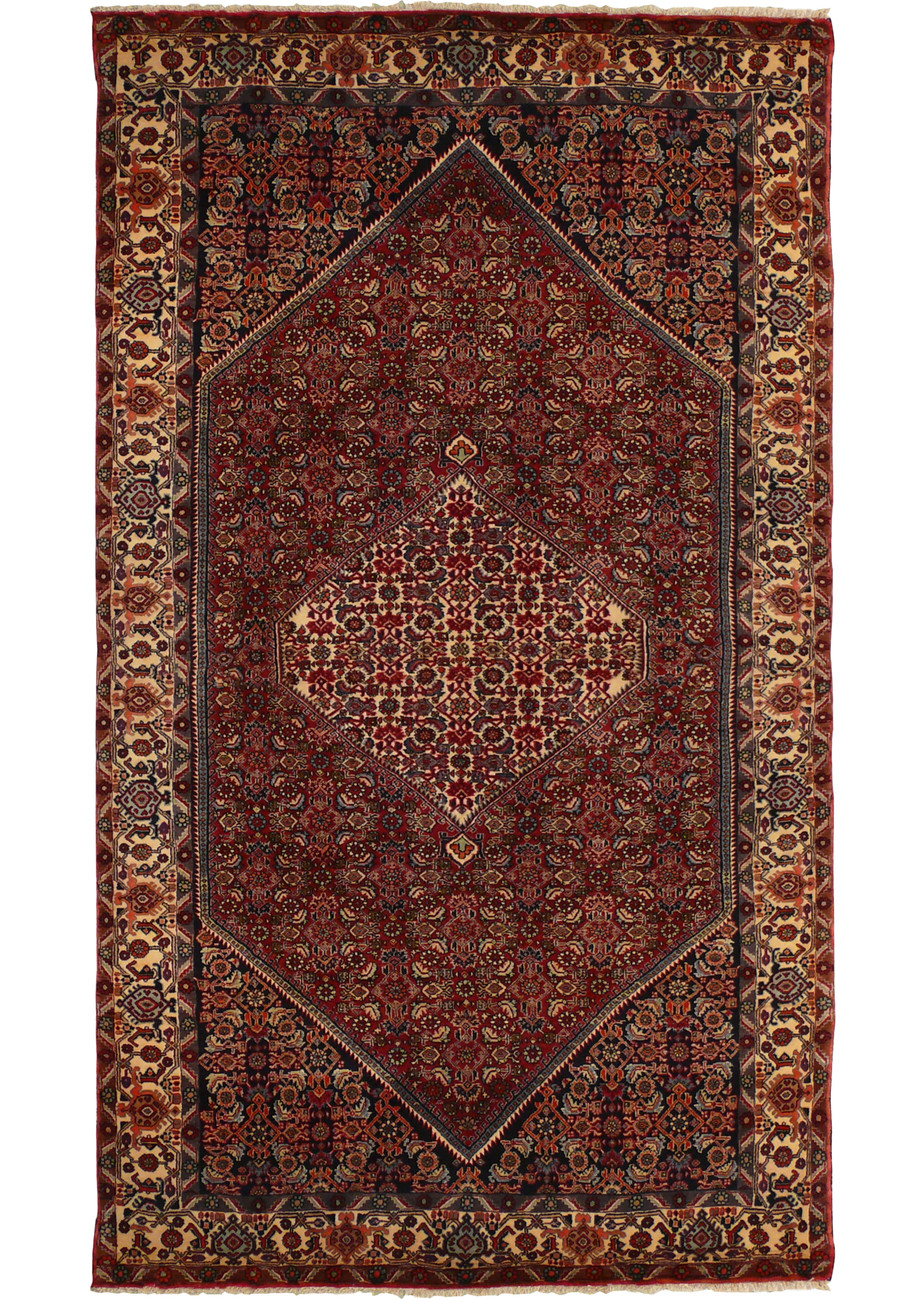
The Mahi pattern, also called the Herati or fish design, is the other great Bijar classic. A continuous lattice of diamonds, each containing a central rosette surrounded by curved lance-shaped leaves that resemble fish swimming around a pond, covers the entire field in an allover repeat. The Bijar version of the Mahi is considered one of the finest renderings of this widely used pattern in all of Persia: the compressed iron construction allows the fine internal detail of each diamond unit to be resolved with a sharpness that looser-woven traditions cannot approach. A Bijar Mahi at 200+ KPSI looks almost printed.
Watch: Classic Bijar Mahi Design
The classic Bijar Mahi design in action. Note the depth of color and the precision of the fish-and-pond lattice that defines this pattern.

Other Classic Bijar Designs
Beyond the Garrus and Mahi, the Bijar tradition encompasses a wide design vocabulary. The Shah Abbas design brings the large stylized palmettes and arabesque scrolls of the formal Safavid court tradition into the iron rug format, producing a piece that reads as both tribal in its color saturation and formally sophisticated in its compositional structure. The Bid Majnun, or Tree of Life and Cypress and Willow design, depicts a stylized weeping willow tree with branches spread across the field, birds nesting among the leaves. The name comes from the Farsi for "crazy willow" because the hanging branches resemble the unkempt hair of a Majnun, a madman in classical Persian literature. The medallion format, both pendant and full medallion, appears across the Bijar tradition with the field typically left more open than in a dense allover piece, allowing the color of the ground to read strongly against the floral or geometric ornament.
Color: The Deepest Palette in Persian Weaving
The color of a fine Bijar is one of its most immediately striking qualities. Kurdish dyers developed a reputation for producing the deepest, most saturated jewel tones in the Persian weaving world, and the Bijar's dense pile construction amplifies this saturation. Where a Kashan might show a rich but somewhat complex layered red, a Bijar shows a red that reads as a single, vibrating, deeply saturated tone. The same applies to the navy blue, the forest green, the gold, and the ivory: each color is pushed to its most concentrated expression.
The traditional Bijar palette draws from natural dyes: madder for the reds and pinks, indigo for the blues, weld for the yellows and golds, pomegranate for brown-golds, and various tannin-based sources for the dark browns and blacks. The interaction of these natural dyes with the high-lanolin Kurdish wool creates a tonal richness that synthetic dyes cannot replicate. Antique and semi-antique Bijars dyed with natural materials have colors that have deepened and harmonized over decades into a warmth that is one of the reliable markers of genuine age.
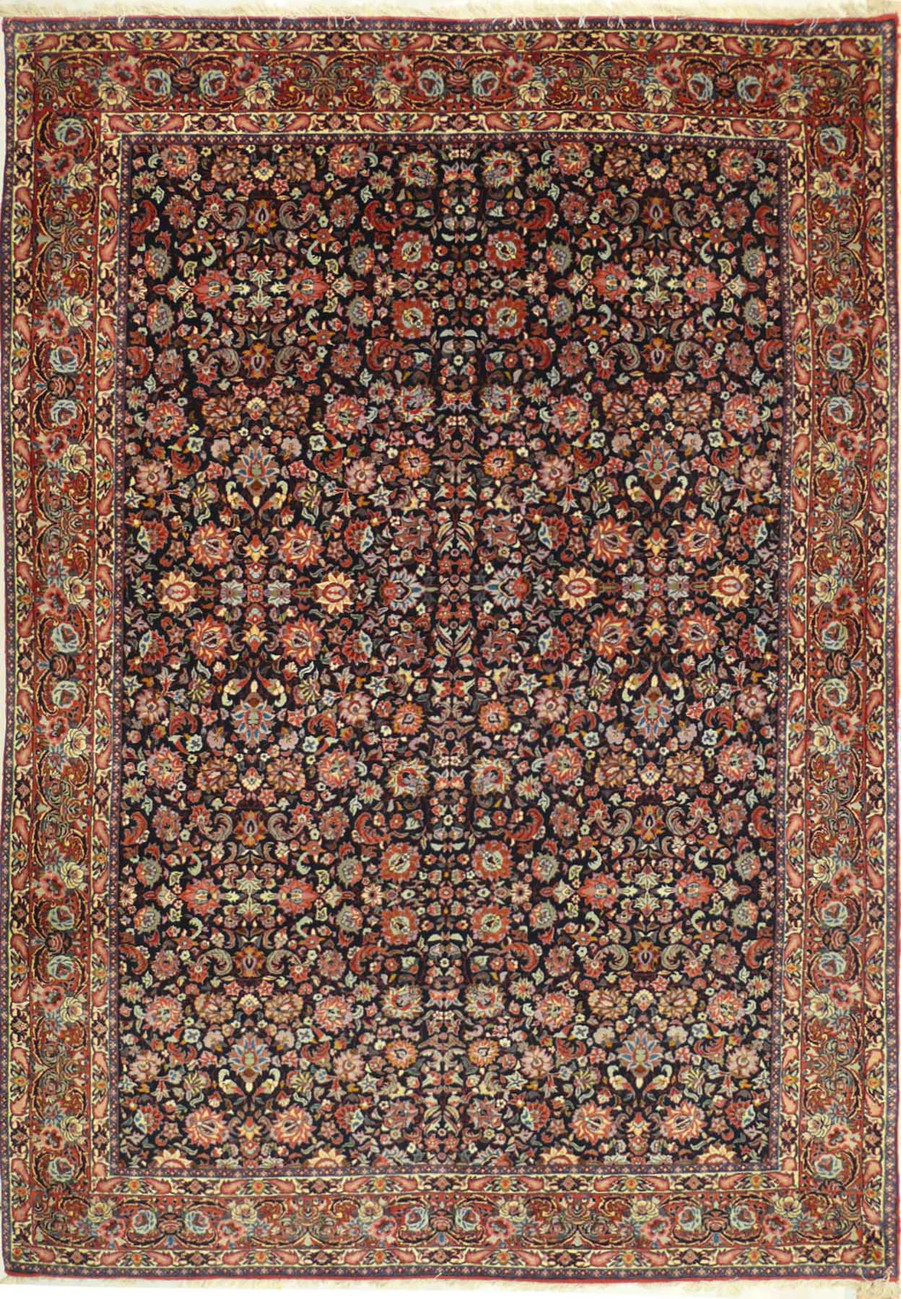
The allover format in particular benefits from this color approach. When a dense Mahi or Garrus field in deep navy or forest green is set against a contrasting border in red and ivory, the visual effect is one of the most powerful in any decorative rug tradition. A Bijar allover does not need a central medallion to command a room. The field itself is enough.
Bijar Allover Rugs

Unusual and Premium Bijars: Rare Pieces in the Tradition
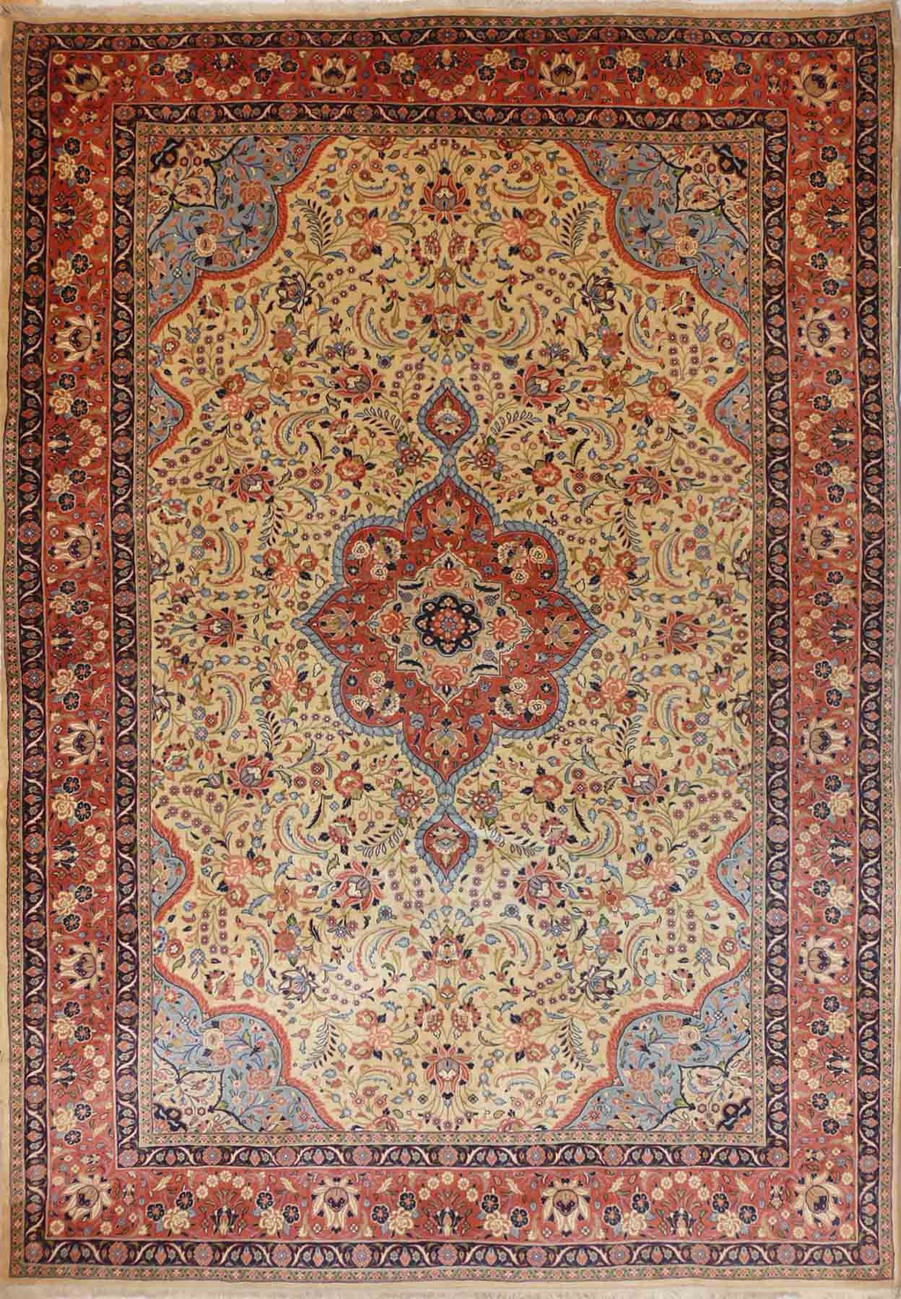
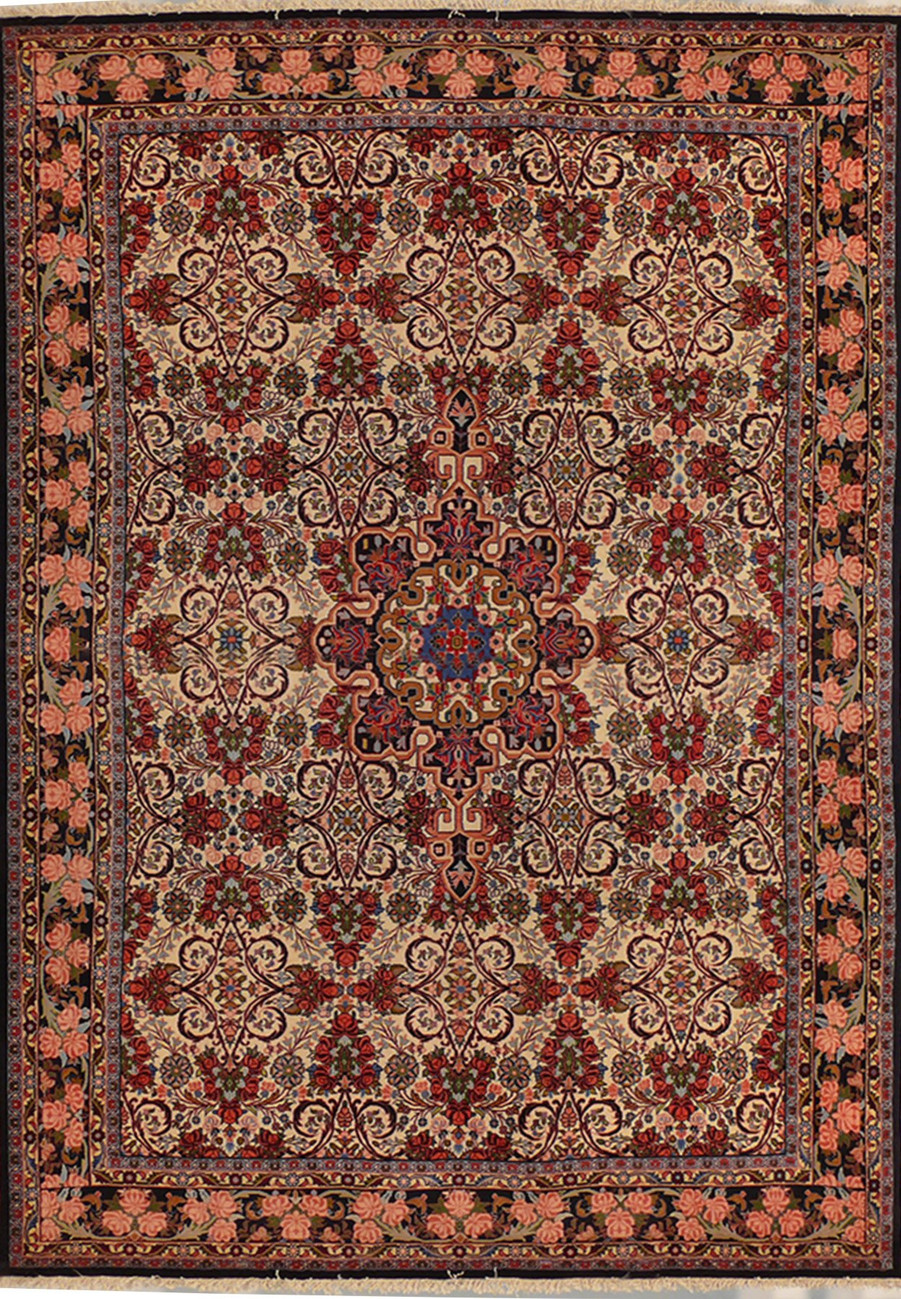
Within the broader Bijar production, certain pieces stand apart from the standard market. These are rugs with exceptional material quality, unusual design treatments, or both, that represent the upper tier of the Bijar tradition at its most refined. The iron construction is present in all of them, but these pieces combine it with a level of design sophistication or material rarity that puts them in a separate collector category from good standard production.
Fine and very fine Bijars at 200 to 350+ KPSI in the 7 x 10 format are particularly sought after because they hit the most practical room size while demonstrating the full capability of the Bijar construction at its highest quality level. These are the pieces where the wet-weft technique is most clearly visible in the quality of the finished surface: the pile stands upright with a density and resilience that is unmistakably different from any other tradition at this size.


Rare Bijars: One-of-a-Kind Pieces and Unusual Formats
Some Bijar pieces fall outside the standard production formats in ways that make them genuinely unusual collector objects. A square Bijar in the 6 x 6 or 9 x 9 foot range is already uncommon. A square Bijar at semi-antique age is rare. An oversize square Bijar at semi-antique age is, in practical terms, nearly impossible to find on the open market.
Similarly, a very rare size such as a 5'5 x 10 runner-proportion Bijar in the iron construction falls outside what most buyers even know to look for in this tradition. Bijar runners of meaningful quality in original condition are sought by collectors specifically because they combine the indestructibility of the Bijar construction with a format that sees heavy daily use in corridors and hallways, where that durability matters most.
Watch: Super Rare 13 x 13 Square Semi-Antique Bijar
A 13 x 13 square semi-antique Bijar. One of the rarest formats in the entire Persian rug tradition. The iron construction at this scale and age is essentially irreplaceable.
How to Identify a Genuine Bijar Rug
Try to fold it. This sounds counterintuitive as a quality test, but it is the fastest and most reliable single test for a genuine Bijar. A real Bijar will resist folding firmly and will creak or feel like it is straining against the fold. No other hand-knotted Persian rug behaves this way. A Kashan, a Sarough, a Tabriz: all fold without resistance. Only the Bijar pushes back.
Weigh it. A genuine Bijar is noticeably heavier than any other hand-knotted rug of equivalent size. The double compressed weft adds significant mass. If you pick up a claimed Bijar and it feels as light as a typical city rug, it is not a Bijar.
Check the back. A genuine Bijar shows the Turkish symmetric knot on the back, with both legs of the knot visible around two warp threads. The back is tight, even, and the knots are packed more densely than in a typical city rug. The weft lines are clearly visible and noticeably more compressed than in other Persian traditions.
Feel the pile resilience. Bijar pile stands upright with a firmness that is different from other Persian rugs. Press your hand into the pile and release: the pile of a genuine Bijar springs back immediately and fully. The Kurdish wool used in the best pieces has a natural resilience that synthetic and lower-grade wools do not match.
Look at the color saturation. The deep, saturated jewel tones of a genuine Bijar dyed with natural or quality synthetic dyes are one of its most distinctive characteristics. If the colors look muted, thin, or uneven in a way that suggests poor dye penetration rather than natural abrash, the piece may not be from the Bijar tradition or may be of significantly lower quality than claimed.
The Bijar vs. Bidjar spelling. Both spellings refer to the same city and the same rug. Geographically and cartographically, Bijar is the correct modern transliteration from Farsi. Bidjar reflects the phonetic reality that the Persian pronunciation of the name has a consonant somewhere between a B and a BD sound that does not translate cleanly into English. Neither spelling is wrong. Both refer to the same tradition.
Bijar vs. Other Persian Rugs
| Origin | Knot | Weft | Durability | Character |
|---|---|---|---|---|
| Bijar | Turkish | Double, wet-compressed | Unmatched | Iron rug, jewel tones, Kurdish heritage |
| Kashan | Persian | Single, dry | Excellent | Formal medallion, arabesque, classic |
| Sarough | Persian | Single, dry | Very good | Rose floral, plush, warm |
| Isfahan | Persian | Double, dry | Very good | Refined, Kork and silk, ivory tones |
| Mashad | Persian | Single, dry | Good to very good | Grand scale, deep reds and navies |