
Mashad, also spelled Mashhad, is the second-largest city in Iran and one of the most important rug-producing centers in the Persian weaving tradition. The city sits in the northeastern province of Khorasan Razavi, close to the borders of Afghanistan and Turkmenistan, at the convergence of ancient Silk Road trade routes that carried textiles, dyes, and design influences for centuries before the first formal workshops were established.
What distinguishes Mashad in the world of Persian rugs is range. The city has produced everything from grand palace carpets woven under royal patronage to commercial workshop rugs made for export. It has given the collector market some of the most celebrated signed masterworks in the entire Persian tradition, the Amoghli atelier, the Sheshkalani workshop, the Makhmal Baf and Saber signatures, alongside a large commercial production sector that makes genuinely good rugs available at accessible prices.
Understanding Mashad means understanding this range. A piece signed by Astan Quds and a post-revolution commercial Mashad in a similar color palette are both authentic Persian Mashad rugs. But they are entirely different objects in terms of quality, rarity, and value. This guide explains everything: the history, the construction, the design vocabulary, the great workshops, and the quality spectrum from top to bottom.
History of Mashad Rug Weaving
The city of Mashad has been a significant settlement since the Sassanian period, but its rise to cultural prominence came with the construction of the shrine of Imam Reza in the 9th century. This shrine, one of the holiest sites in Shia Islam, transformed Mashad into a pilgrimage city of the first importance and drew artisans, merchants, and workshops from across the Iranian world. The concentration of wealth, patronage, and skilled labor that came with the pilgrimage economy created the conditions for a major rug-weaving tradition.
Formal workshop production in Mashad dates to the Safavid dynasty of the 16th and 17th centuries, when the Persian court actively patronized the production of fine carpets for palace interiors and diplomatic gifts. Mashad’s position on the Khorasan road, the great trade route connecting Central Asia to the Persian heartland, gave it access to Central Asian wool, Afghan dyes, and the design influences of Timurid Herat, which left a permanent mark on the Mashad design vocabulary.
The late 19th and early 20th centuries represent the first golden age of Mashad rug production for the Western market. European and American demand for authentic Persian rugs drove an expansion of the workshops, and this is the period when the great Mashad atelier names were established. The Amoghli family, the Astan Quds royal workshops, and the tradition of individually signed masterworks that defines the finest Mashad production all emerged or matured during this period.
The 1979 Islamic Revolution marked a shift in Mashad rug production. The pre-revolution period, roughly 1880 to 1979, is recognized as the era of the finest and most collectible Mashad output: the great signed workshops, the highest knot densities, and the most refined materials were at their peak during this time. Post-revolution production adapted to a broader market, producing genuine hand-knotted Persian rugs at more accessible price points. These are still real Mashad rugs, made by skilled weavers with real wool, and they remain excellent floor coverings that will last for decades. They simply represent a different point on the quality and price spectrum rather than a different category of object.
Construction: Materials, Knots, and Density
Foundation: Quality Mashad rugs use a cotton foundation for both warp and weft threads. Cotton provides the dimensional stability required for the large-format pieces that Mashad is particularly known for: a cotton foundation under consistent loom tension keeps a 10 x 14 or 12 x 18 foot rug flat and geometrically true. Some tribal-influenced Khorasan pieces use a wool foundation, which gives a more flexible handle but less geometric precision.
Pile material: All genuine Mashad rugs are hand-knotted with real wool pile. The quality distinction is in the grade of that wool. The finest pre-revolution pieces use kork wool, the soft undercoat fiber clipped from the neck and shoulder of the sheep, which has exceptional natural lustre, high lanolin content, and a warmth under the hand that develops into a rich patina over decades. Post-revolution commercial production uses good quality body wool: still genuine, still hand-knotted, still durable, but woven to a more accessible price point rather than to the absolute upper limit of material refinement. The finest Mashad pieces also incorporate silk highlights into the pile at floral and arabesque detail areas, creating a selective luminosity that shifts with the angle of light.
Knot type: Mashad weavers use the Persian knot (Senneh, or asymmetric knot), tied around one warp thread and looped under the adjacent one. The Persian knot enables finer design resolution than the Turkish symmetric knot because it allows more knots per unit area and better curve quality in the arabesque and floral forms that define the Mashad design tradition.
Knot density (KPSI): This is the most important single variable distinguishing quality levels within Mashad production. The range is very wide:
| KPSI Range | Quality Tier | Typical Characteristics |
|---|---|---|
| 60 to 120 | Commercial / Village | Post-revolution production, standard wool, less detailed designs than fine tier |
| 120 to 200 | Good Workshop | Solid city rug construction, kork or good wool, traditional designs |
| 200 to 350 | Fine Workshop | Kork wool, precise arabesque rendering, often pre-revolution |
| 350 to 500 | High Fine / Signed | Master atelier production, kork and silk, signed pieces, collector quality |
| 500 to 840+ | Museum / Masterwork | Amoghli, Astan Quds palace production, irreplaceable, museum-caliber |
How to check KPSI yourself: Flip the rug over and count the knots in one square inch on the back. Multiply width knots by height knots. A Mashad commercial piece at 80 KPSI looks visibly coarser on the back than a 400 KPSI fine piece, where the knots are barely distinguishable without magnification.
Designs, Patterns, and the Mashad Color Palette
The Central Medallion Format
The most common Mashad composition features a large central medallion, typically oval or circular, surrounded by a dense arabesque floral field. Corner quarter-medallions mirror the central design. The medallion itself is usually highly ornate, filled with palmettes, arabesques, and compound floral forms. In the finest pre-revolution pieces, the medallion achieves a visual complexity that requires several hundred KPSI to execute without blurring.
The Allover Floral Field
Mashad also produces allover compositions in which the arabesque vine system covers the entire field without a central medallion. This format is less common than the medallion design but appears in some of the most celebrated Mashad pieces, including certain Amoghli and Makhmal Baf productions. The allover format suits rooms where furniture partially covers the rug, since there is no single focal point that needs to be centered and visible.
The Mahi (Fish) Pattern
The Herati or Mahi pattern, a repeating lattice of diamond forms containing a fish motif surrounded by leaves, is a design shared across several weaving traditions but appears in Mashad production with particular refinement. At high KPSI levels, the Mahi pattern in a Mashad rug achieves a precision and interior detail density that clearly distinguishes it from the same design in lower-quality production. The ivory-ground Mahi format, as seen in the finest kork wool Mashad pieces at 400 KPSI, is one of the most visually sophisticated interpretations of this ancient pattern.
The Khorasan Influence
Mashad sits within the historic Khorasan region, and certain rugs from the surrounding villages and smaller towns of the province are marketed under the Khorasan name rather than Mashad specifically. Khorasan rugs typically show a somewhat looser, more tribal interpretation of the Mashad design vocabulary, with bolder geometric elements and less formal symmetry. They represent an important and distinct category within the broader Mashad tradition.
Color Palette
The classic Mashad color palette is dominated by deep crimson and burgundy reds, midnight navy blues, warm ivory, and forest green. These hues derive from the natural dye tradition of the region: madder root for the reds, indigo for the blues, pomegranate for the yellows and golds. Pre-revolution Mashad pieces dyed with natural materials have a tonal depth and an aged patina that synthetic-dye production cannot replicate. The colors shift and deepen over decades rather than fading uniformly.
Post-revolution commercial production more commonly uses chrome-mordant synthetic dyes, which produce consistent and vibrant color that resists fading reliably. These pieces will not develop the same natural patina as older natural-dye pieces over decades, but they hold their color well throughout their lifespan.
The Great Workshops and Signed Masters
The signature tradition in Mashad is one of the most important in Persian rug production. A woven signature in the border of a Mashad rug identifies the specific atelier or master weaver responsible for the piece, functioning exactly as an artist’s signature functions on a painting. These names are not branding. They are provenance.
Amoghli (Saber Amoghli)
The most celebrated name in Mashad rug production. Saber Amoghli established the Amoghli atelier in the late 19th century and produced rugs that are now among the most collectible pieces in the entire Persian rug market. Amoghli pieces are characterized by extraordinary knot density, often exceeding 500 KPSI, the finest kork wool available, natural dyes of exceptional depth, and a design precision that approaches the visual quality of a woven painting. Authentic signed Amoghli pieces are museum-caliber objects that command prices commensurate with that status. The “Saber” name in a Mashad rug refers to this lineage.
Astan Quds
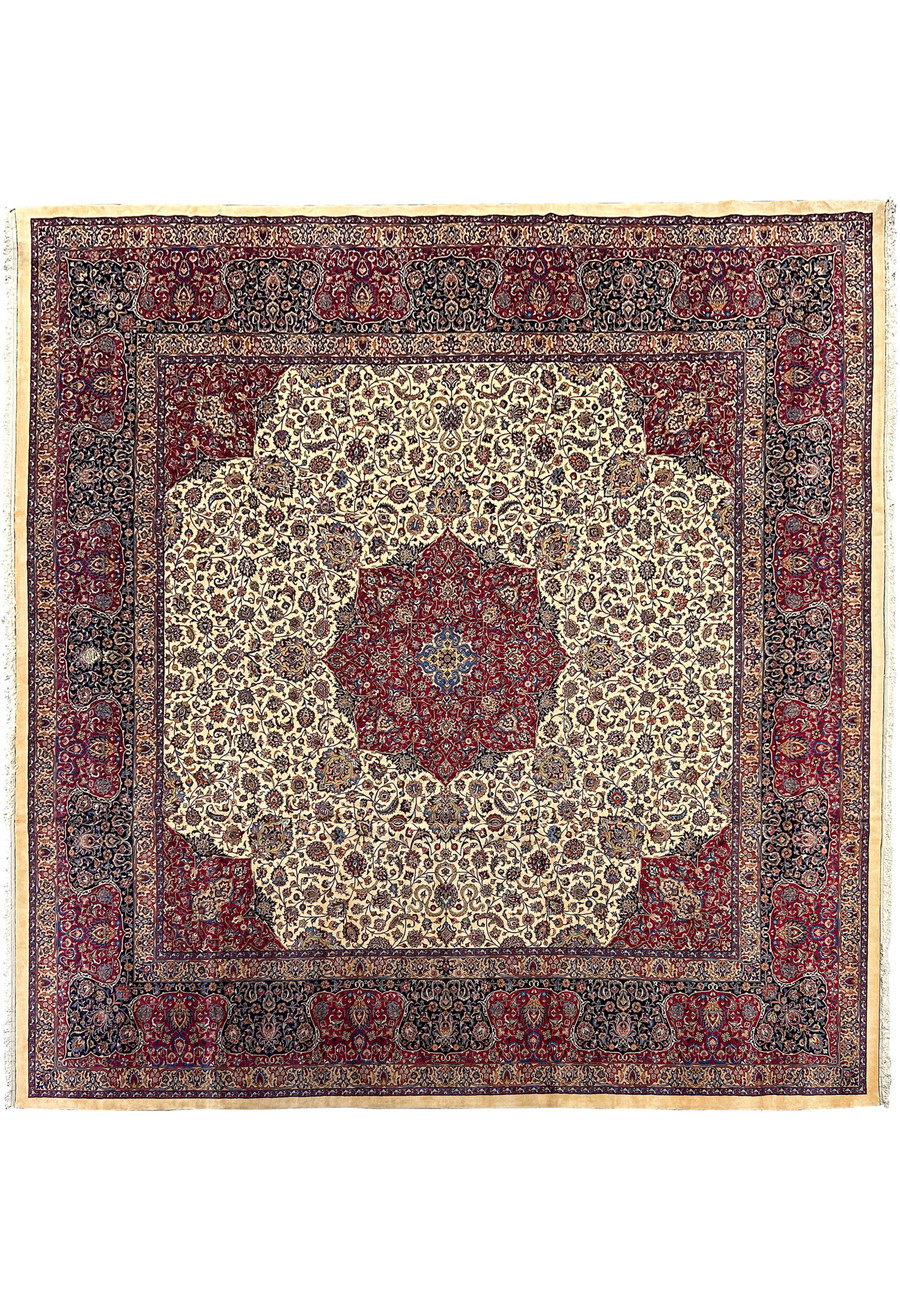
Astan Quds Razavi is the foundation that manages the Imam Reza shrine complex, one of the largest charitable endowments in the world. For centuries it has also operated workshops producing rugs for the shrine’s interior and for presentation as diplomatic gifts. Astan Quds rugs represent the absolute pinnacle of Mashad production: enormous scale, the finest materials, and the highest knot densities achieved anywhere in the tradition. The 20 x 20 foot square Mashad Astan Quds that Rugs.net carries is one of the most extraordinary surviving examples of this tradition available in the open market.
Sheshkalani
The Sheshkalani workshop is among the most respected in contemporary and recent Mashad production. Sheshkalani pieces are known for their large-format capability, their kork-and-silk pile combinations, and a design vocabulary that draws directly from the classical Mashad tradition at the highest quality level. A Sheshkalani-signed piece at 11 x 16 feet represents the finest end of what post-revolution Mashad production has achieved.
Makhmal Baf
Makhmal Baf, meaning “velvet weaver,” is a signature associated with fine Mashad production at the high end of the commercial workshop tier. The name refers to the exceptional softness and close pile of these pieces. A signed Makhmal Baf is a genuine quality indicator: finer than standard commercial Mashad, with more precise design execution and better material selection.
Other Signed Mashad Masters
Beyond these names, dozens of individual master weavers signed their work in the Mashad tradition. Any signed piece, regardless of the specific name, occupies a higher tier than unsigned production: the weaver’s name in the border is a statement of personal accountability for the quality of the work. When evaluating a signed Mashad, research the specific name if possible. If the name is not well-documented, the physical quality of the piece, its KPSI, pile material, and design precision, tells you what you need to know.
Pre-Revolution vs. Post-Revolution: What Changed
Understanding the 1979 Revolution’s impact on Mashad rug production is essential for any serious buyer. The differences are real, measurable, and directly reflected in market pricing.
Pre-Revolution (to 1979)
✓ Natural dyes: madder, indigo, pomegranate
✓ Hand-spun kork wool at highest grade
✓ Master workshops fully intact: Amoghli, Astan Quds, Saber
✓ KPSI commonly 300 to 840 in finest production
✓ Designs from centuries-refined cartoons
✓ Colors develop patina over time
Post-Revolution (1979 onward)
• Genuine hand-knotted wool rugs built for broader market
• Good quality wool pile; kork reserved for finer pieces
• Lower average KPSI reflects accessible price point
• Traditional designs maintained; less complex at lower KPSI
• Reliable durable construction, decades of useful life
• Excellent value for buyers who want a real Persian rug
Both categories have genuine value and both deserve to be understood on their own terms. A post-revolution Mashad is a real hand-knotted Persian rug made by skilled weavers with real wool, designed to be excellent at an honest price. A pre-revolution signed masterwork is a collector object of increasing rarity that will appreciate over time. Knowing which you are looking at, and paying the right price for it, is what matters.
Rare and High-End Mashad Rugs at Rugs.net
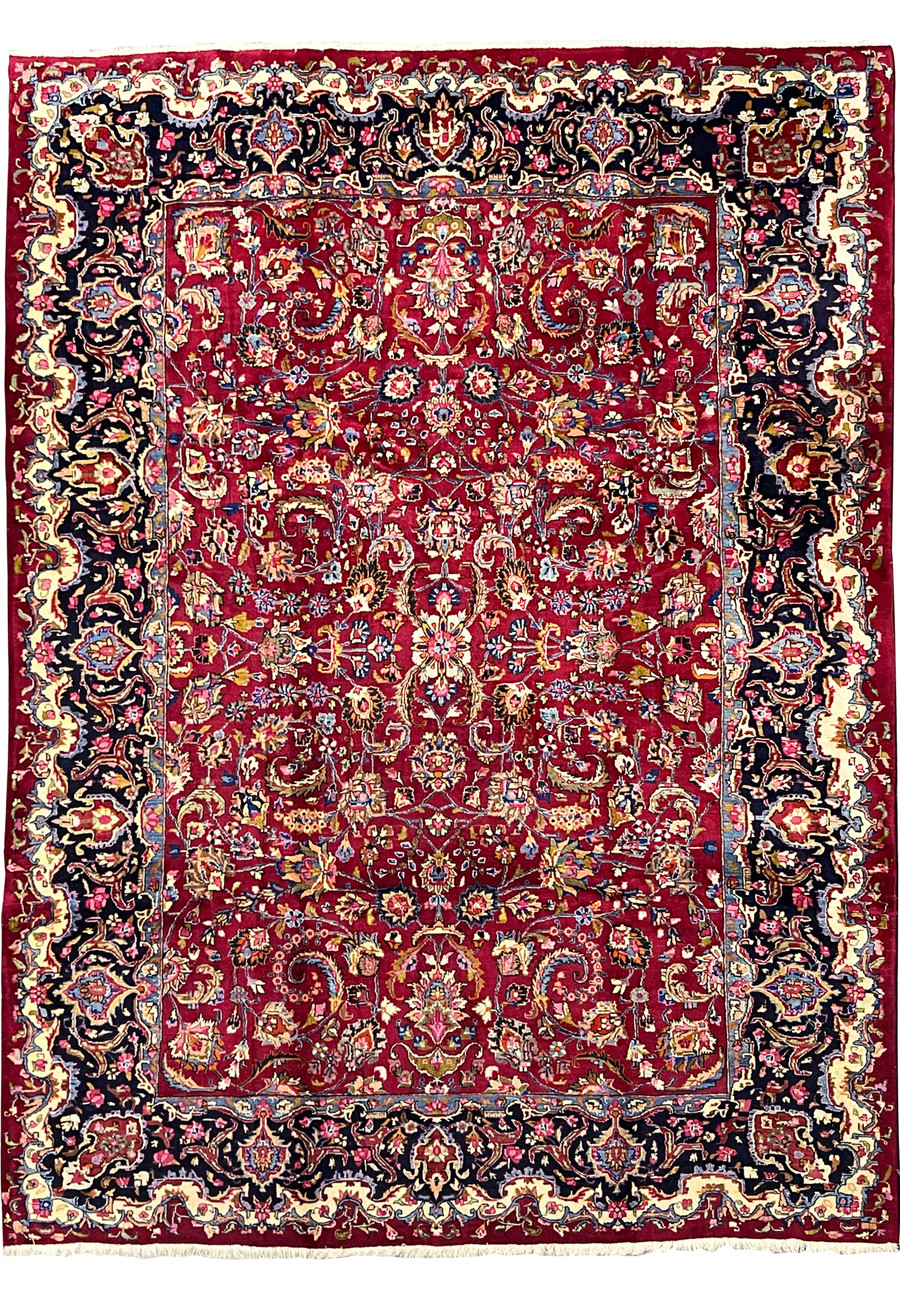
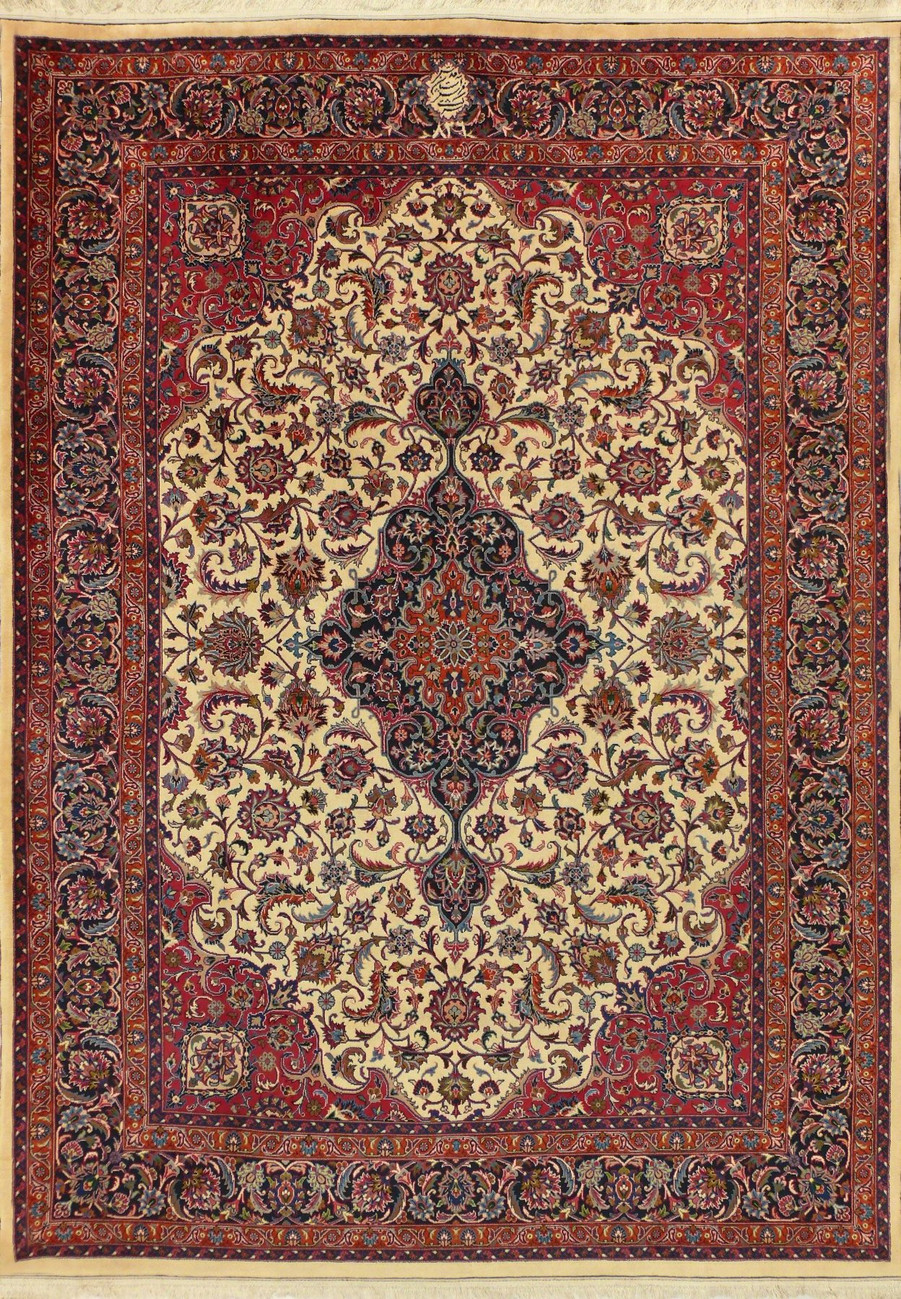
The following pieces represent the exceptional tier of Mashad production. Signed master works, pre-revolution quality, and pieces that are genuinely difficult to find in today’s market. Free shipping to all 50 states. Free returns.


Good Commercial Mashad Rugs
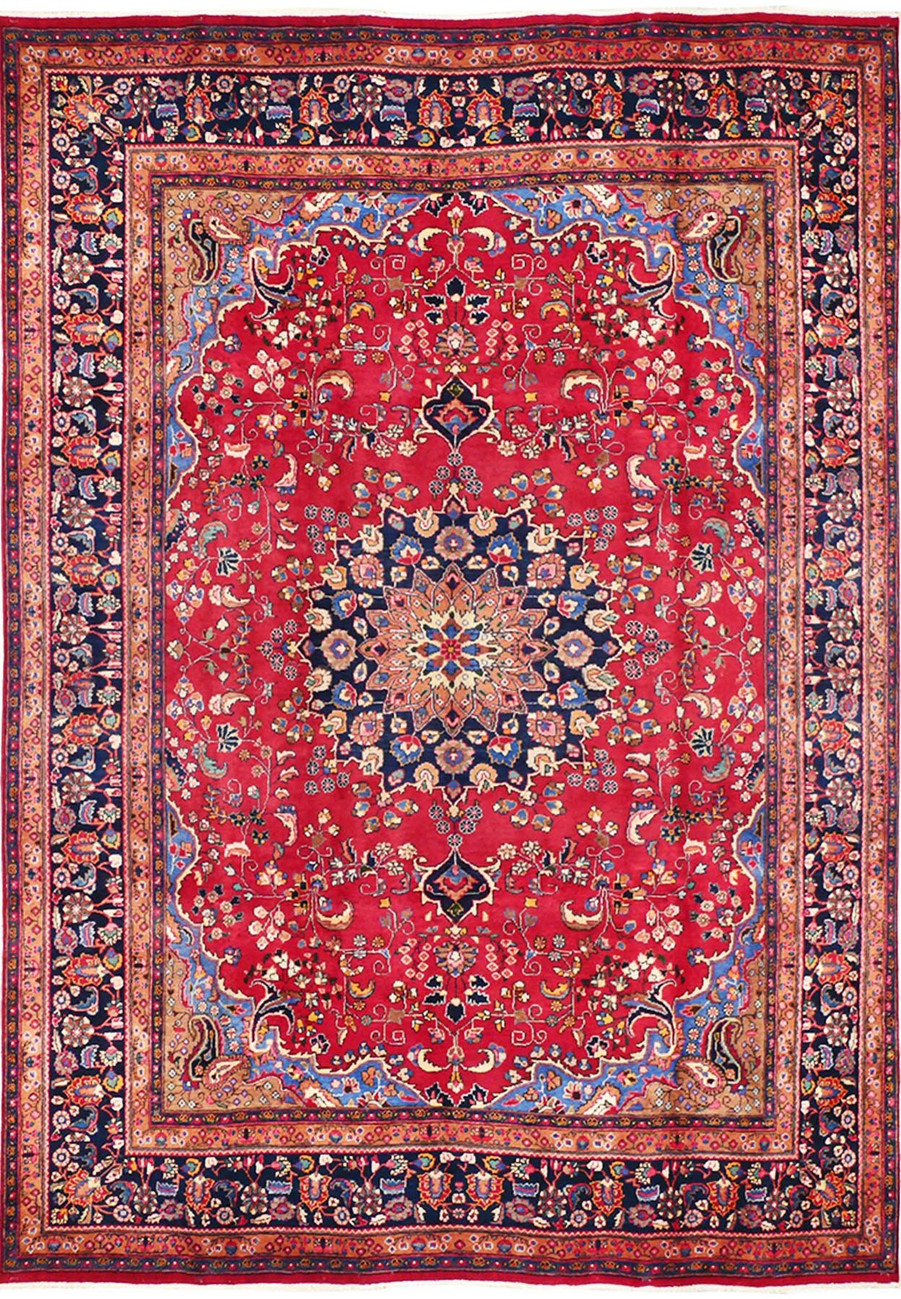
These post-revolution workshop pieces are exactly what good commercial Persian rugs should be: genuine hand-knotted Mashad rugs, made with real wool by skilled weavers in the Khorasan tradition, priced to be accessible without pretending to be something they are not. Excellent everyday rugs with real longevity.


How to Identify and Evaluate a Mashad Rug
Check the back. A genuine hand-knotted Mashad shows its pattern on the back, with individual Persian knots visible. No backing material. The pattern is nearly as clear on the back as on the front in fine pieces. If there is a backing glued or stitched on, it is not hand-knotted.
Count the knots. Count knots per inch on the back in both directions and multiply. 60 to 120 KPSI is commercial. 200 to 400 is fine workshop. 400+ is collector quality. This takes one minute and tells you more than any label.
Feel the pile. Kork wool is warm, soft, and slightly waxy from natural lanolin. The finest pre-revolution Mashad pile has a depth and warmth that feels immediately different from standard wool. A commercial post-revolution piece still feels like a quality wool rug, just without the exceptional softness of the top kork grade. Both are real wool. The difference is refinement, not material category.
Look for the signature. On a signed Mashad, the weaver’s name is woven into the border, typically at one end. It appears as part of the border design in Farsi script. A legitimate specialist can read this and identify the workshop. If a dealer claims a rug is signed but cannot tell you whose name it carries, be skeptical.
Examine the arabesque rendering. In a fine Mashad at 300+ KPSI, the arabesque curves are smooth and continuous, the palmettes have clearly defined internal petals, and the floral transitions are precise. In commercial production the curves are stepped and the floral forms simplified. This is visible to any trained eye.
Age assessment. Pre-revolution Mashad pieces show characteristic abrash, the slight tonal variation in the field color caused by natural dye lot differences. This is not a defect. It is the fingerprint of natural dyeing and one of the most reliable indicators of genuine age and quality. Synthetic-dye post-revolution pieces show no abrash: the color is perfectly uniform throughout.
Mashad vs. Other Persian City Rugs
| City | Typical KPSI | Scale | Character |
|---|---|---|---|
| Mashad | 60 to 840 | Large format specialty | Grand, medallion, deep reds and navies |
| Kashan | 120 to 450 | Standard to large | Formal, classic medallion, crimson and navy |
| Isfahan | 200 to 1000 | Standard sizes | Refined, ivory, kork and silk, warm tones |
| Tabriz | 80 to 1000 | Standard to large | Diverse designs, structured, northwest influence |
| Nain | 300 to 1000 | Standard sizes | Fine, pale palette, kork and silk, arabesque |