
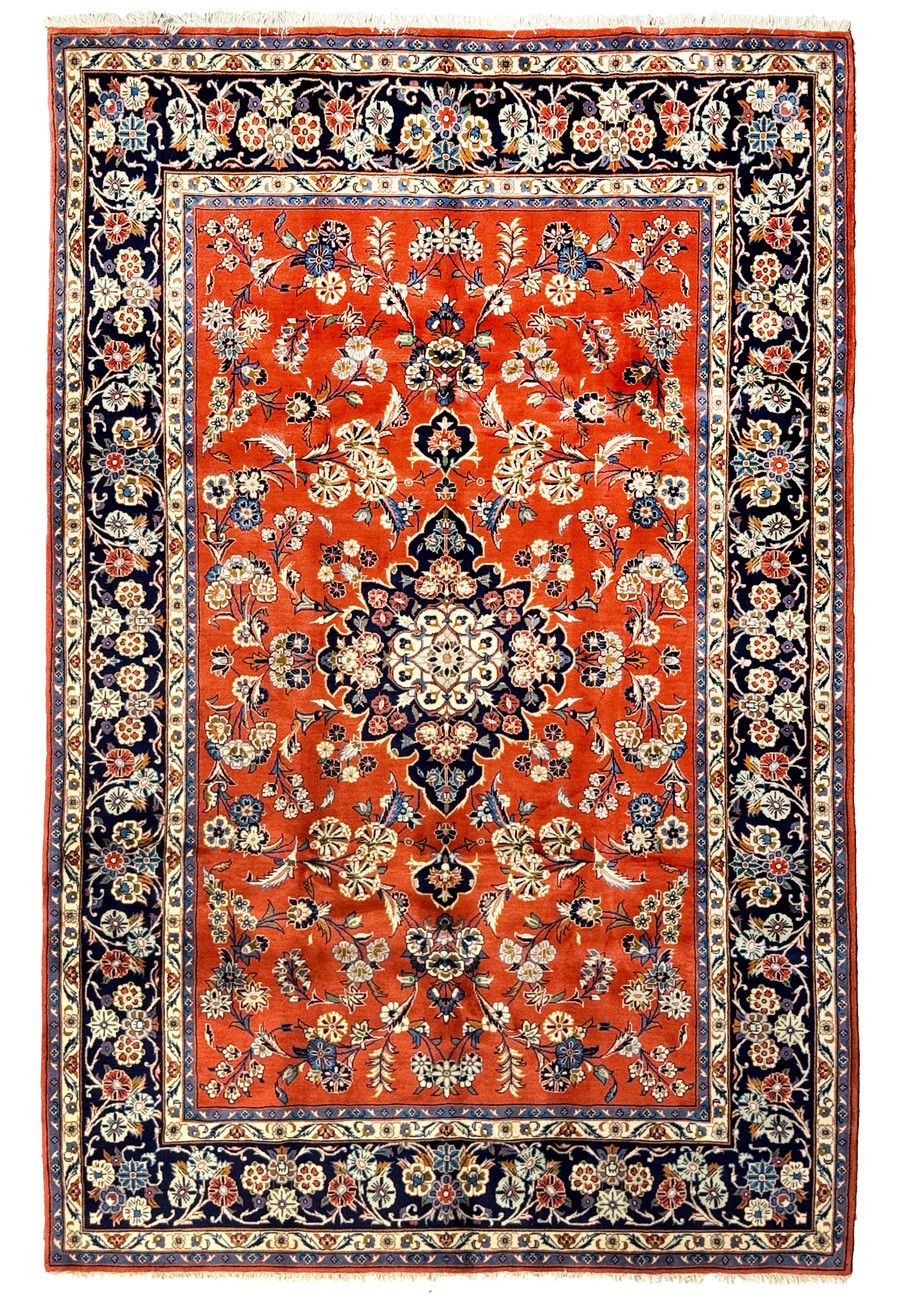
There is almost no other Persian rug whose story is so directly shaped by a foreign market. The Sarough, also spelled Sarouk, Saruk, Saroug, and occasionally Saruq, comes from a small village in the Markazi Province of west-central Iran, in the historic Farahan district between the cities of Arak and Qom. The village of Sarough itself is not large. But the rugs it gave its name to became, in the first three decades of the twentieth century, the best-selling Persian rug in the United States by a margin that no other city or village tradition came close to matching. Understanding the Sarough means understanding that American chapter, and understanding why pieces from that era are now among the most sought antique Persian rugs in the collector market.

View all Sarough rugs at Rugs.net →
History: The Village, the Trade, and the American Chapter
The Farahan district of Markazi Province has produced rugs continuously since at least the early nineteenth century. The region sits at the intersection of several weaving traditions: the formal urban production of Arak (formerly Sultanabad) to the south, the Hamadan tribal village tradition to the north, and its own distinctive local weaving culture. The village of Sarough, embedded in this geography, developed a recognizable style built on floral medallion designs, dense kork wool pile, and a color vocabulary dominated by deep rose-red, navy, and ivory. These rugs circulated through the Arak trading networks and reached European and American importers through the Ottoman and Persian carpet trade routes.
The story takes a decisive turn in the 1910s and 1920s. American interior tastes at the time favored large, formal rugs with open fields, relatively muted palettes, and strong central medallions that could anchor a furniture group without competing with it. The traditional Sarough, with its dense allover floral fields and saturated rose-red grounds, was close to what Americans wanted but not quite there. Two things happened. First, American importers, principally through the firm of J.H. Wyle and others, began commissioning rugs directly from the Arak weaving district built to American specifications: larger formats, more open fields, more ivory ground visible between the floral stems, and a softer overall tonality. Second, a practice emerged of chemically washing completed rugs with a process known as the American wash, or Manchester wash, which stripped some of the saturated intensity from the pile colors and left a softer, more antiqued appearance that American buyers preferred.
The result was the American Sarouk: a distinct sub-category of the Sarough tradition that dominated American parlors, libraries, and dining rooms through the 1920s, 1930s, and 1940s. These rugs were often over-dyed after weaving to shift the ground color from rose-red toward the coral, salmon, or brick tones that American buyers favored. The practice is controversial among purists, who argue it altered the original intention of the dyers and weavers. It is also now considered part of the Sarough’s documented history, and American Sarouks in good condition with clear color and sound structure are legitimate collector pieces in their own right.
The post-war period saw Sarough production shift back toward the more traditional Iranian market and toward a broader range of export formats. Contemporary Sarough rugs draw on the same design vocabulary as the classic period but are woven for general market rather than the specifically American taste that shaped the great pre-war pieces. The finest Sarough production of the twentieth century remains from the pre-war and mid-century period, and the best pieces from those decades are now genuinely difficult to find in sound condition.
Construction: Materials, Knots, and Density
Foundation. Sarough rugs are built on a cotton foundation, both warp and weft. Cotton provides the dimensional stability that the large-format Sarough pieces require: a 9 x 12 or 10 x 14 Sarough lying flat after decades of use owes much of that structural integrity to the cotton base holding consistent tension across the full length of the piece.
Pile material. All genuine Sarough rugs are hand-knotted with wool pile. The finest pieces use kork wool, the undercoat fiber from the lamb’s neck and shoulder, which has a natural warmth, high lanolin content, and a luster that develops over decades into the deep sheen characteristic of antique Sarough pieces. The kork wool of the Arak-Sarough region is considered among the finest in all of Persia, which is one of the primary reasons Sarough pile has a specific tactile quality that distinguishes it from the pile of Kashan, Tabriz, or Mashad. Good commercial Sarough production uses quality body wool: real, durable, and woven to last generations, simply without the exceptional softness of the top kork grade.
Knot type. Sarough weavers use the asymmetric Persian knot (Senneh knot). The asymmetric knot allows the fine curvilinear floral rendering that defines the Sarough design vocabulary. The flowing rose stems, the rounded palmette forms, and the dense arabesques of a fine Sarough require a knot that can resolve smooth curves rather than stepped geometric outlines.
Knot density. The KPSI range in Sarough production is wide, reflecting the spectrum from village-adjacent production to formal workshop pieces.
| KPSI Range | Quality Tier | Typical Characteristics |
|---|---|---|
| 80 to 150 | Village / Regional | Good wool, solid construction, accessible price point |
| 150 to 250 | Good Workshop | Solid city-rug construction, full floral vocabulary |
| 250 to 400 | Fine Workshop | Kork wool likely, precise floral rendering, pre-war typical |
| 400 to 475+ | Master Workshop | Finest kork, collector quality, American Sarouk era masterworks |
Pile height matters in Sarough. One of the defining characteristics of a fine Sarough is a medium to medium-high pile, noticeably deeper than a Nain or a fine Kashan. This deeper pile is part of what gives the Sarough its characteristic visual softness and the plush underfoot quality that made it so appealing to the American market.
Designs, Patterns, and the Sarough Color Palette
The Traditional Sarough Format
The traditional Sarough composition centers on a large floral medallion, rounder and more naturalistic than the formal lobed cartouche of a Kashan, floating on a deep rose-red or navy field densely packed with an allover floral arrangement of roses, palmettes, flowering vines, and curling leaves. The field design is lush and full: the eye moves continuously across it without resting on any single element. Corner spandrels mirror the main medallion. The border system is typically three-banded, with a wide floral main border and two narrow guard borders, rendered with the same dense floral vocabulary as the field.
The roses are the signature motif. Sarough roses, sometimes called American roses in reference to the export trade, are large, open, naturalistic blooms that fill the field with a garden-like abundance. They differ from the more formal Shah Abbasi palmettes of Kashan or the geometric Herati fish motif of Bijar in being softer, rounder, and more immediately readable as actual flowers rather than as stylized ornamental devices.
The American Sarouk Format
The American Sarouk typically replaces the dense allover field with a more open composition. The central medallion remains but the field around it is less crowded, with detached floral sprays scattered on a more visible ground rather than an interlocking vine system covering every inch. The palette is deliberately softer: the saturated rose-red of the traditional Sarough often gives way to a quieter salmon, coral, or brick tone, achieved through the post-weave American wash or over-dyeing process. This open, quieter format was what the American market wanted for the large formal rooms of early twentieth-century houses, and it proved enormously successful.
Color: From Deep Rose to Soft Coral
The classic Sarough palette is built around a deep rose-red ground, drawn from madder root and related dye sources. This is a distinctly warm red, neither the cool crimson of a Kashan nor the dark burgundy of an antique Isfahan, but a rich, slightly warm tone that the American wash softened in the export pieces. The secondary palette includes deep navy blue, ivory, sky blue, soft green, and gold, deployed in the floral work and border. Navy-ground Saroughs also exist and are particularly striking, with the rose floral arrangement reading against the dark blue field as a night-garden composition.
Farahan Rugs: The Ancestor of the Sarough Tradition
To understand the Sarough properly, you need to understand the Farahan. The two are not the same rug under different names. They are related traditions from the same geographic district with different histories, different design vocabularies, and different relationships to the collector market. The confusion between them is common and worth untangling.
The Farahan is the older tradition. Farahan rugs were being produced in the district around what is now Arak from at least the early nineteenth century, and the finest antique Farahans predate the great Sarough export period by several decades. They represent the indigenous weaving culture of the Farahan plain before the American market reshaped it.

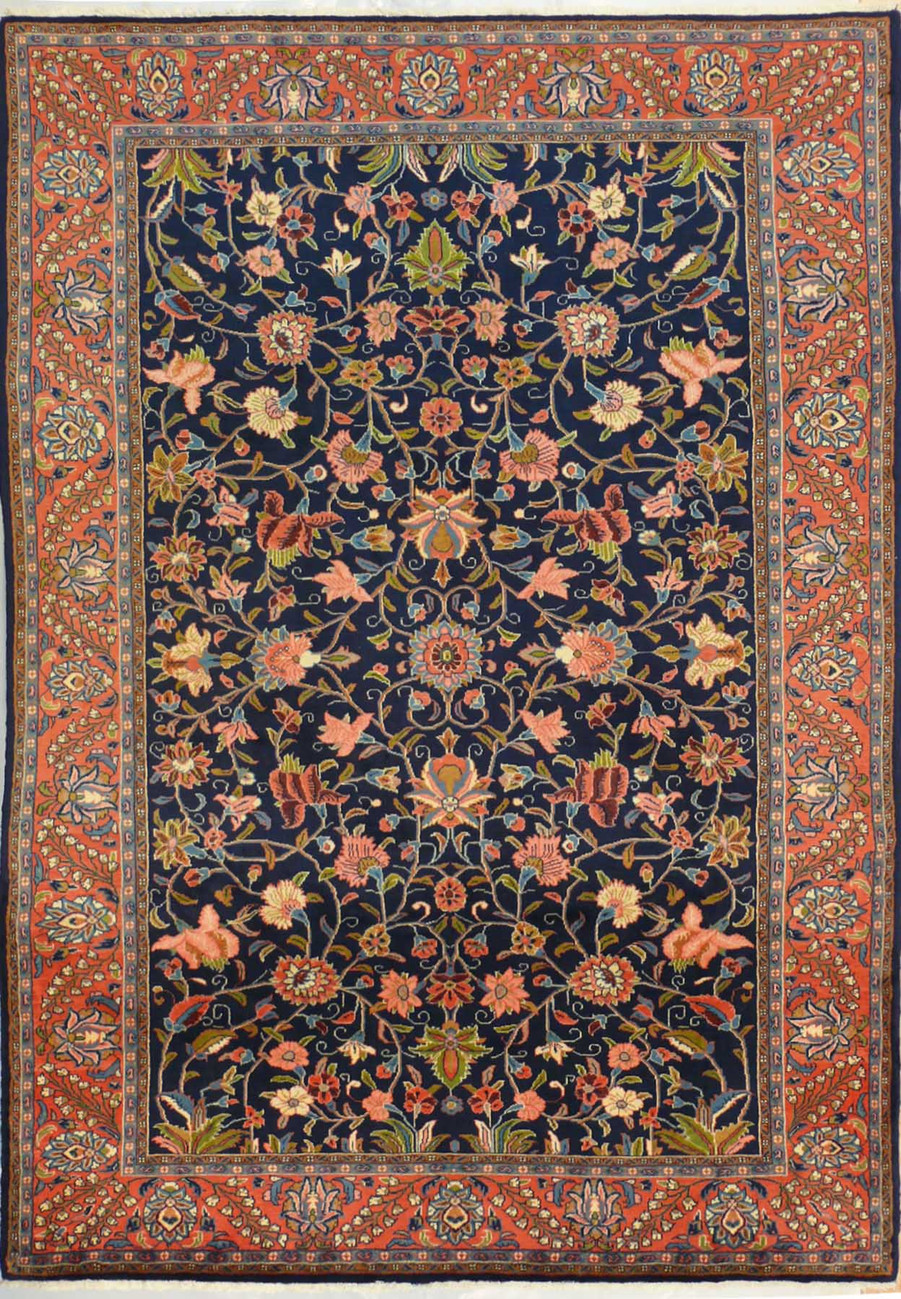
Two genuine Persian Farahan rugs from the Farahan district. Left: ivory field with dense botanical allover pattern. Right: geometric allover, a second major Farahan format. Both show the Farahan’s earthy, restrained palette and precise drawing, unmistakably different from the Sarough despite sharing the same geographic home.
What Makes a Farahan Different from a Sarough
| Feature | Farahan | Sarough |
|---|---|---|
| Era | Early to mid-19th century onward | Late 19th century onward |
| Primary design | Herati, botanical allover, Mina Khani | Floral medallion, rose-dominant allover |
| Primary palette | Earthy: soft blue, green, rust, ivory | Deep rose-red, navy, ivory |
| Field quality | Fine, intricate, botanically precise | Lush, floral, plush and full |
| Pile height | Short to medium | Medium to medium-high |
| Market history | European collector focus | Dominant American export rug |
| Collector status | Antique, increasingly rare | Antique and contemporary |
The Farahan Design Vocabulary
The Farahan’s signature design is the Herati pattern: a repeating lattice of diamonds, each containing a rosette surrounded by curving lance-shaped leaves, often called the fish and pond pattern for the appearance of the leaf forms. The Farahan version of the Herati is considered one of the finest renderings of this widely used motif in the entire Persian tradition, drawn with a delicacy and precision that reflects the very fine wool and relatively high KPSI of the best antique Farahan pieces.
Alongside the Herati, Farahans also appear in the Mina Khani pattern, a repeating diamond lattice of small flowers connected by curved stems, and in allover botanical compositions where the field is covered with a continuous branching system of small flowers and leaves. These designs have a quieter, more meditative quality than the bold roses of the Sarough: where the Sarough announces itself from across the room, the Farahan reveals itself on closer inspection.
The Farahan palette is notably different from the Sarough: earthier, cooler, and more muted. Soft blue-green, dusty rose, ivory, rust, and soft gold are more typical than the bold rose-red that defines the Sarough ground. A genuine antique Farahan in good condition has a visual sophistication that makes it particularly appealing to collectors who know Persian rugs well and want something that stands apart from the standard commercial palette.
The American Sarouk: What It Is and Why It Matters
The American Sarouk deserves its own section because it is genuinely misunderstood. Many buyers encounter these rugs today in estate sales, at auction, and through antique dealers and are uncertain whether the altered color represents damage, restoration, or original production. It is none of those things. It is a documented and specific production practice tied to one of the most commercially successful rug-trade stories in American history.
The American wash (also called the Manchester wash or London wash in different trade contexts) involved soaking completed rugs in a chemical solution, typically involving chlorine compounds, that lightened and softened the pile colors, reduced some of the sheen of the natural dye, and left a quieter, more antique-looking surface. The pile was not damaged by the process when applied correctly. The wool fibers retained their integrity and the rugs continued to wear well over decades. What changed was the color tonality: deep rose-red became warm salmon or coral, saturated navy softened slightly, and the overall effect was a rug that read as mellower and more already-integrated into a room.
American Sarouks are now collected in their own right as a specific category of antique Persian rug with a documented American provenance story. The rug you inherit from your grandmother’s dining room in Connecticut may well be an American Sarouk, and if it is in good structural condition with clear color and an open pile, it is a legitimate antique Persian rug with real collector value. The over-dyeing does not disqualify it. It is part of its history.
How to Recognize an American Sarouk
✓ Warm salmon, coral, or brick-red ground rather than deep rose-red
✓ More open field composition with detached floral sprays rather than dense allover coverage
✓ Large format: most American Sarouks were woven at 9 x 12 or larger for the American parlor market
✓ Slightly matte surface compared to an unwashed Sarough of similar age
✓ Date range: roughly 1910 to 1940 for the classic American Sarouk period
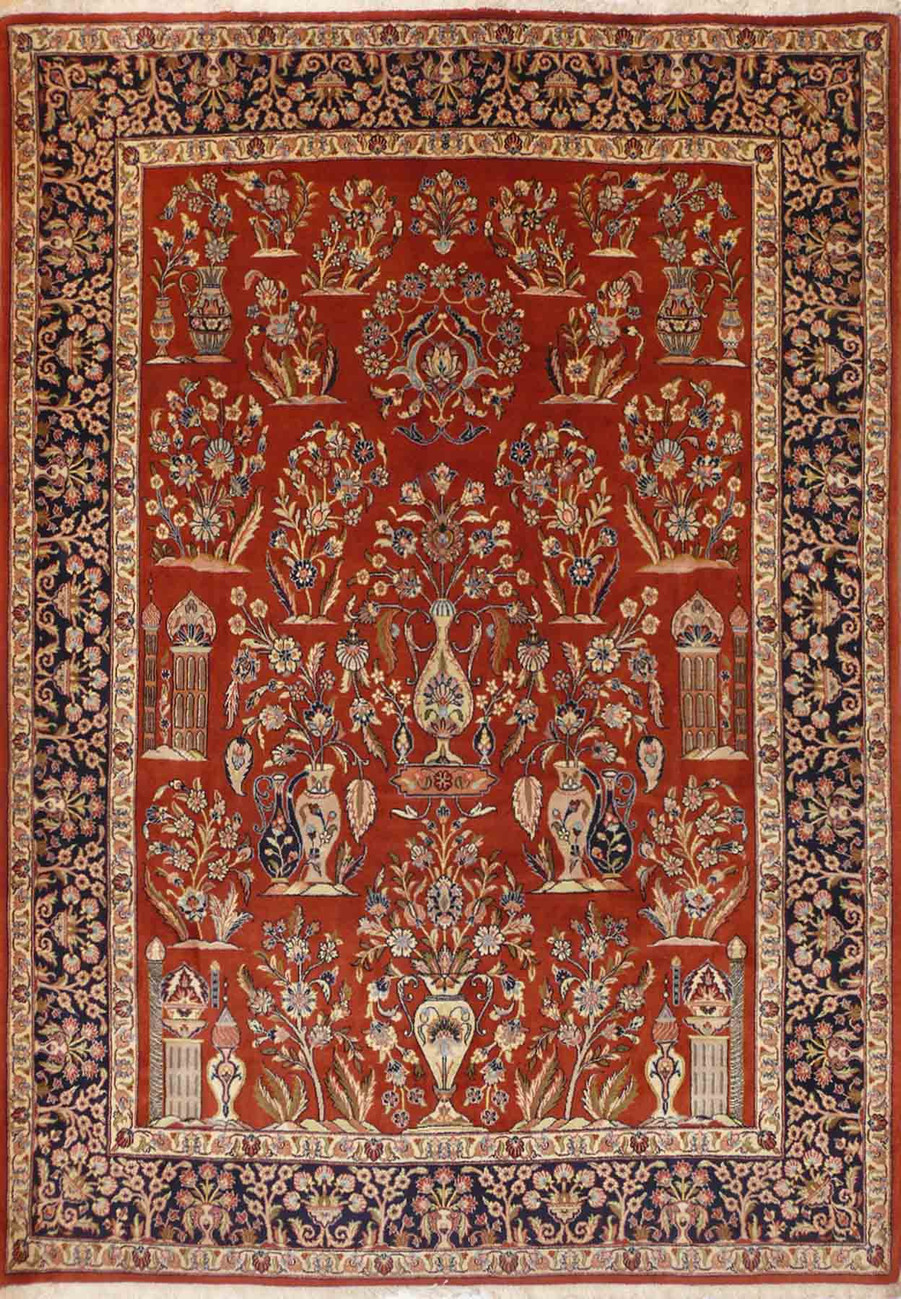

How to Identify and Evaluate a Sarough Rug
Check the back. A genuine hand-knotted Sarough shows the full pattern on the back with individual asymmetric Persian knots visible. No backing material. The fringes are structural warp thread continuations, not applied separately. If you see a latex, canvas, or stitched backing, the rug is not hand-knotted regardless of what the tag says.
Feel the pile. Sarough kork wool has a specific warmth and softness that is one of the most reliably identified pile qualities in the Persian tradition. It feels slightly heavier than Kashan kork and has a distinctive lanolin warmth under the hand. The pile also has a medium-high loft that distinguishes it from the shorter pile of a fine Nain or the denser tighter pile of a Bijar.
Look at the roses. The large, open, naturalistic rose is the signature motif of the Sarough. In a genuine fine piece the rose forms are rounded, symmetrical, and detailed with interior petal gradation. In a copy or a lower-quality production piece the roses are simplified, angular, and mechanically rendered. This is the fastest visual check specific to the Sarough tradition.
Assess the field density. A traditional Sarough field is densely covered: the floral vine system fills the ground almost completely, leaving very little of the base color visible between motifs. An American Sarouk field is more open, by design. Knowing which format you are looking at helps you evaluate whether the openness of a given piece is intentional or the result of pile wear.
On a Farahan, look for the Herati. The fine repeating lattice of the Herati pattern in a genuine antique Farahan is drawn with a precision that is immediately distinguishable from the simplified geometric Herati of a commercial reproduction. The diamond forms are evenly spaced, the rosettes inside them are fully rendered, and the lance-leaf forms curve smoothly rather than stepping in a jagged outline.
Ask for the provenance. A legitimate dealer can tell you whether a piece is a traditional Sarough, an American Sarouk, or a Farahan, the approximate age, the dye type, and the structural condition. If the seller cannot distinguish between these categories, look for a dealer who can.
Sarough vs. Other Persian Rugs
| Origin | KPSI | Pile | Character |
|---|---|---|---|
| Sarough | 80 to 475 | Medium-high, plush | Rose-dominant floral, warm and lush |
| Farahan | 100 to 350 | Short to medium | Herati, botanical, earthy and precise |
| Kashan | 120 to 600+ | Medium-low | Formal medallion, arabesque, classic red-navy |
| Isfahan | 200 to 1000 | Medium-low | Refined, ivory, Kork and silk |
| Tabriz | 80 to 1000 | Medium | Diverse designs, structured, versatile |
| Bijar | 100 to 500 | Very dense, stiff | Iron rug, Herati, exceptionally durable |