
| Size in ft: | Width: 10' x Length: 12'8" |
| Size in Inch: | Width: 120" x Length: 152" |
| Size in meters: | Length: 3.86 x Width: 3.05 m |
| Colors: | Antique Red, Black Blue, Ivory, Olive |
| Shape: | Rectangular |
| Woven: | 100% Hand-knotted | Handmade |
| Foundation: | 100% Cotton |
| Pile: | 3/8" Wool |
| Design: | Heriz | Stepped Geometric Medallion | Ivory Corner Spandrels |
| Origin: | Persian Heriz | Made in Persia |
| Condition: | Excellent | Full even pile |
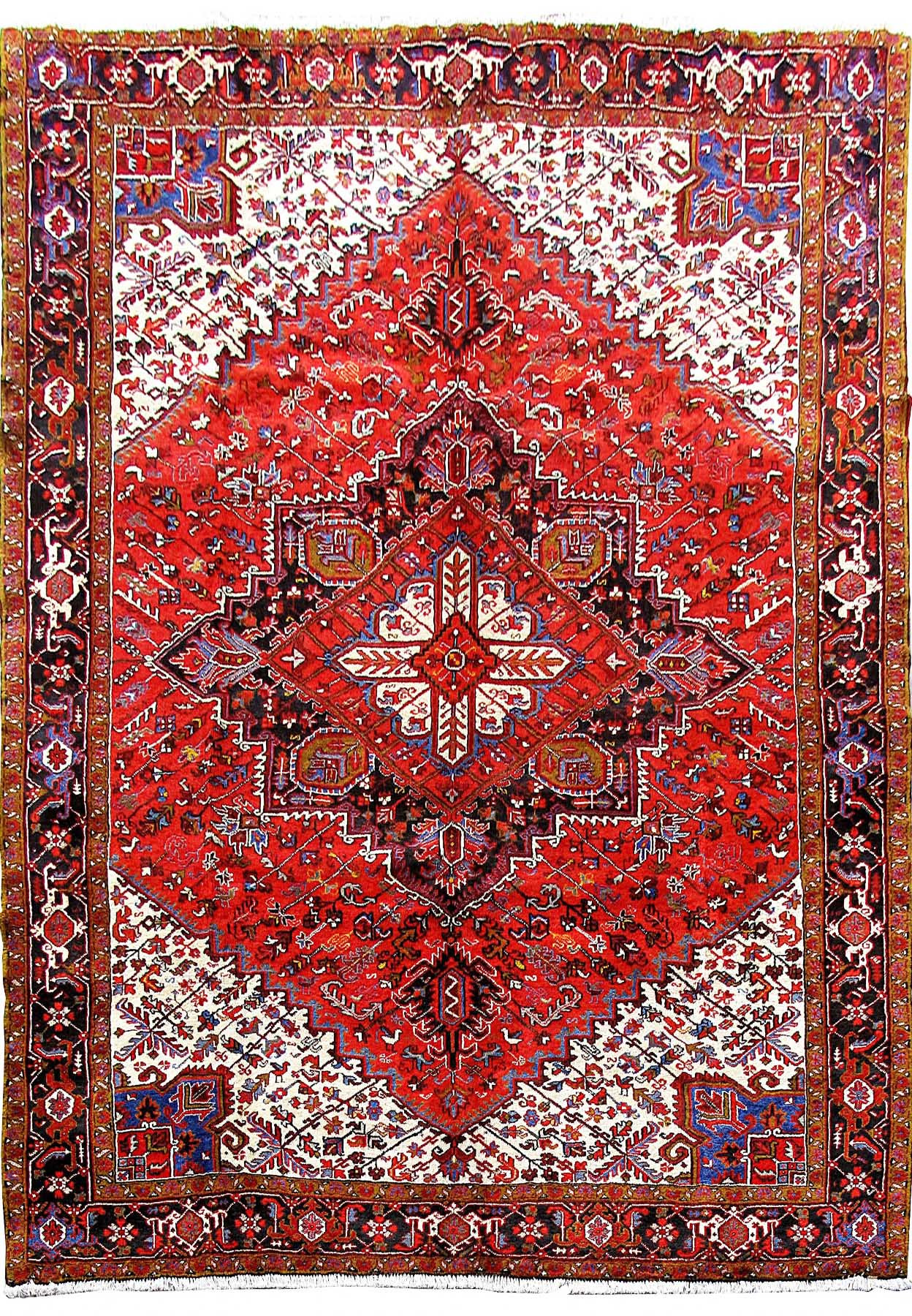
10' x 12'8" Persian Heriz Rug | Stepped Geometric Medallion | Antique Red & Ivory
This is a classic village Heriz in the size that sells fastest and is hardest to find in good condition: a true 10' x 12'8" with an antique red field, ivory corners and a single commanding medallion drawn in straight lines. The wool has the dry, slightly glossy handle that the Heriz district is known for, and the 3/8" pile stands up evenly across the whole rug with no low spots or repiling. It sits squarely in the 10x13 Persian rug range that most living rooms and dining rooms ask for. Every rug we ship carries a certificate of authenticity identifying origin, materials and construction.
Please Note About the Photographs:
The studio photographs and the daylight floor photograph were taken under different lighting, so the red reads deeper in some frames and brighter in others. The true color sits between the two, a warm antique red with real depth. Nothing in these images shows fading, wear or repair.
Design and Motifs
The center is a large stepped diamond medallion built entirely from straight lines and right angles, the drawing language that separates this district from the curvilinear city workshops. Inside it sits an ivory 8 petal rosette around a small red core, flanked by hooked palmettes and 4 olive cartouches set into the black-blue interior. Above and below the medallion, two long anchor pendants reach into the field, each finished with a serrated leaf. The red field around them is filled with small angular vine work, hooked latch motifs, star rosettes and tiny flowering sprays, all of it slightly irregular in the way that only village drawing is. The 4 corner spandrels are ivory and carry the same vocabulary in reverse, with blue and burgundy rosettes anchoring each corner. A wide black-blue main border of alternating palmettes and turtle motifs frames the whole composition, held by narrow flowering guard stripes. Buyers who want this kind of angular drawing across the board can browse more geometric Persian rugs.
Antique Red, Ivory, Black Blue and Olive
The field color is an antique red with a brick undertone, never orange and never pink, and it shifts gently across the width the way naturally dyed handspun wool does. Against it the ivory reads almost chalk white, used for the spandrels, the medallion rosette and the fine outlines that trace every motif and keep the pattern legible from across a room. The black-blue of the main border and the medallion interior is dense enough to look near black in low light, opening into a clear indigo where the light catches it, and the same blue reappears in the corner rosettes and scattered field flowers. Olive green does the quiet work, filling the 4 small cartouches around the medallion center and picking out leaves in the border, with occasional touches of gold, soft aubergine and pale sky blue in the smaller motifs. The overall effect is warm and saturated rather than bright, which is why a rug like this settles easily over wood, stone or a neutral carpet.
Heriz Weaving East of Tabriz
Heriz rugs come from a cluster of villages east of Tabriz, on the slopes below Mount Sabalan in northwest Persia. The water there is mineral rich, and local belief has always held that it is why the fleece from these flocks is unusually tough and takes dye so deeply. Weavers work from memory and from small drawings rather than a fully painted cartoon, which is why the medallion is squared off instead of curved and why no two Heriz rugs of the same design are ever identical. Village weaving in this district generally runs under 200 knots per square inch, and that is by intent: a slightly coarser knot on a heavy cotton foundation with a thick wool pile is what makes these rugs famously long lived under real furniture and real traffic. The back of this piece, shown against a ruler, is even and tightly packed with straight rows and clean selvedges, the marks of competent workshop-grade village weaving rather than a hurried commercial run.


