| Exact Size in ft: | Width: 12'2" x Length: 21'2" |
| Size in Inch: | Width: 146" x Length: 254" |
| Size in meters: | Length: 6.45 m x Width: 3.71 m |
| Some of many colors: | Soft tomato red, terracotta, brick rose, midnight navy, indigo, sky blue, antique ivory, soft cream, sage green, pistachio, forest teal, mustard gold, camel, salmon pink, accents of black |
| Woven: | 100% Hand-knotted | Handmade |
| Foundation: | 100% Cotton |
| Pile: | 100% Wool |
| Quality: | Serapi grade | Top tier of antique Heriz |
| Shape: | Rectangular | Oversized Mansion |
| Style: | Geometric Medallion with Pendant Anchors and Ivory Spandrels |
| Origin: | Persian Serapi Heriz | Made in Persia |
| Age: | Circa 1930s | Approximately 90 years old | Antique |
| Knot Density: | 5 x 5 per cm | 25 knots per cm² |
| KPSI: | 160 |
| Condition: | Very good antique condition |
12'2" x 21'2" Antique Persian Serapi Heriz Mansion Rug | Geometric Medallion with Pendant Anchors and Ivory Spandrels | Circa 1930s | 100% Wool on Cotton Foundation | 160 KPSI
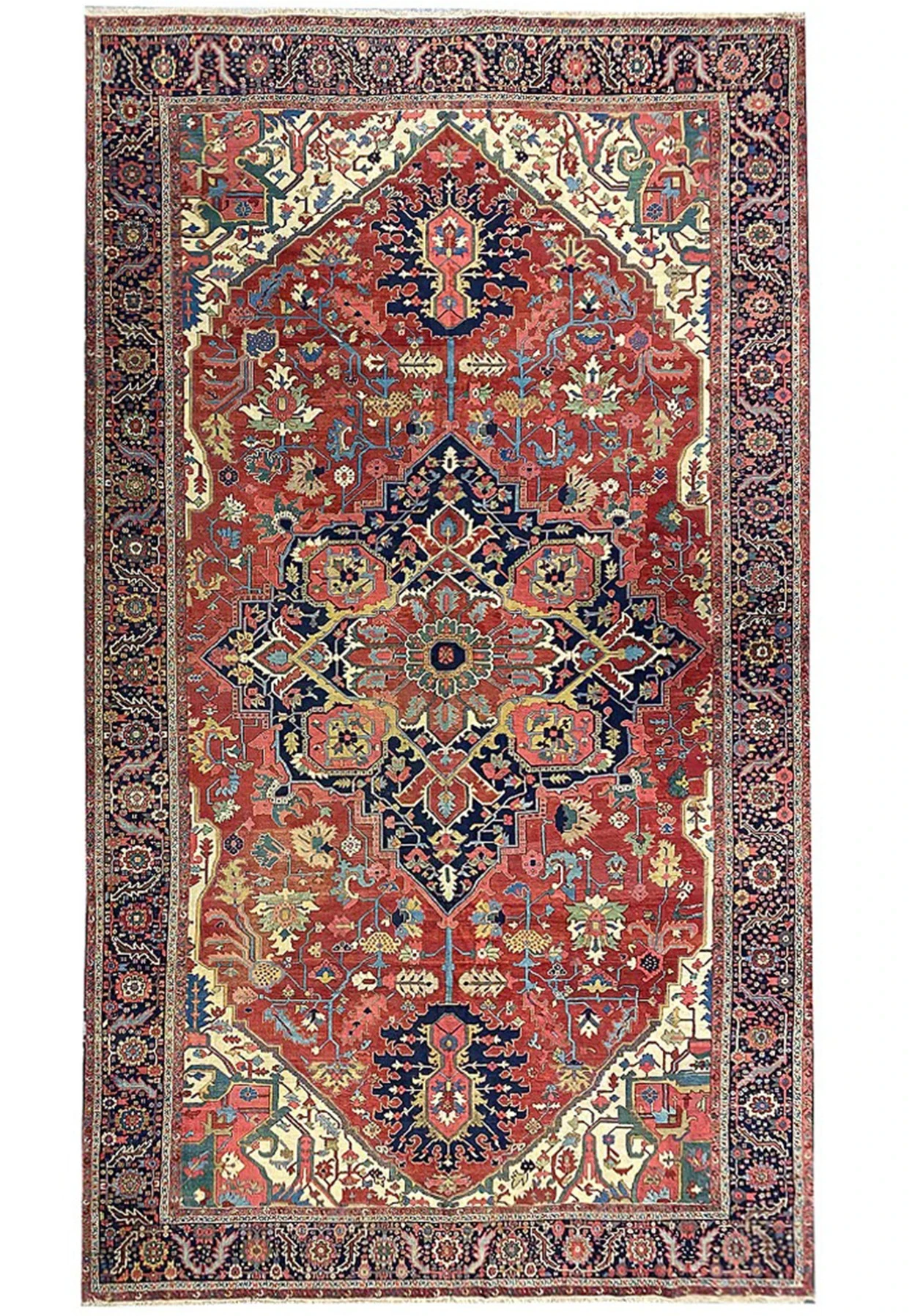
A magnificent oversized mansion piece, this 12'2" x 21'2" antique Persian Serapi Heriz rug was woven approximately 90 years ago in the Heriz weaving district of northwest Persia, in the highly collectible Serapi grade that represents the top tier of antique Heriz production. The rug is hand-knotted in 100% wool on a cotton foundation at roughly 5 x 5 knots per centimeter, equivalent to 25 knots per cm² or 160 KPSI, the spacious knot count that defines authentic Serapi drawing and gives these rugs their iconic bold, architectural geometry. A large stepped diamond medallion in midnight navy anchors the soft tomato-red field, flanked by long pendant anchors at each end and framed by generous ivory corner spandrels. The rug is in very good antique condition with even pile across the field and the soft, mellow color the trade calls "Serapi patina." Read more in our guide to fine antique Persian rugs.
Design and Motifs
The composition is the iconic Heriz architecture in its most ambitious mansion-scale expression, organized around a large stepped diamond central medallion with prominent stepped pendant anchors extending toward the head and foot of the rug. The medallion is drawn in deep midnight navy and filled with a stylized eight-pointed flower-head rosette at its center, surrounded by four red palmette quadrants and an interlocking lattice of curling vines, leaves, and small floral cartouches. The pendant anchors at each end repeat the medallion's interior geometry in miniature, drawn in the same navy ground with red palmette inlays. Generous ivory corner spandrels frame the four corners of the field, each filled with bold scrolling vines, large angular palmettes, and stylized leaves that read almost like cut-paper silhouettes against the cream ground. The vast tomato-red field around these elements is filled with the famously bold Heriz vocabulary of large angular palmettes, stylized weeping-willow forms, cypress-and-willow tree pairs, oversized leafy vines, rosettes, and small bird-and-vase cartouches, all drawn at the spacious, architectural scale that distinguishes Serapi-grade Heriz weaving from the busier later production. The wide midnight-navy main border carries a classical turning palmette-and-vine repeat with alternating large rosettes and curling leaves, framed on either side by minor borders of ivory and rose carrying delicate rosette-and-vine repeats, finished with narrow guard stripes that seal the composition with the strict precision Heriz workshops are known for.
Colors and Placement
The palette is the textbook antique Heriz formal trio of soft tomato red, midnight navy, and antique ivory, lifted by sky blue, sage green, pistachio, forest teal, mustard gold, salmon pink, and camel accents that give the rug its characteristic warm, sun-on-terracotta glow. The vast field reads as a luminous brick rose with the gentle vertical abrash bands that develop naturally in 90-year-old madder-dyed Heriz wool, where slightly different dye lots have aged into a layered, atmospheric ground tone that no new rug can replicate. Against this red ground, the central medallion glows in saturated indigo navy with the eight-pointed central rosette rendered in pistachio, sky blue, mustard, and salmon. The ivory corner spandrels read like daylight breaking through clouds, their cream ground letting the bold blue and red vinework breathe in a way that closed-corner Heriz drawings cannot match. The wide navy main border carries the stepped palmettes in salmon, pistachio, mustard, and sky blue, and the narrow rose-pink minor border frames the navy with an unexpectedly sweet floral repeat. The whole color story is the reason Serapi-grade Heriz rugs have been the favorite oversized rug of American and European tastemakers for more than a century: warm without being heavy, formal without being stiff, and bold enough to anchor the largest rooms while remaining perfectly at home with antique furniture, modern art, or anything in between. At 12'2" x 21'2" this is a true mansion piece, sized for the largest formal living rooms, great rooms, grand dining rooms with banquet-length tables, hotel and club lobbies, library rooms, and historic estate halls.
Persian Serapi Heriz Rugs and Construction
Heriz is the name of a weaving district in the foothills of Mount Sabalan in northwest Persia, near Tabriz, and the rugs woven there from the late 19th century forward have been the single most collected category of antique Persian rugs in the American market for over a hundred years. Within Heriz production, the term "Serapi" is the trade designation reserved for the finest, oldest, and most spaciously drawn Heriz rugs, typically pieces from the late 19th century through the 1930s that show the bold, architectural drawing, the soft natural-dye palette, and the spacious knot count that distinguish the top tier of Heriz output from later, busier village production. Serapi-grade Heriz rugs are prized for the exact qualities this rug shows: the soft tomato-red ground built from natural madder dye, the deep indigo navy from natural indigo dye, the bold ivory spandrels, the architectural medallion-and-anchor geometry, and the gentle vertical abrash that develops as the rug ages. This rug, woven approximately 90 years ago in the 1930s, dates to the closing decades of true Serapi production and shows every classical Serapi marker in textbook form. The rug is hand-knotted using the Persian senneh asymmetric knot at 5 x 5 knots per centimeter, equivalent to 25 knots per cm² or 160 KPSI, and approximately 3.6 million individual hand-tied knots across the full 24 square meter surface. The pile is 100% wool from the long-staple highland fleece of the Heriz region, the same wool tradition that gives these rugs their famous durability, and the foundation is 100% cotton, the standard for Heriz workshop weaving from the late 19th century forward. A mansion-size Serapi Heriz of this quality, drawing, age, and condition is an investment-grade rug that will read as the centerpiece of any large interior for the next hundred years exactly as it has for the last ninety.