| Size in ft: | Width: 12' x Length: 17'9" |
| Size in Inch: | Width: 144" x Length: 213" |
| Size in meters: | Length: 5.41 x Width: 3.66 m |
| Colors: | Light blue, beige, sand, cream, apricot, camel, chocolate brown, sage green |
| Shape: | |
| Woven: | 100% Hand-knotted | Handmade |
| Foundation: | |
| Pile: | |
| KPSI: | |
| Design: | Chobi Ziegler | All-Over Floral | |
| Origin: | Made in Afghanistan |
| Condition: | Brand New | Never used |
12' x 18' Chobi Ziegler Rug | Light Blue All-Over Floral | 280 Knots Per Square Inch | Made in Afghanistan
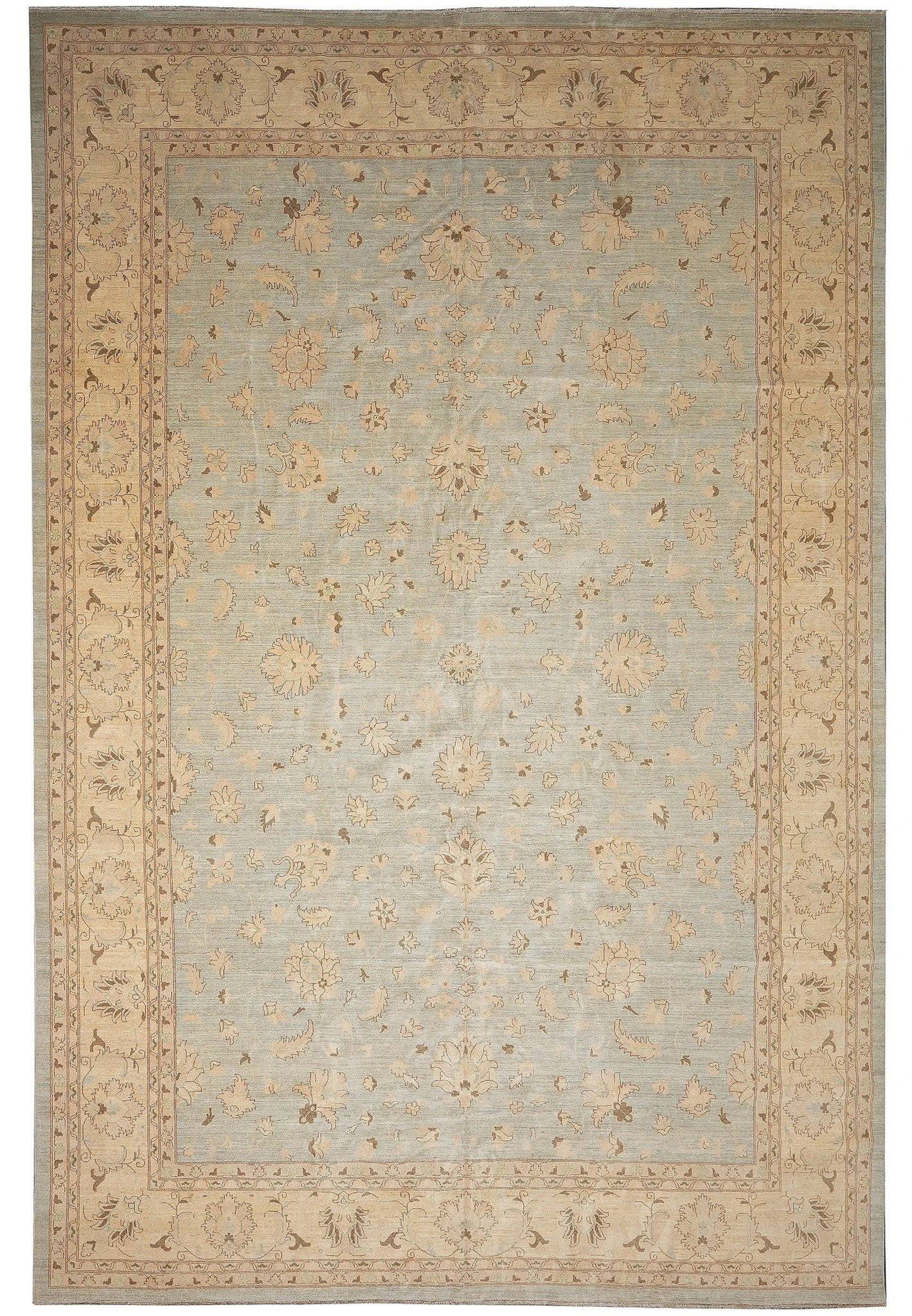
Most oversize rugs are loud. This one is the opposite, and that is the whole point of it. A soft light blue ground carries a scattered floral repeat in sand and cream, the border sits a shade warmer in beige, and nothing in the palette raises its voice. At 12 feet by 17'9" it covers a large room completely while still reading as a quiet surface rather than a statement, which is exactly what a big open floor plan usually needs. It is hand-knotted in Afghanistan at roughly 280 knots per square inch, natural wool on a cotton foundation, and it has never been used. Certificate of authenticity included.
Design and Motifs
This is the Ziegler layout, an all-over floral with no medallion and no center of gravity, and the whole effect depends on how loosely it is drawn. Large open palmettes and rosettes sit scattered across the field, each one a separate island rather than a link in a chain, with small leaf sprays, curling tendrils and tiny buds filling the space between them. The scale is deliberately generous: fewer motifs, drawn bigger, with real air around them, which is why a rug this size never feels crowded. The border shifts to a beige ground and tightens up, running a continuous vine of large palmettes and serrated leaves flanked by narrow guard stripes of small rosettes and paired brown accents. Because the field has no orientation, the rug reads correctly from any doorway and can be turned to suit the room. It also means furniture placed anywhere on it will look intentional rather than covering up a medallion.
The Color
The field is a pale, slightly grey light blue, the shade people mean when they say baby blue but softer and more muted, and it shifts subtly across the rug because the wool was hand spun and takes dye unevenly by nature. That variation, the faint horizontal striation you can see in the field photos, is called abrash and it is one of the marks of natural dyeing rather than a flaw. On top of it the motifs are worked in sand, cream and a warm apricot, with camel and chocolate brown doing the outlining and small touches of sage green appearing in the border rosettes. The border ground is a warmer beige that frames the cooler field and keeps the whole thing from going cold. What makes this palette useful is how little it argues with anything: it sits equally well against white oak, walnut, stone or painted floors, and it works with both cool grey and warm cream walls.
Chobi Weaving in Afghanistan
Chobi comes from the word for wood, and it refers to the dye method: plant and mineral sources rather than synthetics, which is why these rugs age toward softer tones instead of fading unevenly. Afghan workshops built their reputation on this category over the past few decades, combining hand-spun highland wool with the loose Ziegler drawing style, and the result sits in an unusual place in the market. You get genuinely hand-knotted construction at 280 knots per square inch, natural dyes and a wool quality that develops a sheen with use, in a palette designed for contemporary interiors rather than traditional ones. For a rug covering more than 200 square feet, that combination is difficult to find at any price. If you are comparing categories, our article on the difference between an Oriental rug and its regional variations is worth reading, and the rest of our 12x18 rugs sit alongside this one.