Every handmade Persian and Oriental rug begins the same way: with a foundation. Before a single knot is tied, before any pile is formed, before any color appears, the weaver strings a loom with vertical threads and prepares horizontal threads to weave through them.
What those threads are made of determines more about the finished rug than most buyers realize. The foundation is invisible in the completed piece. It is hidden entirely beneath the pile. And yet it governs the maximum possible knot density, the dimensional stability of the rug over time, how it lies on the floor, how it responds to moisture, and how long it will survive heavy use. The foundation is invisible. It is also everything.
At Rugs.net, we examine the foundation of every rug in our inventory and describe it accurately in each listing. This guide explains what foundation materials mean in practice, why most great Persian rugs use cotton, when and why silk is used instead, and how flat-woven kilims handle foundation entirely differently from pile rugs.
Warp and Weft: The Two Threads That Build Every Rug
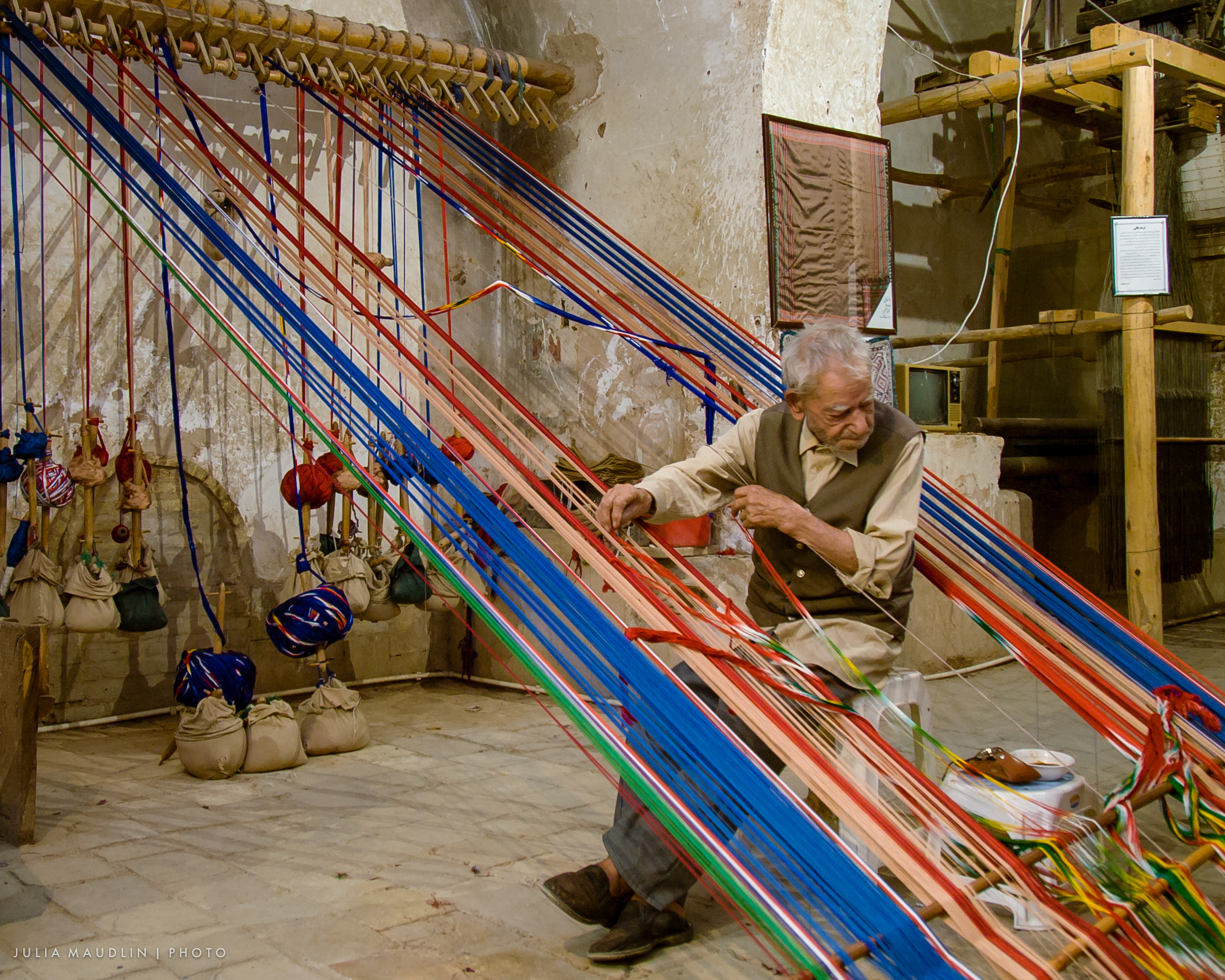
A hand-knotted rug is constructed on a loom. The vertical threads strung on the loom before weaving begins are called the warp. The horizontal threads woven through them row by row are called the weft. Together, warp and weft form the foundation: the structural grid onto which pile knots are tied and beaten down. When the rug is finished, the foundation is almost entirely hidden beneath the pile. Pull the pile back on any hand-knotted rug and you will find it: a tight lattice of interlocked threads holding the entire structure together.
The warp threads carry the greatest stress. They run the full length of the rug under constant tension throughout weaving, and each knot of the pile is tied directly around them. They must be strong, smooth, and resistant to breaking under sustained load. The weft threads pass horizontally between each row of knots, locking them in place. After each row of knots and weft passes is complete, the weaver uses a heavy comb to beat them down as tightly as possible. The tighter the beat, the firmer and more durable the finished rug.
The spacing and fineness of the warp threads also determine the maximum knot count achievable per square inch. A coarser warp can support fewer knots across a given width. A finer warp, set more closely together, allows more knots per inch and therefore finer detail in the design. This single relationship between foundation thread diameter and achievable knot density explains why the most intricate Persian rugs in existence, signed masterworks from Qum at 800 to 1000 KPSI, require silk foundations. Only silk can be spun fine enough to make those densities physically possible.

The Essential Principle
The fineness of the foundation thread sets the ceiling on knot density. A cotton foundation can support up to roughly 500 KPSI in the finest city workshop production. A silk foundation can reach 1000 KPSI. The difference is not a matter of luxury. It is a matter of physics.
Why Cotton Dominates Persian Workshop Rugs
The overwhelming majority of Persian rugs produced in the great weaving cities of Kashan, Isfahan, Tabriz, Nain, Bijar, Mashad, and Qum use cotton for both warp and weft. This is not tradition for its own sake. Cotton earns its place through a combination of properties that make it the most practical foundation material for serious rug production.
Dimensional stability. Cotton does not stretch. Wool, a protein fiber, has natural elasticity and responds to changes in humidity. Cotton holds its dimensions consistently through years of use and varying climates. For a foundation that must maintain even tension across the full width and length of a rug, this stability is essential. A foundation that shifts or stretches produces an uneven pile surface and causes the rug to ripple or buckle over time.
Moisture resistance. Cotton handles humidity significantly better than wool. In homes where rugs are laid on stone or tile floors, or where pieces are periodically washed, a cotton foundation survives conditions that would weaken wool. This is why city workshop rugs, expected to last generations and pass between them, favor cotton.
Flatness. A cotton-foundation rug lies flat. The non-stretching warp prevents the rug from developing a wavy or rippled profile over time. In large oversize pieces, where even slight foundation movement becomes visible across the field, this property is particularly important.
Whiteness. Cotton is naturally white. In tightly knotted rugs where the foundation is visible from the reverse, a clean white cotton foundation is a reliable indicator of quality city workshop production.
From Our Collection: Cotton Foundation Rugs

Bijar · 350 KPSI · Cotton Foundation · 6'6 x 9'10
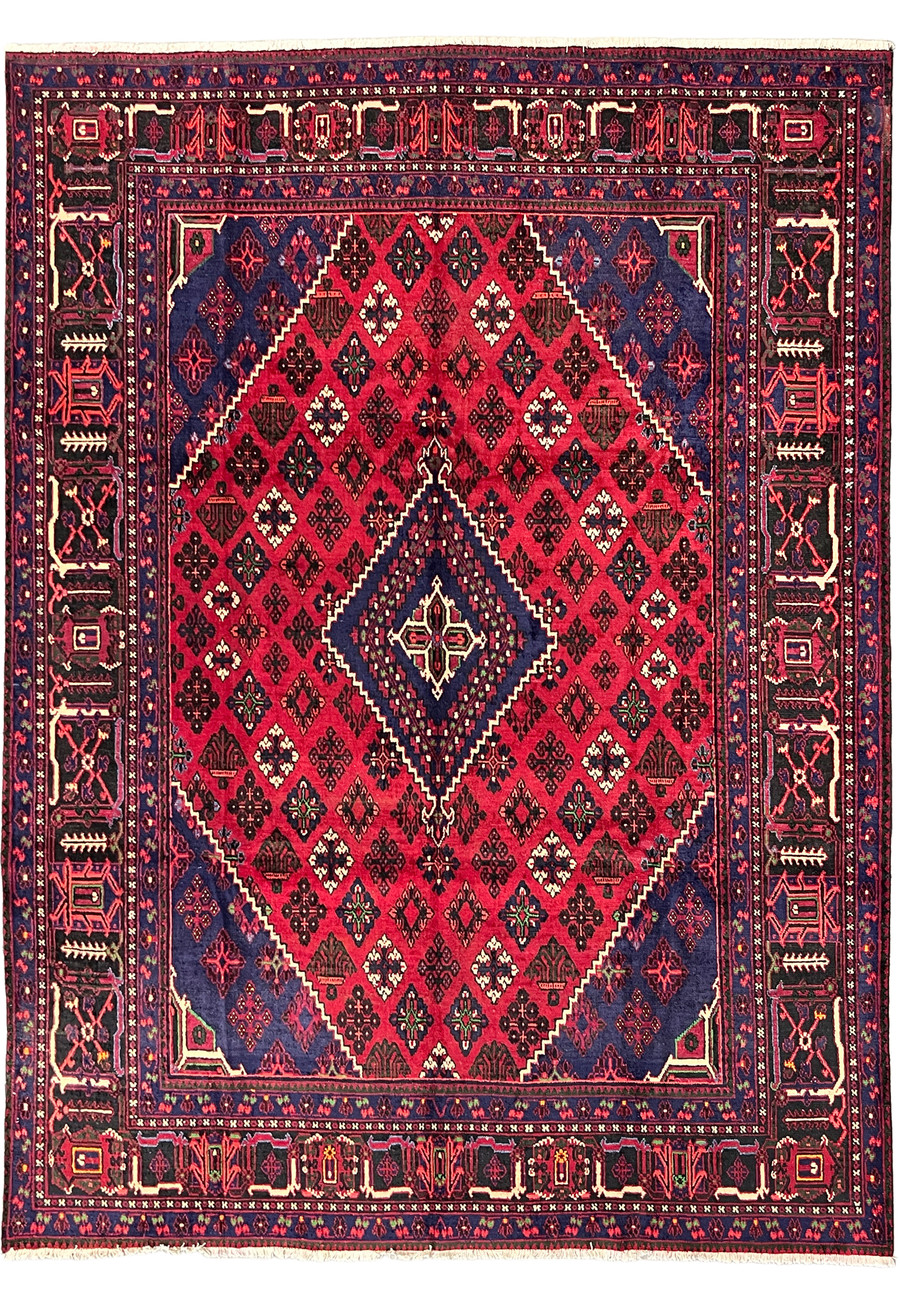
Meymeh · 220-240 KPSI · Cotton Foundation · 10 x 13

Qum Kork · 400 KPSI · Cotton Foundation · 3'5 x 5'4
A note on the Bijar: its cotton foundation uses a uniquely compressed double-weft construction, beaten with exceptional force to create a pile so dense the rug barely bends. The Bijar is called the iron rug of Persia, and its cotton foundation is a direct contributor to that character.
When Silk Is Used: A Technical Necessity, Not a Luxury
Silk foundations appear in a specific and narrow category of Persian rugs: the finest production from Qum, and certain exceptional signed pieces from Isfahan. Understanding why requires understanding what silk can do that cotton cannot.
A silk thread can be drawn to a diameter far finer than any cotton thread while retaining greater tensile strength. This allows a silk warp to be set at a much tighter spacing on the loom, enabling more knots per horizontal inch. A fine cotton-foundation rug can achieve 400 to 500 KPSI in the highest city workshop production. A silk-foundation Qum can reach 800, 900, or 1000 KPSI. At those densities, the pile renders curvilinear designs of extraordinary resolution, with color gradations that shade across a medallion petal the way paint shades on canvas.
Silk is also stronger than cotton weight for weight, which means these ultra-fine warps can sustain the beating force required to lock such densely packed knot rows in place. A weaver working at 1000 KPSI is compressing rows of knots spaced a fraction of a millimeter apart. Only silk holds under that pressure at that scale. The silk foundation is not a luxury addition to make a rug more expensive. It is a technical requirement for making a rug at all in that category.
On Silk Foundation Rugs
A Qum silk-on-silk at 900 to 1000 KPSI is not simply a high quality rug. Its directional luminosity, the way it changes color as you move past it due to the light-reflecting properties of the silk pile, cannot be replicated in any other material. Many are displayed as wall art. All appreciate in value as collector objects.
From Our Collection: Silk Foundation Rugs


Signed Kashizadeh · 1000 KPSI · Silk on Silk · 4'3 x 6'6
Qum Pure Silk, Signed Kashizadeh, 1000 KPSI
$22,500
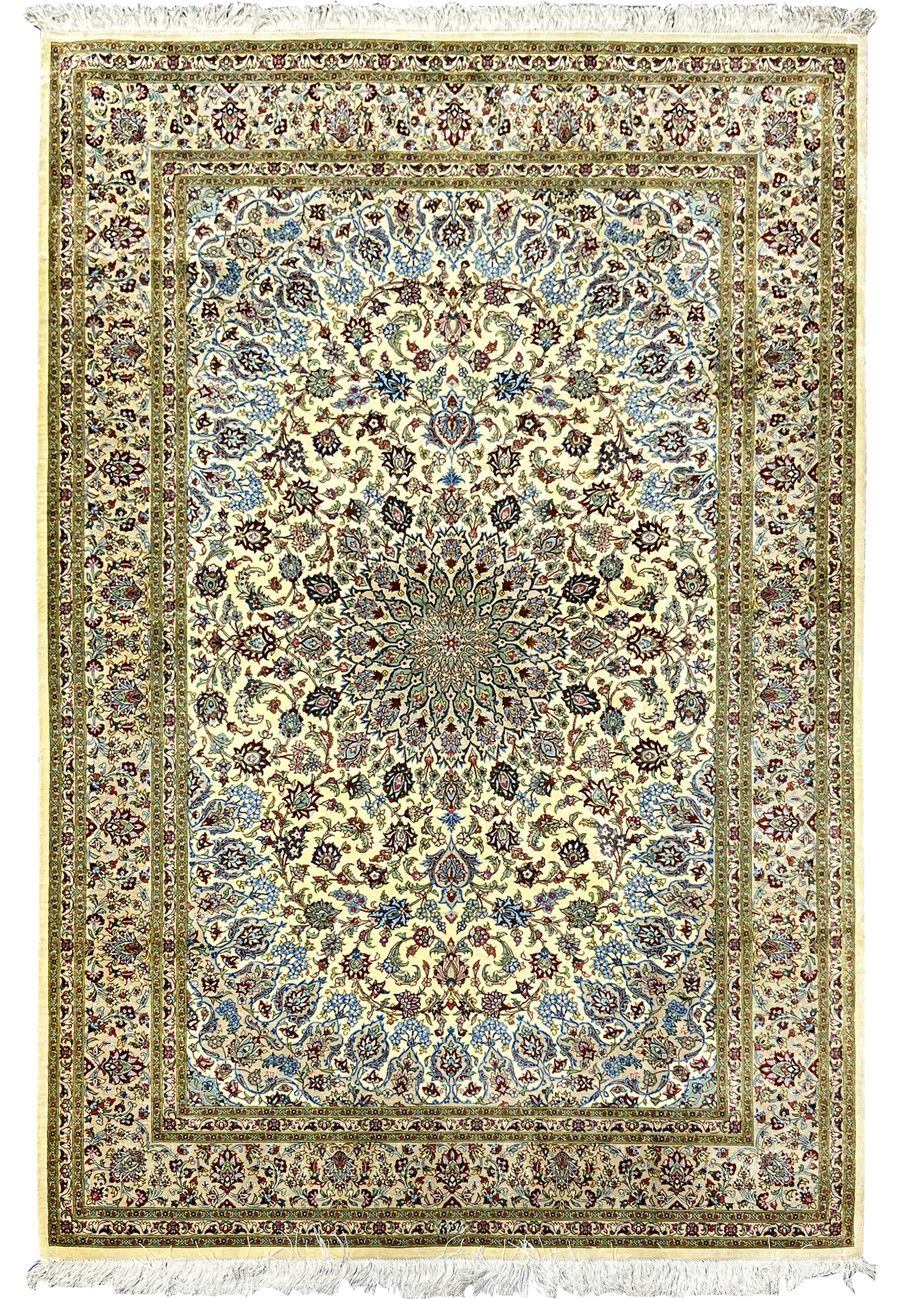
Signed · Qum Pure Silk · Silk on Silk · 4'5 x 6'7
We read the Farsi signature on every signed piece in our inventory. For Qum silk rugs, the signature identifies the master weaver or workshop, which is material to both attribution and value.
Wool Foundations: The Nomadic Tradition
Before cotton became widely available in the Persian weaving centers, wool was the standard foundation material, and it remains so in nomadic and tribal weaving traditions today. Nomadic weavers work with what is available locally, and sheep are always present. A wool warp and weft produces a rug with a softer, more supple body than cotton, and the lanolin in the wool provides some natural resistance to dirt and moisture.
The tradeoff is dimensional stability. Wool stretches slightly under tension and responds to changes in humidity. A wool-foundation rug may develop a slight wave or ripple over time, particularly in variable climates. For nomadic pieces, woven for use on tent floors or as transportable goods, this presents no practical problem. For a formal room in a settled home, cotton is almost always the better choice.
Tribal rugs from Qashqai, Bakhtiari, and Kurdish weavers typically use wool foundations. The somewhat softer and more irregular character of these pieces, compared to city workshop production, is in part a product of that wool foundation. It is not a defect. It is the material signature of the tradition, and in collector terms it is part of what makes these pieces distinct.
Kilims: When the Foundation Becomes the Design
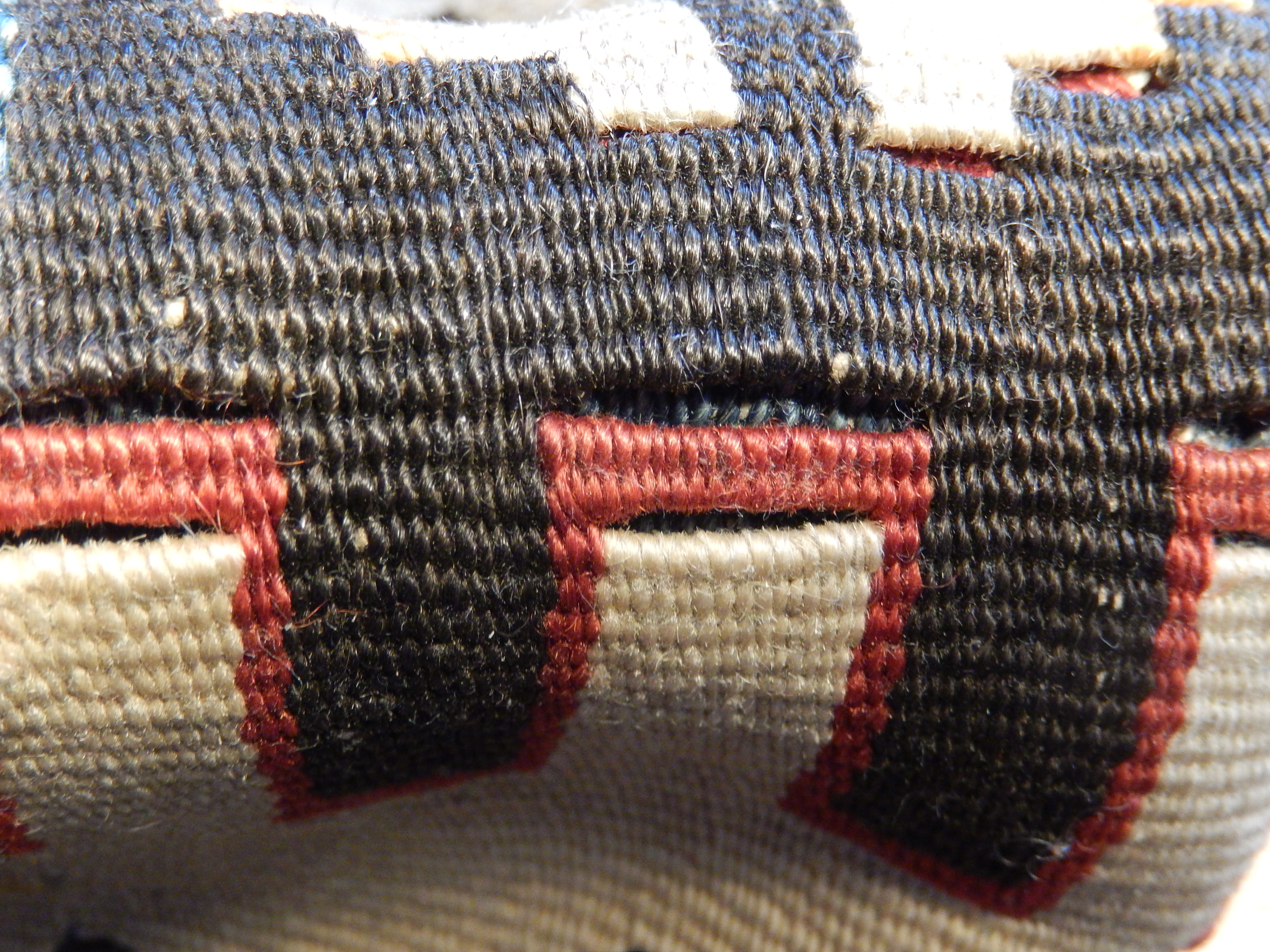
In a pile rug, the foundation is structural and hidden. In a kilim, the foundation is the design. A kilim is a flat-woven rug with no pile whatsoever. The pattern is created entirely by the weft threads: colored yarns woven over and under the warp in specific sequences to produce geometric designs. Because the weft threads create the visible surface, this construction is called weft-faced weaving.
The warp threads in a kilim are set tightly and spun for strength. They will be almost invisible in the finished piece, covered completely by the weft. Unlike a pile rug, where the warp and weft are both structural and subordinate to the pile, in a kilim the weft is simultaneously structure and decoration. Changing the color of the weft thread, and the sequence in which it passes over and under the warps, is the entire language of kilim design.
The absence of pile makes kilims thinner, lighter, and reversible. The same pattern appears on both faces, which extends the useful life of the piece and gives it a flexibility of placement that pile rugs do not have. Historically, kilims were the most practical format for nomadic use: fast to produce, easy to roll and transport, and useful both as floor coverings and as decorative textiles.
From Our Collection: Kilims

Persian Kilim · Flat Weave · 3 x 5'2

Turkish Kilim · Flat Weave · 4 x 6
What the Foundation Tells You When Buying a Rug
Knowing the foundation material of a rug you are considering gives you immediate information about its origin, construction category, and intended use.
Cotton foundation means a city workshop rug, produced by trained weavers from a formal design, built to last generations. The vast majority of great Persian rugs from Kashan, Isfahan, Nain, Tabriz, Bijar, and Mashad are cotton foundation pieces.
Silk foundation means one of the finest pieces the Persian weaving tradition produces. It is not an optional upgrade. It is a physical prerequisite for the knot densities achieved in Qum silk-on-silk production. A genuine 900 or 1000 KPSI rug is impossible on cotton.
Wool foundation usually indicates a nomadic, tribal, or village rug. These can be exceptional pieces on their own terms. Qashqai, Bakhtiari, and Kurdish tribal rugs have produced extraordinary work on wool foundations. But they are structurally and characteristically different from city workshop pieces.
No pile at all means a kilim: flat-woven, reversible, lighter, and faster to produce. The weft thread is the design.
Every listing on Rugs.net describes the foundation material of each piece accurately. If you have a question about a specific rug in our inventory, call us at 855-576-7705 or email info@rugs.net. We know our inventory personally and can answer any question about foundation, pile, knot type, age, or provenance before you make any commitment.