
| Exact Size in ft: | Width: 3'5" x Length: 5'1" |
| Size in Inch: | Width: 41" x Length: 61" |
| Size in meters: | Length: 1.55 m x Width: 1.04 m |
| Some of many colors: | Rose pink, salmon pink, midnight navy, deep blue, chartreuse green, lime, sage, ivory, cream, soft sky blue, burgundy, terracotta, mustard gold, accents of white |
| Woven: | 100% Hand-knotted | Handmade |
| Foundation: | 100% Cotton |
| Pile: | 100% Kork Wool |
| Pile Height: | 0.35 inch |
| Shape: | Rectangular |
| Style: | Vintage Three Panel Mille-Fleur with Central Cartouche |
| Origin: | Persian Qum | Made in Persia |
| Age: | Approx. 60 years old | Vintage |
| KPSI: | Approx. 400 |
| Condition: | Great vintage condition |
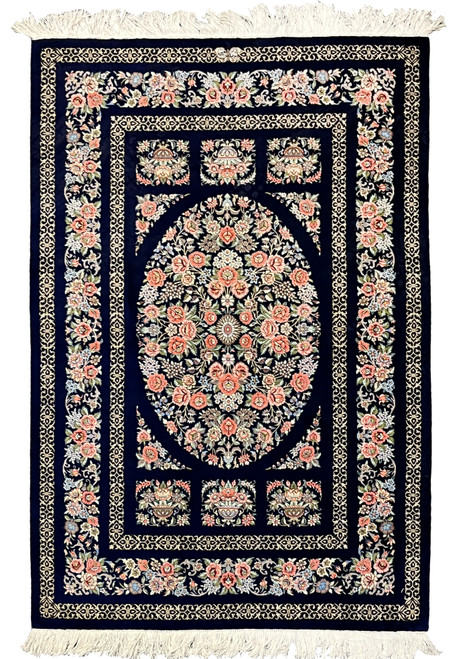
3'5" x 5'1" Vintage Persian Qum Kork Wool Rug | Three Panel Composition with Central Cartouche | Rose Pink and Chartreuse Green | 60 Years Old | 400 KPSI
This is a true collector's piece, a 3'5" x 5'1" vintage Persian Qum kork wool rug woven approximately 60 years ago in the holy city of Qum, Iran, in great vintage condition. The composition is a rare classical Qum three-panel format that has largely disappeared from modern Qum production: a central navy cartouche bearing a chartreuse-green floral medallion, flanked above and below by smaller geometric guard panels, all floating on a glowing rose-pink mille-fleur field. The rug is hand-knotted at 400 KPSI on a cotton foundation in pure kork wool, the rare ultra-fine throat fleece of the lamb, with a lustrous 0.35 inch pile. Read more in our introduction to Persian Qum guide.
Design and Motifs
The layout breaks decisively from the medallion-and-spandrel format that dominates most Qum production and instead presents a classical three-panel architectural composition that early Qum master weavers borrowed from Caucasian and northwest Persian tradition and refined into a uniquely Qum dialect. At the center sits a vertical rectangular cartouche with a deep midnight navy ground, framed in a notched chartreuse-green inner border and filled with a curvilinear floral medallion in lime green outlined by a serrated cream cartouche, the medallion itself rendered with miniature peony blooms, sky blue corner blossoms, and burgundy accents. Above and below this central cartouche sit two horizontal guard panels, each a smaller navy rectangle filled with three diamond-shaped chartreuse and pink rosette compartments arranged in a row. All three panels float on an unbroken rose-pink mille-fleur field, the pink ground enlivened by tiny chartreuse-green tulip-bud and lily motifs spaced in regular vertical files. The composition is framed by an elaborate multi-stripe border system: a narrow chartreuse-and-pink minor border with willow-tree and rosette motifs, then a wide midnight navy main border carrying alternating burgundy weeping willow trees and pink-and-blue eight-pointed star rosettes in a clear repeating rhythm, then narrow pink-and-cream rosette guard stripes, then a final coral selvage. The willow tree motif in the main border is a direct loan from Bidjar and Senneh weaving and signals the early Qum workshop period when masters were still drawing from a wider regional vocabulary.
Colors and Placement
The palette is one of the most striking and unusual in classical Qum production, built on the high-contrast collision of rose pink against chartreuse green, with deep midnight navy providing the structural anchor. The vast field is woven in a soft glowing rose-pink kork wool that has aged into a luminous tone almost impossible to reproduce in new wool, with subtle abrash variation across the surface that shifts the pink toward salmon in some passages and toward true pink in others. The mille-fleur tulip-bud sprigs scattered across this pink ground are rendered in chartreuse green and lime, with tiny burgundy and navy accent buds. The three central panels are all woven on midnight navy grounds for maximum contrast against the pink, with the central cartouche medallion in glowing chartreuse and lime green outlined in cream, and the upper and lower diamond rosettes in alternating chartreuse, pink, and ivory. The notched inner panel borders are chartreuse green with cream serration. The outer main border carries the navy ground forward, with the willow trees rendered in burgundy and rose, and the eight-pointed star rosettes alternating pink-and-sky-blue with chartreuse leafwork. Narrow guard stripes carry pink-on-cream meandering vines and small white-and-blue rosettes. Coral wool selvages frame both long sides, and ivory cotton fringes finish both ends. The entire color story reads as a Persian spring garden, lime-green new growth on rose-pink soil under a deep blue sky.
Persian Qum Rugs and Construction
Qum is the youngest of Persia's great weaving cities. Large-scale rug production only began there in the 1930s, and this rug, woven approximately 60 years ago, dates to the second-generation Qum workshop period of the mid-1960s when master weavers from Kashan, Isfahan, and Tabriz were still actively migrating to the holy city and bringing with them a wider regional vocabulary that included Bidjar willow trees, Senneh diamond compartments, and Caucasian three-panel formats. Pieces from this period are increasingly scarce and represent a moment when Qum had reached technical maturity but had not yet narrowed to the medallion-and-spandrel floral style that dominates contemporary production. The rug is hand-knotted at 400 KPSI, which works out to 640,000 knots per square meter, and approximately 1.04 million individual hand-tied knots across the full 1.61 square meter surface. The pile is pure kork, the rare ultra-fine throat and underbelly fleece of the lamb, hand-spun extremely fine and dyed with the saturation that only kork can hold. After 60 years of careful keeping, the kork has developed a soft natural luster that no new rug can replicate, and the wool has gained a depth of patina that collectors specifically seek out. The Persian senneh asymmetric knot is used throughout, allowing extremely fine drawing of the willow trees, the diamond rosettes, and the mille-fleur tulip buds at a level of detail closer to Persian miniature painting than to typical rug weaving. A 60-year-old Qum kork in great condition like this is a true collector's piece. Read more in our introduction to Persian Qum guide.