
| Size in ft: | Width: 3'7" x Length: 6' |
| Size in Inch: | Width: 43" x Length: 72" |
| Size in meters: | Length: 1.83 x Width: 1.09 m |
| Colors: | Rust Red, Rust, Black, Beige, Ivory, Blue, Light Blue, Dark Olive, Dark Bronze, Burgundy, Dark Gray, Dark Blue |
| Shape: | |
| Woven: | 100% Hand-knotted | Handmade |
| Foundation: |
Cotton |
| Pile: | |
| KPSI: | |
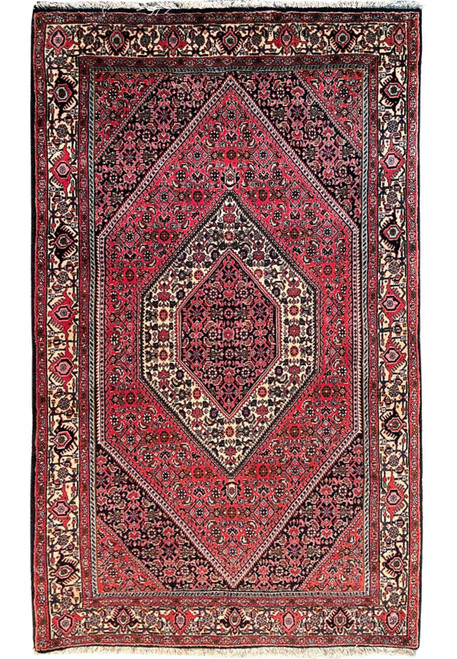
| Design: | All-over Herati (Mahi) | Hexagonal Medallion | Ivory Spandrels |
| Origin: |
Persian Bijar | Made in Persia |
| Condition: | Excellent | Never used |
3'7" x 6' Persian Bijar Rug | Herati Medallion | Approx. 350-380 KPSI
Pick this rug up and you understand the reputation immediately. It is heavy for its footprint, stiff enough to stand on its own edge, and the back is as tightly packed as a woven board. That weight is the signature of Persian Bijar rugs, the iron rugs of Persia, where the weaver drives each row down with a metal comb before the next is tied. At 3'7" x 6' with a hand-knotted wool pile on a wool foundation and roughly 350 to 380 knots per square inch, this is a small piece built to survive decades of daily traffic, and it sits comfortably among our 4x6 Persian rugs. Every rug we ship travels with a certificate of authenticity recording origin, materials and weave.
Design and Motifs
The field carries the classic Herati, also called mahi or the fish pattern: a repeating lattice of small rosettes, each set inside a diamond and flanked by four curved lanceolate leaves that read as fish circling a pool. The repeat runs edge to edge without a break in the drawing, which is the hardest way to weave an all-over field and the fastest way to spot a careless workshop. At the center sits an elongated hexagonal medallion, framed in an ivory band of scrolling vinework and filled with its own darker version of the same Herati repeat, so the medallion reads as a window rather than a separate ornament. Ivory spandrels with matching rosette work cut across all 4 corners. The main border alternates hooked palmettes and eight petal rosettes, and it is fenced on both sides by narrow guard stripes of reciprocal trefoils and a fine barber-pole stripe.
A Rust Red Field Framed in Navy and Ivory
The ground is a warm rust red that leans coral where the light catches the pile and settles toward brick in the shadows, a tone that comes from madder rather than a flat single-note dye. Against it the Herati lattice is picked out in ivory, beige, dark olive, dark bronze and burgundy, with small hits of light blue and dark blue that keep the field from going monochrome at a distance. The medallion interior drops to a deep burgundy brown that is nearly black in low light, which is what makes the ivory frame around it read so cleanly. The main border runs dark navy to black, loaded with rust, ivory and blue rosettes, and the outer guard bands lift back to ivory and beige so the whole rug is bracketed light, dark, light. Dark gray outlining separates the motifs and keeps every element legible.
Bijar, Kurdistan, and Why the Weave Matters
Bijar sits in the Kurdish highlands of northwest Persia, and the town has been producing the densest hand-knotted rugs in the country for well over a century. Weavers there use a heavy wool warp, wet the wefts, and beat each row down with a metal comb so the foundation compresses into something close to a solid slab, which is why a Bijar of this size feels twice the weight a buyer expects. The wool from the surrounding pastures is coarse, high in lanolin and slow to show wear, so the pile keeps its luster instead of dulling. Reaching 350 to 380 knots per square inch on that foundation takes real skill, since the tighter the beat-down the harder it is to keep the Herati repeat square. Collectors who want to sort the sub-groups should read Bijar vs Bijar Zanjan vs Bijar Tekab vs Bijar Bukan before choosing.