
Bijar vs Zanjan vs Tekab vs Bukan: What's the Difference?
Posted by Rugs.net on Apr 28th 2026

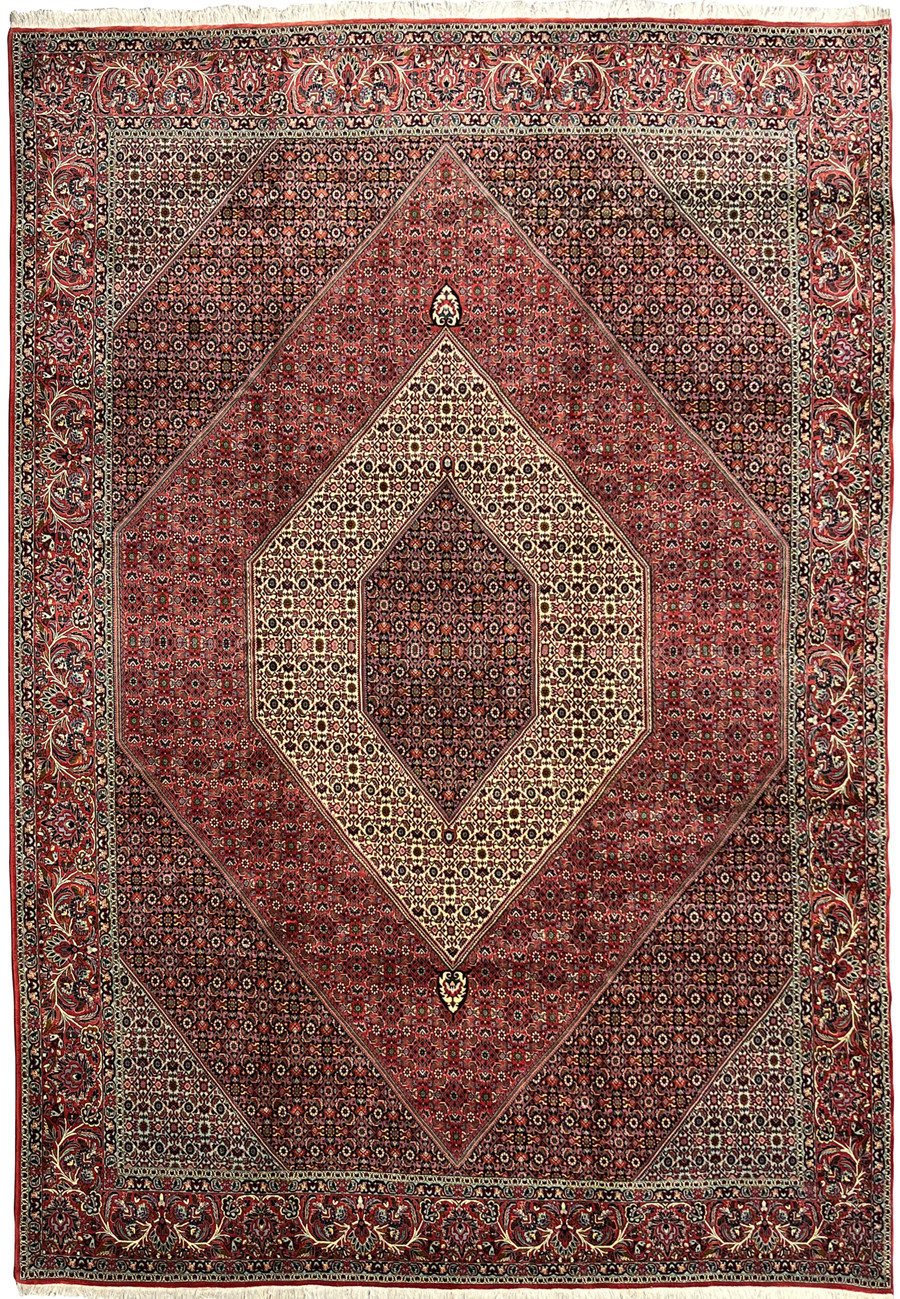
9'10 x 13'2 Bijar Persian Iron Rug, Hexagonal Medallion, 420 KPSI. · City Bijar. The authentic Iron Rug.
If you have spent any time looking seriously at Persian Bijar rugs, you have encountered the problem. A rug is listed as a Bijar. Another is listed as a Bijar Zanjan. A third says Bijar Tekab. A fourth says Bijar Bukan. Are these the same thing? Different things? Is one better than another? Is the seller using regional names interchangeably, or are they describing meaningfully different objects?
The answer is that they are meaningfully different, and understanding those differences matters both for the quality of what you are buying and for the accuracy of the description you are receiving. All four originate from the same broad Kurdish weaving tradition in northwestern Persia. But they come from different cities, are woven by different hands, and have different structural and aesthetic characters that a knowledgeable buyer can distinguish.
This guide explains all four clearly and tells you what to look for and what to expect from each.
The Geography: One Tradition, Four Cities
All four Bijar types come from the Kurdistan province and surrounding region in northwestern Persia, an area of high altitude, cold winters, and a deeply rooted Kurdish weaving culture. The Kurdish people of this region have woven rugs for centuries, and it is from their tribal tradition that the great workshop rug of Bijar city emerged.
The four cities associated with the Bijar name sit within a roughly 200-kilometer radius of each other in the mountainous terrain of western Persia. Each has its own market, its own workshop history, and its own relationship to the broader Kurdish design vocabulary they all share. The name Bijar has become something of a regional brand in the rug trade, applied both to the specific city production and, more loosely, to rugs from nearby cities that share its general character.
The Four Cities at a Glance
Kurdistan province. The original Iron Rug. Workshop production. Wet-beaten construction. The benchmark against which all others are measured.
Zanjan province, northwest of Bijar city. A major weaving center producing rugs in the Bijar style with some regional variation in design and structure.
West Azerbaijan province. Produces rugs with a distinctly tribal character within the broader Bijar design tradition. Bolder, often more geometric.
West Azerbaijan province. A significant Kurdish weaving center whose production overlaps with the Bijar aesthetic but has its own distinct local tradition.
Bijar City: The Original Iron Rug

6'8 x 9'6 Persian Bijar Iron Rug, Rust Red Field, Navy Diamond Center. City Bijar production. The dense, compressed pile surface is the visual signature of wet-beaten construction. Press your hand into this and it springs back immediately and completely.
When dealers and collectors say “Bijar” without qualification, they mean the rug woven in Bijar city, the capital of Bijar County in Kurdistan province. This is the original, the reference point, the only rug that carries the Iron Rug title without qualification.
What makes city Bijar unique is the wet-beating technique. After each row of knots is tied, the weft threads are soaked in water before being beaten down into the foundation. The wet wool expands, and when beaten under high force, compresses to a density that no dry-beating technique can achieve. When the wool dries, it sets permanently in that compressed state. The knots are locked. The foundation becomes rigid. The resulting rug literally resists bending: try to fold a city Bijar tightly and it pushes back.
No other weaving center uses this technique. It is specific to Bijar city, and it is the reason for everything distinctive about the city Bijar as an object: its exceptional weight per square foot, its resistance to crushing under foot traffic, its 100+ year lifespan under daily use, and its characteristic dense, flat pile surface with a natural matte kork wool sheen.
City Bijar production typically runs between 80 and 200 KPSI in the standard grades, with finer examples reaching 300 to 420 KPSI. The designs draw from the Kurdish geometric tradition: the Herati lattice, the Mahi fish pattern, medallion-and-corner formats with bold geometric borders. Colors are the classic Kurdish palette: deep reds, navies, forest greens, and ivory, applied with the directness characteristic of the Kurdish tradition.
How to identify a city Bijar: Pick it up. It should feel noticeably heavier than other rugs of the same size. Try to bend it across the width. It resists. Flip it over: the knots will be tight, even, and very densely packed. The back will feel almost rigid compared to other handmade rugs. The pile, when viewed from above, will be distinctly flat and compressed rather than fluffy.
Bijar Zanjan: The Workshop Neighbor
9'8 x 13'7 Persian Bijar Iron Rug, Classic Geometric Field and Layered Border. The layered border structure and balanced geometric field are consistent across city Bijar and Zanjan production. Zanjan rugs follow the same design grammar but may show slightly more flexibility in the handle.
Zanjan is the capital of Zanjan province, located northwest of Bijar city. It is a significant rug-producing center in its own right, with a weaving tradition deeply influenced by the Kurdish design vocabulary of the Bijar region. Rugs labeled Bijar Zanjan were woven in or around Zanjan city and the surrounding villages, in the Bijar style but not in Bijar city itself.
The critical question for any buyer is whether Zanjan rugs use the wet-beating technique. The honest answer is: sometimes partially, sometimes not at all. The wet-beating technique is associated specifically with Bijar city workshops where it was developed and refined over generations. Zanjan weavers working in the Bijar style may use a modified beating process that produces a denser-than-average result, but the full wet-beaten construction that creates the iron character is not consistently present in Zanjan production.
In practice this means a Bijar Zanjan will typically be denser and heavier than an average handmade rug, and considerably more durable than tribal production, but it will not have the same rigidity and resistance to bending that a city Bijar has. You can usually bend a Bijar Zanjan more easily than a city Bijar. The pile is slightly higher and more tactile. The handle is warmer and softer. These are not deficiencies. They are characteristics of a different, genuinely durable rug from a related tradition.
Zanjan rugs share the Kurdish geometric design vocabulary of city Bijars: Herati patterns, medallion formats, bold borders. The color palettes are similar, though Zanjan production sometimes shows a slightly softer treatment of the deep reds and navies characteristic of the region. The overall visual impression is closely related to city Bijar and an untrained eye may not distinguish them at a glance.
Bottom line: A Bijar Zanjan is a quality handmade rug in the Bijar tradition, durable and well-constructed, but it is not the Iron Rug. It will not have the same physical rigidity or the same extreme longevity under heavy traffic. A legitimate dealer will describe it as Bijar Zanjan, not simply as Bijar.
Bijar Tekab: The Tribal Character

1'4 x 2 Persian Bijar Baby Rug, Herati Fish Design, Rust, Navy, Ivory. The Herati or Mahi fish pattern is one of the most fundamental design elements across the Bijar-tradition rugs. Its execution varies between city, Zanjan, Tekab, and Bukan production, with Tekab versions typically showing a bolder, more angular interpretation.
Tekab is a city in West Azerbaijan province, to the northwest of Bijar city and in a distinctly more rural and tribal weaving context. Rugs labeled Bijar Tekab come from this area and reflect a production tradition that sits closer to the tribal and village end of the Kurdish weaving spectrum than either city Bijar or Bijar Zanjan.
The Tekab tradition is essentially a village interpretation of the Bijar aesthetic. The same Kurdish geometric design vocabulary is present: the Herati, the geometric medallion, the layered border structure. But in Tekab production these designs tend toward a bolder, more angular, more freely interpreted execution. Where a city Bijar medallion is precisely geometric and symmetrically balanced, a Tekab medallion may show the slight irregularities and confident directness of a weaver working from tradition rather than from a formal cartoon.
Construction-wise, Bijar Tekab rugs are not wet-beaten. They are woven on horizontal ground looms in the tribal tradition rather than on the vertical workshop looms of Bijar city. The pile is typically higher and softer than city Bijar, the knotting is less dense, and the foundation is usually wool rather than cotton. The result is a flexible, warm, tactile rug with the visual energy of the Kurdish tribal tradition rather than the architectural precision of the city workshops.
Bijar Tekab rugs are durable in the way that any quality handmade wool rug is durable. They will last decades with normal care and professional washing. But they are not iron rugs. The wet-beaten construction that gives city Bijar its extreme longevity and rigidity is not present. A Tekab rug will show pile compression under heavy traffic in a way that a city Bijar will not.
Bottom line: Bijar Tekab is a tribal Kurdish rug with the design vocabulary of the Bijar tradition. It has genuine character, genuine quality, and genuine durability. But it is a village rug, not a city workshop rug, and the Iron Rug designation does not apply to it. Its value lies in its tribal authenticity and bold design, not in iron construction.
Bijar Bukan: The Regional Sibling

8 x 11'5 Persian Bijar Rug, All-Over Floral Design, Dark Brick and Navy. The all-over floral composition appears across city Bijar and Bukan production. Bukan versions tend toward a slightly more open field and a warmer palette, reflecting the regional weaving character of West Azerbaijan.
Bukan is a city in West Azerbaijan province, one of the larger Kurdish cities in northwestern Persia and a significant rug-producing center with its own established tradition. Rugs labeled Bijar Bukan were made in or around Bukan and share the broader Bijar-tradition aesthetic while reflecting the specific character of this weaving center.
Bukan production tends to sit between city Bijar and Tekab in character. It is more workshop-oriented than Tekab, with greater design consistency and more regular knotting, but it does not use the wet-beating technique of city Bijar. The construction is sound and the knotting is denser than typical village production, but the iron character is not present.
Bukan rugs are known for a slightly warmer and more varied color palette than city Bijar, and the designs often show a somewhat freer interpretation of the classic Kurdish geometric formats. The Herati and Mahi patterns appear frequently, as do medallion compositions, but Bukan weavers bring a regional inflection to these that makes their rugs distinguishable to a practiced eye. The borders in Bukan production can be particularly expressive, sometimes showing a complexity and decorative richness that city Bijar with its more restrained classical approach does not pursue.
In the market, Bijar Bukan occupies a genuine quality tier: a well-made handmade rug with real durability and strong design character, priced appropriately below city Bijar but representing genuine value for a buyer who understands what they are getting. It should not be sold as a Bijar without qualification, and a legitimate dealer will identify it specifically as Bukan.
Bottom line: Bijar Bukan is a quality handmade Kurdish rug with genuine character and real durability. It is more structured than Tekab and more accessible in price than city Bijar. It does not have the iron construction but it represents a legitimate and desirable weaving tradition in its own right.
Side by Side: All Four Types
| Feature | Bijar City | Bijar Zanjan | Bijar Tekab | Bijar Bukan |
|---|---|---|---|---|
| Province | Kurdistan | Zanjan | West Azerbaijan | West Azerbaijan |
| Wet-beaten | Yes | No (sometimes partial) | No | No |
| Iron Rug | Yes | No | No | No |
| Foundation | Cotton or wool | Cotton or wool | Wool | Wool or cotton |
| Production type | Workshop | Workshop | Village | Workshop |
| Pile character | Dense, flat, rigid | Dense, slightly higher | Fuller, softer | Medium, structured |
| Design style | Formal geometric | Formal geometric | Bold, freer geometric | Geometric, decorative |
| Durability tier | Exceptional (100+ yrs) | Excellent | Good | Very good |
How to Tell Which One You Are Looking At
If a dealer is describing a rug accurately, the label tells you which type you have. But if you want to verify independently, here are the physical tests:
The bend test. Pick up the rug and try to fold it across its width. A city Bijar pushes back decisively and will not roll tightly without significant force. Zanjan will flex but feel noticeably stiff. Tekab and Bukan will flex relatively normally, like a quality tribal rug.
The weight test. Lift the rug. City Bijar is noticeably heavier per square foot than other rugs of the same general construction. If two rugs look similar but one is substantially heavier, the heavier one is more likely to be city Bijar.
The press test. Press your palm firmly into the pile and release. On a city Bijar, the pile springs back immediately and completely. On a Tekab or Bukan, the springback is still good (it is quality wool) but slightly slower and less immediate.
The back test. Flip the rug and look at the back. City Bijar knots are tight, very even, and packed densely. The weft threads between rows will be barely visible because they are so firmly beaten down. In Tekab production the weft threads will be more visible and the overall back surface will be less compressed.
The seller test. Any legitimate specialist dealer knows which city their Bijar-tradition rug came from and can tell you without hesitation. If a seller describes every rug in their collection simply as “Bijar” regardless of actual origin, that is a warning sign about the accuracy of their descriptions overall.
Which One Should You Buy?
If maximum durability is the priority and the rug will be in a high-traffic area: city Bijar, without question. Nothing else in the handmade rug world has the same longevity under heavy daily use. A city Bijar in an entry hall or family room will look essentially the same in 30 years.
If you want the Bijar aesthetic at a somewhat more accessible price and can accept slightly less extreme durability: Bijar Zanjan. You get the same design vocabulary, very good construction, and a rug that will last generations, for a price that reflects the absence of full wet-beaten construction.
If you want tribal Kurdish character with the energy and directness of village weaving: Bijar Tekab. This is the choice for buyers who value the human, unrestrained quality of tribal production over the precise formality of the city workshops. Tekab rugs have genuine personality.
If you want something between workshop and tribal with a decorative character that is distinctive within the Bijar tradition: Bijar Bukan. Particularly if you are drawn to the more expressive border treatments and warmer palettes that characterize Bukan production.
Shop the Bijar Family at Rugs.net
Every Bijar-tradition rug at Rugs.net is accurately identified by its specific city of origin. We do not describe Tekab or Bukan rugs simply as Bijar. Every rug is documented, photographed, and described with its true provenance, and every rug ships with a certificate of authenticity. Free shipping to all 50 states. Free returns. Ships within 24 hours.
City Bijar, Zanjan, Tekab, and Bukan. All accurately labeled. The complete Bijar family collection.
The tribal Kurdish sibling of the Bijar tradition. Bold, direct, genuine village production from Kurdistan.
The other great western Persian Kurdish weaving tradition. Village character, strong colors, genuine durability.
The complete collection. 100% authentic. Every rug accurately described. Direct importer pricing.
Also: all Persian rugs, Kashan, Isfahan, Tabriz, Nain, Baluch, large rugs, clearance.