
| Size in ft: | Width: 3'9" x Length: 5'8" |
| Size in Inch: | Width: 45" x Length: 68" |
| Size in meters: | Length: 1.73 x Width: 1.14 m |
| Colors: | Ivory, red, taupe, navy, cobalt blue, sage green, brown, gold, rose, salmon |
| Shape: | |
| Woven: | 100% Hand-knotted | Handmade |
| Foundation: | |
| Pile: | |
| KPSI: | |
| Design: | Gol-o-Bolbol | Flowers and Birds | No medallion |
| Signature: | Isfahan Arfa | Signed |
| Origin: | |
| Condition: | Excellent | Never used |
3'9" x 5'8" Persian Isfahan Rug | Gol-o-Bolbol Flowers and Birds | Signed Arfa | 700 Knots Per Square Inch
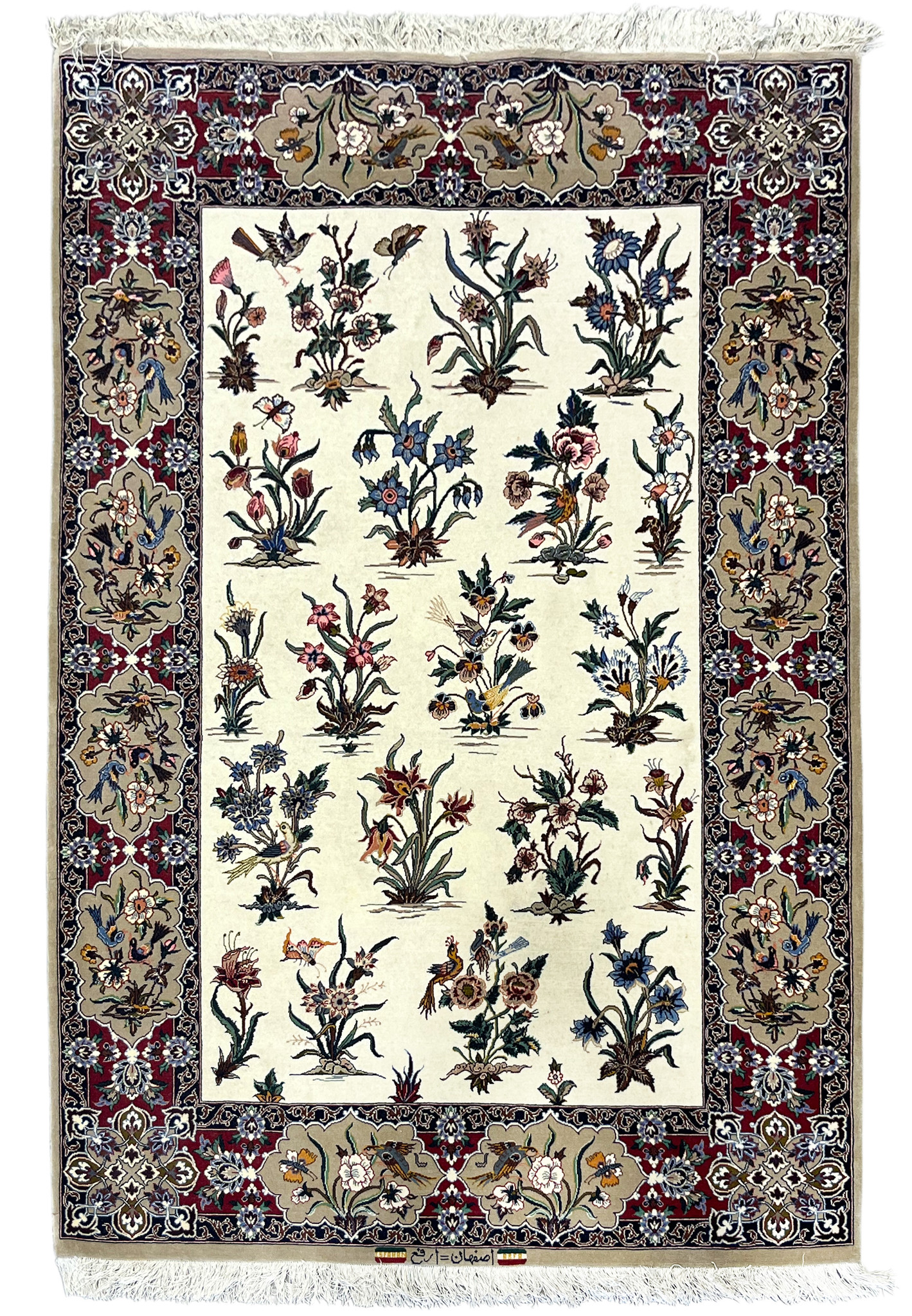
At roughly 700 knots per square inch on a silk foundation, this is a small rug carrying the construction of a museum piece. Every plant in the field is drawn individually, no repeat, no mirroring, each one with its own species of blossom, its own leaf shape and its own little patch of ground. That only works at this knot count, and it is why the birds read as recognizable birds rather than as symbols. The pile is wool and silk with heavy silk highlighting through the petals and wings, so the field lights up in sections as you move around it. It is signed at the lower end and has never been used. Certificate of authenticity included.
Design and Motifs
The field is Gol-o-Bolbol, flower and nightingale, laid out as roughly 20 separate flowering plants standing on a plain ivory ground with no medallion and no connecting vine. Tulips, cornflowers, irises, narcissus, pansies, roses and lilies each stand on their own, with songbirds perched among the stems and butterflies crossing the open space between them. The border is where this rug departs from the standard Isfahan formula: instead of a palmette-and-vine repeat it runs a row of scalloped taupe cartouches on a red ground, and each cartouche holds a pair of confronted birds with white blossoms and a gold butterfly, so the border carries the same subject as the field. Red panels with blue rosettes separate the cartouches, and the whole band is framed by navy guards of fine brown scrollwork. Corner cartouches finish it with a lobed rosette instead of a truncated repeat.
The Color
A plain ivory ground is the hardest choice a weaver can make, because there is nowhere to hide a weak color. Here the ivory is warm and even, and every plant sits on it as a distinct little painting: cobalt and pale blue in the cornflowers and irises, rose and pink in the tulips and peonies, deep red and salmon in the lilies, sage and forest green through the foliage, brown at every root. The birds bring gold, slate blue and rust. The border reverses everything, going dense and dark with madder red, taupe and navy, which frames the light field and gives the rug its weight at the edges. Silk sits in the highlights rather than across whole motifs, so the sheen appears in flashes, on a petal edge, a wing, a curling leaf tip, and then disappears as you shift position.
Isfahan and the Arfa Signature
Isfahan has been a court weaving center since the Safavid workshops of the 16th century, and the city's modern reputation rests on drawing rather than on pattern: the true curve, the flowing line, the accuracy that only holds together above 500 knots per square inch. Gol-o-Bolbol is the design where that skill is most exposed, since a bird drawn badly is obvious to anyone while a badly drawn palmette hides inside the repeat. The lower end panel carries the workshop cartouche flanked by the name in Latin letters, which in Isfahan practice signals a piece the atelier was willing to put its name on. If you want the background on how the city's grades separate, our complete guide to Isfahan rugs covers it, and the rest of our 4x6 Persian rugs sit alongside this one.


