
| Exact Size in ft: | Width: 9'10" x Length: 9'10" |
| Size in Inch: | Width: 118" x Length: 118" |
| Size in meters: | Length: 3.00m x Width: 3.00m |
| Some of many colors: | Ivory, ruby red, navy blue, sky blue, salmon pink, sage green, midnight blue, gold, dusty rose, charcoal |
| Shape: | Square |
| Woven: | Hand-Knotted | Handmade |
| Foundation: | 100% Silk |
| Pile: | Kork Wool and Silk |
| KPSI: | Approximately 700 KPSI |
| Origin: | Persian Isfahan | Signed Ahmad Zojaji |
| Condition: | Excellent | Never Used |
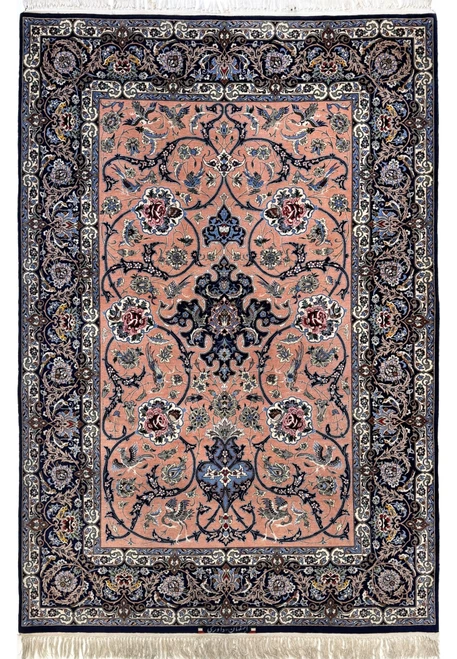
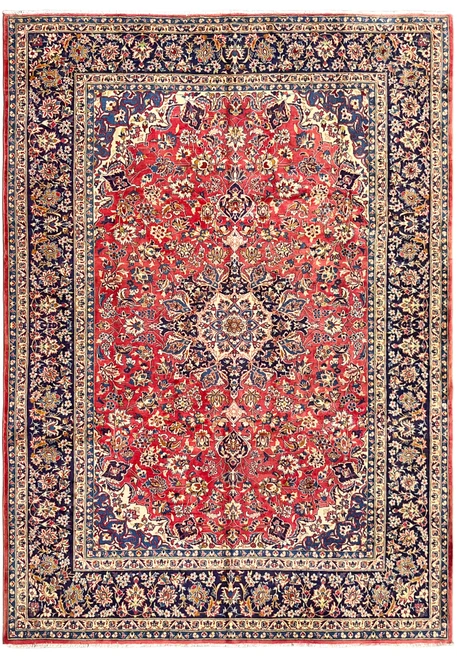
10x10 Square Persian Isfahan Rug | Signed Ahmad Zojaji | Star Medallion with Bird and Floral Field | 700 KPSI
A 9'10 by 9'10 signed Ahmad Zojaji Isfahan is the kind of rug a serious collector waits years for. Square format Isfahans of this size are rarely woven because the loom setup, the pattern symmetry, and the sheer time investment make them economically impractical for most ateliers, which is why nearly every Isfahan you encounter on the market is rectangular. To weave a square Isfahan at 700 KPSI, with a fully resolved Safavid-revival central medallion that reads correctly from all four sides of the rug rather than just two, the master has to redraw the cartoon from scratch and reset the geometry of the entire composition. This is a piece that solves all of those problems and does it on a 100% silk foundation, with kork wool (the softest neck and underbelly fibers of young Persian sheep) used for the main pile and pure silk used for the highlight knots that catch and reflect light. For background on this weaving tradition and what separates true Isfahan from its imitators, see our complete guide to Isfahan rugs.
Design and Motifs
The composition is a classical Safavid-revival central medallion design adapted for the unusual square format, and every element of the layout is mirrored four ways rather than the usual two. At the geometric center of the rug sits a small but intensely detailed eight-point star medallion, drawn in cobalt and sky blue with gold and ivory accents, anchored by a tiny rosette at the very middle. Radiating out from this center is a much larger sixteen-point star, rendered in deep ruby red and outlined in midnight navy, which forms the primary medallion of the field. Around this primary star, four secondary star satellites in matching ruby red sit at the cardinal points (top, bottom, left, right of the medallion), with four smaller salmon-pink star satellites filling the diagonal corners between them. The result is a stylized rosette, or shamsa, that reads as a single luminous star burst against the ivory ground when you stand back, and as a constellation of individual stars when you step closer. The ivory field surrounding the medallion is filled with classical Shah Abbasi palmettes, lotus blossoms, lanceolate sickle leaves, twisting cloud bands, and trailing arabesque vines. Woven into this field, half-hidden among the foliage, are dozens of birds: parrots, songbirds, doves, and nightingales rendered in soft grey, pale blue, salmon, and ivory, perched on vines or in mid-flight, which is the unmistakable signature of the finest Isfahan masters. The main border carries large floral cartouches and rosettes alternating with bird and flower vignettes on a deep ruby red ground, flanked on both sides by paired narrow guard borders carrying ivory floral meanders on midnight navy.
Colors and Placement
The palette is a textbook Isfahan formal palette, balanced and confident, built around three dominant colors that interlock perfectly. The field reads as a warm cream ivory, the kind of off-white that has subtle peach and parchment undertones rather than a flat bleached white, which is what allows the rest of the colors to sit on it without competing. The medallion ground and the main border ground are both rendered in a deep ruby red, the classic Isfahan red that pulls toward burgundy in shadow and toward true crimson in direct light. The third dominant color is navy blue, which appears in two registers: a deep midnight navy used for outlines and the corner-pendants of the secondary medallions, and a softer cobalt and sky blue used for the central star, the bird plumage, and the floral palmette interiors. The accent colors are equally considered and run through the entire field in small doses: salmon pink for the satellite stars and rose petals, sage and olive green for leaves and stems, dusty rose for flower hearts, gold and mustard for the central rosette and select palmette centers, charcoal for outlines and shadow lines, and pure white silk for the highlight knots that catch the light. In a formal living room, dining room, library, or grand foyer, this rug becomes the geometric anchor of the room, particularly under a square table, a round table, or a chandelier where the central star aligns with the architectural center. Square format also lends itself to gallery hanging, and an Isfahan of this caliber displayed on a wall reads as a tapestry rather than a textile, with the silk highlight knots catching directional light and shifting the perceived color of the medallion from cool to warm as the day moves.
Origin and Construction
Isfahan (also spelled Esfahan or Ispahan) was the imperial capital of Safavid Persia in the 16th and 17th centuries, and the rug-weaving tradition that emerged there during that period is the reference standard against which all other classical Persian rugs are measured. The modern Isfahan revival, which began in the 1920s and continues today, is built around a small number of master ateliers who weave to museum specifications, and Ahmad Zojaji is one of the recognized names among that group. The foundation here is 100% silk, both warp and weft, which is essential at this knot density because silk can be spun thinner than cotton without losing tensile strength, allowing the master to pack approximately 700 knots into every square inch. The pile is kork wool, which refers specifically to the softest, finest, and shortest wool fibers taken from the neck and underbelly of young Persian sheep during their first or second shearing. Kork has a natural luster that approaches silk and a softness that makes it the wool of choice for ultra-fine Isfahan weaving. Pure silk is used as a highlight fiber on selected motifs (the bird plumage, the central rosette, the highlight outlines on palmettes), which is why certain elements of the design appear to glow or shift color as you move around the rug. The Zojaji signature in the lower border is woven into the rug itself, not added after, and reads in Farsi as Iran, Esfahan, Ahmad Zojaji. The condition is as it left the loom, with full pile, full silk fringes that taper into the foundation rather than being sewn on, and no wear, sun fade, or repair anywhere on the piece. To understand exactly how kork wool and silk highlights interact in a fine Isfahan, see our deep dive on handmade rug materials.