Wool, Silk, or Both? The Complete Guide to Handmade Rug Materials
Posted by Rugs.net on Apr 19th 2026
When you look at a handmade Persian or oriental rug, you are looking at the result of dozens of individual decisions made before a single knot was tied. What fiber to use for the foundation. What fiber to use for the pile. Whether to introduce silk highlights into a wool pile, or to weave the entire surface in pure silk. Whether the foundation should be cotton or silk or wool.
These are not decorative decisions. They are structural and technical decisions that determine what the rug can do: how dense the knotting can be, how fine the design resolution can achieve, how the surface catches and reflects light, how long the rug will last, and what it will feel like underfoot. Every material choice is a trade-off, and understanding those trade-offs is the difference between buying a rug and understanding what you are buying.
This guide covers every layer: the foundation, the pile, and the relationship between wool and silk in fine rug production. We have organized it in the order a rug is built, from the ground up.
The Foundation: What the Rug Is Built On
The foundation of a handmade rug is the structural skeleton onto which the knots are tied. It consists of two sets of threads: the warps, which run vertically along the length of the rug and are the threads the knots are actually tied around, and the wefts, which run horizontally and are beaten down between each row of knots to lock them in place. The foundation is invisible in a finished rug, but it determines almost everything about the rug’s structural character.
Three materials are used for foundations in handmade rug production: cotton, silk, and wool. Each serves a different purpose and appears in specific rug types for specific reasons.
Cotton Foundation: The Standard for Fine City Rugs
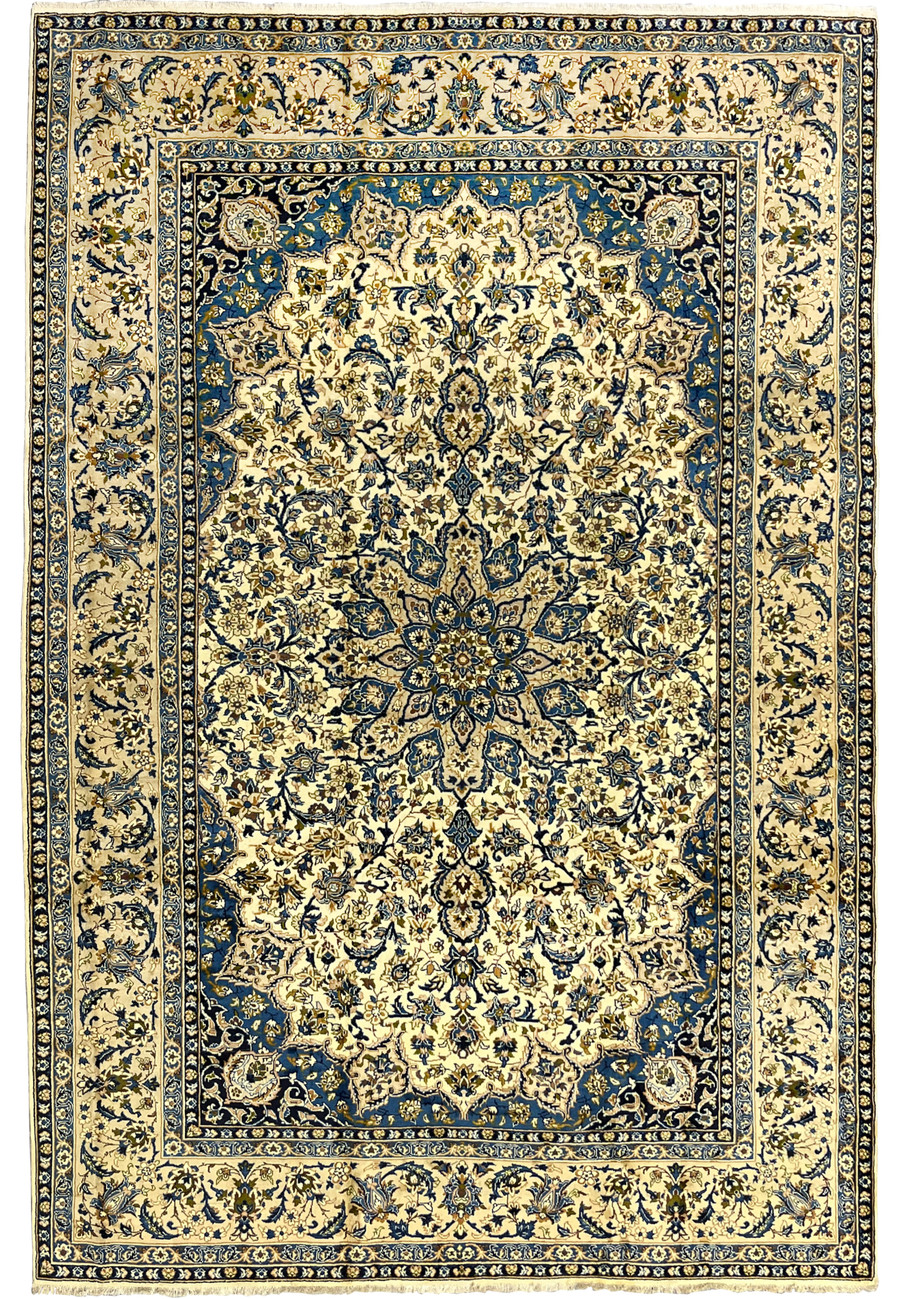
10'2 x 14'3 Persian Kashan Rug. The cotton foundation of this Kashan does not stretch under tension. This dimensional stability is why cotton became the standard foundation material for the great Persian city rug workshops.
Cotton became the dominant foundation material for fine Persian city rugs in the 19th century, and for a reason that is entirely practical: cotton does not stretch. When a rug is woven under high tension on a vertical loom, the foundation threads must remain dimensionally stable or the resulting rug will be distorted. Wool stretches under load and then relaxes when the tension is released, making it difficult to maintain the precise geometric consistency required for dense, formal city rug designs. Cotton maintains its dimensions under tension and releases cleanly from the loom.
The dimensional stability of a cotton foundation also means the rug lies flat on the floor after washing. Wool foundations can curl or ripple if the rug gets wet and the foundation threads absorb moisture unevenly. Cotton foundations dry evenly and return to their original flat geometry.
Almost every major Persian city rug uses a cotton foundation: Kashan, Isfahan, Tabriz, Mashad, Nain, Sarough. For a buyer, a cotton foundation is a sign of workshop production and formal design intent.
How to identify a cotton foundation: Flip the rug over and look at the warp threads visible at the fringe ends. Cotton is white or off-white, has no natural crimp, and feels smooth and slightly stiff. Wool warp threads are thicker, have visible fiber texture, and feel softer.
Wool Foundation: The Tribal and Village Tradition
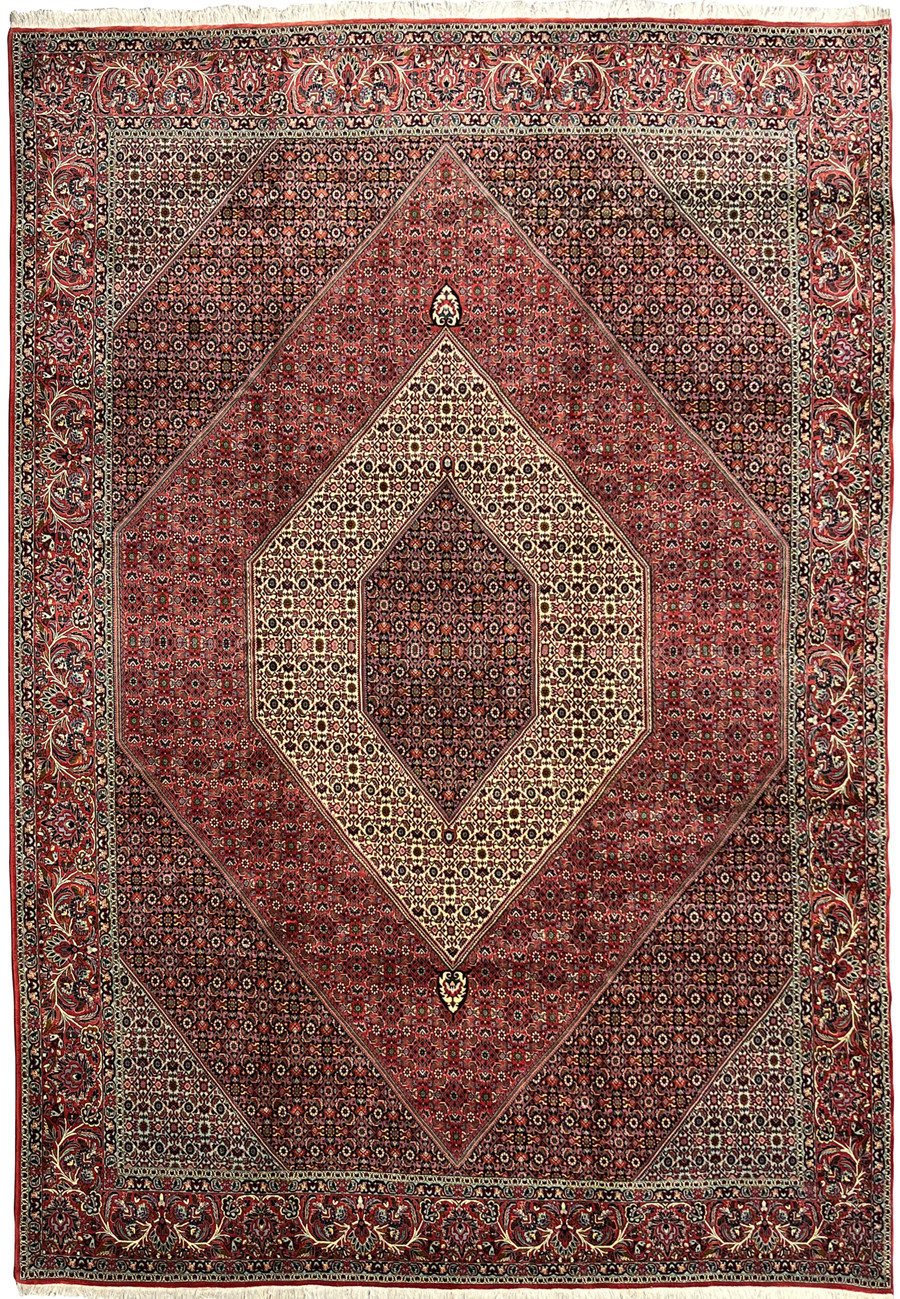
9'8 x 13'7 Persian Bijar Iron Rug. The Bijar rug uses a wool foundation and the unique wet-beating technique: water is applied to the weft threads before beating, swelling the wool fibers so they compress to a density that creates the legendary iron structure. Only possible with a wool foundation.
Tribal and village weavers traditionally used wool for everything, including the foundation, because it was what they produced and had available. Nomadic weavers could not transport the quantities of cotton that a fixed workshop might stock. The wool foundation is the mark of a tribal or village rug, and it gives these pieces a different physical character from their city rug counterparts.
A wool foundation gives the rug a certain softness underfoot that a cotton foundation does not, and it gives tribal rugs their characteristically flexible, almost spongy feel when you pick them up and bend them. This flexibility is a quality in its own right in certain interior contexts, particularly for rugs used on stone or tile floors where a degree of cushion is welcome.
The Bijar rug is the great exception in wool foundation construction. Bijar uses a wool foundation but applies the wet-beating technique, soaking the wool weft threads with water before beating them down so they expand and lock into a compressed density that is actually harder and more rigid than a cotton foundation. This is the technical basis for the Bijar’s reputation as the Iron Rug of Persia.
Silk Foundation: The Platform for Maximum Density
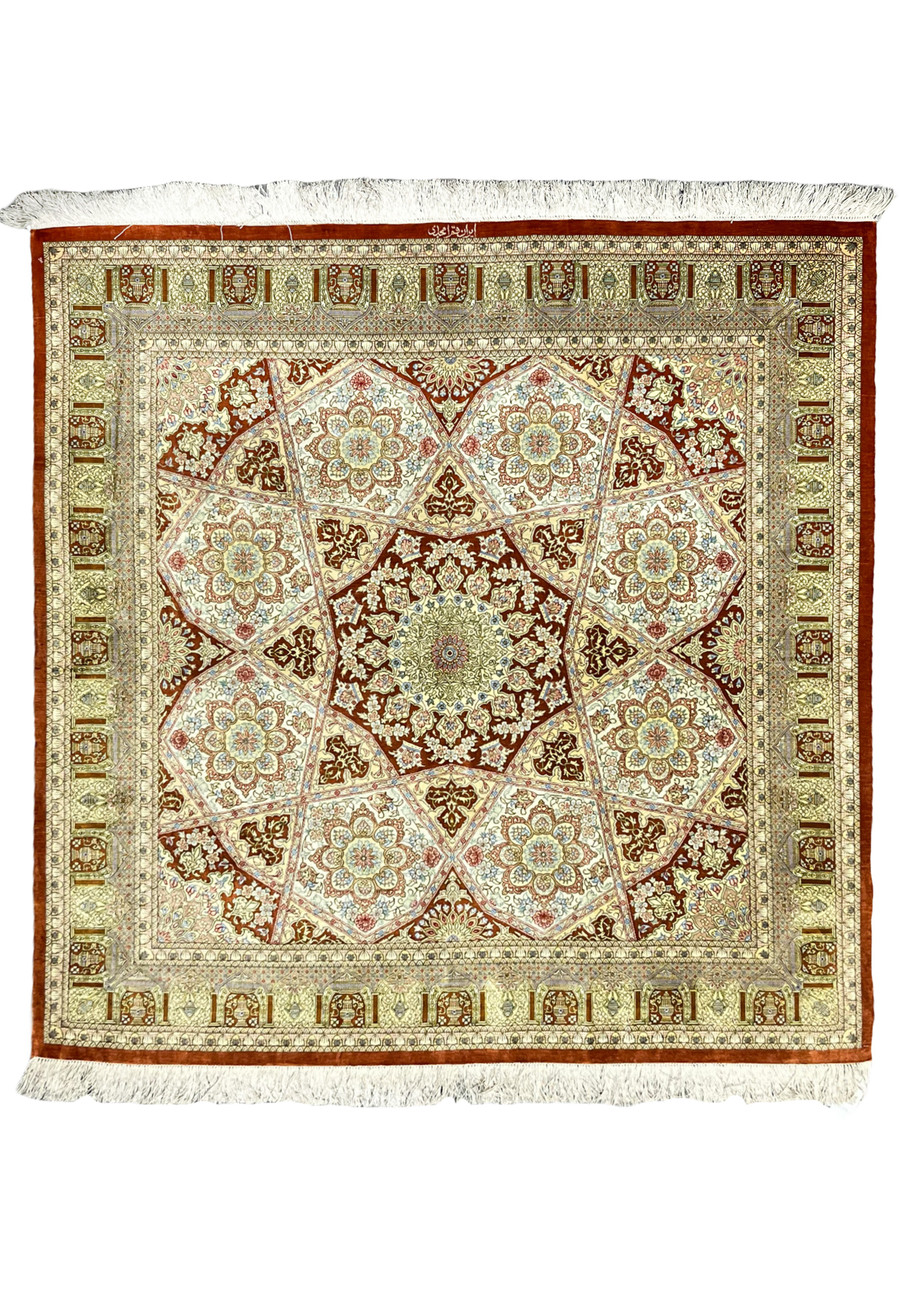
5 x 5 Signed Amjadi Persian Qum Silk on Silk, 1000 KPSI. When both foundation and pile are silk, knot densities of 800 to 1000 KPSI become achievable. A cotton foundation could not support warp threads fine enough to allow this density.
A silk foundation exists for one reason: it allows knot densities that no other foundation material can support. Silk warp threads can be made finer than cotton threads while maintaining the tensile strength required to hold thousands of knots under loom tension. The thinner the warp thread, the more warp threads can fit per inch, and the more knots per inch become possible.
This is why the finest Persian Qum silk rugs reach 800 to 1000 KPSI. A cotton foundation would limit the achievable density to roughly 500 to 600 KPSI in the very finest work. The silk foundation pushes that ceiling dramatically higher.
The silk foundation also contributes to the luminous quality of a Qum silk rug. In a silk-on-silk piece, even the structural skeleton reflects light, giving the surface an almost three-dimensional depth. The rug appears to glow from within because the light is interacting not just with the pile surface but with the foundation threads between the pile tufts.
The Pile: Wool
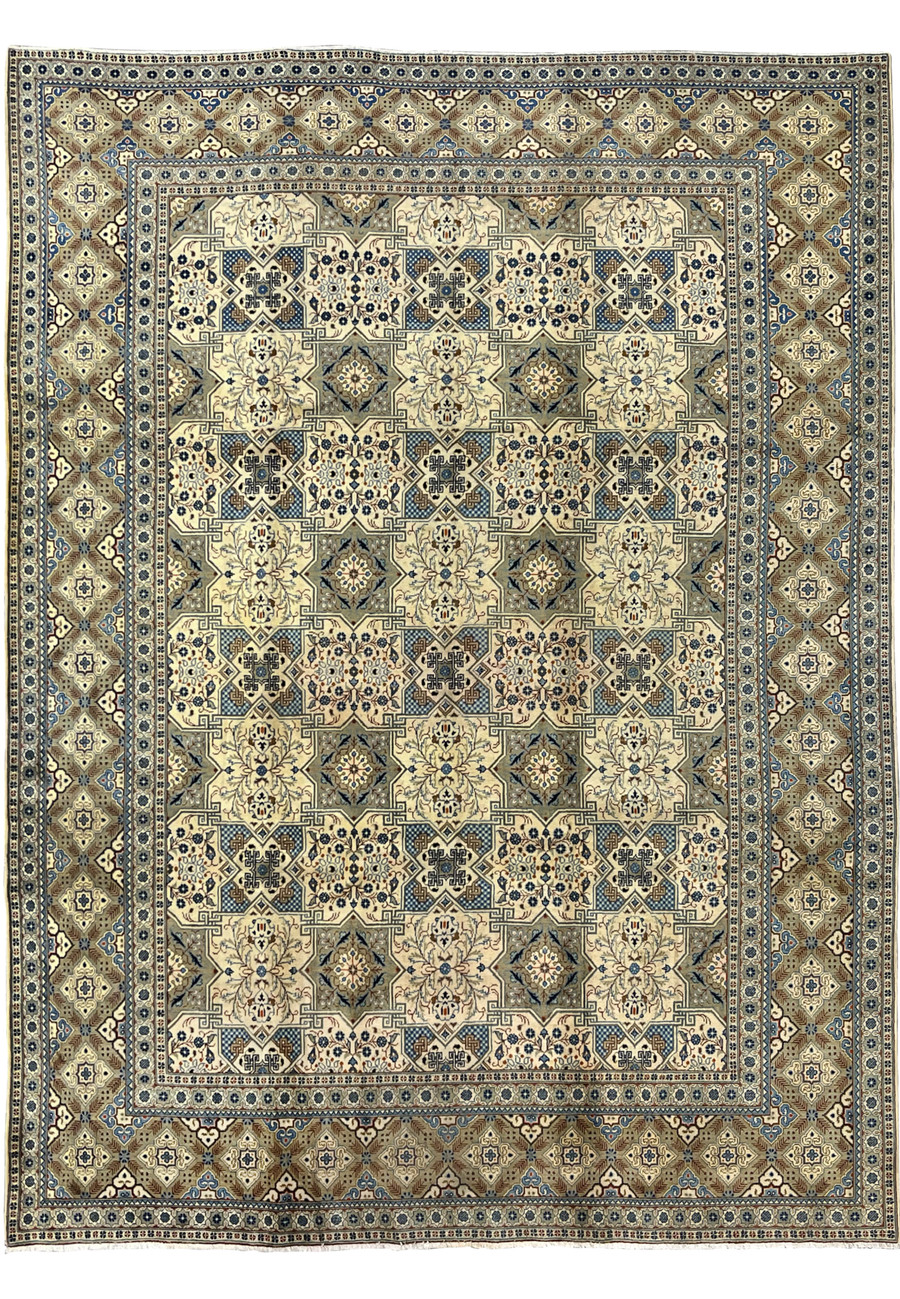
9'8 x 13 Persian Tabriz Rug, Kheshti Panel Design. A wool pile Tabriz on cotton foundation. The natural crimp in the wool fiber gives the pile its resilience: compress it and it springs back, year after year, decade after decade.
Wool is the default pile material for handmade rugs and has been for thousands of years. This is not simply tradition. Wool has a set of physical properties that make it the ideal floor covering material, properties that no synthetic fiber and no other natural fiber replicates in the same combination.
The most important property is crimp memory. Wool fiber has a natural wave structure, a microscopic crimp, that gives it the ability to compress under load and then spring back to its original shape when the load is removed. Walk across a wool rug every day for twenty years and the pile will still have depth and resilience. Compress a synthetic pile and it stays compressed.
The second critical property is natural lanolin content. Sheep’s wool contains lanolin, a waxy natural oil produced by the sheep’s skin, which coats each fiber and gives it natural resistance to moisture, soil, and stains. Lanolin is mildly repellent to liquid before it is absorbed, giving you time to blot a spill before it penetrates the pile. It also makes wool naturally resistant to dust mites and bacteria, which is why a well-maintained wool rug does not accumulate the same allergen load as synthetic carpet.
Not all wool is equal. The finest Persian rugs use kork wool, which is the soft undercoat fiber clipped from the neck and shoulder area of the sheep, the most delicate and lanolin-rich part of the fleece. Kork wool is finer, softer, and more lustrous than standard fleece wool. It takes dye more deeply and evenly. Under polarized light, kork wool has a subtle natural sheen that is one of the identifying characteristics of a fine Persian city rug.
Machine-spun wool, used in lower-grade production, is more uniform but loses much of the natural lanolin in the industrial processing. Hand-spun wool, used in traditional tribal production, retains more lanolin and has a slightly irregular texture that gives tribal rugs their characteristic organic surface quality. Both are wool, and both are vastly superior to synthetic pile, but they are not the same material in practice.
The Pile: Wool with Silk Highlights

7'2 x 10'8 Persian Tabriz Mahi Wool and Silk Rug, 50 Raj. The silk in this rug is woven selectively into the curvilinear detail areas of the Mahi (fish) pattern. Where the silk catches the light at an angle, those threads glow against the matte wool ground. This is exactly how silk highlights work.
The most common way silk appears in fine Persian city rugs is not as a pure silk pile but as selective silk highlights within a predominantly wool pile. This technique is used across the great weaving traditions: Tabriz, Isfahan, Nain, and Kashan. The weaver ties wool knots across most of the surface and reserves silk for specific areas where its optical properties serve a design purpose.
The optical property that silk is used for is directional lustre. Silk fiber reflects light differently depending on the angle of view. When silk threads are used selectively in the outline of a floral motif or the border of a medallion, those areas catch and reflect light in a way that makes them appear to glow or shift in brilliance as you move around the rug. This creates a visual dimensionality that a pure wool rug cannot achieve.
How does the weaver mix wool and silk in a single pile? In practice, each knot in the rug is a discrete unit tied around two warp threads. The weaver simply changes from a wool strand to a silk strand whenever the design calls for it. The two fibers are compatible in the knotting process since both are natural protein fibers that take dye well and tie around the warp in the same way. The transition between wool and silk in the pile is seamless in a well-executed piece.
In a Nain 6 LA, the silk highlights are so finely deployed that they are almost invisible in photographs but immediately apparent in person. The silk threads outline the arabesques and fill the finest interior details of the medallion design, giving the rug a surface that appears to be lit from within at certain angles. In a fine Isfahan, the silk may be used to pick out specific floral elements against the wool ground, creating a visual hierarchy in the design that the wool alone could not produce.

7'3 x 10'5 Persian Nain 6 LA Habibian Wool and Silk Rug. In the Nain 6 LA tradition, silk threads are woven into the finest detail areas of the arabesque and medallion at knot densities of 300 to 500 KPSI. The silk picks out the outlines and interior veining of each floral motif, creating a luminous shimmer that photographs cannot fully capture.
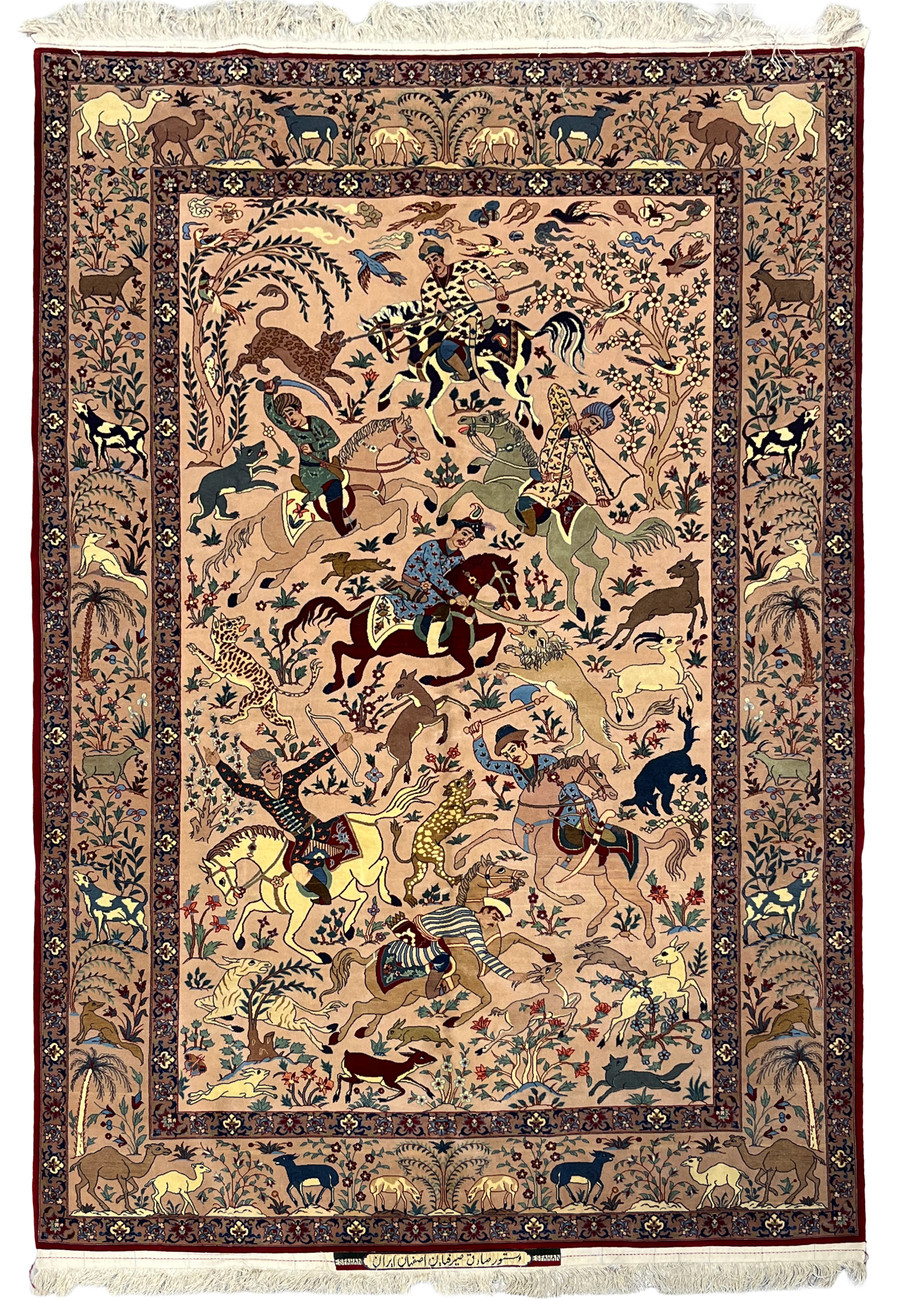
5x8 Persian Isfahan Signed Seirafian, Shikargah Hunting Scene, Wool and Silk. In this signed Seirafian hunting scene, silk renders the human figures, horses, and fine detail elements against a kork wool ground. The silk threads at this KPSI level can capture detail with a resolution comparable to a woven painting.
Why wool and silk together, rather than pure silk?
Pure silk pile is more fragile than wool and less suitable for floor use under heavy foot traffic. A wool-and-silk rug gives the structural durability of wool across the field while using silk selectively for its optical properties in detail areas. The result is a rug that is both visually extraordinary and practically durable. It is a genuinely superior combination, not a compromise.
The Pile: Pure Silk

4'4 x 6'6 Persian Qum Pure Silk Signed Kabiri, Navy and Rose Pink. Pure silk pile on silk foundation. The navy field and rose-pink border rendered in silk display a color depth and directional shimmer impossible in any other pile material. The rug appears to change color as you view it from different angles.
Pure silk pile is used almost exclusively in Persian Qum rugs and in certain high-end Chinese silk rugs. In the Persian tradition, Qum is the city that perfected pure silk rug production in the 20th century, pushing knot densities beyond what any other material or technique could achieve and producing pieces that exist at the intersection of textile and fine art.
Silk pile has properties that wool cannot replicate. The directional lustre of silk means the rug literally looks different from different angles and in different light. In the morning with raking light, one set of colors dominates. In the afternoon with diffuse light, the same rug reads entirely differently. This optical quality makes silk rugs living objects in a room in a way that wool rugs, however beautiful, are not.
Why Is Silk So Much More Expensive?
The raw material cost. Silk fiber is produced by the Bombyx mori silkworm, which must be carefully cultivated, fed exclusively on mulberry leaves, and harvested at precisely the right stage of cocoon development. Each cocoon produces approximately 300 to 900 meters of usable silk filament. A kilogram of silk requires roughly 5,500 silkworm cocoons. The production cost per kilogram of raw silk is many times that of equivalent-quality wool.
The weaving difficulty. Silk is more difficult to work with than wool in almost every technical respect. It is slippery, which makes the knotting process more demanding. It requires greater tension control during weaving or the knots will not pack evenly. The fiber is less forgiving of errors because corrections in a silk pile are more visible than in wool. And the time required at 800 to 1000 KPSI is two to four times what a wool rug of equivalent size requires at its typical knot density.
The skill required. Silk weaving at collector densities requires a level of technical skill that takes years to develop. Very few weavers in Qum can execute 1000 KPSI work at the quality level that produces a signed piece. The scarcity of this skill is itself a cost factor.
Pure silk pile is not more durable than wool pile for floor use. It is more fragile and more sensitive to foot traffic, which is why many Qum silk rugs are displayed on walls or in low-traffic areas rather than in high-use corridors. The extraordinary value of a Qum silk rug is its optical and artistic quality, not its durability. For durability under heavy traffic, a Persian Bijar in kork wool will outlast a silk rug by decades. For visual magnificence, nothing competes with silk.
Material Combinations: What Each Means in Practice
Here is how the combinations found in fine handmade rugs compare across the key practical dimensions:
| Material Combination | Max KPSI | Durability | Lustre | Typical Rug Types |
|---|---|---|---|---|
| Wool / Wool | 40 to 200 | Excellent | Natural matte | Bijar, Hamedan, tribal |
| Cotton / Wool (kork) | 80 to 300 | Excellent | Soft sheen | Kashan, Tabriz, Mashad |
| Cotton / Wool + Silk highlights | 150 to 500 | Excellent | High — directional | Nain 6 LA, Isfahan |
| Silk / Pure Silk | 800 to 1000+ | Moderate | Maximum — luminous | Qum silk, collector pieces |
| Cotton / Pure Silk | 400 to 700 | Moderate | Very high | Fine Qum, Chinese silk |
Which is better? None is universally better. A Bijar in wool on wool is the most durable rug in the world. A Qum silk on silk is the most visually extraordinary. A cotton-foundation kork wool rug with silk highlights, such as a fine Nain 6 LA or signed Isfahan, combines the best properties of both: structural durability, visual luminosity, and maximum design resolution. The right choice depends entirely on where the rug will live and what you are asking it to do.
Is Silk More Difficult to Weave?
Yes, significantly. The difficulty operates on several levels simultaneously, and understanding them explains both the skill premium attached to signed silk work and the time it takes to produce a collector-grade piece.
Slippage. Silk is a smooth, continuous filament with no crimp or texture to grip against itself or the foundation threads. A wool knot, once placed, tends to stay in position. A silk knot requires more precise technique to ensure it seats correctly against the previous row and does not slip or shift before the weft is beaten down. Experienced weavers develop a specific hand pressure and knotting motion for silk that takes years to master.
Tension sensitivity. At 800 to 1000 KPSI, the warp threads are packed so densely that any variation in tension creates visible unevenness in the pile surface. The weaver must maintain almost perfectly consistent hand pressure across thousands of consecutive knots. A slight variation that would be invisible in a 150 KPSI wool rug is plainly visible at 900 KPSI in silk.
Speed. At 1000 KPSI the weaver ties more than three times as many knots per square foot as in a standard 300 KPSI city rug. A skilled Qum weaver working full-time can tie approximately 8,000 to 10,000 silk knots per day at this density. At that rate, a 3 x 5 rug containing over 20 million knots takes approximately six to eight years to complete. This is the single most significant reason why collector-grade Qum silks are as rare as they are.
Design complexity. The design cartoons used for high-density silk work must be drawn at a level of detail that matches the potential resolution of the pile. The floral patterns, hunting scenes, and figural compositions used in fine Qum silk production are among the most complex designs in the entire history of textile art. The weaver must translate these designs into individual knot choices, one at a time, without error.
Scarcity of skill. Very few weavers in Qum can execute 1000 KPSI work at the quality level required for signed production. The skills are transmitted across generations within specific families and workshops. The combination of this skill, the time involved, and the material cost is why collector-grade signed Qum silk rugs are genuinely difficult to find at any price point.
Which Material Is Right for Your Space?
High-traffic areas, entry halls, family rooms, dining rooms: Wool pile on cotton or wool foundation. A Bijar or Hamedan for the very highest traffic. A Kashan or Tabriz in kork wool for medium-traffic formal spaces. Wool withstands daily use for generations.
Formal living rooms, master bedrooms, studies: Wool with silk highlights. A Nain 6 LA or signed Isfahan gives maximum visual quality under moderate traffic, with the silk highlights creating extraordinary luminosity in natural light.
Low-traffic formal rooms, wall display, collector use: Pure silk Qum. The visual quality is incomparable. Protect from heavy foot traffic and direct sunlight, which will fade silk pile over decades.
Investment and heirloom pieces: A signed silk Qum or signed kork wool Isfahan or Nain from an established workshop. These pieces combine rarity, provenance, and material quality in a way that creates genuine long-term value. They will be worth more, not less, in twenty years.
Shop by Material at Rugs.net
Every rug at Rugs.net is accurately described. We state the foundation material, pile material, and KPSI for every piece. Free shipping to all 50 states, free returns, ships within 24 hours.
Silk foundation, pure silk pile. 800 to 1000 KPSI. Signed collector pieces.
Cotton foundation, kork wool and silk pile. 300 to 500 KPSI. The finest wool-silk combination.
Cotton foundation, kork wool pile with silk highlights. Warm ivory tones. Workshop precision.
Cotton foundation, kork wool pile. Classic crimson and navy. 100 to 200 KPSI. Outstanding durability.
Cotton foundation, wool and silk pile. Available from 50 Raj (150 KPSI) to fine 60 Raj (200+ KPSI).
Wool foundation, kork wool pile. Wet-beaten. The most durable handmade rug in the world. 100+ year lifespan.
Also: Mashad, Sarough, Hamedan, Gholtogh, Baluch, Oriental rugs, all rugs, clearance.