
| Size in ft: | Width: 5'4" x Length: 8' |
| Size in Inch: | Width: 64" x Length: 96" |
| Size in meters: | Length: 2.44m x Width: 1.63 m |
| Colors: | Hunter green, red, ivory, sky blue, navy, camel, olive, salmon |
| Shape: | |
| Woven: | 100% Hand-knotted | Handmade |
| Foundation: | |
| Pile: | |
| KPSI: | |
| Signature: | Seirafian | Isfahan |
| Origin: | |
| Condition: | Excellent | Never used |
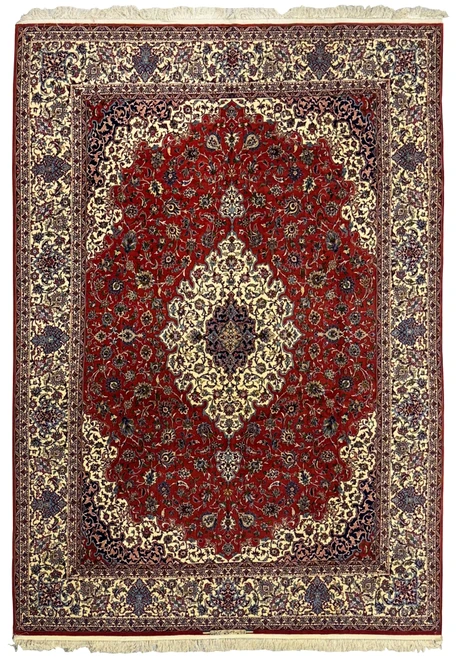
5'4" x 8' Persian Isfahan Rug | Hunter Green Field | Signed Seirafian | Kork Wool and Silk | 600 KPSI
This is the combination Isfahan collectors actually chase: a silk foundation, a kork wool and silk pile, roughly 600 knots to the square inch, and a signed end panel. The silk warps let the weaver draw a curve rather than approximate one, and you can see the payoff anywhere the vine turns back on itself, where the line stays smooth instead of stepping. The kork wool carries the matte body of the drawing while the silk lights up the highlights, so the surface changes character depending on where you stand. It has never been used, the pile is full, and it comes with a certificate of authenticity.
Please Note About the Color in the Photographs:
The field is a deep hunter green. At full-rug distance it photographs almost black, which is normal for a green this saturated under studio lighting. Look at the closeup images and the green reads clearly, warm and forest-toned, exactly as it appears in daylight in the room.
Design and Motifs
The center holds a starburst medallion on ivory, ringed by 16 points and finished with a small navy and red rosette at the exact middle. Ivory anchor pendants run north and south of it, each ending in a red cartouche with a spray of palmettes. Around all of that the green field carries a continuous vine system, thin ivory stems looping in wide arcs and throwing off Shah Abbas palmettes, cypress-like leaf clusters, lotus heads and clusters of small red blossoms, all mirrored perfectly across both axes. The corner spandrels turn ivory with cobalt cloudbands, which is what gives the rug its bright frame. The main border runs a clear red ground with alternating blue and ivory palmette groups, held between narrow guard stripes of navy and ivory meander. The bottom end panel carries the signature cartouche flanked by the workshop name in Latin letters.
The Color
Hunter green is the rare Isfahan ground, far less common than the usual ivory or red, and it is the reason this rug looks different from everything else in the category. The green is deep and slightly warm, closer to pine than to emerald, and it sits under the pattern rather than competing with it. Against it the palette is classic Isfahan: a clean madder red in the border and the pendants, ivory doing all the outlining and the spandrel work, two distinct blues (a bright cobalt for the leaf forms and a darker navy for the shading), plus camel, olive, dusty grey and a soft salmon that appears in the palmette centers. The kork wool takes dye with a slight depth that ordinary wool does not, which is why the green reads solid at close range and never patchy.
Isfahan and the Seirafian Signature
Isfahan in central Persia has been a court weaving center since the Safavid workshops of the 16th century, and its modern reputation rests almost entirely on drawing: the flowing vine, the true curve, the precision of a line that only holds together at a high knot count. Seirafian is the single most recognized workshop name to come out of the city in the modern era, and a Seirafian cartouche has long been treated as a mark of top-tier construction rather than a decorative flourish. Everything in this piece supports the claim, the silk warps, the kork and silk pile, the symmetry that holds across all 4 quadrants. Our full guide to Isfahan rugs explains how the grades separate and what to look for on the back.