Not all wool is equal. Run your hand across an ordinary wool rug and then across a fine kork one, and you feel the difference instantly: the kork is softer, cooler, and carries a faint glow that ordinary wool simply does not have. Kork is the finest wool used in Persian weaving, and for many of the most beautiful wool rugs in the world it is the reason they are beautiful.
What is kork wool?
Kork, sometimes spelled kurk, is the softest and finest grade of sheep's wool. It is not the coarse fleece from the animal's back that makes up most commercial wool. Instead it comes from the soft undercoat of young sheep and lambs, taken from the gentlest areas such as the neck, shoulders, and underbelly, and gathered mainly from the first spring shearing. Only a small amount of this fine wool comes from each animal, which is the first reason it is precious.
The fibers themselves are long, fine, and soft, with a natural luster. Once cleaned, sorted, and spun, kork yarn is smoother and thinner than standard wool and carries a gentle sheen that catches the light. It also takes natural dye exceptionally well, which is why kork rugs tend to show such deep, luminous color.

A Persian Qum in kork wool. The soft, lustrous pile is what gives the color its glow.
Why kork wool is used in rugs
Kork brings together three things a weaver wants and rarely gets all at once: softness, sheen, and strength. It feels wonderful underfoot, it glows with a silk-like luster that lifts every color, and despite that softness it is durable and resilient. Ordinary wool gives you durability. Silk gives you sheen. Kork sits beautifully between them, a wool with much of silk's light and hand at a fraction of silk's fragility.
There is a technical payoff too. Because kork is fine and can be spun thin, weavers can tie more knots per square inch with it than with coarse wool, which means crisper detail and higher-quality drawing. You can read more about that in our guide to knots per square inch. This is why kork is the wool of choice in the fine city workshops rather than in rugged tribal weaving.
Why kork makes a rug more valuable
The value follows naturally from the rarity and the work. Each animal yields only a little of this fine undercoat, so the raw material is limited and costlier from the start. It then has to be carefully sorted by hand and finely hand-spun to keep the yarn even, an extra layer of skilled labor before weaving even begins. And because kork is used for finely knotted rugs, the weaving itself takes far longer than a coarse wool rug of the same size.
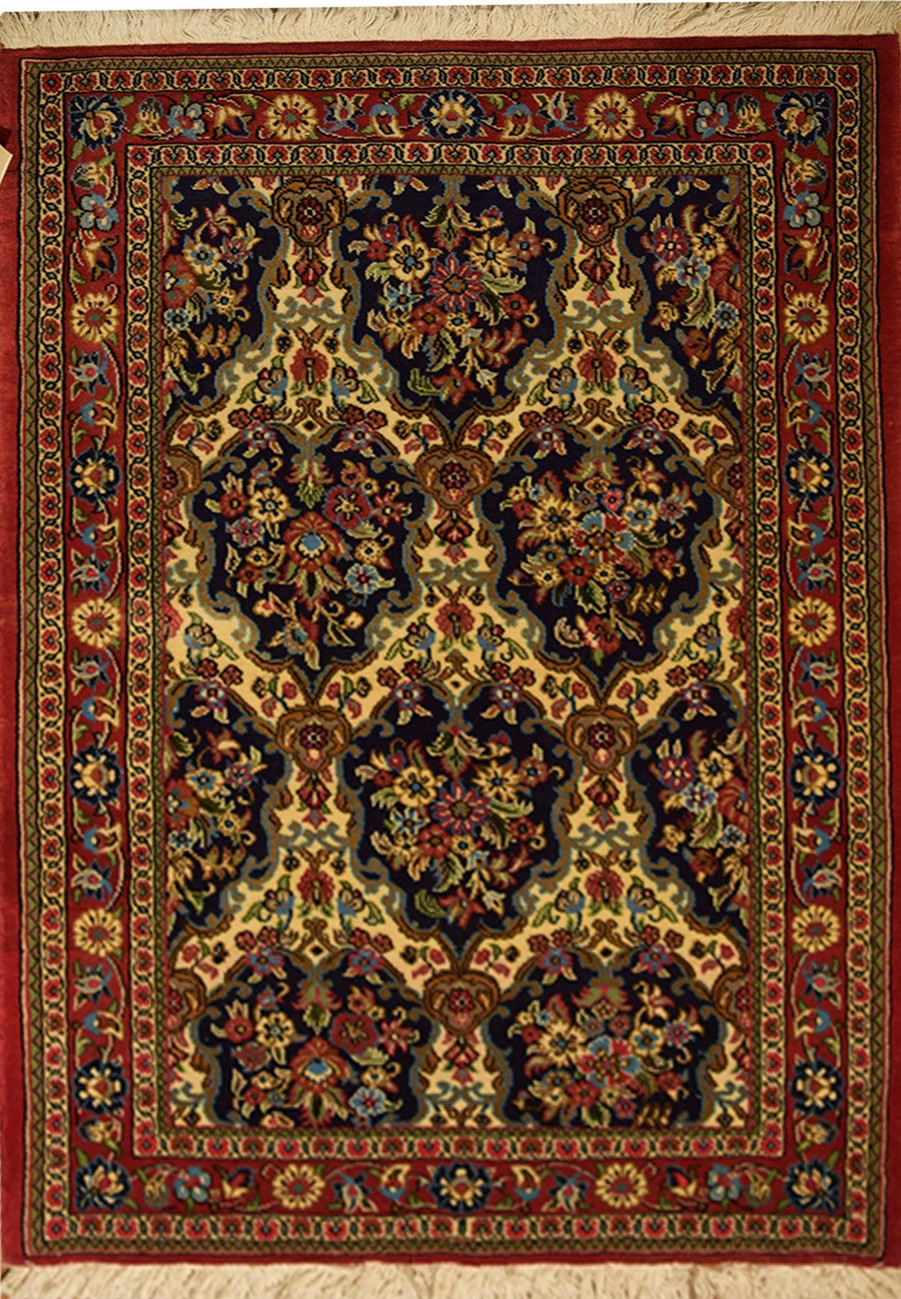
A small floral Persian Qum Kork. Even at accent size, the fineness and glow of kork are unmistakable.
Add it all together, rarer material, extra hand-processing, and slower fine weaving, and a kork rug costs more for the same reasons any handmade luxury costs more: there is simply more rarity and more skilled human hours inside it. It also holds its value well, because that quality is permanent.
How difficult is it to weave with kork?
More difficult than it looks, in two ways. First, the yarn itself is demanding. Fine kork has to be spun thin and perfectly even, because any irregularity shows immediately in a finely knotted rug, so the spinning alone is expert work. Second, kork is chosen precisely for high-knot-count rugs, and tying hundreds of tiny knots per square inch by hand is slow, exacting work that only experienced weavers do well. A coarse wool rug forgives a small mistake; a fine kork rug shows everything. That is exactly why kork weaving is left to master workshops, and why a well-made kork rug is a genuine display of skill.
Why kork so often comes with silk
If you shop for kork rugs, you will keep seeing the words kork and silk together, and there is a good reason. The two fine fibers are natural partners. Weavers use silk in a kork rug in a few ways: as bright highlights woven into key flowers, medallions, and vines so those motifs catch the light and shimmer against the softer kork ground; or with a silk foundation beneath the kork pile, which lets the rug be woven even finer.

A Persian Qum in kork and silk. The silk highlights make the medallion and florals glow against the soft kork field.
The effect is a rug with two kinds of light: the soft, even glow of the kork and the sharp brilliance of the silk where the design needs it most. Because both fibers are fine and luxurious, they belong to the same tier of weaving, so the pairing is common in the finest workshops. To go deeper on the silk side, see our guide to Persian and Oriental silk rugs, and on the layers beneath the pile, our guide to the rug foundation.
Think of kork as the soft, glowing body of the rug and silk as the spark. Together they give you the warmth of wool and the light of silk in one weave.
Where kork rugs come from
Kork is the signature of the fine Persian weaving cities. Qum is the most famous name in kork, celebrated for kork and kork-and-silk rugs of jewel-like precision, and covered in depth in our complete guide to Qum rugs. Isfahan is renowned for kork wool and silk on a silk foundation, and Nain for delicate kork-and-silk in soft ivory and blue.

A fine Persian Mashad in kork wool. At this knot count the kork gives the ivory field an almost silk-like sheen.
Beyond Qum, the great workshop city of Mashad in northeastern Persia weaves superb kork rugs, using the soft wool to give its classic Mahi and floral designs a lustrous, luminous surface. Wherever it appears, kork marks a rug as belonging to the finer end of the wool tradition.
Explore kork rugs
Browse fine kork weaving in our Qum, Isfahan, and Mashad collections, or explore all our wool rugs and wool and silk rugs.
Every rug we sell is genuinely hand-knotted, ships free with a certificate of authenticity, and comes with free returns within 31 days to all 50 states. Want to feel the difference kork makes? Send a photo on chat, call us at (855) 576-7705, or reach us on WhatsApp, and our customers say it better than we can, five stars on Google, every single review.
Rugs.net Headquarter
371 South Main St.
Freeport, NY 11520
Phone and text: (855) 576-7705