Walk into any serious rug gallery and the room quietly organizes itself around one thing: the silk. A fine silk rug does not sit on the floor so much as glow above it, its color deepening and lifting as you move, its detail so fine it looks drawn rather than knotted. Silk rugs are the most valuable rugs in the world, and once you understand what goes into one, the price stops being surprising and starts making sense.
This guide walks through all of it: what silk actually is and where it comes from, why the material is so precious, how weavers achieve detail that seems impossible, why Persian silk rugs are considered the finest ever made, how they compare to Turkish silk, and how to protect yourself from the fakes that flood this part of the market.
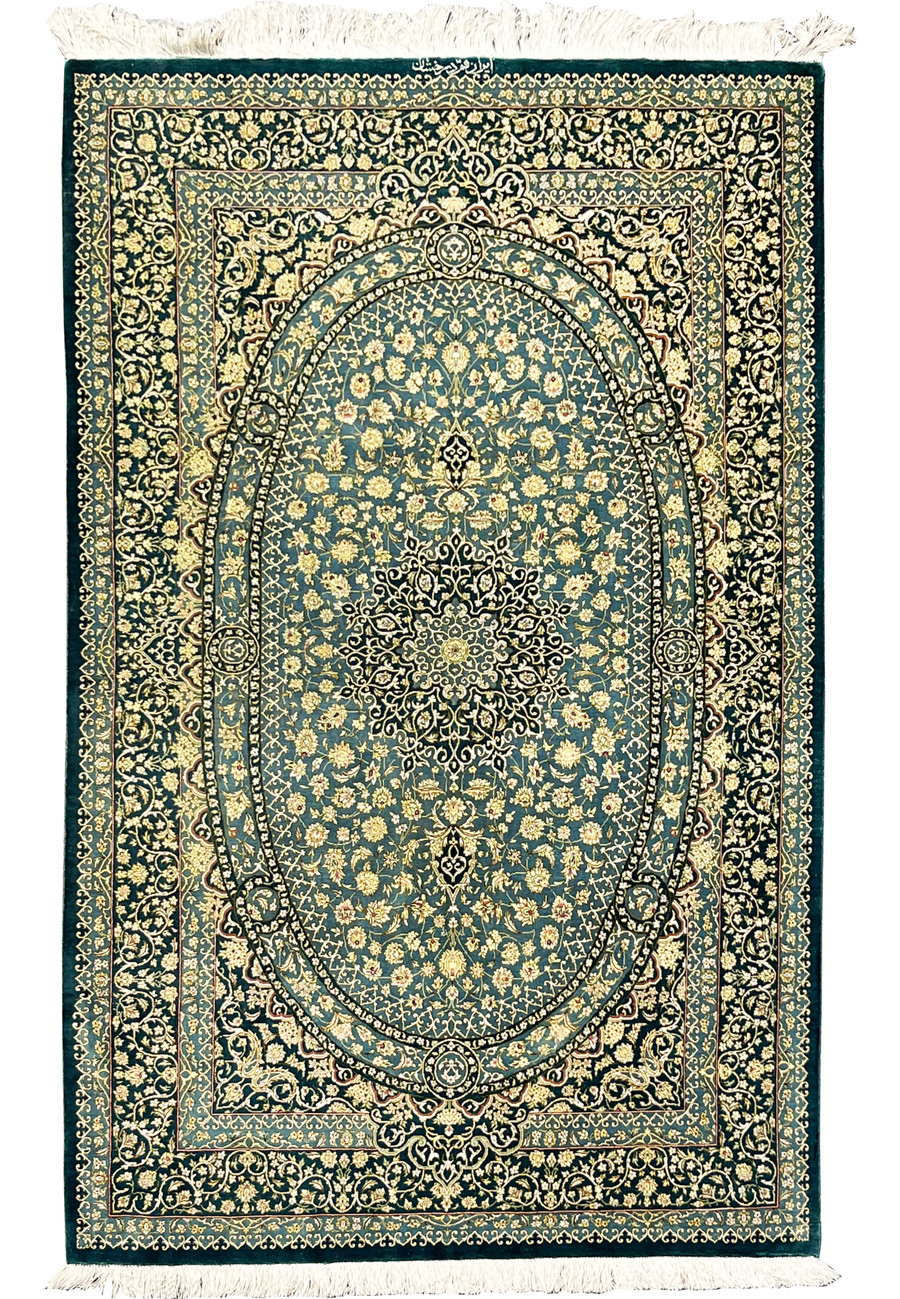
A Persian Qum in pure silk at 1,000 knots per square inch. This level of fineness is only possible in silk.
Where silk comes from, and how it is made
Silk is a natural protein fiber, and every strand of it begins with a caterpillar. The silkworm, the larva of the moth Bombyx mori, feeds on mulberry leaves and then spins a cocoon around itself from a single continuous filament of silk that it secretes from glands near its mouth. That one filament can run well over a thousand yards long, finer than a human hair and remarkably strong.
To turn cocoons into thread, they are gently heated in water to soften the natural gum that binds the filament, and then the filaments are found and unwound, a process called reeling. Because a single filament is too fine to use alone, several are reeled and twisted together into one usable thread. This is painstaking, and the yields are humbling: it takes thousands of cocoons to produce a single pound of usable silk. Sericulture, the raising of silkworms, traces back more than four thousand years to China, and the material was so precious it gave its name to the Silk Road.
So before a weaver has tied a single knot, the raw material has already passed through months of feeding, spinning, boiling, reeling, spinning again, and dyeing. That is the foundation of everything that follows.
Why silk is such a valuable material
Silk is expensive for reasons that have nothing to do with hype. It is labor-intensive at every stage, it cannot be rushed, and it cannot be fully mechanized without losing the very qualities that make it worth having. But its real value in a rug comes from three physical properties that no other fiber shares at once.
First, silk is astonishingly strong for its thinness, stronger than a steel filament of the same diameter, which lets it be spun into a very fine yet durable thread. Second, that thinness allows tiny knots, and tiny knots are the whole game in fine weaving. Third, silk fiber has a natural triangular cross-section that refracts light like a prism, which is why a silk rug seems to change color and brightness as you walk around it. Wool is warm and wonderful, but it cannot do that.
What makes silk rugs so fine
Fineness in a rug is measured in knots per square inch, and it is the single biggest driver of both detail and value. A good wool rug might have 100 to 200 knots per square inch. A fine silk rug routinely reaches 500 to 800, and the very best Qum and Isfahan silk rugs climb to 900 or even 1,000. You can read more in our guide to knots per square inch.
Why does silk get so much finer than wool? Because the thread is so much thinner, the weaver can pack far more knots into the same space, and each knot becomes a smaller, more precise dot of color. At a thousand knots per square inch, the design stops looking woven and starts looking painted. Curved lines flow smoothly, faces and flowers gain real expression, and a border can carry detail you almost need to lean in to read. That resolution is simply impossible in a coarser fiber.

A pictorial Qum in pure silk. At 900 knots per square inch the birds and foliage read like a painting.
How weavers create rugs this fine
The honest answer is time, skill, and eyesight, in enormous quantities. A master weaver works from a detailed pattern, tying each individual knot by hand around pairs of warp threads stretched on the loom, then beating each row down tight before starting the next. On a fine silk rug the knots are so small that a skilled weaver may complete only a few thousand in a day, which sounds like a lot until you realize a modest silk rug can contain many millions of them.
A single fine silk rug can take one to three years to complete, sometimes longer, and the best are woven in named workshops by masters who sign their work in a woven cartouche. That signature is a mark of pride and accountability, and it is one of the things that separates a serious rug from an anonymous one. The skill is generational, passed from parent to child, and it cannot be shortcut.
Why Persian silk rugs are the finest in the world
Persia did not invent silk, but it perfected the silk rug. The reason is a combination of design tradition, technique, and color that no other region has matched across the same span of time. The Persian design vocabulary, its flowing medallions, garden and vase compositions, hunting scenes, and Shah Abbas florals, was built over centuries to reward exactly the kind of fine, curved detail that silk makes possible.
Three Persian names sit at the very top. Qum is the modern capital of pure silk weaving, famous for luminous color and jewel-like precision, and covered in depth in our complete guide to Qum rugs. Isfahan pairs fine kork wool and silk on a silk foundation for a soft glow with structure, explained in our Isfahan guide. And Nain is beloved for its delicate ivory-and-blue palette with silk highlights.
Persian weavers also favor the asymmetrical knot, often called the Persian or Senneh knot, which packs more tightly and follows curved lines more gracefully than the symmetrical knot used elsewhere. Combine that with natural dyes that age beautifully and a design tradition built for silk, and you have the reason collectors and museums treat Persian silk as the standard against which everything else is measured.
A fine wool rug is a beautiful floor covering. A fine Persian silk rug is a work of art that happens to lie on the floor.
Persian silk versus Turkish silk
The one true rival to Persian silk is Turkish silk, above all the legendary weaving of Hereke, near Istanbul, which produced silk rugs for the Ottoman court and can reach extraordinary knot counts. Hereke silk is genuinely world-class, and we are proud to carry exceptional examples of it.

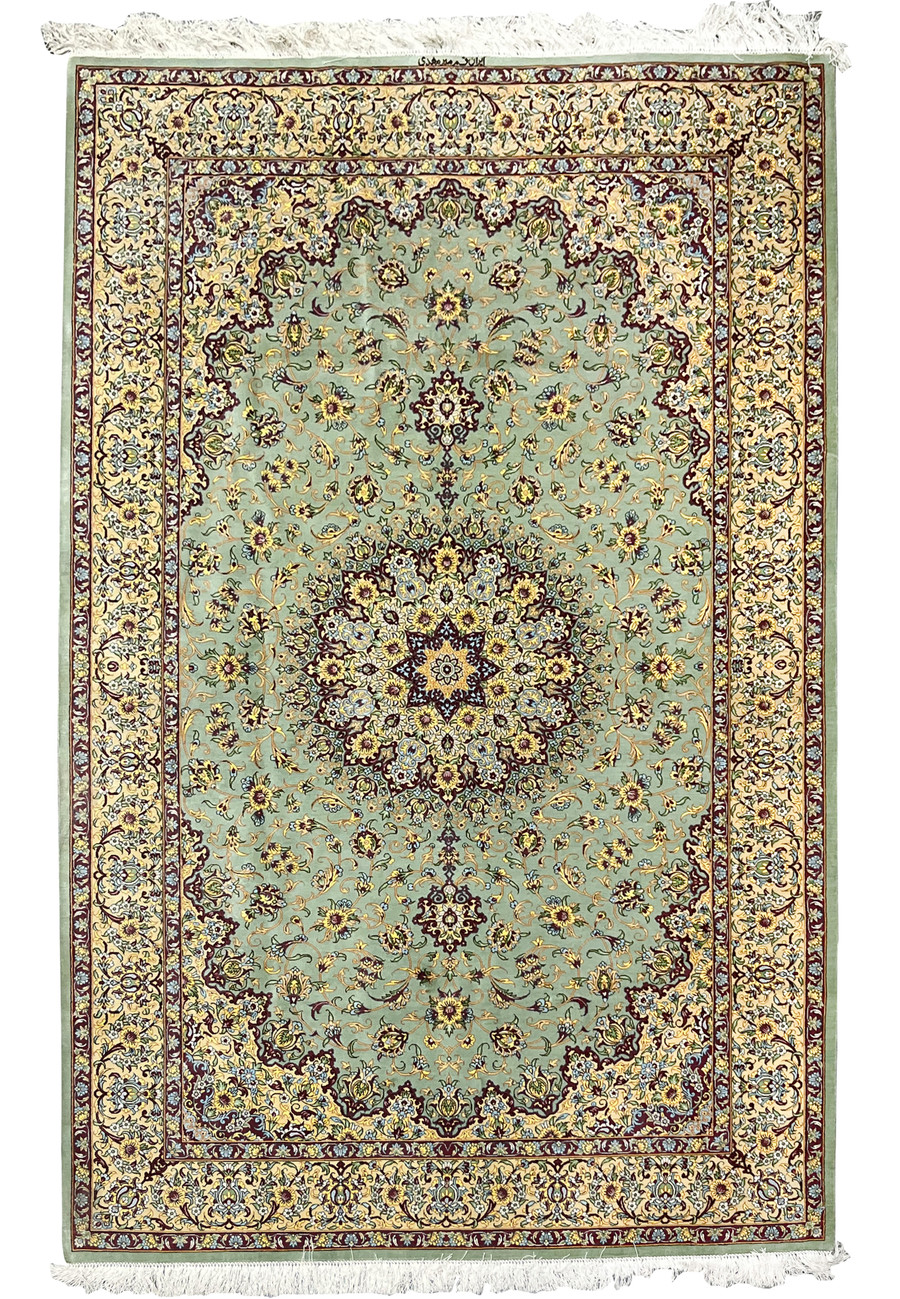
A fine Turkish silk rug at 700 knots per square inch, with a luminous starburst medallion.
So why do collectors still rank Persian first? Two reasons. Turkish weaving traditionally uses the symmetrical knot, which is superb for crisp geometry but less fluid for the flowing, curvilinear designs that define the highest art of the rug. And the Persian design and color tradition, developed over a longer continuous history of court and workshop weaving, is simply deeper. Turkish Hereke is the closest thing to a peer that Persian silk has ever had, and on the finest examples the gap narrows to a matter of taste. But for most collectors, the crown still rests with Persia, especially with Qum and Isfahan.
Why silk rugs cost so much more than other rugs
By now the math writes itself. Start with a raw material that takes thousands of cocoons per pound and months of processing. Add a fineness that multiplies the number of knots by five or ten times over a wool rug. Multiply that by the years of a master weaver's time. Finish with natural dyes and a workshop signature. Every one of those factors pushes the price up, and they stack.
A silk rug is not marked up like a luxury good with an arbitrary premium. Its cost is a fairly direct reflection of the labor and material inside it. That is also why a genuine silk rug tends to hold its value, and why the very finest examples are treated as investments and passed down through generations.
How to tell a real silk rug from a fake
Because real silk commands real money, the market is full of imitations sold as the genuine article. The usual culprits are mercerized cotton and viscose or rayon, often marketed with soft-sounding names like art silk, bamboo silk, or banana silk. These fibers can shine, but they are not silk, they do not wear like silk, and they are worth a fraction of the price. A few honest checks protect you.
A buyer's checklist
◆ The back. On a real silk rug the design is crisp and legible on the reverse, the knots are tiny and dense, and genuine silk fringe is part of the rug itself, an extension of the warp, not sewn on.
◆ The feel. Real silk is warm to the touch and warms further when you rub it briskly. Viscose feels cool and can feel slightly damp or squeaky.
◆ The sheen. Genuine silk changes tone as you view it from different angles. A fake tends to hold a flatter, more uniform, almost metallic shine.
◆ The burn test. A single fiber from the fringe, carefully burned, tells the truth. Real silk smells like burning hair and leaves a brittle black ash you can crush to powder. Viscose smells like burning paper and leaves a soft grey ash.
◆ The price. A large, cheap silk rug is a contradiction. If the price seems too good for the fineness claimed, it is not silk.
The simplest protection of all is who you buy from. Every silk rug we sell is genuine, hand-knotted, and ships with a certificate of authenticity that states exactly what it is. It also helps to understand what sits under the pile, which we cover in our guide to the foundation of a handmade rug.
Why people fall in love with silk rugs
For all the technical reasons, people buy silk for how it makes a room feel. The color has a depth wool cannot reach. The surface shifts and shimmers with the light and the time of day, so the rug is never quite the same twice. The detail rewards a close look and a lifetime of second looks. It is light enough to hang on a wall as art, fine enough to become the most valuable object in the house, and beautiful enough that none of that is the point. A silk rug is one of the few things you can buy that is genuinely made to outlive you.
Explore our silk rugs
Browse the full collection of silk rugs, or our wool and silk rugs for silk detail with a little more structure underfoot. A few in the collection now:

Every silk rug we sell is genuine and hand-knotted, ships free with a certificate of authenticity, and comes with free returns within 31 days to all 50 states. Questions about a specific rug? Reach us any hour at (855) 576-7705, on live chat, or on WhatsApp, and our customers say it better than we can, five stars on Google, every single review.
Rugs.net Headquarter
371 South Main St.
Freeport, NY 11520
Phone and text: (855) 576-7705