
Everyone looks at the pile of a rug, the color, the pattern, the sheen. Almost no one looks at the part that decides whether the rug lies flat, stays square, and survives a century of use: the foundation. It is the hidden skeleton every knot is tied onto, and on the great majority of fine handmade rugs it is made of cotton. Here is everything worth knowing about why.
What a foundation actually is
A handmade rug is built on two sets of threads. The warps run the full length of the rug, stretched tight on the loom from top to bottom. The wefts run side to side, passed between the rows of knots to lock them in place. Together the warp and weft are the foundation, and the pile you see is simply thousands of individual knots tied around pairs of warp threads. The fringe at each end is not decoration added later; it is the ends of the warp threads themselves, which is why a genuine hand-knotted rug can never truly lose its fringe without losing part of its structure. We cover the full anatomy in our guide to the foundation of a handmade rug.
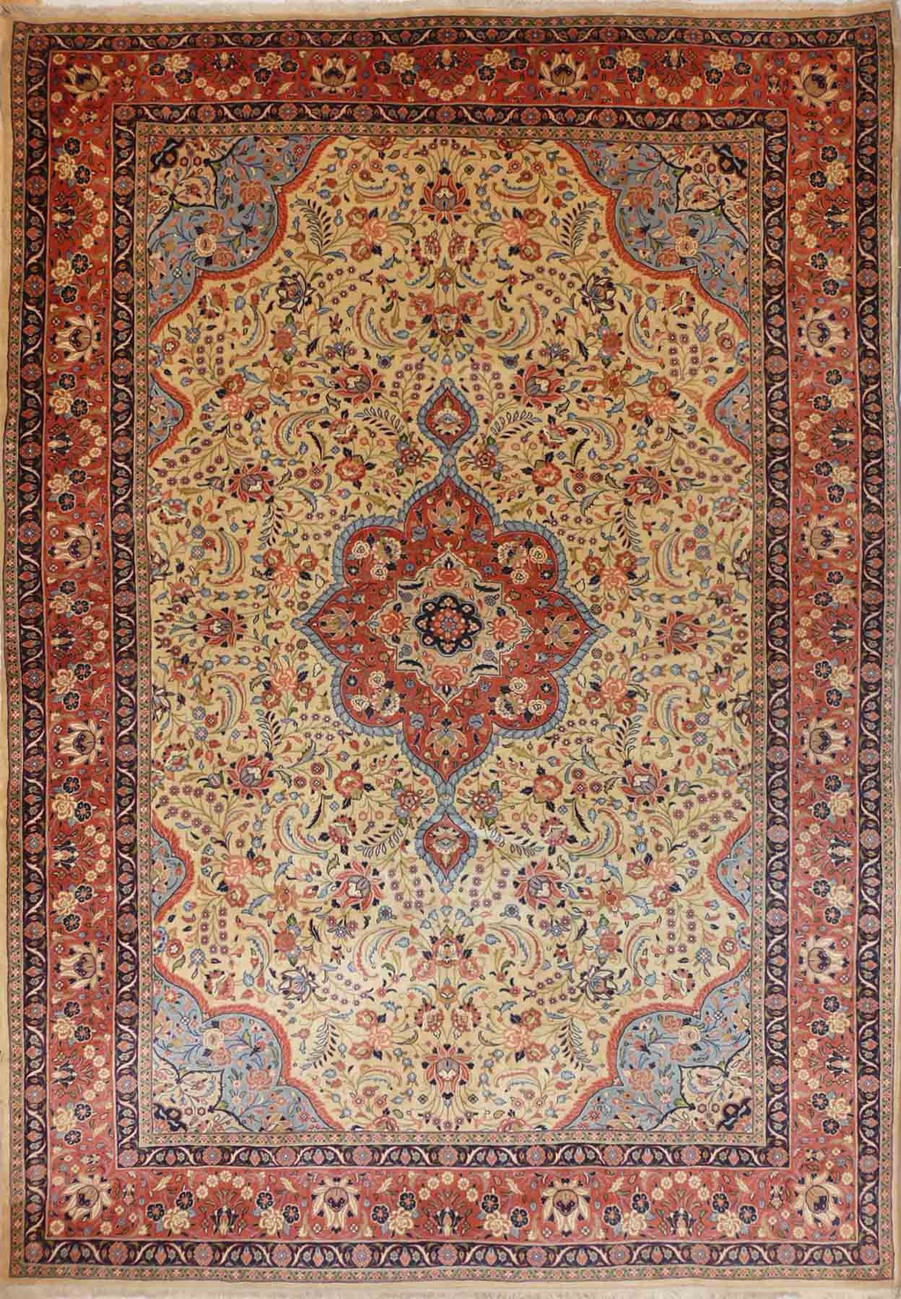
A Persian Bijar, the famous iron rug. Its legendary durability starts with a dense, tightly packed cotton foundation.
Why cotton is the standard for fine rugs
Cotton became the foundation of choice in the great weaving cities for one overriding reason: it holds its shape. Cotton is strong under tension, dimensionally stable, and it does not stretch or relax the way wool does. That means a weaver can pull the warps drum-tight, pack the knots down hard, and end up with a rug that lies flat, sits square, and keeps those qualities for generations.
A cotton foundation also allows finer weaving. Because cotton yarn is thin, even, and consistent, the warps can be set closer together, which lets the weaver tie more knots per square inch and render sharper detail. Village and nomadic rugs are often woven on a wool foundation, which is why they tend to be a little more irregular and relaxed in shape. The formal city rugs of Kashan, Tabriz, Bijar, and their peers use cotton precisely because it delivers the flat, true, disciplined structure those refined designs demand.
The wool is what you fall in love with. The cotton is what makes sure the rug is still lying flat and square long after you have.
What cotton actually is
Cotton is a natural plant fiber. It grows as a soft, fluffy boll around the seeds of the cotton plant, and each fiber is almost pure cellulose, the same structural material that gives plants their strength. Those short fibers, called the staple, are cleaned, combed, and spun together into yarn. Longer, cleaner staple spins into stronger, smoother, more even thread, and that difference in staple quality is exactly where one cotton foundation pulls ahead of another. Cotton is inexpensive, abundant, and remarkably strong for its weight, which is why it is ideal for the unglamorous but critical job of holding a rug together.
Why Persian cotton is prized
Persia has grown cotton for its rugs for centuries, and the reputation of Persian cotton rests on craftsmanship as much as on the plant. Traditionally it is hand-spun and tightly plied, producing a warp that is strong, even, and durable, able to take the punishing tension of a fine loom without weak spots. In the best workshops the cotton is chosen and prepared with the same care as the wool, because experienced weavers know the foundation determines whether a masterwork survives.
That is the honest version of why Persian cotton foundations are held in such regard: not a secret in the soil, but a long tradition of selecting good staple, spinning it tightly, and building the rug on it properly. A well-made Persian foundation is a large part of why these rugs last for generations rather than years.

A classic Persian Kashan. The cotton foundation is why a room-size rug like this lies perfectly flat and true.
Persian, Indian, Pakistani, and Afghan cotton
Cotton foundations are used across the whole rug-weaving world, and there are real differences between weaving regions, though the country of origin matters less than how the cotton is grown, cleaned, spun, and plied. Persian workshop cotton is prized for tightly hand-spun, high-quality staple used in disciplined city weaving. India and Pakistan are enormous cotton producers, and their rugs are very often built on cotton foundations too, with quality that ranges from excellent to ordinary depending on the workshop and the grade of cotton.
Afghanistan is a little different. Much of the classic Afghan tradition is tribal and nomadic, and those rugs are frequently woven entirely in wool, foundation included, rather than on cotton. Where Afghan rugs do use cotton, it can be coarser and more rustic, in keeping with that heavier tribal aesthetic. The takeaway is simple: a fine, tightly spun cotton foundation is a mark of careful city weaving wherever it is made, and the Persian tradition has been refining exactly that for a very long time.
Cotton and moths: why cotton foundations resist them
This is one of the quiet advantages of a cotton foundation, and it comes down to basic biology. Clothes moths and wool-eating beetles feed on protein, specifically the keratin in animal fibers like wool and silk. They cannot digest cellulose. Cotton is cellulose, so a cotton foundation is essentially not food to them. When moths damage a rug, they go after the wool pile, not the cotton skeleton underneath it.
That is why a cotton-founded rug is far more forgiving of a moth problem than an all-wool one. Even in a worst case where the wool pile takes some damage, the cotton warp and weft holding the rug together remain intact, so the structure survives and the rug can be repaired. An all-wool rug offers moths a meal from top to bottom, foundation included, which is one more reason the great city rugs are built on cotton.
A quick note on the finest rugs: a silk foundation is protein, not cellulose, so it does not share cotton's built-in moth resistance. Silk-founded rugs are almost always treasured, well-kept rugs that see careful handling, but it is worth knowing the distinction.
When weavers use a silk foundation instead
Silk enters the foundation for one main reason: fineness. Silk thread is far thinner and stronger than cotton, so a silk foundation lets the weaver set the warps extraordinarily close together and tie far more knots per square inch. That is how the most detailed rugs on earth are made. When you see a Qum, a fine Isfahan, or a top Nain or Tabriz reaching 700, 800, or 1,000 knots per square inch, there is almost always a silk foundation making that resolution possible. You can read more in our guides to knots per square inch and to Persian and Oriental silk rugs.

A fine Persian Isfahan in kork wool and silk on a silk foundation. The silk warp is what allows this level of fineness.
Cotton foundation versus silk foundation
The two materials do different jobs. A cotton foundation is thicker, firmer, extremely stable, naturally moth-resistant, and inexpensive, which makes it the right choice for the vast majority of rugs, from hard-working room-size wool rugs to very fine city weaves. A silk foundation is thinner, lighter, more flexible, and far more costly, and it exists to enable the highest knot densities and the most delicate detail. A silk-founded rug also tends to feel more supple in the hand and can be woven in a finer, thinner body.
Neither is simply better. A durable Bijar or Kashan wants a stout cotton foundation, and putting silk under it would add cost for no benefit. A 900-knot Qum needs silk, because cotton could never be spun fine enough to reach that density. The material is chosen to match the rug.
Why a silk foundation makes a rug more expensive
There are two reasons, and they stack. The first is the material itself: silk costs many times more than cotton to produce, so the raw foundation is more expensive before a single knot is tied. The second is what a silk foundation signals. Weavers reach for silk in order to weave finer, and finer means more knots, and more knots means more months or years of a master's labor. So a silk foundation almost always sits beneath a far more finely knotted rug, and it is that combination of costly material and enormous labor, not the foundation alone, that lifts the price.
How to read the foundation yourself
Turn the rug over. On a hand-knotted rug the design shows clearly on the back, and you can see the individual knots and the warp and weft between them. Cotton foundation threads look matte and pale. A silk foundation looks finer and carries a faint sheen, and the knots will be dramatically smaller and denser. Check that the rug lies flat and sits square, both signs of a properly tensioned foundation, and remember that the fringe should be part of the rug, an extension of the warp, not stitched on. A little practice at the back of a rug teaches you more about its quality than a long look at the front.
Explore rugs built to last
Every rug we sell is genuinely hand-knotted on a proper foundation and ships free with a certificate of authenticity. See the durable cotton-founded classics in Bijar and Kashan, or the fine silk-founded weaves in Qum, Isfahan, and our silk rugs collection. To go deeper, read our full guide to the foundation of a handmade rug.
Questions about a specific rug's construction? Reach us any hour at (855) 576-7705, on live chat, or on WhatsApp, and our customers say it better than we can, five stars on Google, every single review.
Rugs.net Headquarter
371 South Main St.
Freeport, NY 11520
Phone and text: (855) 576-7705