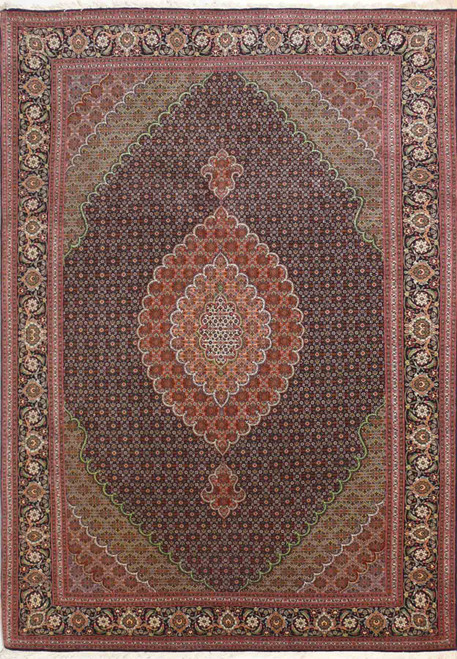

| Size in ft: | Width: 6'6" x Length: 8'10" |
| Size in Inch: | Width: 78" x Length: 106" |
| Size in meters: | Length: 2.69 x Width: 1.98 m |
| Colors: | Madder Red, Ivory, Gold, Dark Green, Salmon Pink, Slate Blue, Chocolate Brown |
| Shape: | |
| Woven: | 100% Hand-knotted | Handmade |
| Foundation: | |
| Pile: | |
| KPSI: | |
| Design: | Pazyryk | All-over Panel Field |
| Origin: |
Persian Tabriz | Made in Persia |
| Condition: | Excellent | Never used |
6'6" x 8'10" Persian Tabriz Rug | Pazyryk Design | 55 Raj | Silk Foundation
Almost every rug in the world descends from a design someone invented. This one descends from the design that started the record. The pattern is Pazyryk, taken from the oldest knotted pile rug ever found, a piece that sat frozen in a Siberian burial mound for roughly 2,500 years and came out of the ice with its colors intact. A Tabriz workshop has rewoven it here at 55 Raj, about 400 knots per square inch, on a silk foundation. The rug measures 6'6" x 8'10" and sells as a 6x9 Persian rug, which fits a dining room or a study without dominating it. Search the word Pazyryk and you will find photographs of the original; then look at the field of this rug and count the same squares. It ships with a certificate of authenticity.
Design and Motifs
The field is a grid of small squares, each outlined in a beaded ivory frame and each holding a single 4 petal star flower with slim green leaves between the petals. Nothing wanders, nothing curves; the whole field is arithmetic, which is what makes the borders hit so hard when you reach them. Five bands surround it. Closest to the field, octagon panels on dark green hold winged griffins in ivory. Beyond that an ivory band carries a procession of elk, heads down, antlers thrown back, walking single file around the entire rug. Then a gold band of 4 point rosettes, and then the widest band of all, deep red, filled with mounted horsemen leading their horses, each rider in a helmet, each horse under a saddle cloth drawn in pink and blue. The outermost guard repeats the griffin octagons at half scale. Every animal faces the same direction, so the border reads as one continuous march.
Deep Madder Red With Ivory and Gold
The dominant color is a deep madder red, warm and slightly brick rather than blue-toned, and it holds both the field and the horseman border, which ties the two ends of the composition together. Against it the ivory does most of the work: the beaded grid lines, the elk band, the griffin bodies, the flower petals, all in a soft cream that has visible luster where the light crosses the pile. A clear golden yellow sets the rosette band apart and gives the border stack its warmest note. Dark green, nearly black in the photographs, backs the griffin panels and edges the field, which is what keeps the red from spreading unchecked. Smaller quantities of salmon pink, slate blue and chocolate brown appear in the saddle cloths, the riders' tunics and the antlers, and those small colors are the reason the animal bands hold up to close inspection. The fringe is ivory and untouched.
Tabriz and the 55 Raj Standard
Tabriz, in northwestern Persia, is the city that reproduces designs other towns cannot attempt, because its workshops measure fineness in Raj and build to a number before the first knot is tied. Raj counts knots across a gereh of about 2.75 inches. 40 Raj is standard commercial work; 55 Raj, roughly 400 knots per square inch, is the grade where a weaver can render a horse's bridle, a griffin's wing and an elk's antler at the size of a thumbnail and still have them read correctly. The silk foundation is what makes that possible, because silk warps are thinner than cotton and let the knots pack tighter without the rug growing stiff. A design this old asks to be copied exactly, and this is the standard of workshop that can do it.