
| Exact Size in ft: | Width: 6'7" x Length: 10'3" |
| Size in Inch: | Width: 79" x Length: 123" |
| Size in meters: | Length: 3.14m x Width: 2.01m |
| Some of many colors: | Terracotta Red, Ivory, Midnight Navy, Salmon Pink, Sage Green, Deep Brown, Sky Blue, Gold, Soft Coral, Charcoal |
| Shape: | Rectangular |
| Woven: | Hand-Knotted | Handmade |
| Foundation: | 100% Cotton |
| Pile: | 100% Wool |
| KPSI: | 340 - 360 |
| Origin: | Persian Bijar |
| Condition: | Excellent | Never Used |
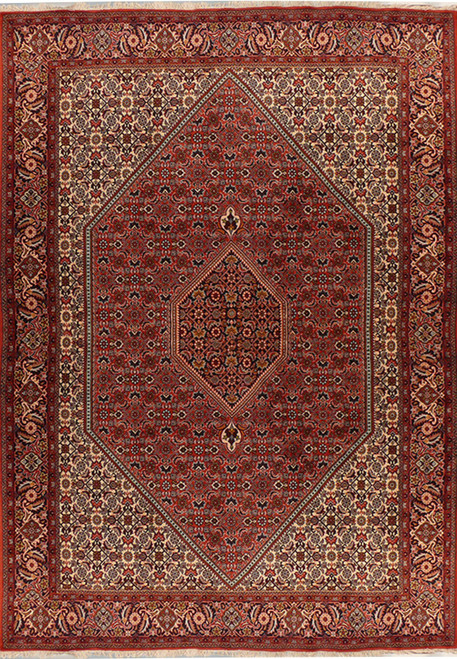
6'7 x 10'3 Persian Bijar Rug | Double Diamond Medallion with Herati Field | Terracotta and Ivory Palette | 340 KPSI
A 6'7 by 10'3 Persian Bijar is one of the most useful sizes in the entire Persian rug catalogue, big enough to anchor a full living room or dining room, narrow enough to slot under a queen bed or down a wide hallway. Bijar rugs come from the Kurdish town of Bijar in northwestern Iran, and the tribe has earned its nickname (the "Iron Rugs of Persia") through a wet-loom weaving technique that produces a foundation so dense and so stiff you can almost stand the rug up on its edge. This particular piece carries the textbook Bijar layout: a stepped double-diamond medallion stacked at the center of the field, surrounded by an allover herati lattice, framed by indigo corner spandrels and a wide ivory floral border. To understand why these rugs outlast almost every other Persian weaving on the market, see our complete guide to Bijar rugs.
Design and Motifs
The composition is built around the classical Bijar mahi-to-hoz layout (literally "fish in the pond"), which is the Bijar weaver's interpretation of the herati pattern. At the geometric center of the rug sits a small lozenge inner medallion drawn in midnight navy, filled with a tight herati lattice in terracotta, salmon, and ivory, and capped at top and bottom with a small floral palmette finial. Surrounding this inner core is a larger ivory hexagonal medallion, outlined in red and navy, that frames the inner lozenge in a generous halo of cream ground. Stepping outward, the medallion is then enclosed by a much larger stepped diamond, drawn with a stair-stepped outline in indigo and rendered against the same allover herati lattice as the rest of the field. The outermost layer of the medallion structure is a great diamond outline that nearly touches the borders, with deep navy spandrels filling the four corners of the field. Across the entire terracotta ground, the herati pattern repeats in a tightly packed grid: each repeat unit consists of a small rosette flanked by four lanceolate "fish" leaves, with the leaves curving around the rosette in a way that reads as an ornamental fish and pond when you look closely. The main border carries a continuous procession of large palmettes and rosettes alternating with serrated boteh, drawn in red, salmon, and gold on an ivory ground, and is flanked on both sides by paired narrow guard borders carrying floral meanders on indigo and rust grounds.
Colors and Placement
The palette is grounded in the warm earth tones that Bijar weavers are known for, with the field reading as a soft terracotta red that pulls toward salmon in direct light and toward brick in shadow. The medallion's core is anchored by a deep midnight navy that almost reads as black, providing a strong visual stop at the very center of the rug, while the surrounding ivory cream brings the eye outward in a gentle halo. The corner spandrels echo the navy of the medallion's heart, creating a balanced four-point anchor across the field. Throughout the herati lattice, small accents of salmon pink, sage green, sky blue, gold, deep brown, and soft coral appear inside the rosettes and along the curved fish leaves, giving the field a subtle multi-color shimmer when viewed up close while still reading as a unified terracotta from across a room. The ivory main border ties the whole composition together and carries the same accent palette through its palmettes and boteh. This rug is built for hardworking rooms: living rooms, dining rooms under a six- or eight-seat table, family rooms, master bedrooms placed at the foot of a queen or king bed, libraries, and study spaces. Bijars perform especially well in high-traffic areas because the wet-loomed foundation means the rug barely compresses under furniture and recovers from foot traffic faster than almost any other Persian weaving.
Origin and Construction
Bijar is a small Kurdish town in the Kurdistan province of northwestern Iran, perched at high altitude in a region with cold winters and a long-standing weaving tradition that predates most other named Persian centers. The defining feature of a true Bijar is the wet-loom technique: the warps are kept damp throughout weaving and the wefts are beaten down with extreme force using a heavy iron comb, which is what compresses the foundation into the dense, board-like structure that gave these rugs their iron nickname. The foundation of this piece is 100% cotton, both warp and weft, woven double-wefted in the classical Bijar manner so that one weft sits taut and one weft sits loose between every row of knots, locking the structure together. The pile is 100% hand-spun wool from the Kurdish highlands, which is naturally lustrous and high in lanolin, making it both more colorfast and more dirt-repellent than industrial wools. The knot is the Persian asymmetric (senneh) knot, tied at approximately 340 per square inch, which is the typical density range for Bijar town production and substantially denser than most village Persian weavings. The condition is as it left the loom, with full pile, full cotton fringes, and no wear, sun fade, or repair. To understand exactly why a Bijar's wet-loom construction means it will outlive most of the furniture in your house, see our deep dive on why Bijar rugs last a lifetime.