| Exact Size in ft | Width: 6'9" x Length: 9'6" |
| Size in Inch | Width: 81" x Length: 114" |
| Size in meters | Length: 2.90m x Width: 2.06m |
| Some of many colors | Deep Red, Ruby, Terracotta, Ivory, Cream, Navy Blue, Indigo, Sky Blue, Sage Green, Gold, Burgundy |
| Woven | 100% Hand-knotted | Handmade |
| Foundation | Cotton |
| Pile | 100% Wool |
| Shape | Rectangular |
| Style | Traditional, Classic Persian, Diamond Medallion, Allover Herati |
| Origin | Persian Bijar | Made in Persia |
| KPSI | 360-380 KPSI |
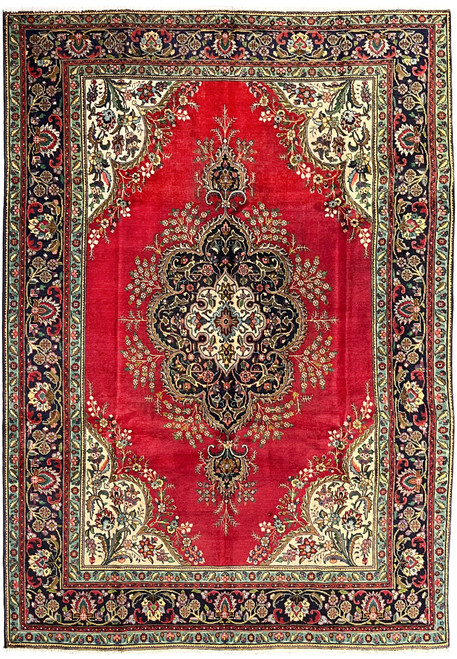
| Condition | Never Used | (minor edge knot irregularity, see note below) SEE VIDEO and 2nd PICTURE |
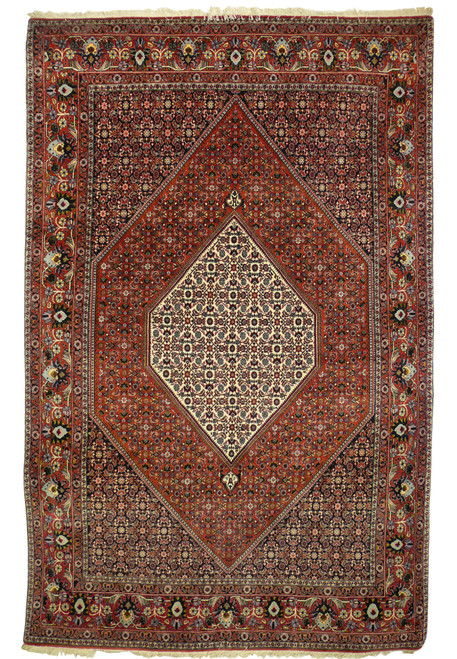
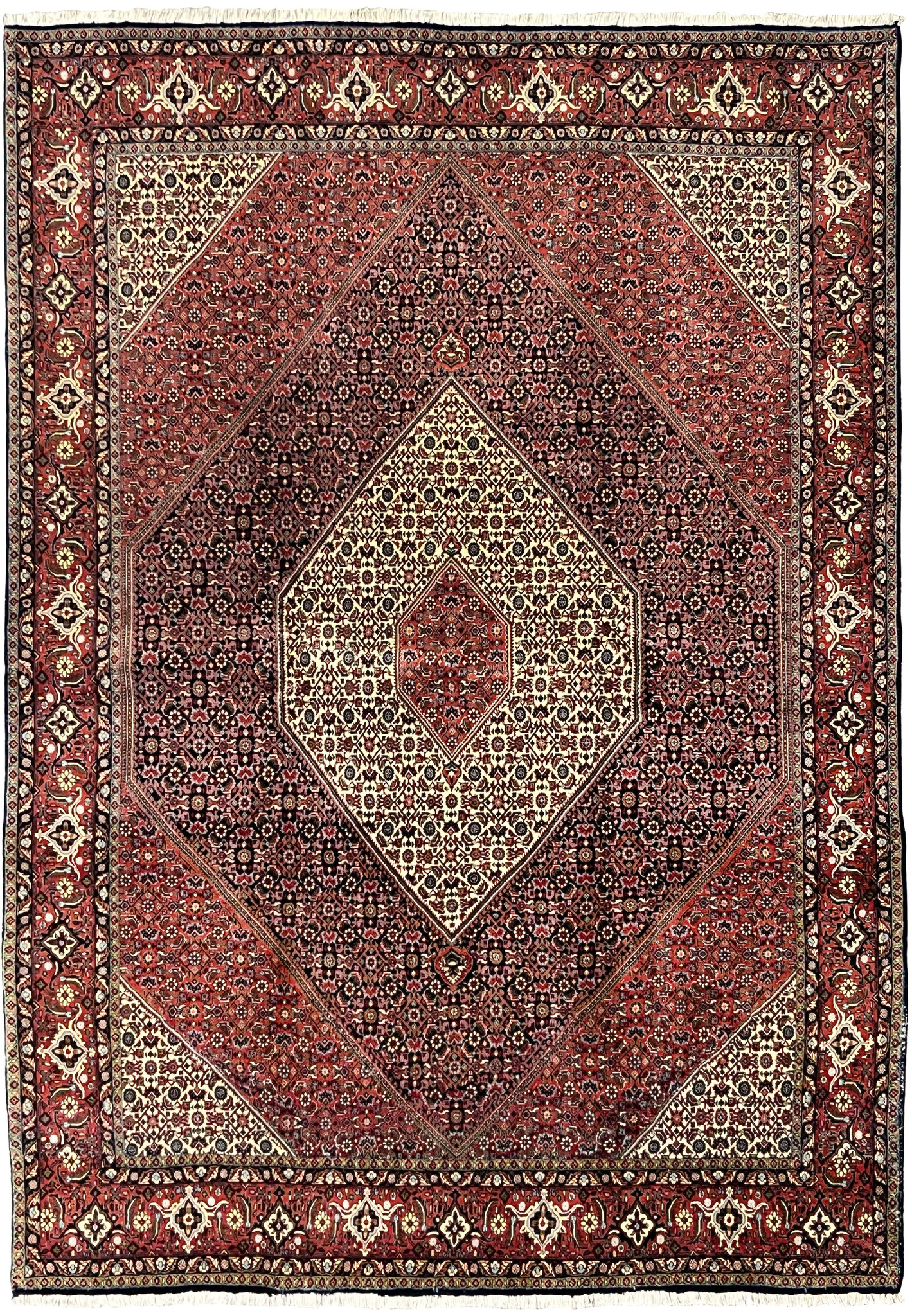
6'9" x 9'6" Persian Bijar Iron Rug with Ivory Diamond Medallion on Red Field
This 6'9" x 9'6" Persian Bijar is a true iron rug, hand-knotted in the Bijar tradition that has earned these pieces a global reputation as the densest, heaviest, and most durable rugs ever made. The composition centers on a stepped ivory diamond medallion floating on a deep red field, anchored at the four corners by ivory diamond corner pieces and framed by a richly drawn navy main border. The drawing is precise, the wool is dense, and the structure is unyielding. For broader context on what makes a Bijar a Bijar, our complete guide to the iron rugs of Persia covers the history, the construction technique, and what separates a real Bijar from rugs that imitate the look.
Design and Motifs
The composition is the classical Bijar diamond format. A small ruby red core medallion sits inside a larger ivory stepped diamond, which itself sits inside a still larger diamond outline drawn against the red field. Four ivory corner pieces mirror the medallion geometry, drawn with the same dense herati infill that fills the rest of the field. The herati pattern, also called the fish or mahi design, is built from a small diamond surrounded by curved leaves and rosettes, repeated thousands of times across the rug to create a textured, jewel-like ground that rewards close inspection. The navy main border carries large rosette palmettes and curling vines in ivory and gold, framed by smaller floral guard borders that step the design out cleanly to the edge. Every inch is drawn deliberately. Bijar weavers are known for not leaving empty space, and this rug is a textbook example of how that discipline turns into visual richness.
Colors and Placement
The palette is deep, warm, and grounded. The field reads as a mix of true Persian red, terracotta, and a deeper ruby that shifts in the light, set against a strong ivory medallion and corners that pull the eye to the center. Navy blue anchors the main border and gives the whole rug weight, while sage green guard borders and small flashes of gold, sky blue, and burgundy give the design dimension without ever pulling focus. The 6'9" x 9'6" footprint sits naturally under a queen bed with bed-side reveal, in front of a sofa in a medium-sized living room, in a dining room around a six-seat table, or as the anchor of a study or library. Bijars are built to be lived on, and this palette was made to absorb traffic without showing it. Pairs naturally with traditional and transitional interiors, walnut and oak furniture, leather seating, and rooms where you want one piece of serious craftsmanship to do the heavy lifting.
Persian Bijar Rugs and Construction
Bijar is a small Kurdish town in northwestern Iran, and it has produced rugs unlike any others on earth for well over a century. The local weaving tradition uses a wet-loom technique where the wool is moistened during weaving and the wefts are pounded down with a heavy metal comb after every row of knots, packing the structure to a density that gives Bijars their nickname, the iron rugs of Persia. A Bijar in the hand feels noticeably heavier than any other Persian rug of the same size, and that weight is the entire point. It is the reason these rugs are famous for surviving generations of heavy use without showing it. This rug is hand-knotted on a cotton foundation with a 100% wool pile at 360 to 380 KPSI, which is on the fine end of Bijar production and explains the clarity of the herati drawing across the field. Despite the minor edge irregularity disclosed above, the rug is structurally sound, has never been put down for use, and will outlive everything else in the room. For more on why these rugs last the way they do, see our complete guide to why Bijar rugs last a lifetime.