
8'6" x 12'2" Persian Isfahan Rug | Signed Seirafian | Kork Wool and Silk on Silk Foundation
A signed Seirafian is the kind of Isfahan that collectors wait for, and this one comes in a full room size of 8'6" x 12'2", placing it among the 9x12 Persian rugs, a format that rarely comes to market from a top workshop. It is knotted at approximately 670 to 700 knots per square inch in kork wool with silk highlights on a full silk foundation, then clipped so low that the rug handles almost like heavy paper: thin, supple and crisp at the edges. The Seirafian name is woven into a signature cartouche at one end, and the family is regarded as one of the most respected workshop names in Isfahan today. It has never been used, and it ships with a certificate of authenticity recording origin, materials, knot count and signature.
Design and Motifs
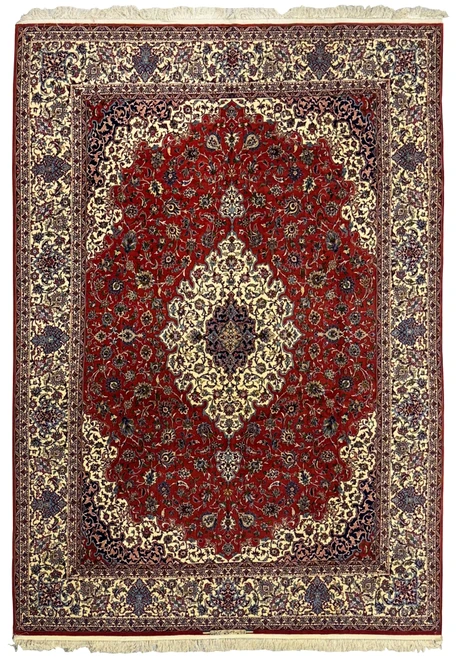
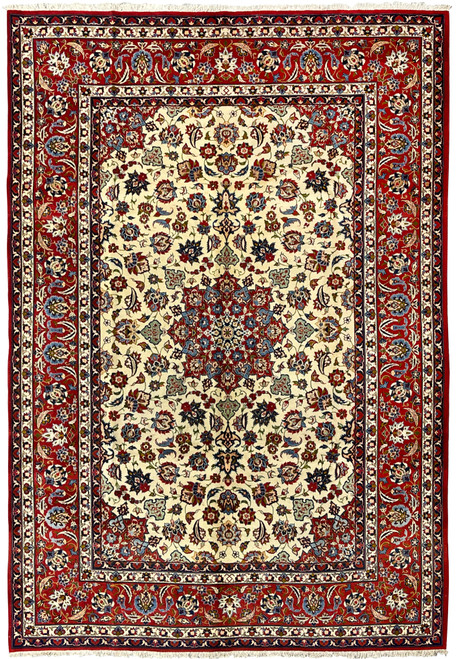
The composition is classic Isfahan court drawing. At the center sits a large many pointed star medallion in crimson and navy, built in concentric rings around a pale pink rosette with a coral heart and blue palmette leaves. Above and below it hang 2 shield shaped red pendants, each filled with small lotus and rosette forms. The ivory field around them is carried by a network of fine dark spiraling vines, the Eslimi scroll, which loops in perfect circles from end to end and carries hundreds of Shah Abbasi palmettes, serrated leaves and small blossoms. All 4 corners are closed by navy spandrels with red arabesque tracery, edged by a soft taupe band that frames the field. The main border is a wide crimson band of large Shah Abbasi palmettes and lotus flowers on a continuous vine, held between ivory guards of curling leaf scrolls and narrow navy stripes of ivory and gold cloud forms. At one end the signature cartouche sits inside green, white and red bands just above the fringe.
Ivory, Crimson and Navy Lit by Silk
The field is a clean warm ivory, which makes the rug read light and open in a room even though the drawing is dense. Against it the vinework is worked in deep navy, almost black, so every scroll reads as a crisp line. The flowers are crimson and wine red, accented with sky blue, rose pink, coral, olive green and touches of gold. The medallion gathers the strongest color at the center: crimson and navy around a soft pink ring and a coral core. The main border repeats the crimson as a full ground, with ivory, navy and pale pink palmettes, which gives the rug a rich frame without making the field feel heavy. The silk is used for highlights and outlines, and it catches the light differently from the kork wool around it, so the flowers seem to lift off the ivory as you walk past. The navy spandrels and their taupe edging add a quiet, cooler note in each corner that balances all that red.
Isfahan and the Seirafian Workshop
Isfahan was the Safavid capital, and its court workshops set the standard for the curvilinear drawing that the finest Persian Isfahan rugs still follow today, with designs prepared by master designers and executed knot for knot. Among the city's modern workshops, Seirafian stands near the very top, and a signed piece from the workshop carries real collector weight. This rug shows why. Kork is the soft, fine wool from the neck and shoulders of the lamb, and at 670 to 700 knots per square inch on a silk warp it can hold a drawing with the precision of silk alone, with no stepping on the curves of the scrolls or the points of the medallion. The pile is clipped very short to keep that clarity, the silk fringe is original at both ends, and the signature confirms it as a true Seirafian, a rare and hard to find piece for a serious collection.