
| Size in ft: | Width: 8' x Length: 10'2" |
| Size in Inch: | Width: 96" x Length: 122" |
| Size in meters: | Length: 3.10 x Width: 2.44 m |
| Colors: | Ivory, Rose, Burgundy, Sage Green, Slate Blue |
| Shape: | Rectangular |
| Woven: | 100% Hand-knotted | Handmade |
| Foundation: | Cotton |
| Pile: | Wool |
| KPSI: | Approx. 200 |
| Age: | New | Never used |
| Signature: | Small woven cartouche in the border |
| Design: | Traditional | English Garden Floral | All-over |
| Origin: | Pakistani | Made in Pakistan |
| Condition: | New | Never used |
8' x 10'2" Pakistani Oriental Rug | Ivory English Garden Floral | Signed, 200 KPSI
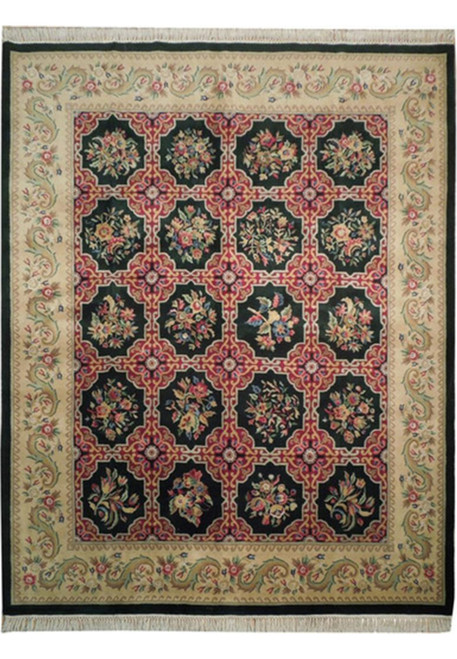
This hand-knotted piece measures 8' x 10'2" and belongs to the English garden family of designs: a pale ivory ground carrying an unbroken spread of lilies, tulips, rosebuds and long curling leaves, drawn as though they were cut from a real flower border rather than flattened into a strict repeat. The weave runs at roughly 200 knots per square inch, which is why the petals hold three and four shades each and the stems stay thin and continuous across more than 10 feet of field. Pile is full wool on a cotton foundation, the ends finished in hand-tied natural fringe, and the rug is new and never walked on. A small woven cartouche sits in the border. It ships with a certificate of authenticity, and as one of our 8 x 10 rugs it lands in the most requested room size we sell, with the drawing quality of a far more expensive workshop piece.
Design and Motifs
There is no medallion and no open corner spandrel here. The field is a true all-over garden: trumpet lilies with speckled black throats, half-open tulips, cabbage roses seen in profile, small buds on hair-thin stems and broad pointed leaves that twist to show both faces. Each bloom is drawn at a slightly different angle, so the pattern reads as scattered growth instead of a stamped grid, and the eye keeps finding a flower it had not noticed. The main border repeats a large rose and lily group facing a central flowering spray, flanked by pairs of leaves that curl back on themselves. Two narrow guard bands frame it, one filled with small paired blossoms, the other a fine beaded stripe, and the outermost band steps down into a row of small crowned florets. Detail of that border and its cartouche is visible in the close-up photographs, along with the tight, even rows of knots that let such small elements resolve cleanly.
Ivory Ground, Rose Petals and Garden Greens
The ground is a warm ivory, closer to cream and oatmeal than to bright white, and it takes light softly rather than glaring under a lamp. Against it the flowers run through a long rose range: dusty pink, blush, deep raspberry and an oxblood burgundy used for the darkest petals and for the small buds tucked between stems. Apricot and pale gold appear in the folded petals, while the foliage moves from dark forest green through sage and a muted teal, with occasional slate and powder blue leaves that cool the whole field down. Fine black outlining inside the lily throats and along a few leaf edges gives the drawing its definition without hardening it. The border carries the same palette at higher contrast, burgundy and rose against ivory, and the beaded guard stripe picks up blue-grey. For buyers working in soft neutral rooms, this sits with our other ivory and beige rugs but brings far more color life than a plain cream ground.
Woven in Pakistan: Workshop Quality and Knot Count
Pakistan is one of the few places still producing hand-knotted floor rugs of this fineness at any volume, and its workshops have built that reputation on consistency: level knot rows, an even wool clip and drawing that holds true from one end of the rug to the other. At approximately 200 knots per square inch this piece is a dense weave by any standard, well above ordinary commercial production, and the density is what makes the shaded petals and single-knot stem lines possible. The wool is well spun and lustrous, the cotton warps and wefts hold the rectangle square, and the back shows the design almost as clearly as the front. If you want the broader distinction between this kind of work and the classical weaving traditions, our guide on what separates a Persian rug from an Oriental rug is worth reading before you buy.