
8'1" x 11'4" Persian Bijar Rug | Brick Red Herati Field | Navy Medallion
A Bijar that has never been walked on is the best way to own one, because you get every year of its very long working life. This 8'1" x 11'4" rug is hand-knotted in wool at approximately 280 to 300 knots per square inch and is still in the condition it left the loom: crisp pile, straight edges and full fringe. Its proportions place it among the 9x12 Persian rugs most often chosen for living rooms and dining rooms, with a little extra length to run under a long table or sofa group. It ships with a certificate of authenticity recording origin, materials and knot count.
Design and Motifs
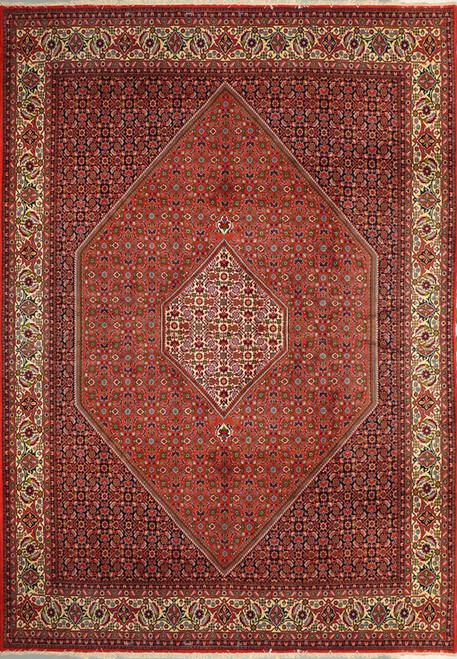
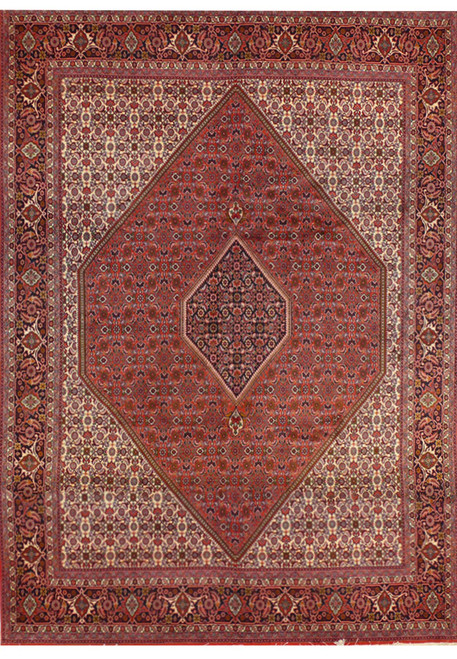
The composition is a classic Bijar lozenge. A long brick red field with stepped points runs nearly the full length of the rug, set against ivory spandrels that fill the corners. At the center is a navy hexagonal medallion outlined in olive, with a small ivory finial above and below. Every zone is covered in the herati, or mahi, pattern: a small rosette held in a diamond of 4 curved leaves, repeated in an unbroken lattice. On the red field the lattice is open and airy, while inside the navy medallion it tightens into a denser, jewel-like grid. The main border is a dark navy band of large palmettes, rosettes and curling leaves in ivory, red and green, held between narrow red guard stripes.
Brick Red, Ivory and Navy
Brick red sets the tone, a warm terracotta that leans slightly orange in daylight and deepens toward wine red by lamplight. Across it the herati is drawn in navy, wine and olive with small green and rose rosettes, so the field has texture without busy contrast. The navy medallion is the darkest point, its lattice picked out in red, rose, light blue and green, and the olive outline gives it a soft golden edge. The ivory and beige spandrels lighten the corners and frame the red field, their herati worked in red and navy. The navy main border brings the depth back at the edge, with ivory palmettes and touches of purple and green that echo the field. It is a balanced, traditional palette that works with warm wood floors and with both classic and transitional furniture.
Why Bijar Rugs Last
Bijar is a Kurdish town in the highlands of western Persia, and its weavers built a reputation on construction rather than fashion. After each row of symmetric knots, the wefts are dampened and beaten down with a heavy metal comb until the warps sit on 2 levels and the fabric becomes almost rigid. That is the reason Persian Bijar rugs are known in the trade as iron rugs, and why so many survive in use for a century or more. The tight packing also keeps the pile standing upright, so the rug feels firm and springy underfoot. This piece has that iron build, a well drawn herati in every zone and a pile that has never seen traffic, which makes it a Bijar ready for generations of daily use.