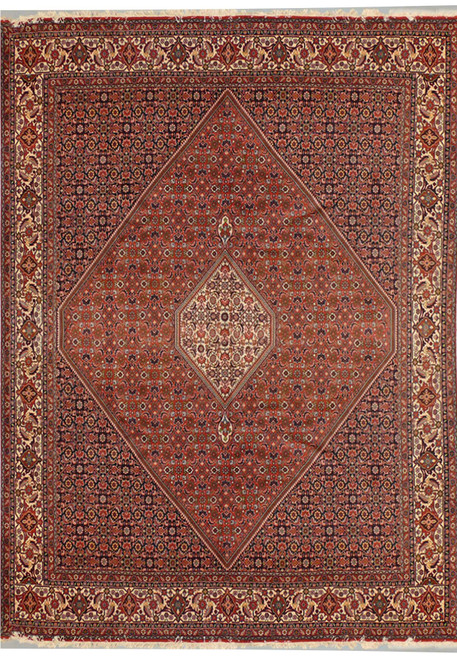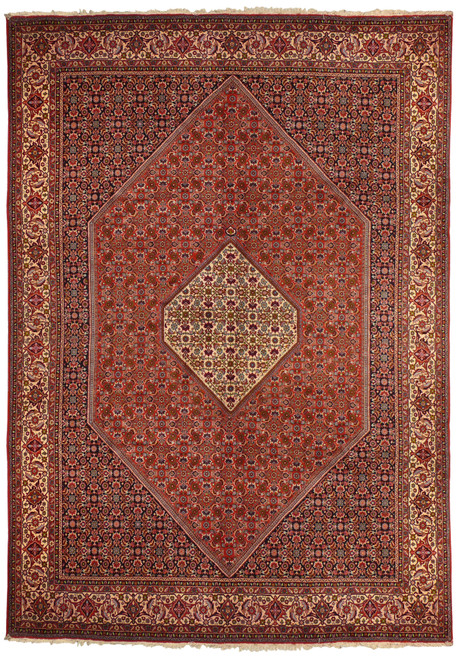

8'3" x 11'8" Persian Bijar Rug | Rust Red Herati | Navy Medallion and Corners
If you picture a Bijar, this is very likely the layout you see: shapes nested inside each other on a rust red ground, every inch filled with the herati pattern. This 8'3" x 11'8" example is hand-knotted in wool at approximately 280 to 320 knots per square inch, which gives the small herati units clean, legible outlines. At this size it belongs with the 9x12 Persian rugs that ground a full living room, a dining room or a large office. The rug is in excellent condition with full, even pile, and it ships with a certificate of authenticity recording origin, materials and knot count.
Design and Motifs
The drawing works like a set of frames. The outer field is rust red, with 4 large navy triangles closing the corners. Inside it, a long rust red lozenge outlined in pink runs nearly from end to end. Within that sits a navy hexagonal medallion, and at the very center a small rust red hexagon, so the eye is drawn inward step by step. The same herati pattern, called mahi or fish in Bijar, covers every one of these areas: a small rosette held in a diamond of 4 curved leaves, repeated in a tight lattice that changes color but never changes shape. The main border is a navy band of ivory and rose palmettes with leafy offshoots, edged by ivory and rust guard stripes and a red outer band.
Rust Red Against Deep Navy
Most of the rug reads as rust red, a warm earthy tone that turns brighter and almost coral where light hits the pile. The navy corners and the navy medallion give it a strong rhythm of dark and light, so the layout is clear even from across a room. On the red areas the herati is drawn in navy and dark red with small ivory, turquoise and green rosettes. On the navy areas the lattice turns rust, pink and ivory, so the 2 grounds mirror each other. Thin pink outlines separate each nested shape and add a soft glow between the red and the navy. The ivory guard stripes and the rose and ivory palmettes in the navy border lighten the edges, with touches of light blue, olive and gray in the smallest details. It is a deep, warm, traditional palette that suits wood floors, leather and darker furniture.
Kurdish Weaving From Bijar
Bijar sits in the Gerus region of western Persia, a fertile part of the Kurdish highlands, and most of its rugs are woven by Kurdish and Afshar weavers in the town and surrounding villages. Their method is what made Persian Bijar rugs famous. The wool is dampened, the knots are tied, and the wefts are pounded tight with a heavy metal comb until the warps are pulled onto 2 levels. The rug that comes off the loom is heavy, firm and so tightly packed that its pile stands straight up, giving a cushioned feel underfoot. That is why the trade calls Bijars the iron rugs of Persia. This one has exactly that construction, paired with a rich nested herati design, and it will hold its shape and color through decades of daily use.