| Exact Size in ft: | Width: 8'6 x Length: 11'2 |
| Size in Inch: | Width: 103 in x Length: 134 in |
| Exact Size in meters: | Length: 3.41 x Width: 2.62 |
| Some of many colors in this rug: | Rust-Red, Beige, Light Blue, Rose, Red, Olive, Teal, Mint, Gray, Light Green |
| Woven: | 100% Handmade and Hand knotted |
| Foundation: | Wool & Silk |
| Pile: | Wool & Silk |
| Shape: | Rectangle |
| Style: | Traditional Persian Tabriz |
| Origin: | Persian Tabriz | Made in Persia |
| KPSI | 380 - 420 |
| Condition: | Excellent | New |
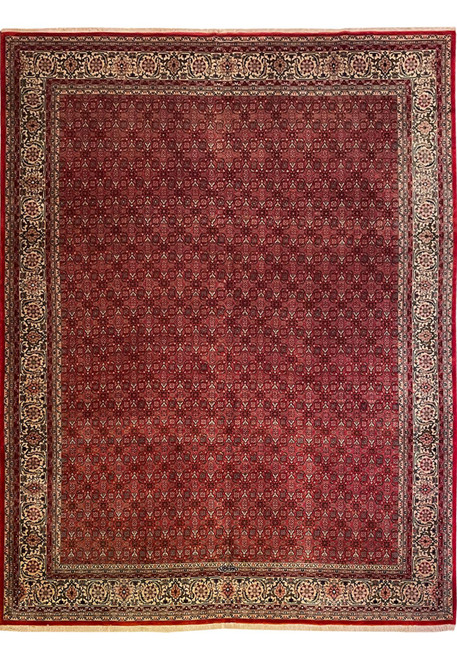
A signed Persian Tabriz in the weave that built the city's reputation: the Mahi, or fish, design. From across a room the deep red field reads as a single warm surface with a faint shimmer. Step closer and it resolves into a lattice of small rosettes, each one flanked by a pair of curved, serrated leaves. Those leaves are the "fish" the name refers to, and Persian weavers have been drawing them for something like four centuries.
There is no central medallion. The motif repeats edge to edge across the whole field, which is what carpet people call an allover composition. It is a harder thing to weave well than a medallion design, because there is nowhere to hide. A medallion draws the eye and forgives a slack passage in the corners. An allover has to hold its rhythm across every square inch, and any drift in the drawing shows up immediately as a wobble in the lattice. Sight down the length of this one and the rows stay true.
What 380 to 420 knots per square inch actually means
Knot counts get quoted a lot and explained rarely. The practical effect is resolution. At this density each rosette in the field is built from a few dozen knots rather than a handful, so its petals come to a point instead of a stair-step, and the fine navy outlines stay one knot wide the whole way round a curve. It is the difference between a drawing and a sketch.
There is a simple test you can do on any hand knotted rug, and it costs nothing. Turn a corner over. On a coarse weave the back is a blur of colour with the pattern only roughly suggested. On a fine one the design is nearly as legible from behind as from the front, because there are enough knots per inch to carry the detail through the pile. Photograph twelve in our gallery shows exactly that on this piece.
The signature
Woven into the border at one end is a cartouche carrying the workshops name in Nastaliq script, dark navy on ivory. This is not decoration. Persian weavers signed only work they were prepared to stand behind, and the practice stayed largely confined to master workshops, the ones whose reputation travelled beyond their own bazaar. A signature on a Tabriz of this density is the maker putting their name to the standard of the piece, in the knowledge that it will outlive them.
It also gives the rug a provenance most pieces simply do not have. Two rugs can be equally fine and equally old, and the signed one will hold its value better, because it can be placed.
Colour
The field is a warm red that leans toward rust in daylight and deepens toward burgundy under lamps. It is not a flat colour. Because the wool takes dye slightly differently from batch to batch, the field carries a soft variation across its width that photographs never quite capture, and that variation is what keeps a red rug of this size from reading as a solid block.
Against it sits an ivory main border carrying rotating palmettes and rosettes in rose, salmon and olive, drawn with olive brown vine work and outlined in navy. Between border and field run narrow guard bands in sage, light blue and navy, and their job is spacing: they hold the two apart so neither crowds the other. Look at the corners in photograph four and you can see the drawing turn the angle cleanly, which is another thing that separates workshop weaving from village work.
Wool and silk
The pile is wool with silk, and the silk is not spread evenly. It sits in the highlights, along petal edges and through the finer scrollwork, where it catches light at a different angle from the surrounding wool. The effect is that the pattern appears to shift as you walk past it or as the light moves through the day. Stand at one end and the border glows. Walk to the other and it settles down while the field lifts.
The wool does the work underfoot. Silk is beautiful and not especially hard wearing, so putting it only where it earns its keep, in the detail rather than the ground, is the sensible way to build a rug that has to live in a room rather than hang on a wall. Ends finish in a flat woven rust kilim with natural fringe.
Size and placement
At 8'6" x 11'2" this is a room defining rug rather than an accent. In a living room it will carry a full seating group with the front legs of every piece standing on the rug, which is the arrangement that makes a room feel composed rather than assembled. Under a dining table it leaves enough margin on all four sides for chairs to pull back without catching an edge, roughly two feet clear of the table on the long sides.
The allover pattern is forgiving of furniture. With no medallion to obscure, you can place a coffee table anywhere on it without loosing the composition, and the rug still works if you rearrange the room next spring. That is a practical advantage that medallion designs do not have.
Condition and availability
Hand knotted in Persia. Condition is excellent, with full even pile, sound sides and ends, and no repairs. Like every rug we sell this is a single piece rather than a line item, so when it sells we cannot order another. If it is right for your room, it is worth deciding on.
New to Persian weaving? Our guide to Persian rugs explains how origin, knot count and materials shape what you are looking at, or browse the full Persian collection.