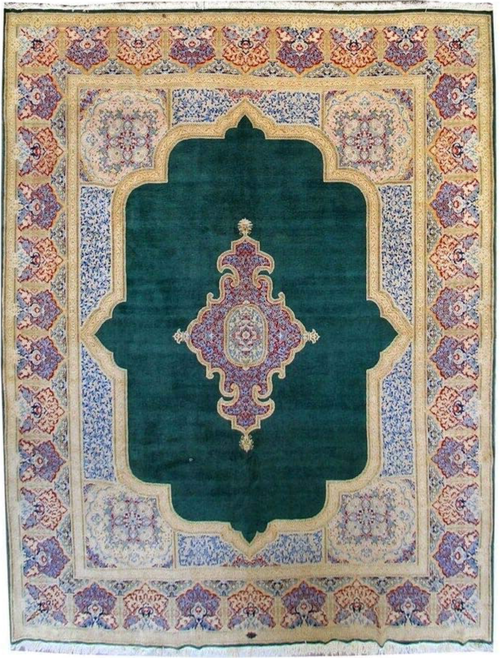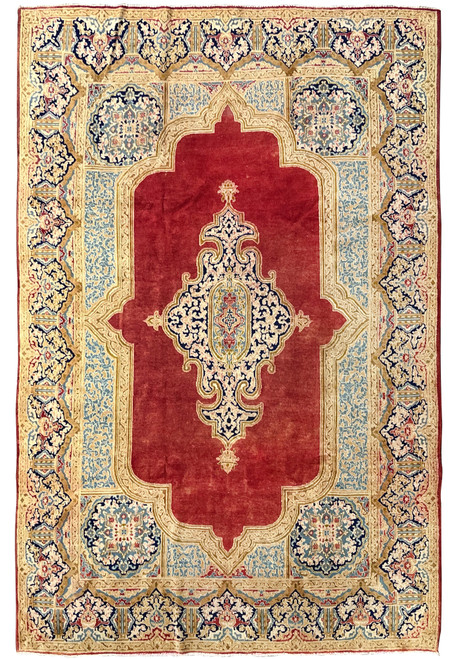

| Size in ft: | Width: 9' x Length: 17'8" |
| Size in Inch: | Width: 108" x Length: 212" |
| Size in meters: | Length: 5.38 x Width: 2.74 m |
| Colors: | Ivory, Rose Red, Green, Blue |
| Shape: | Rectangular |
| Woven: | 100% Hand-knotted | Handmade |
| Foundation: | Cotton |
| Pile: | Wool |
| Age: | 1940's | Approx. 85 years old |
| Design: | Lavar Kerman | All Over Floral | Ivory Field |
| Origin: | Persian Kerman | Made in Persia |
| Condition: | Excellent | Full even pile |
9' x 17'8" Persian Lavar Kerman Rug | Ivory All Over Floral Field | 1940s Gallery Size
Rolled out, this piece reads as one continuous ivory garden, 9 feet across and 17'8" long, the gallery proportion Kerman workshops kept for long salons, wide entry halls and rooms where a standard 9x12 stops short of the furniture. It was knotted in the 1940s on a cotton foundation with a full wool pile, and the pile is still deep and even underfoot, with the ivory ground bright rather than yellowed and the rose red border holding its depth. Among oversize Persian rugs of this length, very few carry drawing this small and this controlled from one end to the other. It ships with a certificate of authenticity from our Freeport showroom.
Please Note About the Photographs:
A few of the close-up photos show soft fold lines and shadows across the ivory field, left from the rug being folded and stored on a pallet. Those lines are not wear, not fade and not damage. They relax as soon as the rug is laid flat, and every rug is professionally steamed and pressed before it leaves us.
Design and Motifs
The field is a true all over floral design rather than a single big medallion layout: sprays of small cornflowers, rose blossoms and 8 petal rosettes rise on thin green stems, mirrored across both axes, with curled acanthus leaves and thin scrolling vines threading between them. A small navy cartouche medallion sits at the center with matching navy pendants above and below it, drawn just large enough to anchor the eye without interrupting the flowers. Broad navy spandrels turn the 4 corners, and the border system runs 3 deep: a narrow navy inner band of pink daisies, a wide rose red main border of palmettes and curling leaves, then a pistachio green outer band that lightens the whole edge. The repeat is tight enough that the pattern never visibly restarts along the 17'8" length, which is exactly the kind of cartoon work that separates Lavar drawing from ordinary village floral rugs.
Ivory, Rose Red, Blue and Pistachio Green
The ground is a warm ivory with a faint cream to wheat cast where the light catches the wool, and it carries roughly two thirds of the surface, which is why the rug photographs so much brighter than most antiques of this age. Against it the flowers are worked in two clearly separated blues, a strong cornflower blue for the open blossoms and a deep navy for the medallion, spandrels and inner band. The reds move from a soft rose pink through raspberry to the deeper rose red of the main border, so the flowers read as shaded rather than flat. Supporting tones do the fine work: pistachio and bottle green in the leaves, camel and old gold in the curled vines, and small touches of lilac and mauve that appear only in the close-up photos. Nothing here is harsh, and there is no orange or hot red anywhere in the palette.
Kerman and the Lavar Standard
Kerman sits in southeastern Persia, and its workshops built their name on pictorial and floral drawing rather than geometry, with the finest pieces associated with the village of Lavar (Ravar) to the north of the city. Lavar Kerman is a quality designation as much as a design name: finer spun wool, a denser knot count on a cotton foundation, and a master cartoon that the weavers follow flower by flower instead of counting a repeat from memory. The signs of that work are visible in the back-tag photo, where the knotting is small and regular, and in the pile, which is clipped low enough to keep the tiny blossoms legible. The 1940s production date puts this piece in the last decade of that fully hand-drawn tradition, and if you want to understand how weavers, dealers and collectors read age from wool, dyes and weave, our guide on how to date an Oriental rug covers the same evidence we used here.