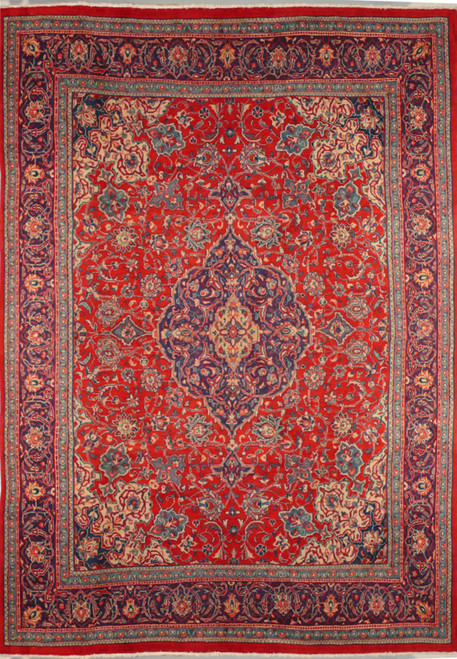

9'6" x 13'5" Persian Najafabad Rug | Crimson Field, Navy Star Medallion, Cream Spandrels | Semi-Antique
Najafabad sits a few miles west of Isfahan and weaves the Isfahan pattern, and this 9'6" x 13'5" rug is the pattern in full: a 16-point navy star medallion on a crimson field covered edge to edge in Shah Abbas palmettes, butter cream spandrels in the 4 corners, and a wide midnight navy border of carnations and blossom sprays. It was knotted in wool on a cotton foundation about 40 years ago at 180 to 220 knots per square inch, and it has never been on a floor: the pile is full and even across the whole surface, the ivory cotton fringes are clean, one selvage carries its original leather binding on the back, and the crimson has the settled depth that only decades give to good wool. A certificate of authenticity from Rugs.net accompanies the rug.
Design and Motifs
The medallion is built in rings. At the very center a small rosette in salmon, navy and ivory sits inside a ring of 16 pointed petals in navy and powder blue, and around that a lobed ivory star with 8 broad points carries gold and salmon blossoms on a chestnut vine. The outer ring is a great 16-point navy star, each point a lobed navy panel filled with a gold palmette, a crimson carnation and powder blue leaves, so that the medallion reads as a dark star on the red with a pale star at its heart. A tall ivory pendant hangs from the medallion on the vertical axis at each end, drawn as a lobed cartouche with a navy core and gold fronds, and beyond each pendant a smaller navy cartouche with an ivory palmette closes the axis. The crimson field around the medallion is the classic Isfahan all-over: a dense lattice of chestnut vines carrying large Shah Abbas palmettes in ivory and gold, lotus flowers, feathered saz leaves in powder blue and teal, small rosettes and buds, mirrored across both axes so that no patch of red is left plain. The 4 corners of the field are cut by butter cream spandrels with a scalloped inner edge, each one holding a powder blue and navy arabesque cartouche surrounded by gold vines and navy palmettes. A cream inner guard with a red and blue vine, then a navy guard with ivory blossoms, frame the field, followed by the midnight navy main border, which alternates large ivory carnations and lotus palmettes with sprays of ivory 5-petal blossoms on teal and olive stems. An ivory outer guard with a red and blue vine, a powder blue guard with navy rosettes and a plain crimson selvage complete the frame.
Colors of This Crimson and Navy Najafabad Rug
The field is a clear crimson red, brighter and cooler than the brick red of a village rug and a step lighter than a Kashan madder, and it reads as a strong, even red across the room because the palmettes on it are drawn in pale colors rather than dark ones. The medallion star, the main border and the pendant cores are a midnight navy that reads near black beside the red, and the same navy outlines every motif on the rug. The spandrels are a butter cream, warm and slightly yellow, and the palmettes and border flowers are an ivory a shade paler, so the light shapes on the rug come in two tones. Inside the flowers the palette runs through a mustard gold in the palmettes and the medallion fronds, a powder blue and a teal in the leaves, an olive green in the stems, a salmon pink in the medallion core and a few blossoms, and a chestnut brown for the vines. On the back the colors sit a shade lighter with no bleeding, and the knot rows are even and close.
Najafabad Weaving and the Isfahan Design
Najafabad is a town in the Isfahan province of central Persia, close enough to the city that its weavers work from the same cartoons and the same tradition, the curved line, the flowing vine and the star medallion that Isfahan has drawn since the Safavid court workshops of the 16th century. What Najafabad does differently is scale and price: where an Isfahan rug is woven small at 500 knots and above on silk, a Najafabad is woven room-size at 180 to 220 knots on cotton, in heavy wool pile that is meant to be walked on. The drawing survives the lower knot count because the motifs are drawn large, and the result is the look of an Isfahan medallion in a size and at a price the city itself rarely offers. A 40-year-old example that has never been used is as close to a new rug of that period as a buyer will find. Among 10x13 Persian rugs it is a piece for a living room or dining room where the medallion sits clear of the furniture and the red carries the room.