
"Cheap Persian Rug" — What Are You Actually Searching For?
Posted by Rugs.net on Apr 26th 2026

6'6 x 6'9 Signed Erami Persian Qum Pure Silk Rug, 1000 KPSI. · Millions of knots. Years of a human life. Cannot be copied. Cannot be cheapened.
Every day, thousands of people type the words “cheap Persian rug” into a search engine. They want something real. They want a handmade rug, they want it to be Persian, and they want to pay as little as possible for it. This is an understandable human impulse. It is also, when you understand what a Persian rug actually is, a category error on the same level as searching for a budget Patek Philippe or a discounted hand-built Maybach.
The issue is not affordability. Genuine Persian rugs exist at many price points, and some of them are genuinely accessible to buyers with ordinary budgets. The issue is the word cheap. Cheap implies that the value of the object is lower than its asking price. Applied to a handmade Persian rug, the word cheap is simply inaccurate. Once you understand what the object actually is, what went into it, what it will do over the decades you own it, and what happens to its value over time, the right word is not cheap. The right word is undervalued.
This article is about that distinction. It is also about the real costs that go into putting a genuine Persian rug in front of you: not just the weaver’s years of labor, but the documentation, the shipping, the storage, the expertise, the infrastructure, and the commitment to service that a legitimate specialist brings to every single piece. All of that is included in the price. None of it is cheap. And all of it is worth it.
The Rolex and the Maybach
A Rolex Submariner is not expensive because the company charges too much. It is expensive because of what goes into making it. Precision machining. Proprietary alloys. Movements assembled by hand to tolerances measured in microns. Decades of engineering refinement. Quality control that rejects any component that does not meet standards most manufacturers have never attempted. You are not paying for a brand. You are paying for an object whose creation required extraordinary skill and extraordinary care, and whose market value reflects that honestly.
A Maybach is not expensive because the manufacturer is greedy. It is expensive because every surface, every mechanism, every material was chosen for its quality rather than its cost. The people who built it had a skill that took years to develop. The materials they used were sourced for their properties, not their price. The result is an object that does what it does better than almost anything else, and will continue to do so for decades.
A Persian rug is not expensive for any different reason. A weaver sat at a loom and tied individual knots, one at a time, around the foundation threads, for months or years. Every knot was placed by a human hand. Every color choice was made by a human mind. Every design decision reflected a tradition developed over centuries and transmitted between generations of weavers who understood it as a living art form. The object you are looking at took a human life to produce. Not metaphorically. Literally: a significant portion of a human being’s working life went into it. The price reflects that. It does not inflate it. It reflects it.
“Millions of attempts. Never once repeated. Every rug that has ever been woven is the only one of itself that has ever existed or ever will exist. That is not marketing language. That is a material fact about the object.”
Rugs.net · Direct Importer, Freeport New York
Machine-made rugs, synthetic rugs, polypropylene floor coverings with Persian-inspired patterns: these are not cheaper versions of the same thing. They are a completely different category of object. Every major rug-producing country, every synthetic textile manufacturer, every mass-production facility has attempted to replicate the Persian handmade rug. None of them has succeeded. The knot density cannot be reproduced at scale. The natural wool cannot be replaced by synthetic fiber without losing what makes it valuable. The design tradition cannot be fed into an algorithm without losing the human intelligence that makes it meaningful. A million copies, and not one of them is the thing itself.
Knot by Knot: What It Actually Takes
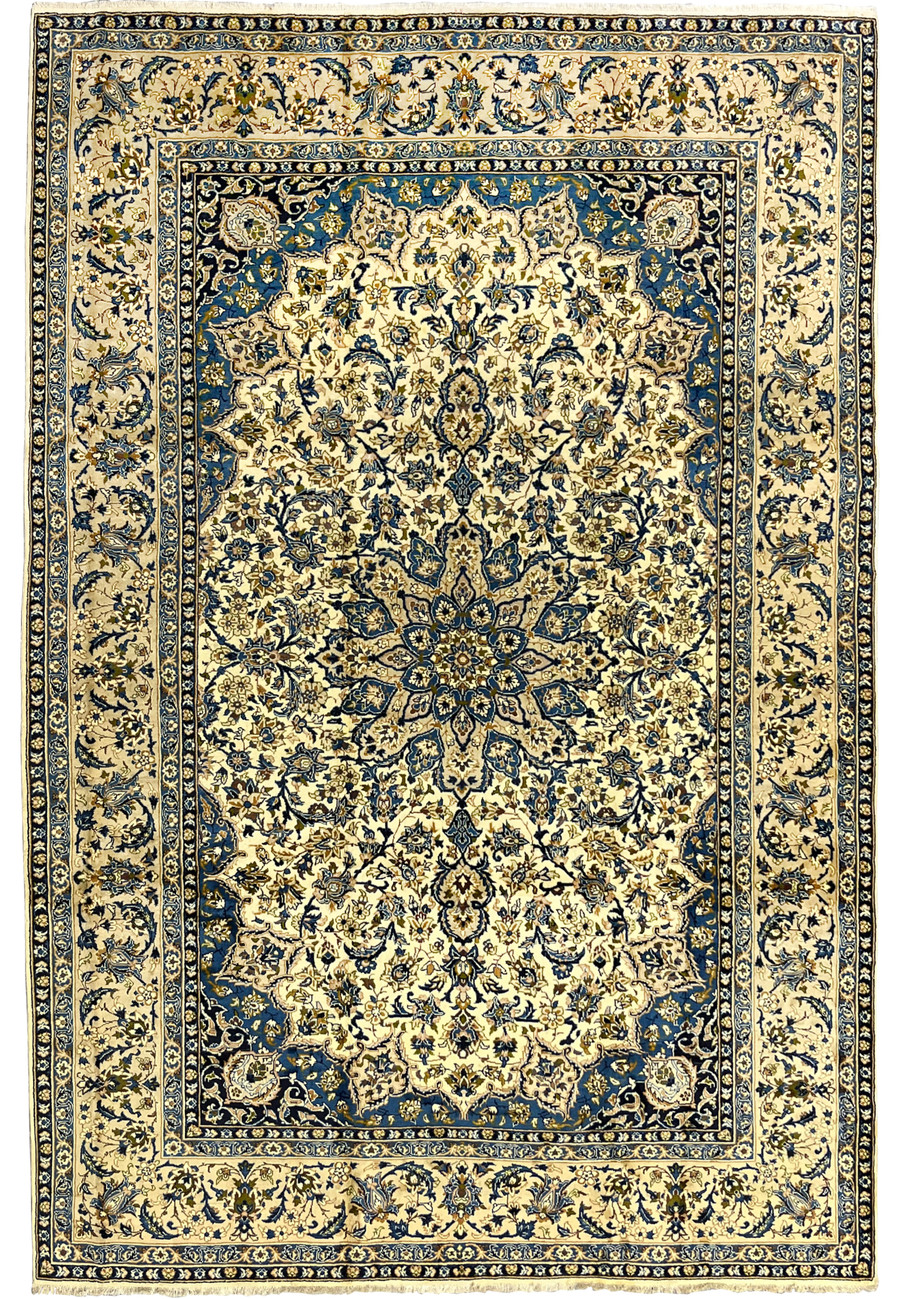
10'2 x 14'3 Persian Kashan Rug. At 150 knots per square inch, this rug contains approximately 22 million individual hand-tied knots. A skilled weaver working full-time tied around 10,000 knots per day. At that rate, this rug took roughly six years to complete.
Here is the arithmetic that the word cheap ignores. A skilled Persian rug weaver working full-time can tie between 8,000 and 14,000 knots per day depending on the complexity of the design and the fineness of the work. A standard Persian Kashan at 150 knots per square inch in a 9 x 12 format contains approximately 19 million individual hand-tied knots. At 10,000 knots per day, that is 1,900 days of work. Over five years, full-time, to produce one rug.
A fine Nain 6 LA at 350 KPSI in the same format contains roughly 45 million knots. Over twelve years of full-time work. A signed Qum silk rug at 1000 KPSI in a 3 x 5 format contains over 21 million knots of silk, each requiring more precise technique than wool, taking up to eight years for that single small piece.
These are not approximations for effect. They are the actual numbers. The price of any genuine handmade Persian rug is, at its core, the price of that human time and skill, plus the cost of the materials, plus the cost of getting it to you. When you look at the number and think it seems high, the right question is not “why is this so expensive?” The right question is “how is this not more?”
And then consider the trajectory. A quality handmade Persian rug does not depreciate. It ages. It develops patina. The colors deepen and shift in the way that natural dyes do over decades. Antique pieces from the great weaving workshops of the 19th century sell at major auction houses for multiples of what they cost when new. The object you buy today for a price that feels significant will almost certainly be worth more, not less, in twenty years. No machine-made rug has ever appreciated in value. Not one.
The Real Cost of Getting It to You
The rug’s craftsmanship is one cost. The cost of making it available to you is another. Most people who think about rug prices think only about the first. The second is substantial, and it is why the price of a genuine Persian rug from a legitimate specialist is what it is, regardless of how efficient that specialist tries to be.
Rugs are heavy. A quality 9 x 12 Persian rug in kork wool can weigh 60 to 80 pounds. Shipping costs for objects of that weight have risen significantly with fuel prices and in the current economic environment show no sign of reversing. We absorb those costs entirely. Every rug at Rugs.net ships free to all 50 states, including Alaska and Hawaii, no minimum purchase, no exceptions. That is not a promotional offer. It is our permanent policy. But it is not free to us. The cost is real and it is included in the price of the rug.
Tariffs on imported goods have increased the cost of bringing rugs into the country. Importing costs more today than it did two years ago and significantly more than it did five years ago. We absorb this too, because we are a direct importer and because passing every cost increase directly to the customer is not how we operate. But these costs exist and they are reflected in the price of every piece we carry.
We are based in Freeport, New York. Not in a remote warehouse in a low-cost state where operating expenses are minimal. New York. One of the most expensive states in the country to operate a business. The cost of storing tens of thousands of square feet of high-value inventory in the New York metro area is not comparable to storing the same inventory in a rural distribution center in a low-cost state. That overhead is real and it is part of what we manage so that we can offer you a genuine specialist’s level of service and expertise from a location that allows us to operate with the standards we believe in.
And then there is the documentation. Every single rug at Rugs.net is photographed from multiple angles, in controlled light, showing the full face, the detail areas, the border, and where relevant the back. Videos are produced for significant pieces. Every specification, from knot density to foundation material to pile fiber to origin, is documented and verified before a listing goes live. This is not a perfunctory process. It is a substantial investment of time and expertise that we make for every rug because we believe you deserve to know exactly what you are buying before you buy it. That belief has a cost too.
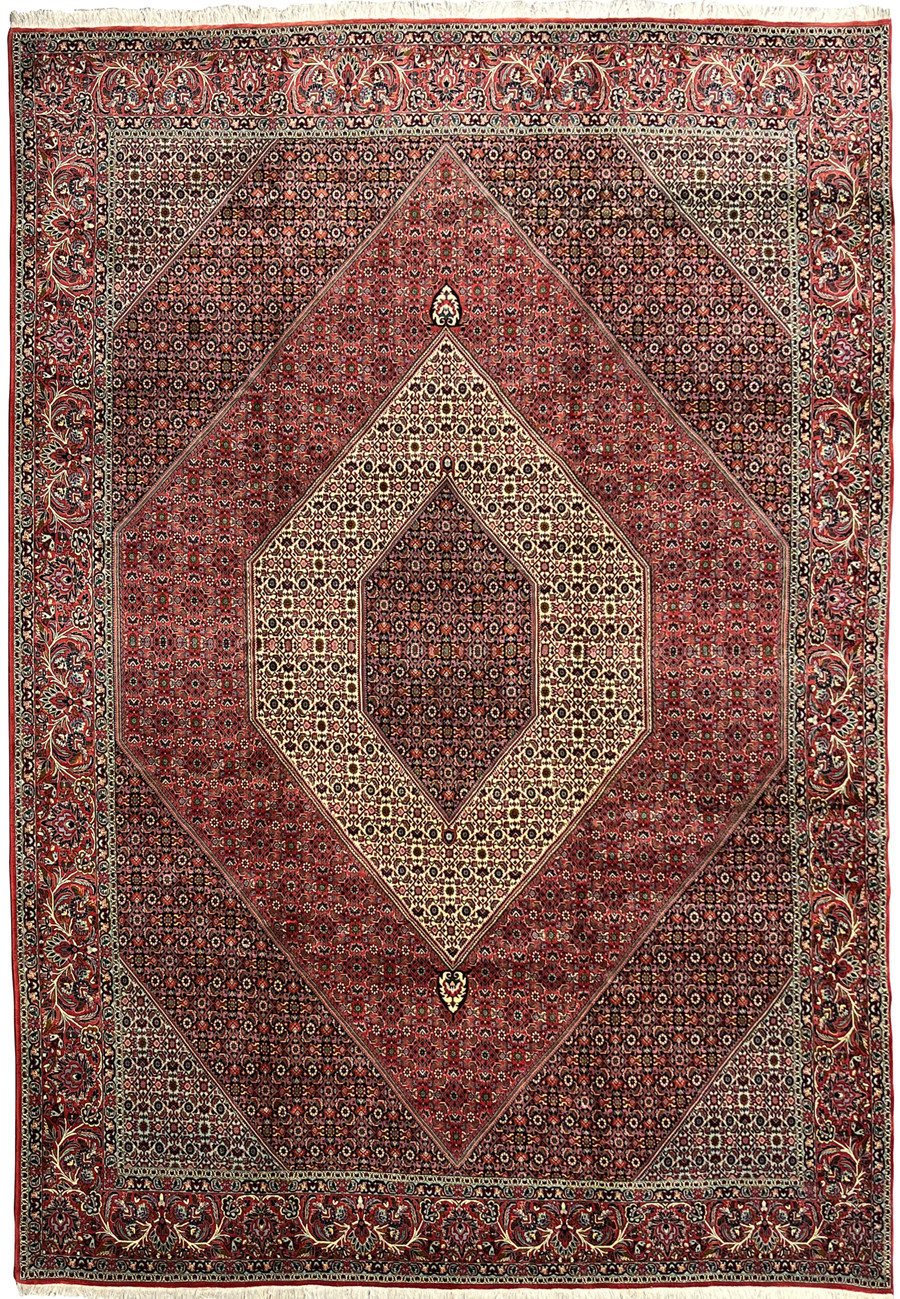
9'8 x 13'7 Persian Bijar Iron Rug. This rug was photographed, documented, catalogued, stored in New York, and will ship free to your door anywhere in all 50 states with free returns included. Every one of those steps has a real cost that is part of what you are paying for.
What is included in the price of every rug at Rugs.net:
✓ Professional photography and video documentation of every piece
✓ Expert verification of origin, construction, materials, and knot density
✓ Storage in a specialist facility in the New York metropolitan area
✓ Free shipping to all 50 states including Alaska and Hawaii, regardless of weight
✓ Free returns with home pickup, no questions, no restocking fees
✓ Ships within 24 hours of purchase
✓ A 10% price beat guarantee on any comparable piece
How Can Decades of History Be Cheap?
The weaving traditions of the great Persian cities, Kashan, Isfahan, Tabriz, Nain, Qum, Bijar, were not established in the last decade. They were established over centuries. The arabesque floral pattern that appears in a Kashan rug today was developed and refined by generations of designers and weavers whose innovations compounded across hundreds of years of unbroken tradition. The Herati pattern in a Bijar rug. The Gombadi medallion in a Nain. The Mahi fish lattice in a Tabriz. These are not designs that were created. They are designs that evolved, over timescales no individual person lived long enough to witness in full.
When a master weaver in Isfahan sits down to execute a Seirafian design today, they are working within a design language that was already ancient when the 20th century began. The knowledge of how to do this, the hand memory, the understanding of color and proportion and pattern, was transmitted to them across generations. It cannot be downloaded, generated, or mass-produced. It exists only in the people who carry it, and those people are fewer with every generation that passes.
This is what you are buying when you buy a genuine Persian rug. Not just an object. A physical manifestation of a continuous human tradition stretching back further than most countries have existed. The history is not an abstraction or a marketing claim. It is literally woven into the structure of the thing. Every design decision reflects it. Every color choice sits within it. The object could not have been made by someone outside that tradition, no matter how technically skilled.
How can that be cheap? The more useful question is why it is not more expensive. The honest answer is that it probably should be.
A Million Copies. Never Once Repeated.

8'2 x 11'2 Signed Paradies Persian Tabriz Rug. This is the only one of this rug that has ever existed. Not a limited edition. Not one of a short run. The only one. The weaver made decisions at every step that no other weaver made in the same way at the same moment. It cannot be reproduced. It is, by definition, irreplaceable.
The entire history of global manufacturing has been an attempt to solve the problem of scarcity by replication. Find something people want, build a machine that can make it repeatedly and cheaply, and sell volume. This model works for almost everything. It has never worked for genuine handmade Persian rugs, and a century of trying has not changed that.
Machine-made rugs with Persian patterns exist at every price point from $29 to $2,000. Turkish mass-production has attempted to replicate Persian city rug designs. Chinese workshops have produced Persian-pattern rugs at scale. Indian manufacturers have created lines marketed as “hand-knotted in the Persian tradition.” None of them has replicated what a genuine Iranian workshop produces. The density is not the same. The materials are not the same. The dye quality is not the same. The design intelligence is not the same. The result looks similar in a photograph and completely different in a room, in natural light, after five years of use.
But even beyond the quality comparison, there is a fact about genuine handmade Persian rugs that no copy addresses: every piece is unique. Not in the marketing sense. In the literal sense. No two handmade rugs are identical even when they were made from the same cartoon in the same workshop by the same weavers. The slight variation in tension between individual knots. The minor difference in dye lot between sections of the same color. The tiny irregularity in pattern that any honest weaver will tell you is not a defect but a signature of the human hand. These variations are called abrash, and collectors have understood for centuries that they are not imperfections. They are proof.
Proof that this object was made by a person and not by a machine. Proof that it exists once and will not exist again. A million pattern copies have been produced. The original has been woven once. It is sitting on a floor or hanging on a wall somewhere in the world, and there will never be another one exactly like it. This is what art means. This is what genuine Persian rugs are.
Affordable Is Not Cheap. Undervalued Is Not Expensive.
None of this means that genuine Persian rugs are out of reach for the ordinary buyer. They are not. The range of prices within authentic handmade Persian rug production is enormous. A quality Hamedan village rug or a Gholtogh tribal piece at a direct importer price is accessible to buyers who would never consider a gallery. A Sarough or a mid-grade Tabriz at direct importer pricing gives you a rug that will last your children’s lifetime at a price most families can absorb without difficulty.
The difference between a direct importer like Rugs.net and a gallery is specifically this: we have removed three to five layers of markup between the weaver and you. A rug that costs $600 at the source and $6,000 in a gallery costs what it costs because each person in the chain between those two points added their margin. We have shortened the chain. The rug is the same. The price reflects reality rather than accumulated markups.
So the right question is not “how do I find a cheap Persian rug?” The right question is “how do I find a genuine Persian rug at a fair price from a source I can trust?” Those are completely different searches, and the second one has a clear answer: buy directly from a specialist importer who can verify what they are selling, describe it accurately, and stand behind it with free returns and real customer service.
The Vocabulary of Value
Cheap
Does not apply to genuine Persian rugs. The word implies the price exceeds the value. For a handmade rug that took years to produce and will last a century, no honest price can exceed the value.
Affordable
Means the price is within your budget. This applies to genuine Persian rugs at many price points, particularly from direct importers who have removed gallery markups from the chain.
Undervalued
The most accurate word for most genuine Persian rugs in the current market. An object that took years to make, will last a century, and will be worth more in twenty years than it costs today is not expensive. It is undervalued.
Find Your Rug at a Fair Price
Every rug at Rugs.net is 100% authentic, accurately described, and priced at direct importer rates with no gallery markup. Free shipping to all 50 states. Free returns. Ships within 24 hours. A 10% price beat guarantee on any comparable piece.
The complete collection. Every piece authentic, hand-knotted, and accurately described.
From Iran. Kashan, Isfahan, Nain, Tabriz, Bijar, Qum, Mashad, Hamedan, Sarough and more.
5x7, 6x9, 7x10. The most accessible size range. Real rugs at accessible prices.
Authentic handmade Persian rugs at reduced prices. Not cheap. Undervalued.
By origin: Hamedan, Gholtogh, Baluch, Sarough, Kashan, Isfahan, Bijar Iron Rugs, Qum Silk. By size: 3x5, 5x7, 8x10, 9x12, large rugs, runners.