How to Tell a Fake Persian Rug From the Real Thing
Posted by Rugs.net on Apr 14th 2026
Every year, billions of dollars worth of machine-made rugs are sold with language that implies, suggests, or directly claims that they are handmade Persian rugs. Some of this is deliberate fraud. More often it is aggressive ambiguity: terms like “Persian-style,” “hand-crafted,” “oriental design,” and “heirloom quality” applied to factory products that share nothing with a genuine Persian rug except a vaguely similar pattern printed onto synthetic fiber.
The average buyer walking into a furniture store, scrolling through a marketplace, or even visiting a rug gallery cannot reliably distinguish a $150 machine-made rug from a $3,500 handmade one. The patterns can look nearly identical at a glance. The colors can be close. Even the pile height can be similar. The differences are physical, structural, and detectable, but only if you know where to look.
This guide gives you four specific tests you can perform on any rug in under two minutes, using nothing but your hands and eyes. You do not need expertise. You need to know what to look for.
Why This Matters: What You Are Actually Paying For
A genuine handmade Persian rug is made by a human being tying individual knots of wool or silk around the foundation threads of a loom, one knot at a time, across the entire surface of the rug. A 9 x 12 city rug might contain 20 to 30 million individual hand-tied knots and take one to three years to complete. What you pay for is that labor, those materials, and that time.
A machine-made rug is produced on a power loom at a rate of hundreds of square feet per hour. The “pile” on most machine-made rugs is not knotted at all, it is tufted: a mechanical gun punches synthetic yarn through a backing fabric, and the whole thing is held together with latex glue. The backing holds the pile in place because there is nothing else holding it.
These are not two versions of the same product. One is a permanent object with a potential lifespan of 100+ years. The other is a consumable with a lifespan of 3 to 7 years. Paying $1,200 for a machine-made rug because it was described as “handcrafted” or “Persian-inspired” is one of the most common and expensive decorating mistakes people make.
What the Terms Actually Mean
“Hand-knotted”
The real thing. Every knot tied by a human hand. No backing. Pattern visible on both sides. This is what Rugs.net sells exclusively.
“Hand-tufted” or “handmade”
Not hand-knotted. A mechanical gun punches yarn through a backing by hand. Always has a latex glue backing. Sold as “handmade” in a technically legal but profoundly misleading way. Lifespan 5 to 10 years.
“Persian-style” / “Oriental-inspired” / “Traditional design”
Machine-made in synthetic fiber with a pattern derived from Persian designs. Not handmade. Not Persian. Not a rug in any traditional sense of the word.
“Authentic Persian rug” / “Hand-knotted Persian”
Should mean what it says. But this language appears on fraudulent products too, which is exactly why you need the four tests below.
Test One: Flip the Rug Over
This is the single most reliable test, and it takes five seconds. Pick up the corner of the rug and look at the back.
On a genuine hand-knotted rug, the back looks almost exactly like the front. You can see the pattern. You can see individual knots. The back of the rug is a mirror of the front because the knots pass completely through the foundation and are tied on the back side. There is no backing material. What you see is the raw structure of the rug itself.
Real Hand-Knotted Rug: Back View
✓ Pattern clearly visible on the back
✓ Individual knots visible as small bumps or loops
✓ No backing material, canvas, or glue layer
✓ Warp threads (the foundation) visible running through
✓ Back feels like the front, slightly flatter, no slippery coating
Fake / Machine-Made Rug: Back View
✗ Back is completely different from the front
✗ A canvas, jute, or synthetic fabric backing is glued on
✗ Pattern either absent or only faintly visible
✗ Back feels smooth, stiff, or waxy from the latex
✗ May have a printed or woven label sewn into the backing
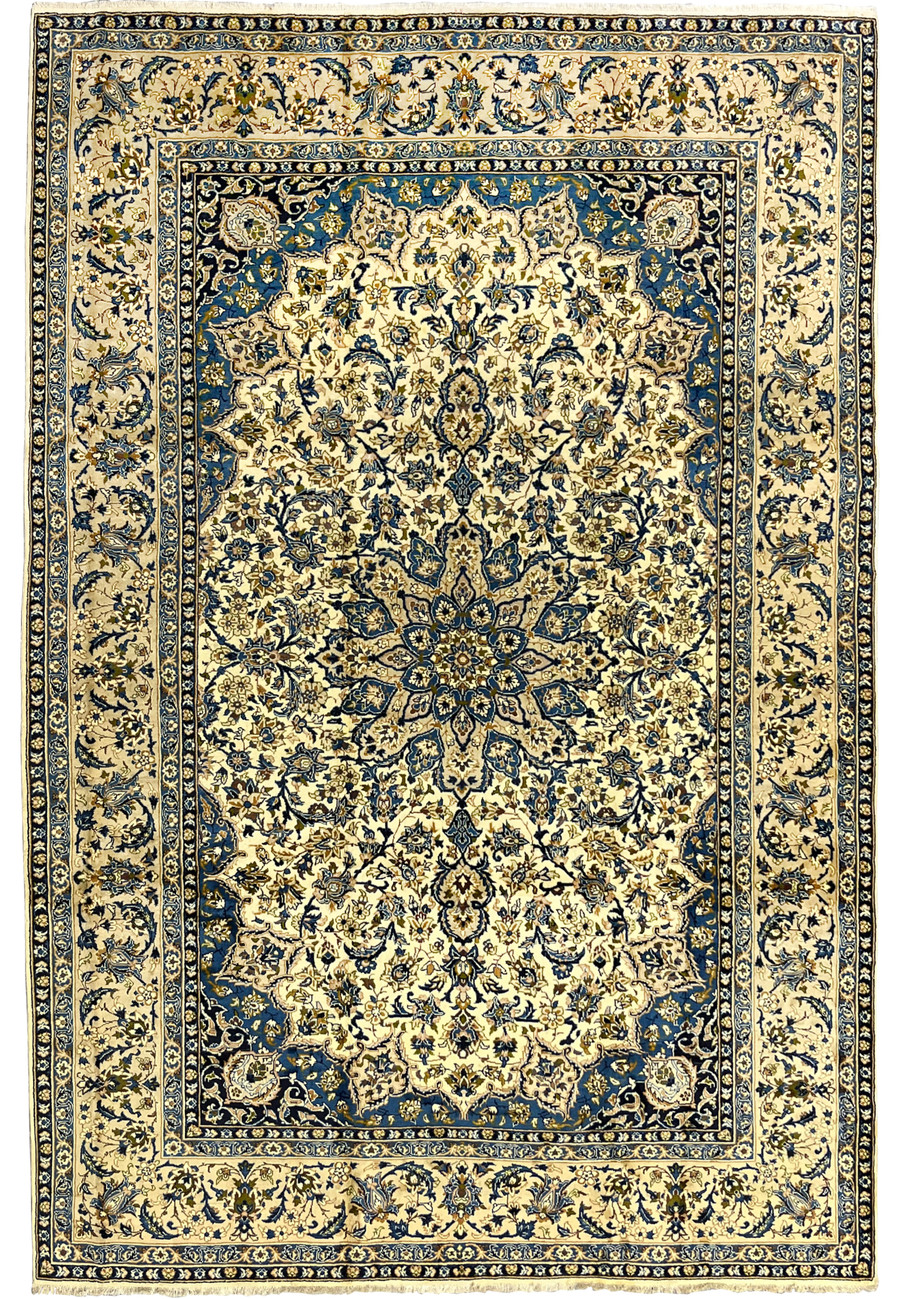
10'2 x 14'3 Persian Kashan Rug with Ivory Field and Navy Medallion. On the back of this rug, every knot is individually visible and the pattern on the reverse mirrors the front almost exactly. This is impossible to replicate on a machine-made or hand-tufted piece.
The test in one sentence: If you can see the pattern on the back and there is no backing material, it is hand-knotted. If the back has a fabric or rubber layer glued on, it is not.
Test Two: Count the Knots
With the rug flipped over, look closely at the back surface. On a hand-knotted rug you will see individual knots, rows upon rows of them, running across the width of the rug. They are not perfectly uniform. They are the work of human hands, and the slight variation between them is normal and expected.
KPSI, knots per square inch, is the standard measurement of a rug’s density. You can estimate it yourself by counting the number of knots in one inch along the back, then counting the rows in one inch across, and multiplying.
What the Knot Count Tells You
| KPSI | What It Means | Typical Type |
|---|---|---|
| 0 | No knots visible. Backing present. | Machine-made or hand-tufted. Not authentic. |
| 40 to 80 | Knots clearly visible, relatively large | Hamedan, Gholtogh, village rugs. Genuine, durable, affordable. |
| 100 to 200 | Fine, even knotwork, good design clarity | Kashan, Tabriz, Mashad. Standard city rug quality. |
| 200 to 400 | Very fine, dense, intricate pattern resolution | Isfahan, Nain 6 LA. Fine city rug production. |
| 400 to 900+ | Extremely fine, almost invisible individual knots | Qum silk, signed masterworks. Collector level. |
On a hand-tufted rug, there are no knots to count because there are no knots. The yarn was punched through a backing, not tied around a foundation thread. On a machine-made rug, the back surface will be uniform and fabric-like with no visible knot structure at all. If you cannot see individual knots on the back of a rug that was sold to you as handmade, it is not handmade.
Test Three: Look at the Fringe
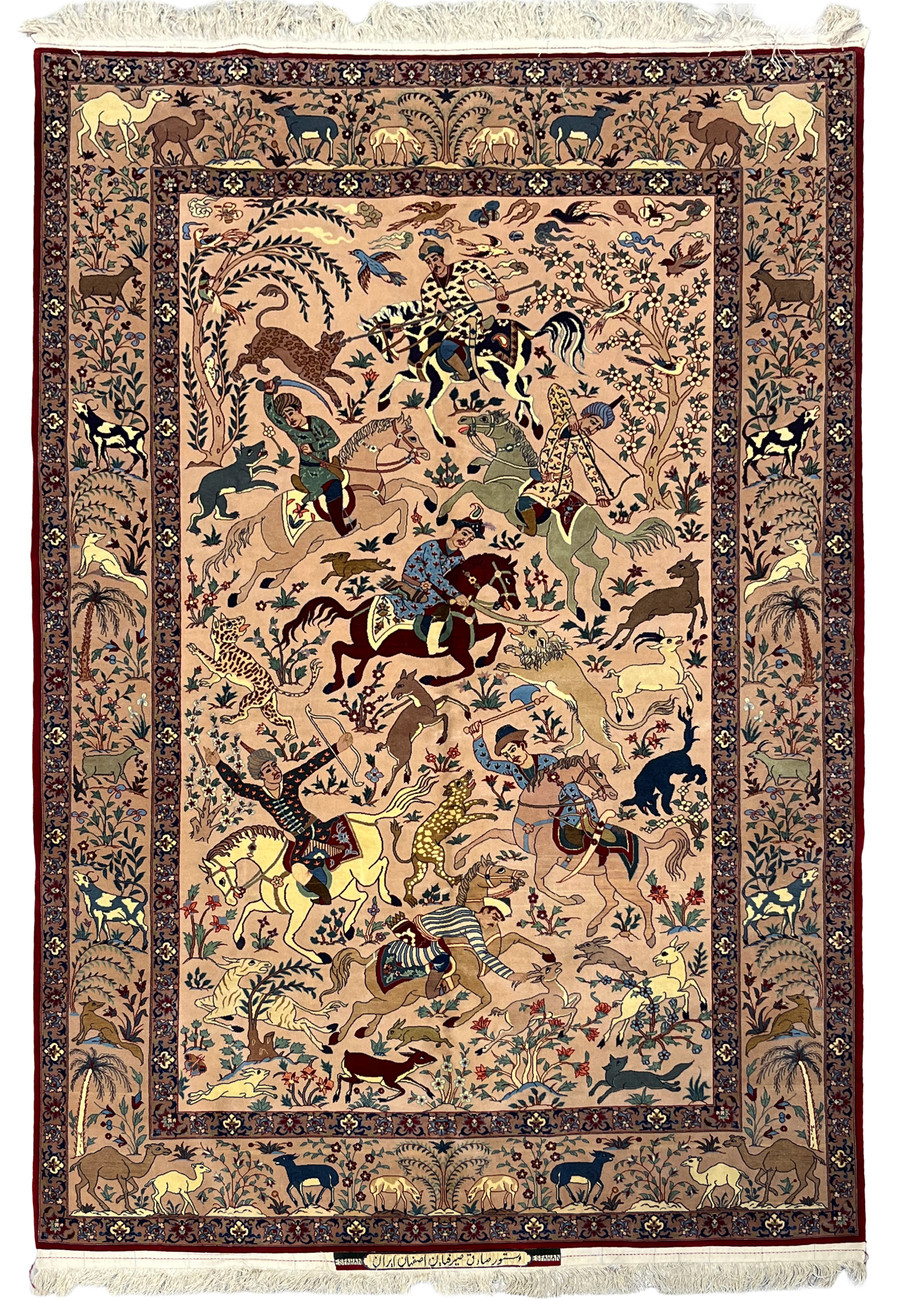
5x8 Persian Isfahan Signed Seirafian Rug, Shikargah Hunting Scene. The fringe on this authentic Persian Isfahan is not decorative trim. It is the literal end of the warp threads that the rug was woven onto, emerging from the body of the rug as a structural continuation of the foundation.
The fringe on a genuine hand-knotted rug is not decoration. It is the continuation of the warp threads, the vertical foundation threads that the knots are tied around. When the rug is cut from the loom, the warp threads are left to extend from both ends. That extension is the fringe. It is made of the same material as the rug’s foundation, typically cotton or wool, and it emerges directly from the body of the rug.
On a machine-made or hand-tufted rug, there are no structural warp threads to extend into fringe. So fringe is sewn on as decoration, either glued or stitched onto the end of the backing fabric. It looks similar from a distance. Up close, the difference is unmistakable.
Authentic Fringe
Grows out of the rug body itself
Same fiber as the rug foundation (cotton or wool)
You can trace each fringe thread back into the rug structure
Slightly irregular spacing, as woven by hand
Applied / Fake Fringe
Sewn or glued onto the end of the backing fabric
Often a different, cheaper material than the rug
A seam or stitching line visible at the attachment point
Perfectly uniform spacing, machine-applied
Gently pull one fringe thread at the end of the rug. On an authentic hand-knotted rug, the thread goes into the body of the rug and you feel resistance from the foundation. On a rug with applied fringe, the thread detaches from the rug’s body and you feel nothing but the backing fabric.
Test Four: Touch the Pile and Check the Fiber

8'2 x 11'2 Signed Paradies Persian Tabriz Rug. The kork wool pile of this signed Tabriz contains natural lanolin, which gives it a warmth and softness that no synthetic fiber replicates. Run your hand across the pile and back: the light play and directional sheen are characteristic of natural wool.
Genuine Persian rugs use natural wool, kork wool, or silk. Fake or machine-made rugs almost always use polypropylene, polyester, or nylon. These fibers look and feel genuinely different, and with a little practice you can feel the difference within seconds of touching a rug.
Natural wool contains lanolin, a waxy natural fat produced by sheep, which gives the fiber a warmth and slight resistance to your hand that synthetic fiber does not have. Polypropylene feels slick, cool, and slightly waxy in a different way, the way a plastic bag feels compared to a cotton shirt. Silk is unmistakable: cool, smooth, and luminous, with a directional quality that changes color as you move your hand across it.
The Burn Test (for absolute certainty)
Pull a single fiber from the pile or fringe of the rug. Hold it with tweezers and touch the end to a flame.
Wool or silk:
Burns slowly, self-extinguishes when the flame is removed, leaves a brittle ash that crumbles, and smells of burning hair. This is the smell of keratin, the protein in natural fiber.
Polypropylene or polyester:
Melts rather than burns, continues melting after the flame is removed, leaves a hard bead of plastic residue, and smells chemical. There is no mistaking this smell for natural fiber.
The burn test is definitive and requires no expertise. You need only a single fiber pulled from anywhere on the rug. If the seller will not allow you to pull one fiber, that is itself a significant warning sign.
The Quick Comparison: Real vs. Fake at a Glance
| What to Check | Authentic Hand-Knotted | Machine-Made / Hand-Tufted |
|---|---|---|
| Back of rug | Pattern visible, knots visible, no backing | Fabric or rubber backing glued on, pattern absent |
| Knot count (KPSI) | 40 to 900+, countable on the back | Zero knots. No knot structure visible. |
| Fringe | Grows from rug body, is the warp thread | Sewn or glued on. Seam visible at attach point. |
| Fiber material | Wool, kork wool, or silk | Polypropylene, polyester, or nylon |
| Burn test | Burns like hair, self-extinguishes, brittle ash | Melts, stays melted, hard plastic bead, chemical smell |
| Pattern irregularity | Slight human variation across the field | Machine-perfect uniformity throughout |
| Weight | Heavy for its size (dense knotwork and natural fiber) | Lighter than expected, or heavy only due to thick backing |
| Lifespan | 50 to 200+ years | 3 to 10 years |
Red Flags When Buying: Language That Should Make You Stop
Beyond the physical tests, the language used to describe and sell a rug tells you a great deal about what you are actually buying. These are the phrases that should make you ask hard questions before handing over money.
“Persian-inspired,” “Persian-style,” “Traditional design” These are explicit statements that the rug is not Persian and is not traditional. The “inspired by” construction is specifically designed to evoke something the product is not.
“Handcrafted,” “artisan-made,” “hand-loomed” None of these terms mean hand-knotted. “Handcrafted” can legally be applied to almost anything. “Hand-loomed” often refers to flatweave production on a loom that a human operates, which is not knotted pile. Ask specifically: is this hand-knotted?
“Heirloom quality,” “built to last generations” Applied to machine-made or hand-tufted rugs, these are false claims. A hand-tufted rug with a latex backing will begin to deteriorate within a decade. It will not last generations.
“Wool blend,” “wool-look,” “soft fiber” Not wool. These terms are used when the product contains little or no natural wool. “Wool blend” can legally mean 5% wool and 95% polypropylene.
Inability to show the back of the rug Any legitimate seller of a genuine hand-knotted rug will show you the back without hesitation, because the back is proof of authenticity. If a seller resists showing the back, refuses to allow a fiber sample, or becomes evasive when you ask about knot structure, treat that as a decisive signal.
Why Buying From a Direct Importer Removes All of This Risk
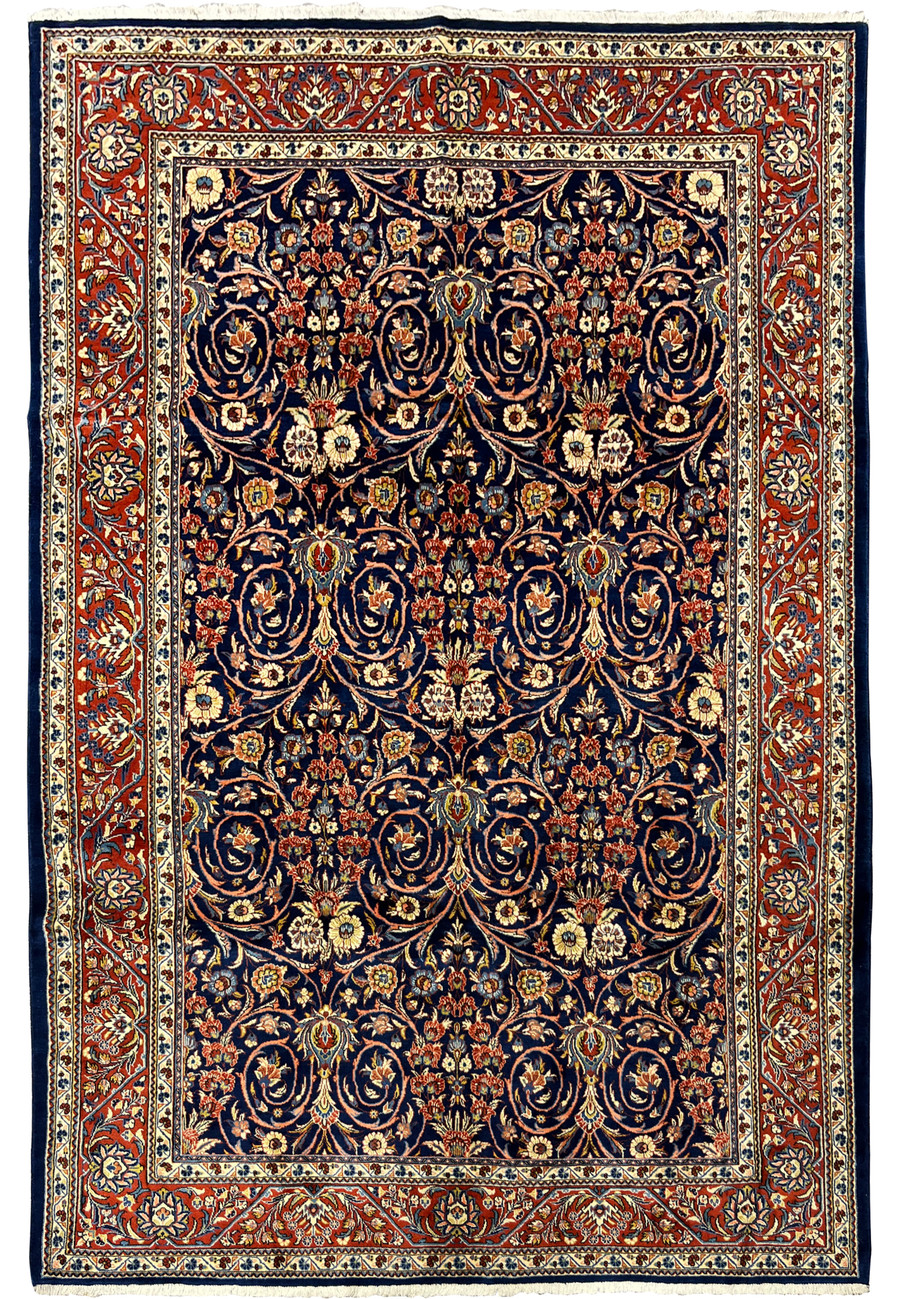
7'2 x 10'8 Floral Persian Sarough Rug. When a rug comes directly from the importer who sourced it in Iran, every claim about its origin, construction, and quality can be verified. There is no chain of middlemen with incentives to obscure the truth.
The fraud and misrepresentation that exists in the rug market is largely a product of the traditional retail chain. A rug passes from weaver to exporter to importer to dealer to gallery, and at each step the incentives to exaggerate provenance and minimize honest description increase. By the time a rug reaches a retail floor, the person selling it may genuinely not know where it came from or how it was made.
Rugs.net is a direct importer based in Freeport, New York. We source every rug directly from dealers and workshops in Iran, Turkey, Afghanistan, India, and other rug-producing countries, and we sell directly to you. We stock only genuine hand-knotted rugs because that is the only kind we buy. Every rug description on our site accurately states the origin, construction, and materials because we know the origin, construction, and materials firsthand.
Every rug at Rugs.net also comes with free returns. If you receive a rug and the back does not show what it should show, if the fringe is applied rather than structural, if anything about the piece does not match the description, send it back at no cost. We have never had a return for misrepresentation because we do not misrepresent. But the guarantee exists so that you can buy with complete confidence.
Shop Authentic Hand-Knotted Persian Rugs
Every rug at Rugs.net is 100% authentic and 100% hand-knotted. Direct importer pricing. Free shipping all 50 states. Free returns. Ships within 24 hours.
100% authentic, from Iran. Every piece described accurately. Direct importer pricing.
Kork wool and silk. 200 to 400 KPSI. Among the finest Persian city rug production.
Habibian-signed 6 LA pieces in kork and silk. 300 to 500 KPSI.
Wet-beaten construction. The most durable hand-knotted rug ever made. 100+ year lifespan.
The iconic Persian medallion. Classic crimson and navy. Workshop precision.
Pure silk at 700 to 900 KPSI. Museum-quality. The burn test will leave no doubt.
Also browse: Tabriz, Mashad, Hamedan, Sarough, oriental rugs, clearance.