

Persian Kashan Rugs: History, Designs, and Buying Guide
Posted by Rugs.net on May 3rd 2026

If you know one Persian rug, you probably know a Kashan. The crimson red field, the midnight navy medallion, the dense arabesques, the refined layered border: this is the image that most people carry in their mind when they think of a Persian rug. The Kashan is not just a popular rug. It is the archetype. The design language it established became the visual grammar of the entire Persian city rug tradition.
But the Kashan is far more complex and more varied than its archetype suggests. There are antique Kashans worth hundreds of thousands of dollars and commercial Kashans worth hundreds. There are Kashans in green, ivory, slate blue, gold, and charcoal. There are Kashans with allover patterns and Kashans with single central medallions. There are signed Kashans from specific master workshops and unsigned production pieces from the large commercial ateliers. Understanding the differences matters enormously, both for what you pay and for what you get.
This guide covers everything: the history of Kashan weaving, the classic and less common designs, the construction standards, the difference between antique and modern production, and what to look for when you buy. It is the most complete guide to Persian Kashan rugs available online.
The History of Kashan Weaving
Kashan is an ancient city in Isfahan Province, central Iran, located in the northern foothills of the Karkas mountain range at the edge of the Dasht-e Kavir desert. Its position on historic trade routes between the Persian Gulf and the Caspian Sea made it a commercial hub for centuries, and its access to mountain water in an otherwise arid landscape made it suitable for the intensive dyeing processes that fine rug production requires.
The Kashan weaving tradition is documented to at least the Safavid period (1501 to 1736), during which the city became one of the most important centers of Persian luxury textile production under royal patronage. The Safavid court demanded the finest possible rugs for palace interiors, and Kashan weavers responded by developing the technical standards, the design vocabulary, and the workshop organization that define the city’s production to this day.
The Ardabil Carpet, now divided between the Victoria and Albert Museum in London and the Los Angeles County Museum of Art and widely considered one of the finest rugs ever woven, is attributed to the Kashan workshops of the early Safavid period. Dating to approximately 1539 to 1540 and carrying a dedication inscription with the name of master weaver Maqsud of Kashan, it contains roughly 25 million hand-tied knots across its approximately 34 by 17 foot surface. It established a benchmark for Kashan production that weavers have been reaching toward ever since.
The tradition suffered a significant disruption in the 18th century as political instability in Persia reduced royal patronage and disrupted trade routes. The great Kashan workshops declined. Production fell in quality and quantity. For a period in the late 18th and early 19th centuries, Kashan was a shadow of its Safavid-era self.
The revival came in the second half of the 19th century, driven by surging European and American demand for Persian rugs. The Mohtasham family of weavers is credited with leading this revival, developing the refined floral arabesques, the precise medallion formats, and the kork wool pile quality that became the hallmarks of the late 19th and early 20th century Kashan production now prized by collectors as “antique Mohtasham Kashans.” By 1900, Kashan was again one of the dominant centers of Persian rug production, exporting heavily to Europe and North America.
How a Kashan Rug Is Built

9'10 x 13'3 Persian Kashan Rug, Red Field, Navy Medallion. Featured on Shark Tank. The classic Kashan composition: centralized medallion with pendant teardrops, arabesque floral field, layered guard borders framing a main border. Cotton foundation, kork wool pile. This is what 220 KPSI looks like in a room-scale rug.
Foundation: Quality Kashan rugs are woven on a cotton foundation. Cotton warp and weft threads provide the dimensional stability that formal city rug production requires: the rug holds its shape under loom tension, lies flat after washing, and maintains precise geometric alignment across its full length and width. A wool foundation, used in tribal production, would allow distortion that the Kashan’s formal symmetrical designs would make immediately visible.
Knot type: Kashan weavers use the Persian knot (Senneh knot), also called the asymmetric knot, which is tied around one warp thread and looped under the adjacent one. The Persian knot allows finer design resolution than the Turkish (Ghiordes) symmetric knot because it can be packed more densely. In a fine Kashan, the Persian knot enables the precise rendering of curvilinear arabesques and the gradation of petal forms that define the style.
Pile material: The finest Kashan rugs use kork wool, the soft undercoat fiber clipped from the neck and shoulder of the sheep. Kork wool is finer, richer in natural lanolin, and more lustrous than body fleece. It takes dye more deeply and evenly and develops a characteristic patina as it ages. Commercial-grade Kashan production often uses machine-spun wool or mixed-grade pile, which accounts for much of the quality variation within the Kashan market.
Knot density: Standard Kashan production runs between 120 and 200 knots per square inch (KPSI). Fine Kashan workshops produce pieces at 200 to 350 KPSI. The celebrated antique Mohtasham Kashans of the late 19th century regularly achieved 300 to 450 KPSI, which is why their design resolution approaches that of a woven painting. At higher knot densities, the arabesque scrolls can be rendered with a curve quality and interior detail density that lower-density production cannot achieve.
Pile height: Kashan pile is typically medium-low, shorter than a tribal rug and considerably shorter than a Tabriz pile. The lower pile height contributes to the crisp design resolution that Kashan production is known for: a higher pile would blur the fine arabesque outlines that are central to the style.
Kashan Construction at a Glance
Foundation
Cotton warp and weft
Pile
Kork wool (finest grades), wool
Knot type
Persian (asymmetric, Senneh)
KPSI range
120 to 450 (antique fine)
Pile height
Medium-low (6 to 9mm)
Fringe
Cotton, structural (not applied)
Classic Designs and Patterns
The Kashan design tradition is one of the most codified in Persian weaving. Certain compositional formats and pattern elements appear with great consistency across centuries of production, while individual workshops introduce variations that distinguish their output from competitors. Understanding these formats helps you read a Kashan rug the way a specialist does.
The Central Medallion Format
The most iconic and common Kashan composition features a central medallion surrounded by a dense arabesque floral field, with corner quarter-medallions (called lachak) that mirror the main medallion’s design. The medallion is typically oval or diamond-shaped and filled with elaborate palmette and arabesque motifs. Pendant teardrop forms called toranj hang from the ends of the medallion along its long axis.
The field surrounding the medallion is covered with an unbroken arabesque scroll: a continuous curvilinear vine system that spirals across the field, terminating in palmette blossoms, lance-shaped leaves, and compound floral forms. In a fine Kashan at 200+ KPSI, this arabesque system is rendered with the precision of a technical drawing, every spiral curve consistent, every blossom internally detailed. This level of design resolution is one of the primary markers distinguishing fine workshop production from commercial output.
The Allover Pattern

8'1 x 11'8 Vintage Persian Kashan, Steel Blue, Allover Format. This vintage piece uses the allover format: no central medallion, the arabesque floral system extends continuously across the entire field. The steel blue ground is rare in Kashan production and reflects the natural indigo dye palette of earlier production periods.
The allover format dispenses with the central medallion entirely, covering the full field with a continuous repeat of the arabesque floral system. This format appears in both historic and contemporary Kashan production and is particularly associated with certain antique pieces from the late 19th and early 20th century workshops. The allover format makes no single focal point of the composition and tends to read differently in a room: more immersive, less architecturally structured, better suited to furniture arrangements where the rug is partially covered by seating.
The Border System
The Kashan border is one of its most distinctive and consistently executed elements. A typical Kashan border consists of a wide main border flanked on both sides by narrow guard borders, the innermost of which is often a reciprocating vine pattern. The main border carries its own arabesque or palmette repeat, which harmonizes with the field design while maintaining a visual distinction from it.
In fine Kashan production, the border design is engineered to turn precisely at the corners so that the border pattern reads continuously around the rug without awkward mitering or pattern interruption at the corner. This corner resolution is technically demanding and is one of the marks of a skilled workshop: lower-grade production often shows visible discontinuities at the corner where the border pattern does not resolve cleanly.
The Shah Abbas Motif
Named after Shah Abbas the Great who patronized its development during the Safavid era, the Shah Abbas motif is a large stylized palmette with a distinctive radiating structure that appears repeatedly in Kashan fields and borders. It is to the Kashan what the Herati is to the Bijar: a signature motif so strongly associated with the tradition that its presence is one of the first indicators of Kashan origin.
The Shah Abbas palmette appears in several versions within the Kashan tradition, from highly complex multi-layered forms in the finest antique production to simplified versions in contemporary commercial pieces. The rendering quality of this motif, the number of internal petals, the precision of the surrounding leaves, and the regularity of the overall form, is one of the most reliable indicators of the quality level of a given Kashan rug.
The Kashan Color Palette: More Than Red and Navy
The red-and-navy Kashan is the archetype that most buyers know, and for good reason. It is the most common combination in Kashan production, historically grounded in the madder red and indigo blue dyes that were the primary colorants available to Persian dyers for centuries. But the Kashan color palette is considerably wider than this archetype suggests, and understanding it opens up options that many buyers overlook entirely.

6'7 x 9'10 Green Persian Kashan Rug. A green-field Kashan is one of the rarer color treatments in the tradition. Green was historically difficult to achieve in natural dyes at the depth and stability required for quality rug production. A green Kashan in good condition represents an unusual and highly distinctive alternative to the standard red or ivory ground.
Crimson and deep red fields with navy or dark blue medallions and borders: the archetype. Historically derived from madder root (rubia tinctorum) which produces a range of reds from orange-red to deep burgundy depending on the mordant. Modern versions use synthetic dyes that are more consistent but lack the depth variation of natural dye.
Ivory or cream fields with navy and rose accents: common in 20th century production and highly versatile in contemporary interiors. The ivory-field Kashan tends to read lighter and more neutral than the red-field version and works well in both traditional and transitional settings.
Steel blue or slate fields: less common in contemporary production, more associated with antique and vintage pieces. Blue-field Kashans use indigo as the dominant ground color, often with ivory, rose, and gold accents. These pieces have a distinctly different character from the red-ground tradition and are sought by collectors who want something outside the standard palette.
Green fields: historically the rarest treatment, because natural green in pile wool required layering yellow dye over blue in a process that could be unstable over time. Contemporary green Kashans use more reliable synthetic dyes. A genuinely antique green-field Kashan in sound condition is a collector’s piece.
Gold, ochre, and warm brown fields: appear in certain Kashan production periods and are associated with the warmer end of the madder dye range. These pieces tend to have a rich, autumnal quality and work particularly well in rooms with warm wood tones.
Within any field color, the Kashan palette always includes multiple accent tones: the arabesques are rendered in several tones of the complementary color, the leaves in various greens and ivories, the palmette interiors in contrasting accents. The richness of a Kashan color composition lies not in the number of colors but in the precision of their relationships across the design.
Antique, Vintage, and Modern Kashan Rugs
The Kashan market is unusually stratified by age. Pieces from different production periods have meaningfully different characteristics in terms of materials, design quality, dye type, and market value. Understanding where a piece falls in this chronology is essential to evaluating what you are looking at.
Antique Kashan (pre-1920, Mohtasham era and earlier)
The benchmark of the tradition. All-natural dyes: madder red, indigo blue, pomegranate yellow, walnut brown. Finest kork wool pile at 250 to 450 KPSI in the best examples. Design cartoons drawn by master designers working in the full Safavid tradition. These pieces represent the pinnacle of Kashan production and are priced accordingly: serious antique Mohtasham Kashans sell for tens to hundreds of thousands of dollars at auction. Their colors have a tonal richness and a patina, called abrash, that develops from slight lot variations in natural dyeing and that synthetic dyes cannot replicate. They are collector objects of the highest order.
Vintage Kashan (1920 to 1980)
The transition period. Early vintage pieces (1920 to 1950) may use natural or early synthetic dyes and still show high pile quality. Later vintage pieces (1950 to 1980) increasingly use synthetic aniline and chrome dyes, which produce more consistent color but lack the natural depth and tonal variation of madder and indigo. Knot density in vintage production ranges widely, from fine pieces at 200+ KPSI to commercial production at 100 to 150 KPSI. Vintage Kashans in good condition represent accessible collector quality and are highly sought in the current market as genuinely old handmade rugs at prices below antique levels.
Contemporary Kashan (1980 to present)
Produced in Kashan city workshops using modern synthetic dyes with consistent, vibrant color and available in the full traditional design range. The finest contemporary Kashan workshops use kork wool pile and achieve 150 to 250 KPSI, producing pieces of genuine quality that will age well. The broader commercial sector of contemporary Kashan production uses machine-spun wool at 100 to 150 KPSI with more standardized designs. These are still genuine handmade Persian rugs with 50+ year lifespans, but they do not have the material depth of fine kork wool production.
The practical implication for buyers: always ask the dealer about the age and dye type of a Kashan they are selling. A legitimate specialist will know and will tell you. The age determination matters not just for value but for what the rug will do over time: a natural-dye piece will develop and deepen with age, while a synthetic-dye piece will remain relatively stable. Both are valid choices; they simply have different trajectories.
The Great Workshops: Mohtasham and the Master Weavers
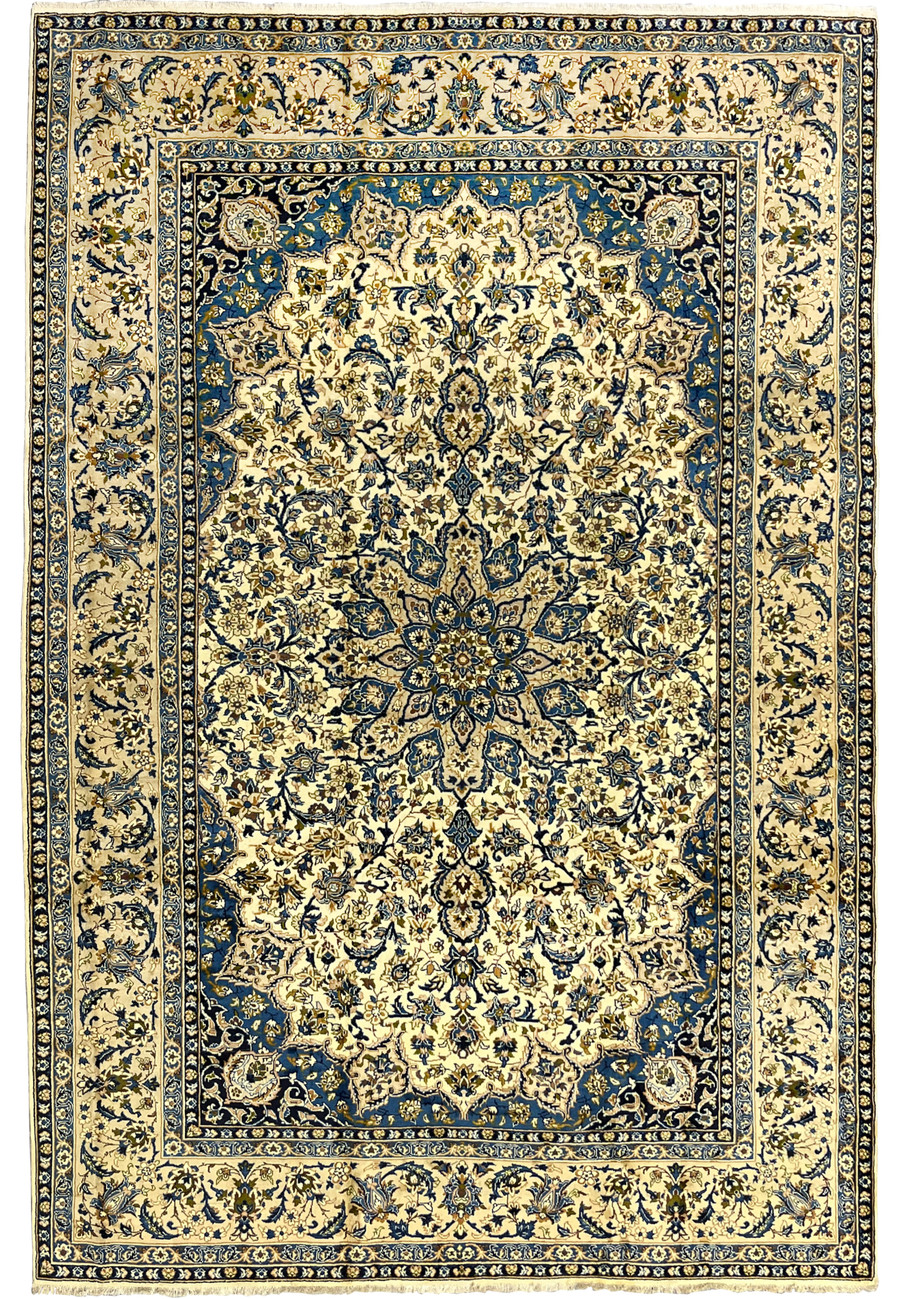
10'2 x 14'3 Persian Kashan Rug, Ivory Field and Navy Medallion. Ivory-ground Kashan with the full medallion-arabesque composition. The ivory field is associated with 20th century workshop production and gives the rug a lighter, more neutral character than the traditional red ground. This palette works across a wide range of interior styles.
Within the broad Kashan production category, certain workshops and weaver families have achieved a reputation that commands a significant premium in the collector market. Understanding these names tells you something important about the quality level a rug was produced to.
Mohtasham: The name most associated with the finest antique Kashan production. The Mohtasham family atelier operated in the late 19th and early 20th centuries and produced rugs widely considered the finest workshop output from Kashan. A signed Mohtasham Kashan, authenticated and in sound condition, represents one of the most prestigious categories in the antique rug market. The quality markers of a genuine Mohtasham include exceptional kork wool softness and lustre, natural dye depth with developed abrash, KPSI consistently in the 300 to 450 range, and a precision of arabesque rendering that is immediately recognizable to an experienced eye.
Dabiri, Seirafian, and other named workshops: Other named ateliers from the late 19th and early 20th century have similarly strong collector followings. These workshops maintained their own design cartoons and quality standards, and signed pieces from any of them carry a provenance premium in the market.
Contemporary signed production: Several contemporary Kashan workshops continue to produce signed pieces at high quality levels. These are not the equivalent of a Mohtasham antique, but they represent the upper tier of modern Kashan production and will age into genuinely valuable pieces over time.
Commercial workshop production: The majority of contemporary Kashan rugs are produced by commercial workshops without individual weaver attribution. These are genuine handmade Persian rugs, accurately described as Kashan, woven in the traditional designs at standard commercial quality levels. They are not collector pieces but they are durable, beautiful, and represent excellent value for buyers who want an authentic handmade Persian rug without the collector premium.
Understanding Commercial Kashan Production
Kashan is one of the most commercially productive rug weaving centers in Iran, and a significant portion of what the market calls “Kashan rugs” is standard workshop production rather than fine atelier work. This is not a criticism: these rugs are genuinely handmade, genuinely from Kashan, woven in authentic Persian designs. But understanding what commercial Kashan production involves helps buyers calibrate their expectations and pricing.
Commercial Kashan workshops typically use machine-spun wool rather than hand-spun kork, which produces a more uniform pile with less natural lustre and lanolin content. The designs are drawn from the same traditional cartoon vocabulary but are often simplified for production efficiency: fewer interior details in the palmette forms, less complex arabesque transitions, standardized border treatments. KPSI typically runs 100 to 160 in commercial production.
The dyes are modern chrome-mordant synthetics, which produce consistent, vibrant, fade-resistant color. They do not have the tonal depth and variability of natural dyes, and they will not develop the same patina over time. But they will also not experience the color bleeding or shift that poorly mordanted natural dyes can show under adverse conditions.
A commercial Kashan from a reputable dealer is a legitimate product at a fair price. It will last 50 years under normal household use. The designs are beautiful. The construction is sound. The issue arises only when commercial Kashan is presented as fine atelier production, or when the price does not reflect the quality level. A knowledgeable dealer distinguishes between them. A dishonest one does not.
The way to distinguish commercial from fine production in a Kashan: examine the back of the rug for knot density and evenness. Look at the interior of the palmette motifs for detail density. Feel the pile for the softness and warmth of true kork wool versus the cooler, more uniform feel of machine-spun wool. Ask the dealer for the KPSI and the pile material. These questions are neither rude nor unusual: they are exactly what an informed buyer should ask, and a legitimate dealer will answer them without hesitation.
Kashan Rugs in Your Home: Style and Placement
The Kashan’s enduring popularity in both traditional and contemporary interiors comes from its structural clarity. The centralized medallion format anchors a room around a focal point, an organizing principle that works across a wide range of furniture arrangements and room shapes. The arabesque field creates visual richness without the busy energy of a geometric tribal pattern.
In a traditional or formal interior, the red-field Kashan is essentially irreplaceable. It brings depth, warmth, and visual authority to formal dining rooms, reception rooms, and studies. Under a mahogany dining table or in a library with dark wood, a crimson Kashan is the rug that every other option is measured against.
In a transitional interior where traditional elements meet cleaner contemporary lines, the ivory-field Kashan is the more versatile choice. The lighter ground reads as less emphatic, works better with pale painted walls and lighter wood tones, and bridges the gap between formal Persian and contemporary neutral with considerable success.
In a contemporary interior with mid-century or modern elements, a green or slate-blue Kashan introduces the Persian design vocabulary without the traditional color associations that can feel heavy in a light modern space. These less common color treatments are increasingly sought by interior designers precisely because they bring the authenticity and quality of a handmade Persian rug to spaces where the standard red-navy combination would feel incongruous.
For size, the Kashan works at every scale from accent rug to oversized gallery carpet. The medallion format scales well: a small medallion Kashan at 4 x 6 works in a bedroom or sitting area, a 9 x 12 anchors a formal room, and a 10 x 14 or larger defines a grand space.
One principle applies across all Kashan placements: the medallion should be centered in the room, or at minimum centered on the primary seating group. The Kashan’s symmetrical design is organized around a central axis, and placing it off-center breaks the compositional logic of the piece. Unlike an allover tribal pattern that can be placed at any angle, a medallion Kashan has a correct orientation and a correct position in the room.
How to Identify a Genuine Kashan Rug
The Kashan design has been copied more widely than almost any other Persian rug type. Machine-made rugs, Indian workshop copies, Pakistani and Chinese production: all use Kashan-derived designs. Here is how to distinguish the genuine article.
Flip it over. A genuine hand-knotted Kashan shows its pattern clearly on the back, with individual knots visible and no backing material. A machine-made or hand-tufted rug has a backing glued or stitched on and shows no knot structure on the reverse.
Feel the pile. Genuine kork wool has a warmth and softness that machine-spun wool and synthetic fibers do not replicate. Press your hand into the pile: quality kork wool springs back with a warmth and resilience that is immediately distinguishable from polypropylene or polyester, which spring back with a cooler, more plastic quality.
Check the fringe. On a genuine hand-knotted Kashan, the fringe emerges directly from the body of the rug as the structural warp threads. It cannot be detached without pulling out the rug’s foundation. Applied fringe, sewn or glued onto a backing, indicates a non-hand-knotted piece.
Look at the design on the back. In a fine Kashan at 150+ KPSI, the pattern on the back is almost as clear as on the front. In a lower-density piece, it is less distinct but still legible. In a machine-made piece, the back bears no resemblance to the face.
Check the arabesque rendering. In a quality Kashan, the arabesque vine curves continuously and smoothly, terminating in clearly rendered palmette blossoms with internal petal detail. In a lower-quality copy, the arabesque curves are stepped and angular, the palmettes simplified to rough geometric forms.
Ask the dealer directly. A legitimate specialist will tell you the KPSI, the pile material, the approximate age, and the dye type of any Kashan they sell. These are not trade secrets. They are the basic product information that any honest seller of a genuine rug should volunteer without being asked.
Shop Persian Kashan Rugs at Rugs.net
Every Kashan at Rugs.net is 100% authentic, hand-knotted in Kashan, Iran, accurately described with pile material, KPSI, and construction details. Direct importer pricing. Free shipping to all 50 states including Alaska and Hawaii. Free returns. Ships within 24 hours.
The complete Kashan collection. Classic red, ivory, green, and blue. Medallion and allover formats. All sizes.
The other great central Persian city rug tradition. Kork wool and silk. Finer knot density than standard Kashan.
From northwestern Iran. More diverse design range than Kashan. Available in wool, wool and silk.
The complete collection. 100% authentic. Every piece hand-knotted and accurately described. Direct importer pricing.
Also: Nain, Qum Silk, Bijar, Mashad, Sarough, Hamedan, Oriental rugs. By size: 6x9, 8x10, 9x12, large rugs. Clearance.