The Rug That Bends the Rules, and Then Won't Bend at All | Bijar Rug
Posted by Rugs.net on Apr 10th 2026
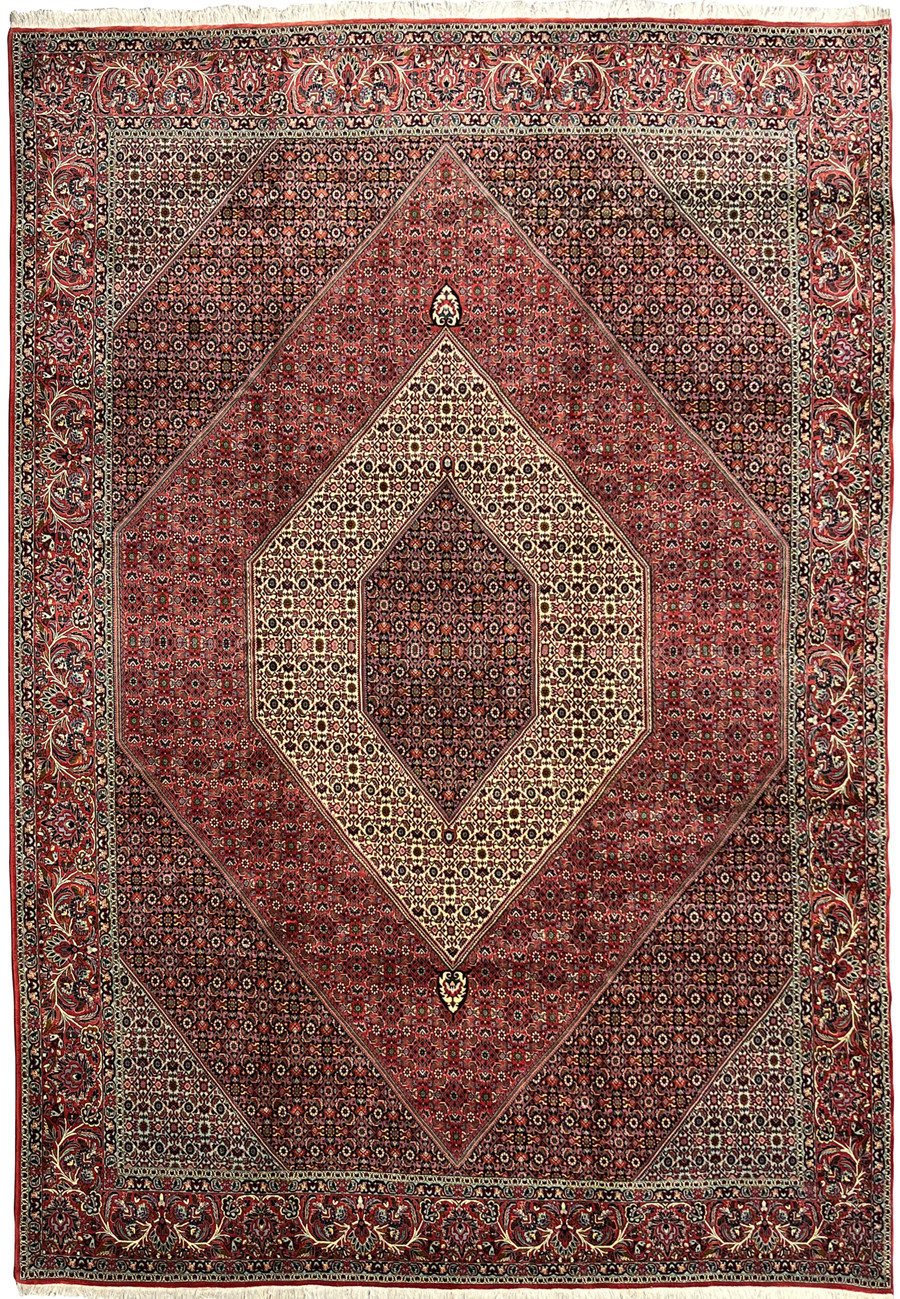
9'8 x 13'7 Persian Bijar Iron Rug · The Iron Rug of Persia
Pick up a Bijar rug and try to fold it. You cannot. Not the way you can fold other rugs. It resists. It pushes back. The pile is so compressed, the foundation so dense, that the rug behaves less like a textile and more like a slab of material. There is a reason weavers have called it the Iron Rug of Persia for generations. It is the most physically durable handmade floor covering ever produced anywhere in the world, and the reasons why are specific, technical, and extraordinary.
This is the complete guide to understanding why a Bijar rug outlasts everything else, what makes it physically different from every other Persian rug, and how it relates to the other rugs woven in the same region that share its heritage but not its iron character.
Bijar: A City, a Region, a Single Tradition
Bijar is a city in the Kurdistan province of northwest Iran, sitting at altitude in the Zagros foothills. The climate is harsh and cold. The weaving tradition that developed there over centuries is one of the most distinctive in the entire Persian rug world, not because of its designs, which draw from the broader Kurdish geometric vocabulary, but because of its construction method.
The Bijar tradition is sometimes called a city rug and sometimes a tribal rug, and this ambiguity points to something real about its character. It has the structural density and technical ambition of a city rug, produced in a workshop setting with multiple weavers working from a pattern. But it has the bold geometric vocabulary, the strong color, and the physical directness of the Kurdish tribal tradition from which its weavers descend.
The result is a rug that looks like it means business, because it does. The Bijar was never made to be admired from a distance. It was made to be walked on, lived with, and survived. A well-made Bijar does not just last decades. It lasts generations. A century-old Bijar in regular use still looks like a rug.
The Wet-Beating Technique: Why You Cannot Fold a Bijar
Every handmade Persian rug uses a beating comb to pack the weft threads tightly after each row of knots. This is standard practice. What Bijar weavers do is entirely different, and it is the single technical reason the rug is in a category of its own.
The Bijar Wet-Beating Process
Weave a row of knots
The weaver ties a row of Persian (Senneh) or Turkish (Ghiordes) knots around the warp threads in the usual way.
Soak the weft threads in water
Before beating the weft, the weaver soaks it with water. Wet wool expands and becomes temporarily malleable.
Beat down with maximum force
The weaver beats the wet weft down with far greater force than is used in standard rug construction. The wet fibers compress to a density that dry wool could never achieve.
The wool dries locked in position
As the wool dries, it sets permanently in the compressed state. The knots are locked. The foundation becomes rigid. The rug is now, functionally, iron.
The result: structural density no other rug achieves
The foundation is so compacted that the rug resists bending, resists crushing, and will not deform under decades of foot traffic. This is the physical basis for the 100-year lifespan.
No other rug-producing region uses this technique. It is specific to Bijar. You can feel it the moment you pick one up. A Bijar rug is measurably heavier than other rugs of the same size. The pile does not move the way normal pile moves. Press your hand into the surface and release it: a Bijar springs back immediately and completely. Press your hand into a standard Persian rug and you leave a temporary impression. Press into a synthetic rug and the impression stays.
Try to roll a Bijar tightly the way you would roll a kilim or a flatweave. You cannot do it without force. The rug pushes back. This is not a metaphor. It is a physical property of the construction that you can test with your own hands the moment you touch one.
What 100+ Years Actually Looks Like

8' x 11'5 Persian Bijar Rug, All-Over Floral Design in Dark Brick and Navy. The even, dense pile surface is the visual signature of wet-beaten construction. Under daily foot traffic, this surface remains essentially unchanged for decades.
When collectors and dealers speak of a rug lasting a hundred years, they usually mean with careful handling, occasional professional washing, and the kind of moderate use a formal room receives. When people speak of a Bijar lasting a hundred years, they mean in actual daily use, in a family home, walked on by children and adults and pets, without apology.
The durability comes from several reinforcing properties working together. The compressed foundation means the knots cannot shift or loosen over time. The natural wool pile, particularly when the finest kork wool is used, has a resilience memory that synthetic fibers simply do not possess. The natural dyes used in traditional Bijar production, typically vegetable and chrome dyes, do not fade the way synthetic dyes do. They develop patina: a gradual softening and deepening of color that makes a 30-year-old Bijar often more beautiful, not less, than a new one.
The result is a rug with almost no aging curve in the direction most rugs age. Most floor coverings degrade linearly: the more they are used, the worse they look. A Bijar used normally over decades often reaches a visual peak somewhere between 20 and 50 years of age, when the colors have mellowed, the pile has acquired its characteristic low even sheen, and the overall surface has developed the patinated authority of something that has been genuinely lived with.
| Rug Type | Typical Lifespan | Aging Direction |
|---|---|---|
| Machine-made synthetic | 3 to 7 years | Degrades from day one |
| Standard handmade Persian | 50 to 100+ years | Stable, patinates well |
| Bijar Iron Rug | 100 to 200+ years | Improves for decades |
| Antique Bijar (existing pieces) | Still in active use at 150+ yrs | Museum and collector value |
Antique Bijar rugs from the 19th century regularly appear at major auction houses in fully functional condition, having been in continuous use in family homes for their entire lives. No other category of handmade rug has this track record.
The Bijar Family: Iron Rugs and Their Relatives
The name Iron Rug belongs exclusively to Bijar. No other rug earns that title, and it is important to understand why, because the broader region around Bijar produces several other rug types that share its Kurdish heritage, its geometric vocabulary, and many of its visual characteristics, but are made differently and do not possess the iron construction. Understanding the family helps you appreciate what the Bijar achieves, and what its relatives offer in their own right.
The Bijar Family · Related but Distinct
Senneh (Sanandaj) Rugs: The Refined Cousin
Senneh is the capital city of Kurdistan province, and its rugs are among the most technically refined in the Kurdish weaving world. The Senneh rug is actually tied using the Persian knot, which is also called the Senneh knot, so there is some historical irony in the fact that Bijar weavers often use the Turkish knot while the city that gave its name to the Persian knot produces some of the finest examples of it.
Senneh rugs are finely knotted and precisely designed, often featuring the Herati pattern or geometric medallion compositions. They are made on cotton foundations with relatively short pile. The result is a thin, flat, elegant rug with extraordinary design clarity and a silky surface feel. Beautiful. Technically impressive. But not iron. Senneh rugs are not wet-beaten, and they do not possess the structural rigidity of a Bijar. They are refined where the Bijar is rugged.
In short: Senneh is to Bijar what a precision instrument is to a hammer. Both are excellent. They do different things.
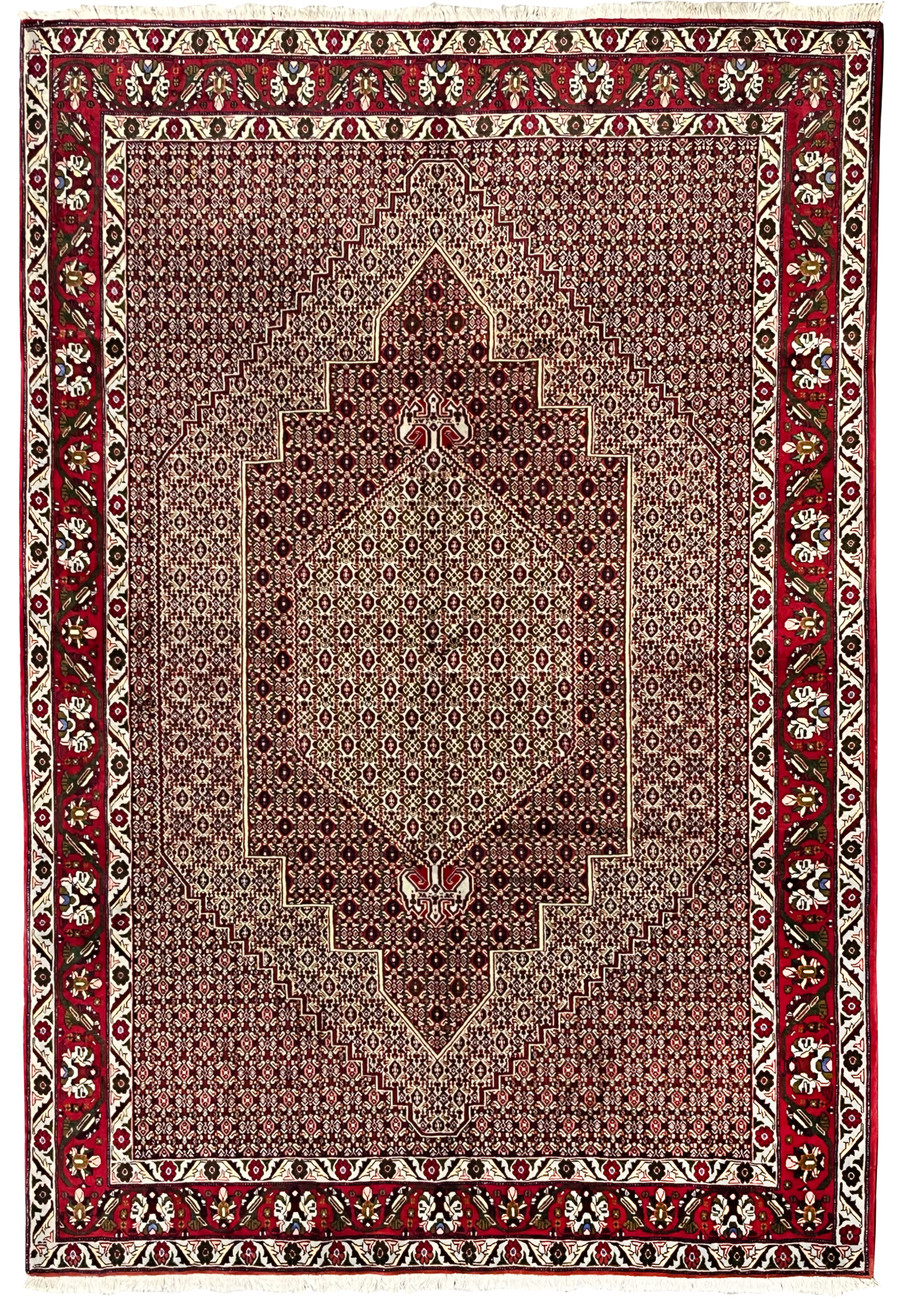
6'8 x 9'8 Persian Senneh Rug with Dense Geometric Design. From the same Kurdish weaving region as Bijar, sharing the same geometric vocabulary and natural wool quality, but woven without the wet-beating technique. Refined, precise, and beautiful, but not iron.
The Bijar Family · Related but Distinct
Gholtogh Rugs: The Tribal Sibling
Gholtogh is a village in the Kurdistan province, and its rugs come from the same Kurdish tribal weaving tradition as Bijar. The designs are bold geometric compositions with strong medallion structures, rich deep reds and navies, and the confident color vocabulary of the Kurdish highland weaver. Visually, a Gholtogh and a Bijar can share considerable character.
But Gholtogh rugs are tribal village pieces, woven on horizontal ground looms by individual village weavers, not in workshops using the Bijar wet-beating method. The pile is fuller and softer, the foundation less compacted, the overall structure more flexible. A Gholtogh is durable in the way all quality handmade wool rugs are durable. It is not iron. It will not last 150 years under heavy traffic the way a Bijar will. It offers something different: the warmth, the visual energy, and the direct character of a tribal piece made without compromise to the aesthetic vocabulary of the weaver's heritage.
In short: Gholtogh carries the same blood as Bijar. It is woven by people from the same tradition, using the same colors and geometric vocabulary. But it is a tribal rug, and the Iron Rug title belongs only to its workshop cousin from the city.
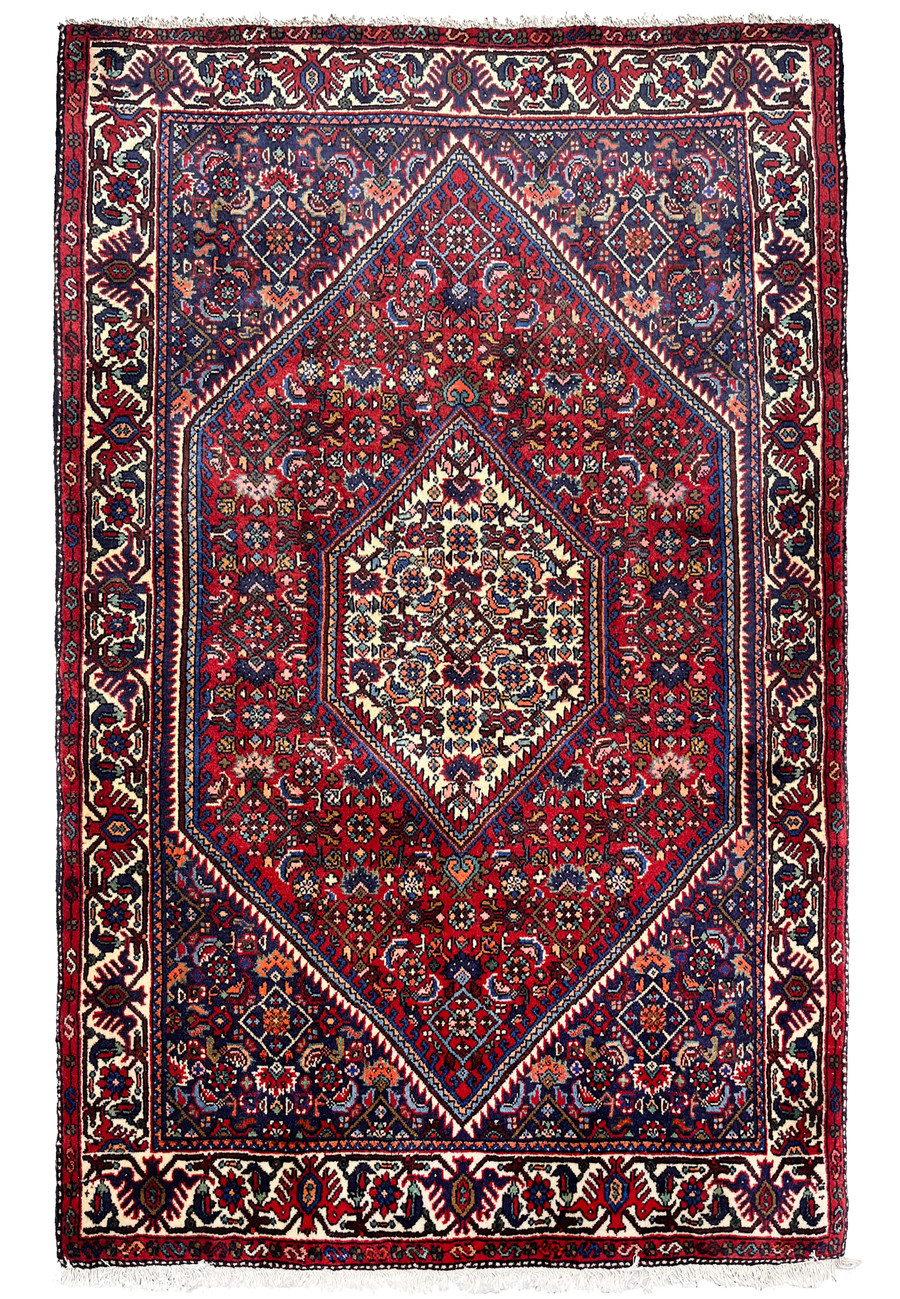
3'3 x 5 Persian Gholtogh Tribal Rug with Ivory Medallion and Deep Red Field. The bold color and geometric medallion are pure Kurdish tribal. The character is related to Bijar. The wet-beaten iron construction is not. A beautiful tribal piece on its own terms.
Bijar Designs: What to Expect
The design vocabulary of the Bijar rug draws primarily from three sources: the Kurdish geometric tribal tradition, the Herati pattern (a fish and rosette lattice of Persian origin that became ubiquitous in Kurdish weaving), and the medallion-and-corner format of the broader Persian city rug tradition.
The most classic Bijar design is the Herati all-over field with layered geometric borders: dense, structured, repeating. The Mahi Herati pattern, with its characteristic fish motif set within a diamond lattice of palmettes and leaves, appears in Bijar in a distinctively bold, compressed form. Where the same pattern in a Kashan or Isfahan reads as fluid and floral, in a Bijar it reads as architectural and strong.
Medallion formats are also common: a central geometric medallion, often angular and imposing, with corner pieces and an all-over field of secondary motifs. The borders of Bijar rugs are typically multiple, layered, and generous in proportion, a characteristic that gives classic pieces a sense of visual containment and authority.
The color palette runs deep. Classic Bijar colors are the strong reds, navies, and forest greens of the Kurdish tradition, with ivory for contrast and gold for accent. The palette reads as decisive, not tentative, which suits a rug whose construction philosophy is the same. These are not rugs that whisper. They are rugs that anchor a room.
Where a Bijar Belongs in Your Home
Because of its extraordinary durability, the Bijar is the right answer for spaces that other fine rugs cannot handle without care and compromise.
Entry halls and foyers: The highest traffic area in any home, where every guest arrives and departs. Most fine rugs suffer here. A Bijar does not notice. Its compressed pile resists crushing even under the concentrated traffic of a narrow entry corridor, and the strong color palette hides the occasional tracked dirt that any honest entry hall sees.
Family rooms and living rooms: The room where a family actually lives: children, pets, furniture moved for guests, daily foot traffic. A fine Isfahan or Nain deserves a more protected space. A Bijar was built for exactly this room and will look as good in 20 years as it does today.
Dining rooms: Chair legs dragged, food dropped, feet shuffling under a table every day. The Bijar's dense pile resists the crushing damage that dining room use inflicts on softer rugs, and its bold color palette is forgiving of the occasional spill that reaches the floor.
Stairs: Stair runners are among the most demanding applications for any floor covering. The Bijar, with its rigid compressed structure and maximum pile density, is one of the only handmade rugs that can be used on stairs without concern. Where a softer rug would quickly show the edge wear at each step nosing, a Bijar holds.
Anywhere that needs to last a lifetime: If you are buying a rug you intend to leave to the next generation, a Bijar is the correct choice. It is not a metaphor when dealers say this rug can last 100 years. They mean it literally, and antique Bijars still in daily use prove it.
Shop the Bijar Family at Rugs.net
Rugs.net is a direct importer of authentic handmade Persian rugs. Every Bijar, Senneh, and Gholtogh rug we sell is 100% authentic, genuinely hand-knotted, and accurately described. Free shipping to all 50 states, free returns, ships within 24 hours.
Persian Bijar Iron Rugs
The Iron Rug of Persia. Wet-beaten construction. 100+ year lifespan. The strongest handmade rug in the world.
Persian Gholtogh Rugs
Kurdish tribal sibling of the Bijar. Bold geometric character, deep colors, authentic village weaving.
Persian Senneh Rugs
The refined city cousin. Fine knotting, precise geometric design, elegant and thin. Kurdistan province.
All Handmade Persian Rugs
The complete collection. 100% authentic. Direct importer pricing. Free shipping all 50 states.
Also browse: Hamedan tribal rugs, red and burgundy rugs, navy and blue rugs, large rugs, runners.