
Wool vs. Silk Rugs: Which Should You Actually Buy?
Posted by Rugs.net on Apr 21st 2026
The Short Answer
Daily use, high traffic, decades of durability. The safest choice for any room that gets lived in.
The best of both: durability of wool with the luminosity of silk. The most versatile fine rug combination.
Maximum visual impact, collector-level quality. Best for low-traffic formal spaces or wall display.
The question comes up on almost every serious rug purchase. You are looking at two pieces of similar size. One is kork wool. One is pure silk. Or one is wool with silk highlights woven in. The person selling tells you the silk is finer. The person who sold you your last rug says wool is more practical. Both are saying something true, but neither is giving you the full picture.
The honest answer is that none of these materials is universally better. A wool rug and a silk rug are not competing versions of the same product. They are different objects that do different things. Understanding what each one actually does is the only way to make the right choice. This guide gives you that understanding, from the bottom up.
Wool Rugs: Built for Real Life
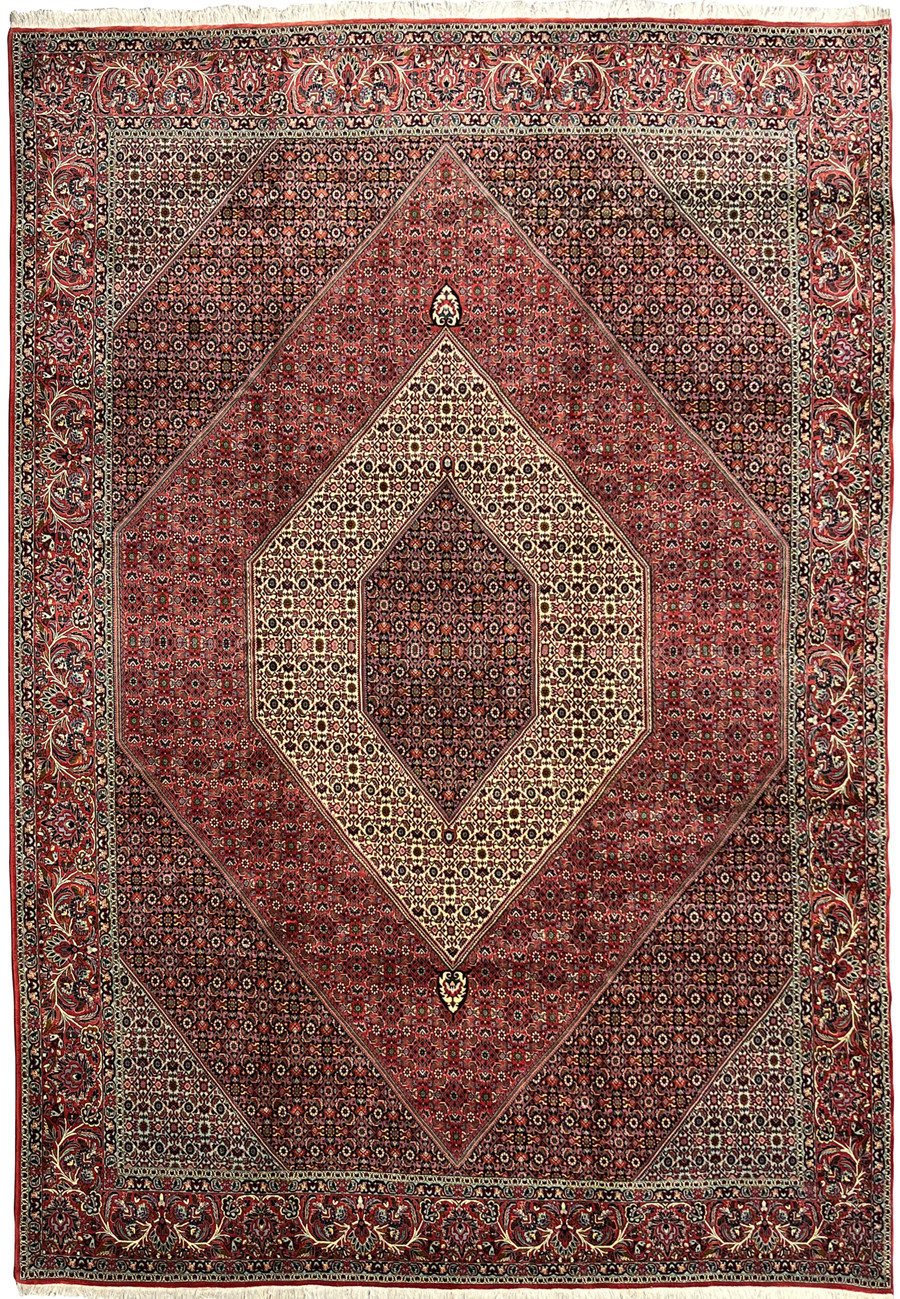
9'8 x 13'7 Persian Bijar Iron Rug. Pure kork wool pile, wet-beaten construction. Walk on this every day for 50 years and it will look essentially the same. This is what wool does at its best. Shop all wool rugs.
Wool has been the primary pile material in handmade rugs for over 2,500 years, and not out of habit. Wool earned and kept its place because it is the closest thing to a perfect floor covering fiber that nature has produced. No synthetic material and no other natural fiber replicates its combination of properties in the same object.
The defining property is crimp memory. Wool fiber has a natural microscopic wave structure that allows it to compress under load and spring back when the load lifts. Walk on a quality wool rug every day for twenty years and the pile still has depth and resilience. Crush a synthetic fiber and it stays crushed. Silk, as we will cover, does not perform the same way under sustained foot traffic.
The finest Persian rugs use kork wool, clipped from the softer undercoat of the sheep’s neck and shoulder. Kork is finer, richer in natural lanolin, and more lustrous than standard body fleece. It takes dye more deeply and evenly. A fine Kashan, Tabriz, or Mashad in kork wool has a natural sheen and color depth that immediately distinguishes it from standard wool production.
Wool also contains natural lanolin, making it inherently resistant to moisture and staining. A spill on a wool rug sits briefly on the surface before absorbing, giving you time to blot it. Lanolin also makes wool naturally resistant to dust mites, which is why a well-maintained wool rug does not accumulate the same allergen load as synthetic carpet over time.
Wool rugs are the right choice when:
✓ The rug will be in a high-traffic area: entry hall, family room, dining room, corridor
✓ You have children or pets and need genuine durability
✓ You want a rug that will last 50 to 100+ years under normal household use
✓ You want a rug that can be professionally washed and restored
✓ You want maximum KPSI for the price
Best wool rug categories at Rugs.net: Bijar Iron Rugs (most durable rug in the world), Kashan, Tabriz, Mashad, Hamedan, Sarough. Browse all wool rugs.
Wool and Silk Rugs: The Best of Both

7'3 x 10'5 Persian Nain 6 LA Habibian Wool and Silk Rug. Kork wool provides the durable field. Silk threads woven selectively into the arabesque outlines create a directional shimmer that shifts with the light. This is the wool-and-silk combination at its finest. Shop all wool and silk rugs.

7'2 x 10'8 Persian Tabriz Mahi Wool and Silk Rug, 50 Raj. The Mahi (fish) pattern rendered in kork wool with silk highlights in the curvilinear detail areas. Where the silk catches the light, those threads glow against the matte wool ground, creating depth that a pure wool rug cannot produce.
The wool-and-silk combination is not a compromise. It is the deliberate choice of the finest Persian city rug workshops for hundreds of years, and it is the most technically sophisticated pile arrangement in rug production.
Here is how it works. The weaver ties wool knots across most of the rug’s surface, providing the structural durability and resilience of kork wool throughout the field. In the areas where the design calls for fine outline detail, interior petal veining, or highlighting of a medallion element, the weaver switches to a silk strand for those specific knots. The silk threads and wool threads sit side by side in the pile, each contributing its specific property to the areas where that property is most valuable.
The result is a rug with the floor performance of wool and the visual luminosity of silk. In a fine Nain 6 LA, the silk highlights are barely visible in photographs but immediately apparent in a room: the rug appears to be lit from within at certain angles. In a signed Isfahan, the silk picks out specific floral elements against the wool ground and creates a visual hierarchy that the wool alone could not produce.
Wool-and-silk rugs typically reach 150 to 500 KPSI depending on the tradition, significantly higher than pure wool production. The combination is found across the great city rug workshops: Nain, Isfahan, Tabriz, and Kashan.
Wool and silk rugs are the right choice when:
✓ You want a fine city rug with exceptional visual quality that can still handle real use
✓ The room is formal but lived in: a dining room, master bedroom, or principal sitting room
✓ You want maximum design resolution at a price below a pure silk collector piece
✓ You want a signed piece from an established workshop tradition
Best wool-and-silk categories at Rugs.net: Nain 6 LA, Isfahan, Tabriz, Kashan. Browse all wool and silk rugs.
Pure Silk Rugs: Collector-Level Visual Mastery
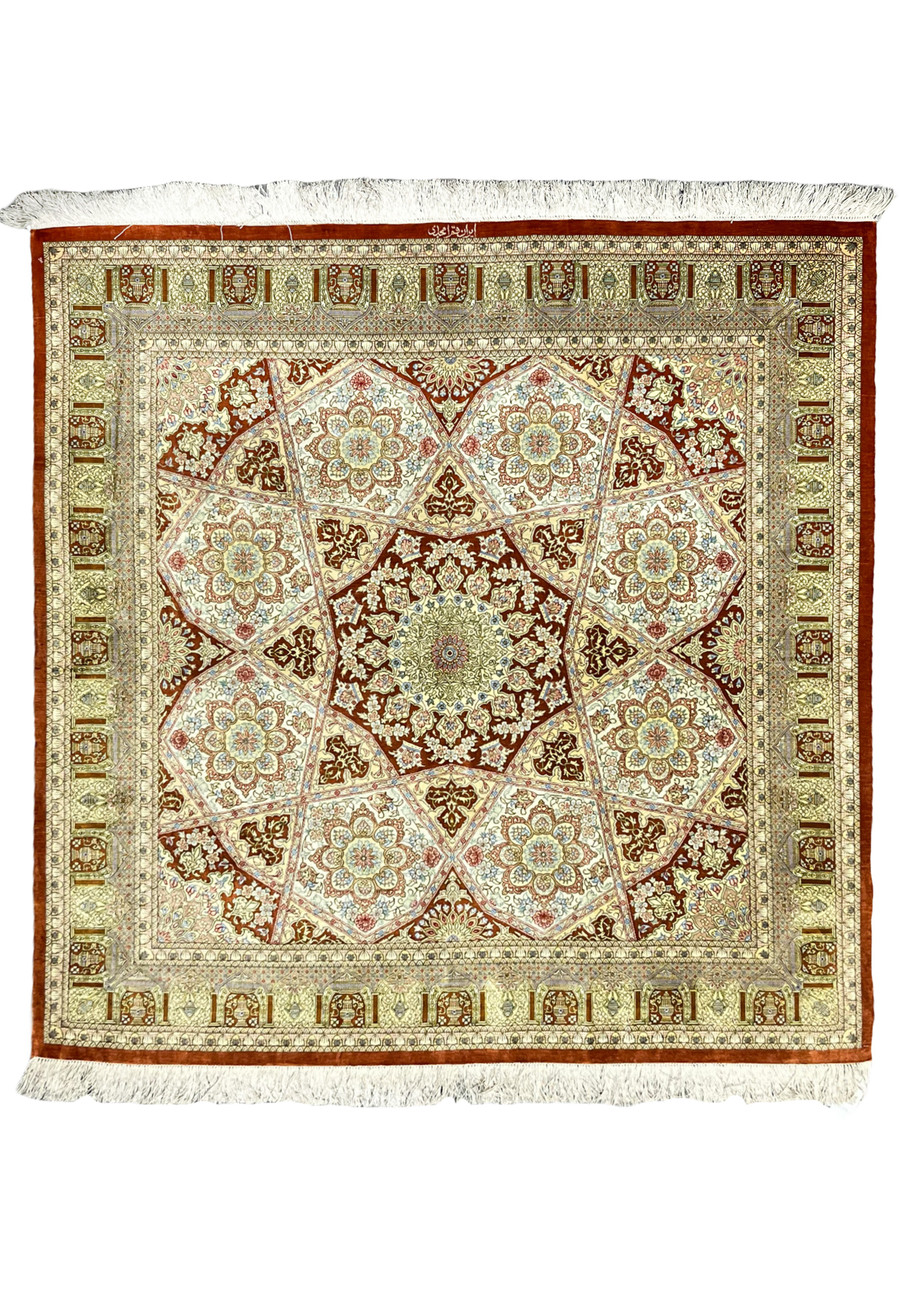
5 x 5 Signed Amjadi Persian Qum Silk on Silk, 1000 KPSI. Pure silk pile on a silk foundation. At 1000 knots per square inch, this piece contains over 25 million individual hand-tied knots. The surface shifts color with every change of light and angle. Shop all silk rugs.

4'4 x 6'6 Persian Qum Pure Silk Signed Kabiri, Navy and Rose Pink. The contrast between deep navy and rose pink in pure silk is luminous in a way that wool cannot replicate. The colors catch the light differently at every angle, changing the entire feel of the rug throughout the day.
Pure silk rugs exist in a category of their own, and the reason comes down to a single optical property: directional lustre. Silk fiber reflects light differently depending on the angle. The same rug looks different in morning light and afternoon light. Walk around it and the colors shift. This quality, called lustre play, is impossible to replicate in wool or any synthetic material. It makes a silk rug a living object in a room in a way that even a fine wool rug is not.
Pure silk pile also allows knot densities that no other material can achieve. The finest wool rugs reach 300 to 500 KPSI. Persian Qum silk rugs routinely reach 800 to 1000 KPSI because silk fiber is fine enough to allow warp threads packed at densities that cotton or wool warps cannot achieve. At 1000 KPSI, a 3 x 5 rug contains over 21 million individual hand-tied knots. The design resolution at that density is comparable to a woven photograph.
The trade-off is real. Silk pile does not have the same resilience under sustained foot traffic that wool does. A fine silk rug on a high-traffic floor will show wear in the pile over years in a way that a Bijar or Kashan in kork wool will not. For this reason most silk rugs are used in low-traffic formal spaces or displayed on walls, where their visual qualities can be appreciated without the physical demands that accelerate pile wear.
Why Silk Costs More: The Three Reasons
The raw material
Silk is produced by the Bombyx mori silkworm, cultivated on mulberry leaves and harvested at the precise cocoon stage. A kilogram of silk requires approximately 5,500 cocoons. The production cost per kilogram is many times that of equivalent wool.
The weaving time
At 1000 KPSI a skilled Qum weaver can tie approximately 8,000 to 10,000 knots per day. A 3 x 5 rug at that density takes up to eight years to complete. Silk is also slippery and requires a more precise knotting technique than wool, further slowing the process.
The skill scarcity
Very few weavers in Qum can execute 1000 KPSI work at the quality required for a signed piece. These skills pass between generations within specific families. The combination of material cost, weaving time, and skill scarcity is why collector-grade signed Qum silk rugs are genuinely rare at any price point.
Pure silk rugs are the right choice when:
✓ The rug will be in a low-traffic formal room or displayed on a wall
✓ Visual impact and collector quality are the priority over durability
✓ You want a signed piece from a master workshop as an investment or art object
✓ You want the maximum KPSI and design resolution achievable in any handmade rug
Best pure silk categories at Rugs.net: Persian Qum Silk Rugs at 800 to 1000 KPSI, signed by master weavers. Browse all silk rugs.
Wool vs. Wool and Silk vs. Pure Silk: Head to Head
| Feature | Wool | Wool and Silk | Pure Silk |
|---|---|---|---|
| Durability | Exceptional | Excellent | Moderate |
| Visual lustre | Soft natural sheen | High, directional | Maximum, luminous |
| Max KPSI | 40 to 300 | 150 to 500 | 800 to 1000+ |
| Best use | All traffic levels | Formal, moderate traffic | Low traffic, display |
| Floor resilience | Springs back for decades | Springs back well | Shows traffic over time |
| Design resolution | Good to excellent | Excellent | Photograph-level |
| Investment value | Appreciates with age | Strong appreciation | Highest appreciation |
How to Choose: By Room and Use
Entry hall, family room, dining room, stairs: Wool. These are your highest-traffic areas. A Bijar for the very highest traffic, a Kashan or Hamedan for standard family use. Do not put silk in these rooms.
Formal living room, master bedroom, study: Wool and silk. A signed Isfahan or Nain 6 LA in kork wool and silk gives you extraordinary visual quality with the durability to handle real daily use.
Low-traffic formal room, display, collector use: Pure silk. A signed Qum silk rug at 800 to 1000 KPSI is an art object that happens to work on a floor. Protect it from heavy foot traffic and direct sunlight.
Shop by Material at Rugs.net
Every rug we sell is accurately described with foundation material, pile material, and KPSI. Free shipping to all 50 states. Free returns. Ships within 24 hours.
Kork wool pile on cotton or wool foundation. Built for daily life. Includes Bijar, Kashan, Tabriz, Hamedan, Mashad, Sarough, and all tribal and village types.
Kork wool pile with silk highlights. The finest Persian city rug combination. Includes Nain 6 LA, signed Isfahan, fine Tabriz, and Kashan with silk.
Pure silk pile. 800 to 1000 KPSI. Signed collector pieces from master workshops. Includes all Persian Qum silk rugs.
Also browse by origin: All Persian rugs, Oriental rugs. By size: large rugs, medium rugs, runners. Clearance.