
Your Cheap Rug Is Poisoning Your Home. Here Is the Proof.
Posted by Rugs.net on Apr 26th 2026
Walk into any big-box home goods store and the rug section will be dominated by products described with reassuring language. “Easy clean.” “Stain resistant.” “Washable.” “Durable.” These descriptions are not false. A polypropylene rug is indeed easy to clean. It does resist certain stains. It is washable. What the label does not tell you is what the rug is made of at a chemical level, what happens to your indoor air quality after you unroll it in your home, where it goes when you throw it away, and what cost the planet pays for your convenient, affordable floor covering.
This article covers all of that. It is not a polemic against affordable furniture. It is an honest look at the chemistry of synthetic rugs, the health implications that the marketing materials omit, and why the natural alternative, the handmade wool or silk rug that your grandparents might have owned, turns out to be not just more beautiful but genuinely better for your health, your home, and the world your children will inherit.
What Polypropylene Actually Is
Polypropylene is a thermoplastic polymer derived from petroleum. It is, in the most literal sense, a form of plastic, the same family of materials as plastic bottles, packaging film, and industrial containers. It is produced by polymerizing propylene, a byproduct of oil and natural gas refining, under heat and pressure with chemical catalysts.
The fiber produced from this process is cheap, consistent, and highly versatile. It can be extruded to any thickness, dyed to any color using synthetic dyes, and formed into a pile surface that, at a glance, resembles wool. It does not absorb water, which makes it easy to clean. It resists mold and insects, which require organic material to thrive. It can be manufactured at enormous scale for very little cost.
What polypropylene cannot do is what wool and silk do naturally: breathe, regulate temperature, repel allergens biologically, age gracefully, or decompose when its useful life is over. What it does do, that wool does not, is off-gas volatile organic compounds into your home, shed microplastics into your environment, and contribute to one of the fastest-growing categories of non-biodegradable waste on the planet.
Other synthetic rug materials with similar issues:
Polyester (PET): Made from recycled plastic bottles in “eco” versions, but still petroleum-based, still non-biodegradable, still sheds microplastics.
Nylon: Stronger than polypropylene, still synthetic, still derived from petrochemicals, still off-gasses, still a landfill problem.
Viscose and “faux silk”: Derived from wood pulp but heavily chemically processed. Not petroleum-based but involves significant toxic chemical use in production, including carbon disulfide, a neurotoxin.
Latex backing on hand-tufted rugs: Rubber or synthetic latex is used to hold the pile in place in hand-tufted rugs. Latex backing deteriorates over time and releases compounds into your indoor air, particularly in warm environments.
VOCs: The Invisible Problem in Your New Rug
VOC stands for volatile organic compound. These are carbon-based chemicals that evaporate at room temperature and enter the air in your home. A new synthetic rug, fresh from the factory or the store, is one of the most significant sources of VOC off-gassing in a typical household.
The compounds released include formaldehyde, acetaldehyde, styrene, benzene, and a range of other chemicals depending on the dyes, adhesives, backing materials, and manufacturing processes involved. These are not trace quantities. A new wall-to-wall synthetic carpet or a large synthetic area rug can measurably elevate the VOC concentration in a room for days, weeks, or in some cases months after installation.
The health implications range from minor to serious depending on the compounds involved and the sensitivity of the people in the home. At low concentrations, VOC exposure commonly causes headaches, eye irritation, throat irritation, dizziness, and nausea. At higher concentrations or with prolonged exposure, certain VOCs are classified by health agencies as probable or known human carcinogens. Formaldehyde, which is used in some carpet adhesives and finishes, is classified as a human carcinogen by the International Agency for Research on Cancer.
Children are particularly vulnerable. They spend more time at floor level than adults. They breathe faster, which means they inhale more air per unit of body weight. Their developing respiratory and nervous systems are more sensitive to chemical exposure than those of adults. A toddler playing on a new synthetic rug is in closer proximity to the source of off-gassing for longer periods than any other member of the household.
People with asthma, allergies, or other respiratory conditions are at additional risk. The VOC compounds released by synthetic rugs can trigger asthma attacks, worsen existing allergic conditions, and create a sensitization effect in previously unaffected individuals with repeated exposure.
The “new rug smell” is not neutral. The characteristic chemical smell of a new synthetic rug is the smell of VOCs off-gassing. Many consumers note it and consider it temporary and harmless. The smell fades within days or weeks as the most volatile compounds are released. The less volatile compounds continue to off-gas long after the smell has disappeared, at concentrations too low to detect by nose but still measurable by air quality monitoring equipment.
The advice commonly given, to air out a new rug before installation, helps reduce initial peak concentrations. It does not eliminate the problem. Off-gassing continues throughout the rug’s life, diminishing over time but never reaching zero as long as the rug is intact and present in the home.
Microplastics: The Problem That Stays Forever
Every time a synthetic rug is walked on, vacuumed, or disturbed, tiny fragments of plastic fiber break away from the pile. These are microplastics: plastic particles smaller than five millimeters, often microscopic, that enter the dust in your home, travel through your ventilation system, and eventually reach the wider environment through waste disposal and wastewater systems.
Microplastics have been found in human blood, breast milk, lung tissue, and the placentas of unborn children. They have been found in the deepest ocean trenches, in Arctic ice, in rainwater collected in the most remote locations on earth, and in the bodies of animals that have never come near a human settlement. They do not break down. They accumulate.
The health effects of microplastics in human tissue are still being studied, but the picture that is emerging is not reassuring. Microplastics carry with them the chemical additives, dyes, and stabilizers used in their manufacture, and these compounds can leach into surrounding tissue. Certain plastic-associated chemicals, including phthalates and bisphenols used as plasticizers, are known endocrine disruptors that interfere with hormone signaling in the body.
A synthetic rug in a family home sheds microplastics continuously. Every vacuuming session captures some of them in the dust bag, but a portion escapes into the air and settles on every surface in the room. Every washing, if the rug is a washable type, releases microplastics into wastewater that treatment plants are not designed to capture.
A natural wool rug, by contrast, sheds wool fibers. Wool is a protein fiber, fully biodegradable, already present throughout the natural environment, and not carrying any of the chemical load that synthetic plastics carry. Wool fibers in household dust are not a health concern. Polypropylene microplastics in household dust are.
Where Your Cheap Rug Goes When You Throw It Away
A polypropylene rug has a typical usable lifespan of five to ten years. At the end of that period it goes to landfill. Almost without exception. Synthetic rugs are not recyclable through standard municipal waste streams. The combination of multiple materials, adhesives, latex backings, dye compounds, and structural components makes them economically impractical to process. Most synthetic rug recycling programs are limited in scope and geography, and the vast majority of discarded synthetic rugs end up in landfill regardless of the consumer’s intentions.
In landfill, a polypropylene rug does not decompose. It photodegrades in sunlight into smaller and smaller plastic fragments, which eventually become the microplastics described above. In a landfill environment, buried without light, it may persist essentially intact for 20 to 30 years, slowly leaching chemical compounds into the surrounding soil and groundwater.
The scale of this problem is significant. Americans discard an estimated four billion pounds of carpet and rugs annually, the vast majority of which is synthetic. That is a staggering quantity of non-biodegradable petroleum-derived material entering the waste stream every year, and the number has grown steadily as the cheap, disposable rug market has expanded.
The carbon cost of production adds another dimension. Producing polypropylene from petroleum involves energy-intensive refining and polymerization processes with significant greenhouse gas emissions. The cost of synthetic rug production in carbon terms has never been priced into the $79 price tag at the store. It is externalized to the atmosphere, the waste system, and future generations.
The lifetime environmental comparison
Synthetic rug (polypropylene):
Derived from petroleum. Carbon-intensive production. Off-gasses VOCs in your home. Sheds microplastics continuously. Lasts 5 to 10 years. Goes to landfill. Does not biodegrade. Persists in the environment for decades.
Natural wool rug (handmade):
Derived from sheep’s wool, a renewable resource. Low processing intensity. No VOC off-gassing. Sheds biodegradable protein fibers. Lasts 50 to 100+ years. Fully biodegradable at end of life. Returns cleanly to the natural environment.
The Washable Rug Myth
“Washable rugs” have become one of the fastest-growing product categories in the home goods market, marketed primarily to parents of young children and pet owners as a practical, hygienic alternative to traditional rugs. The selling proposition is simple: spill something, put it in the washing machine, problem solved.
The environmental reality of a washable synthetic rug is considerably less appealing. Every machine wash cycle of a synthetic textile releases hundreds of thousands of microplastic fibers into the wastewater system. A single wash of a synthetic rug can release several million plastic fibers. Wastewater treatment plants capture a portion of these, but studies have consistently found that a significant fraction passes through treatment and enters waterways, marine environments, and ultimately the food chain.
The convenience of the washable rug, the very feature that justifies its price premium, is also the mechanism by which it contributes most aggressively to microplastic pollution. Every time you do exactly what the product is designed to do, you release a pulse of microplastics into the water supply.
There is also the question of what the washing accomplishes for the rug itself. The latex or rubber backing that gives a washable rug its structure is not improved by repeated wetting and agitation. It degrades. The adhesive bonds between the pile, the backing fabric, and the rubber layer weaken with each wash cycle. A washable rug that is washed frequently will reach the end of its structural life faster than one that is not, creating a cycle of purchase and disposal that maximizes both consumer spending and environmental impact.
A quality natural wool rug is not washable in a domestic machine, and this is not a disadvantage. It is professionally washed, typically every three to five years depending on use, by a specialist who knows how to clean wool without damaging the fiber, foundation, or dye. This washing releases no microplastics, uses biodegradable natural cleaning agents, and restores the rug to near-original condition. A 30-year-old wool rug that has been professionally washed ten times is a better rug than it was new. A 3-year-old washable synthetic rug that has been machine washed fifty times is approaching the end of its useful life.
What Natural Wool Does That Plastic Cannot
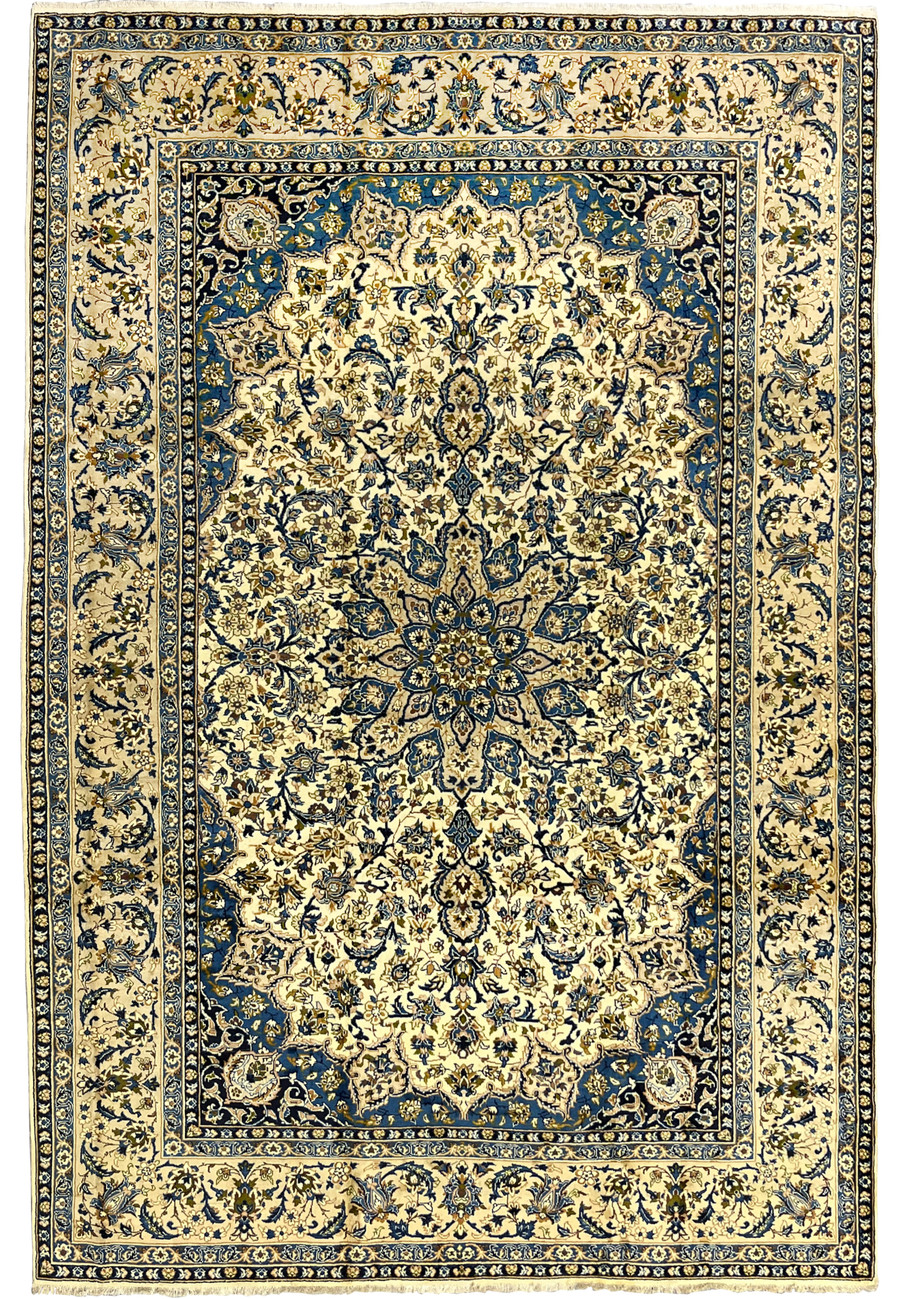
10'2 x 14'3 Persian Kashan Rug. Pure kork wool pile on a cotton foundation. No petroleum. No synthetic dyes in the traditional palette. No latex backing. No off-gassing. No microplastics. Fully biodegradable at the end of a lifespan measured in generations.
Wool is one of nature’s most sophisticated functional fibers, shaped by millions of years of evolution to protect an animal that lives outdoors year-round in conditions ranging from summer heat to winter cold. Every property that makes it extraordinary as a fiber for clothing and rugs is the result of that evolutionary refinement.
Wool actively improves indoor air quality. This is not marketing language. It is a documented property of the fiber. Wool absorbs and holds VOCs from the surrounding air, including formaldehyde and nitrogen dioxide, through a process called chemisorption. A wool rug does not release VOCs into your home. It removes them. Studies conducted at universities in the UK and Australia have found that wool textiles can absorb and permanently retain significant quantities of indoor air pollutants, effectively functioning as a passive air filter.
Wool is hypoallergenic. Wool contains lanolin, a natural wax that gives the fiber antimicrobial and antifungal properties. Wool rugs do not support the growth of dust mites and bacteria as readily as synthetic textiles do. Contrary to the common misconception that wool causes allergies, true wool allergy is extremely rare. Most people who react to wool products are reacting to the chemical dyes, processing agents, or finishing compounds applied to lower-grade wool, not to the wool fiber itself.
Wool is naturally fire-resistant. Wool has a high ignition temperature and does not sustain a flame when the ignition source is removed. It chars rather than melts, and the char layer actually acts as an insulating barrier. Synthetic fibers melt when exposed to flame and can stick to skin, creating burn injuries far worse than those caused by natural fiber fires. This is why wool is required in certain occupational safety contexts and preferred in others.
Wool regulates temperature and humidity. Wool fiber can absorb up to 30% of its weight in moisture vapor without feeling wet and releases it gradually as conditions change. This buffering effect moderates humidity levels in your home, reducing the conditions that promote mold growth and dust mite proliferation. Polypropylene has no moisture-buffering capacity whatsoever.
Wool is fully renewable and fully biodegradable. Sheep grow wool continuously. Shearing does not harm the animal. Wool fiber, at the end of its life, decomposes in soil within months to years, releasing nitrogen and other nutrients. A 100-year-old wool rug that finally reaches the end of its useful life can be composted. A 10-year-old polypropylene rug that reaches the end of its life cannot.
Silk: The Clean Luxury Alternative

4'4 x 6'6 Persian Qum Pure Silk Rug, Signed Kabiri. Pure silk is a natural protein fiber, biodegradable, hypoallergenic, and produced by the Bombyx mori silkworm without petroleum-derived inputs. It is marketed as a luxury material. From an environmental standpoint, it is simply the natural alternative to synthetic “faux silk” and viscose.
The term “faux silk” is used extensively in the affordable rug market to describe viscose (also called rayon) or polyester pile that mimics the visual sheen of real silk. The environmental profile of these alternatives differs significantly from natural silk.
Viscose, despite being derived from wood pulp and therefore technically “natural” in origin, requires intensive chemical processing using carbon disulfide, sodium hydroxide, and sulfuric acid. Carbon disulfide is a serious neurotoxin. Workers in viscose manufacturing facilities face documented health risks, and the production process generates toxic wastewater that requires careful treatment. Viscose is biodegradable in its final form, but the environmental cost of production is substantial.
Natural silk, by contrast, is produced by silkworms as a protein fiber and processed using water and heat with minimal chemical intervention. It is biodegradable, hypoallergenic as a fiber, and does not off-gas. The high cost of genuine silk reflects the difficulty of its production, not chemical complexity.
A pure silk rug from Qum, Iran at 1000 KPSI is as far from a petroleum-derived plastic floor covering as it is possible to get in the world of textiles. It is an entirely natural object that will outlast its owner and biodegrade cleanly when it eventually reaches the end of its life. Calling it a luxury product understates how fundamental the difference is.
Practical Guidance: What to Do
If you currently have synthetic rugs in your home and are concerned about the issues raised here, there are practical steps you can take:
Ventilate aggressively in the first weeks. If you have recently installed a new synthetic rug, open windows and run fans to dilute the initial VOC off-gassing. This does not eliminate the problem but reduces peak exposure during the highest-emission period.
Look for low-VOC certification. Some synthetic rugs carry certification from organizations that test and limit VOC emissions. These are not zero-emission products, but they represent a lower-emission option if natural fiber is not practical in your situation.
When replacing rugs, replace with natural fiber. The transition from synthetic to natural fiber does not need to happen all at once. Prioritize the rooms where children spend the most time at floor level: nurseries, playrooms, family rooms. These are the spaces where the difference matters most.
Reconsider the washable rug. If you have young children and are buying a washable rug specifically for spill management, consider a wool rug with a professional cleaning budget built in. Professional wool rug cleaning is less frequent than machine washing and far less damaging to the environment and the rug.
Think in decades, not seasons. The economics of a quality natural rug look different from the economics of a cheap synthetic rug when you think across 20 or 30 years rather than 5. One Persian Kashan that lasts 50 years has a smaller environmental footprint than five synthetic rugs that last 10 years each, even before accounting for the off-gassing, the microplastics, and the landfill problem of the five replacements.
The Natural Alternative at Rugs.net
Every rug at Rugs.net is 100% natural fiber. We sell only genuine handmade Persian and oriental rugs in wool, kork wool, wool and silk, or pure silk. No polypropylene. No polyester. No faux silk. No latex backing. No off-gassing. Free shipping to all 50 states. Free returns. Ships within 24 hours.
Kork wool pile. Absorbs VOCs. Biodegradable. No microplastics. 50 to 100+ year lifespan. The healthy floor covering.
Natural kork wool with natural silk highlights. Both fibers fully biodegradable. No synthetic content. The finest combination.
Pure natural silk. Protein fiber. Biodegradable. Hypoallergenic. The clean luxury alternative to every synthetic imitation.
The complete collection. 100% authentic. 100% natural fiber. Direct importer pricing. Free shipping all 50 states.
By origin: Kashan, Isfahan, Bijar, Tabriz, Nain, Qum Silk, Hamedan, Mashad, Sarough, oriental rugs. Clearance.