
Dating and Style
A rug rarely tells you its age outright. Now and then a date is woven into the field or the border, but far more often the year has to be read from the weave itself, from the pattern, the colors, and the way a tradition slowly drifts over time. Here is how dating works, and why it is never an exact science.
01 Reading the Woven Date
02 Why Dating Is So Difficult
03 Dating by Style and Pattern
04 Dating by Color
05 When the Rug Lost Its Nature
Reading the Woven Date
It happens now and then that the year of a rug appears in its central field or its border, written either in Turkish or Persian numerals according to the Islamic calendar, or in our own Arabic numerals according to the Christian calendar. In every such case you have to be very careful, because the figure is not always honest: weavers often knotted an earlier year into the piece to make it seem older and raise its value.
Converting an Islamic date to the Christian one takes a small calculation. The Islamic year rests on the lunar calendar, which is noticeably shorter than our solar year, so you divide the Islamic year by 33.7, subtract that quotient from the original figure, and then add 622. That last number matters because the year 622 of our calendar is when the Islamic era begins: in 622 the Hegira took place, the flight of Mohammed from Medina.
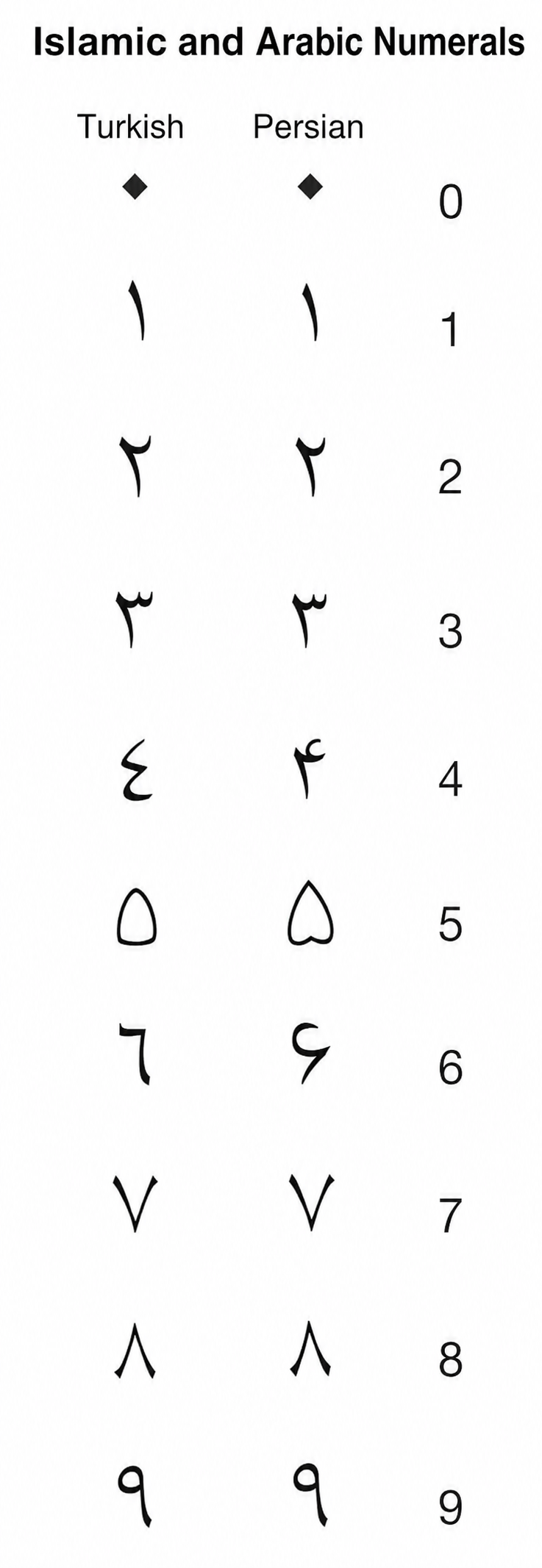
Islamic and Arabic numerals, zero through nine, in their Turkish and Persian forms. These are the figures you will find woven into a dated rug.
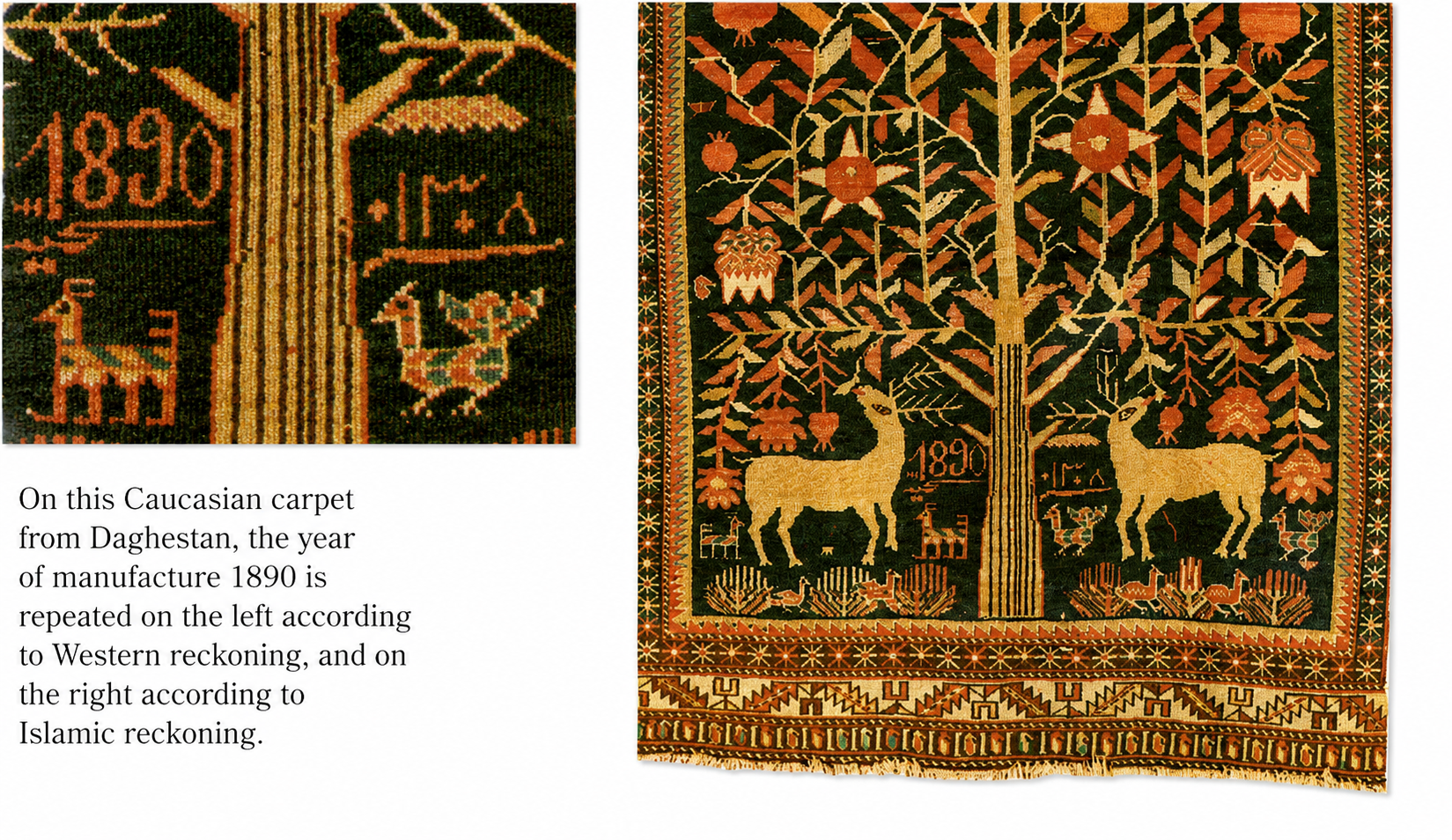
On this Caucasian rug from Daghestan the year of manufacture, 1890, is given twice: on the left in the Western calendar and on the right in the Islamic calendar.
Why Dating Is So Difficult
When the helpful clues are missing, a year, an inscription, or a signature, which is rare and found only on old pieces from court manufactories, dating a rug becomes just as hard as identifying where it was made. Several problems get in the way at once. The first is simply that not enough antique pieces survive for us to follow the development of every pattern and every workshop with any certainty.
The second is that, with the patterns themselves, we usually cannot speak of stylistic periods or clear phases at all. The models stayed remarkably constant: the oldest pieces of a given production became the templates that every later generation copied. It is enough to think of the two layouts still most common today, the medallion rug and the prayer rug, to see how little the basic vocabulary changed.
So, as with origin, there is really only one way to judge a rug's age, and even then the answer is a broad span of time rather than a single year. It calls for a whole reading of the piece at once: its state of preservation, which is not always a reliable guide, its characteristic techniques, and above all its style. Technique alone can already place a rug, since synthetic dyes are a dependable sign that a piece was made after roughly 1860 to 1870.
Dating by Style and Pattern
Stylistic analysis sets the rug to be dated against pieces of different ages from the same place of origin. You weigh the general quality of the patterning, the kinds of pattern used in the field and in the borders, and the colors. The quality of the drawing is especially telling. A clear, well defined design with a balanced relationship between the patterned and the open areas is normally the mark of the oldest pieces.
A drawing that is more mannered, stiffer, or more crowded tends to look unbalanced, and it usually belongs to later work. As a rule, the purer the pattern types and the more closely they hold to tradition, the older the rug. When the motifs drift toward stylized, rigid, or, on the contrary, exaggerated versions of themselves, that drift points to a younger piece.
A single ornament can help too. Some decorative elements are known to have appeared only from a certain date onward, and their presence sets a clear earliest possible age. The reverse works as well: the absence of a motif that fell out of use over time can quietly date a piece.
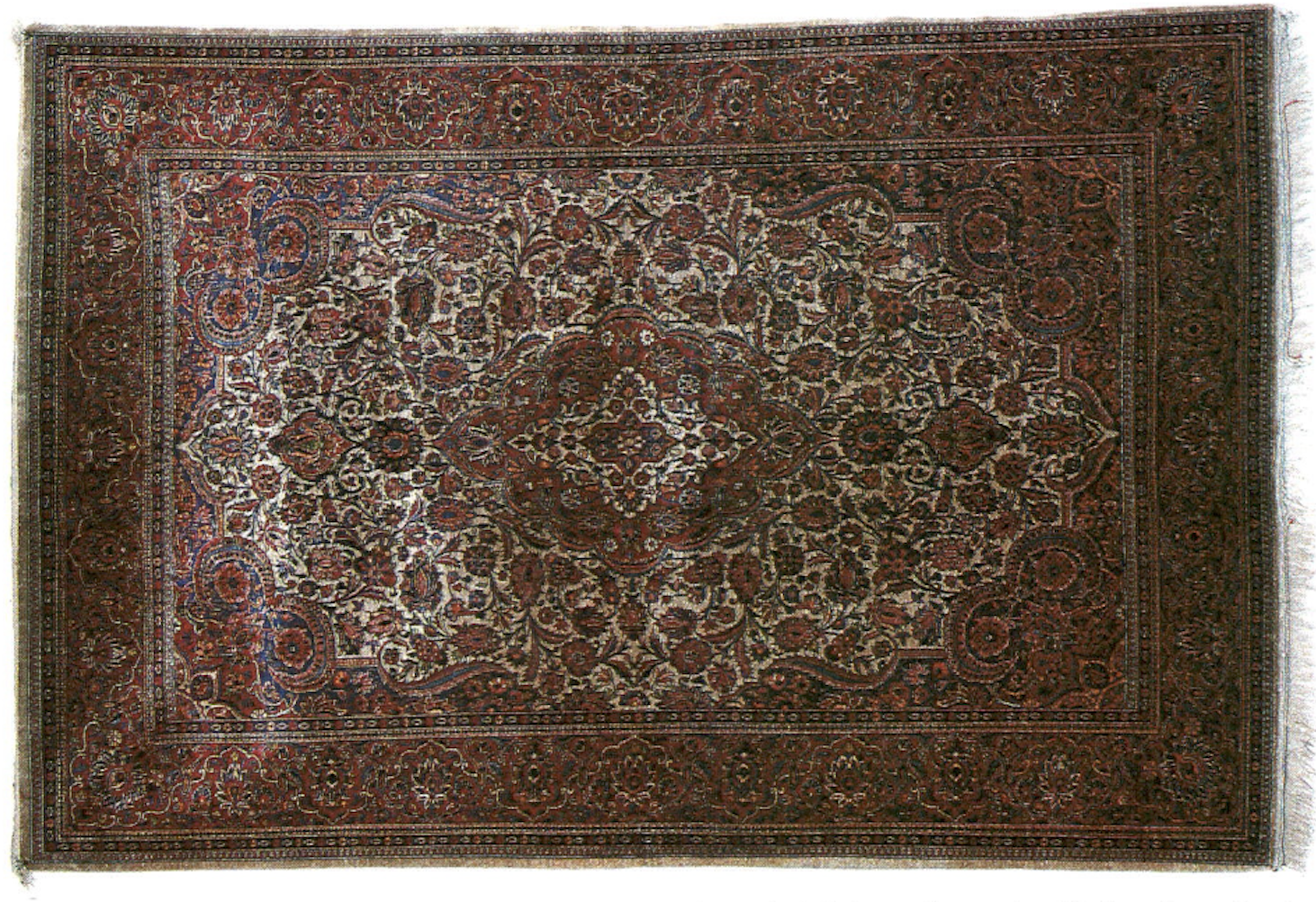
Medallion rug from Kashan. Persia, 19th century. The clear, balanced drawing and rich palette are typical of the older pieces.
Dating by Color
Color matters for dating in two ways. The technical side is the question of natural versus synthetic dyes, since synthetics only enter the picture from the 1860s onward. The stylistic side is just as useful. The oldest rugs are generally recognizable by their wealth of strong, brilliant colors, used in great number and held in fine balance.
Pieces made toward the end of the 18th century and after tend to show a narrower palette, with lighter, more pastel tones increasingly preferred. A muted, gentle range of color is therefore one more quiet signal that a rug belongs to a later moment rather than an earlier one.
When the Rug Lost Its Nature
One thing should always be kept in view: across the 19th century the rug slowly lost its original character. Many of the traditional nomadic peoples gradually became settled, and as they did, their rugs moved ever closer to the qualities of town and city production, in their dimensions as much as in their motifs and patterns.
Nor should we forget that during the same century the Persian rug became steadily more popular in the West. It turned into a trade product made for export, one shaped to satisfy the tastes of the Western market. The so-called semi-antique or old pieces, produced in the East mainly after the years between 1860 and 1870, that is, after synthetic dyes had arrived, can still be valuable objects. Yet in their patterning and their use of color they most often show a falling away from the very qualities that had once made them best.
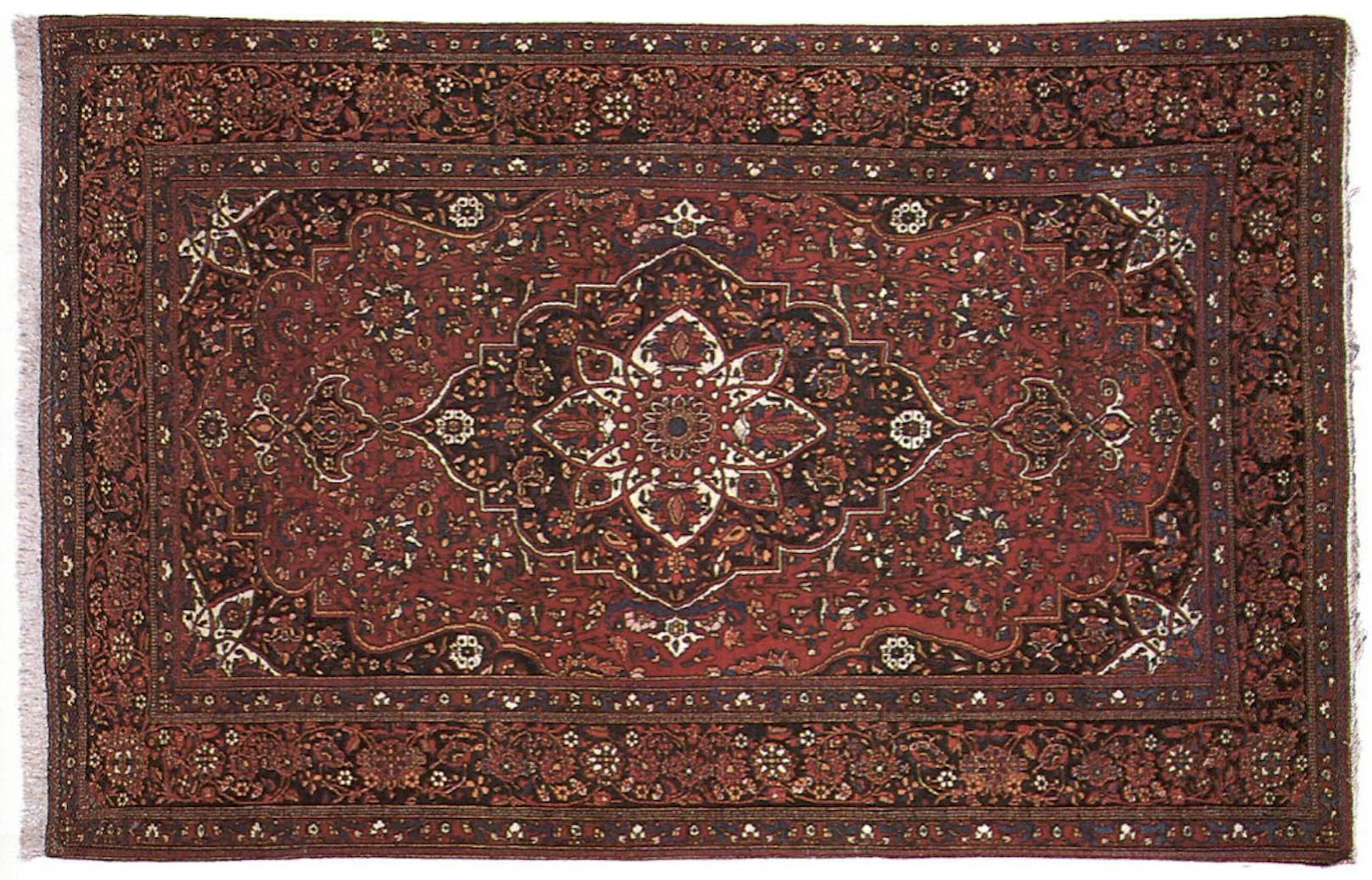
Medallion rug from Kashan. Persia, modern production. Set beside the 19th century example above, the modern style looks distinctly stiffer and less harmonious.
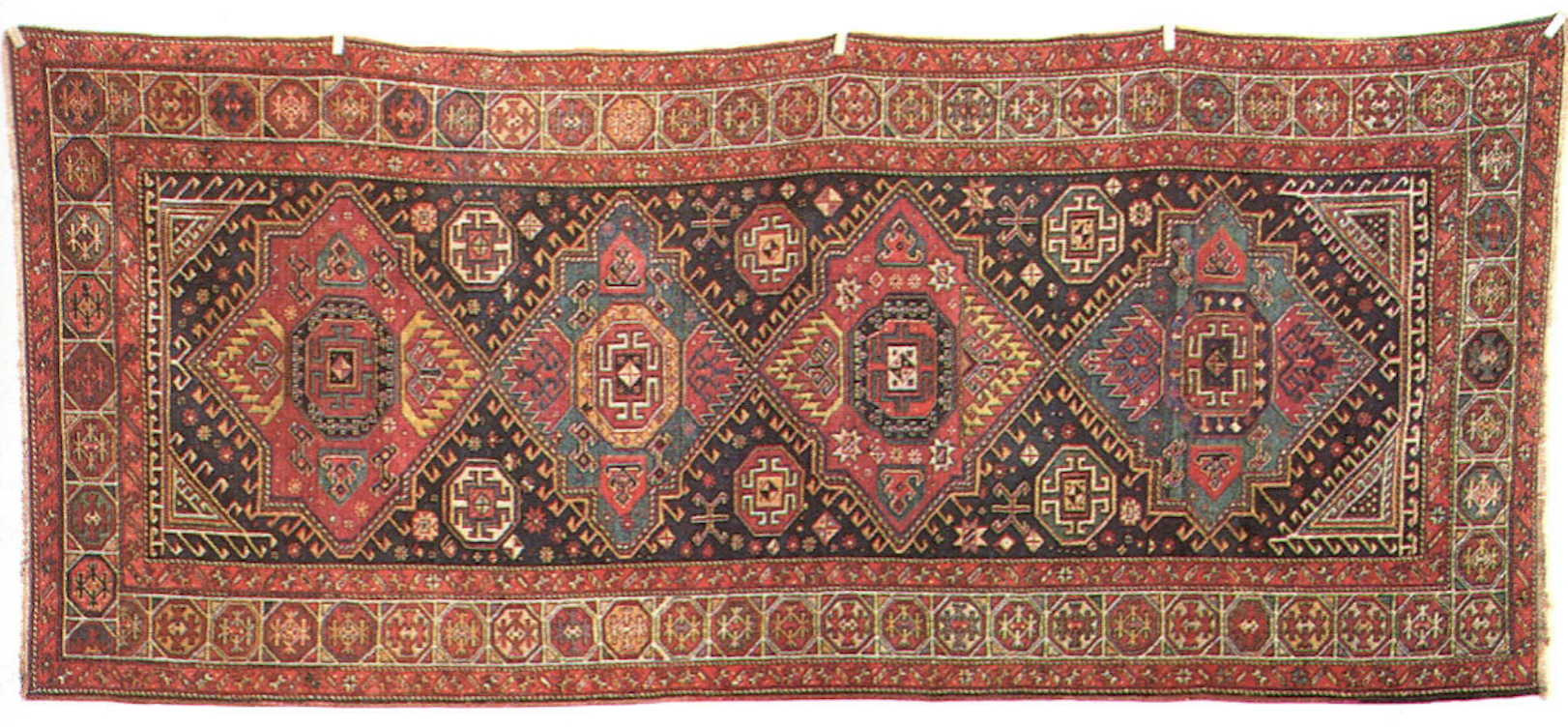
Medallion Kazak. Caucasus, late 19th century. The relatively soft, less luminous colors point to a late date; the piece is from the end of the 19th century at the earliest.
Authentic Handmade Persian and Oriental Rugs
Direct importer pricing, free shipping and returns to all 50 states, and provenance you can verify. Browse the collection and find a piece worth keeping.
© Rugs.net · 371 South Main Street, Freeport, NY 11520